

























Nigeria’s high debt burden, rising domestic borrowing costs, and opaque external reserves pose risks to economic stability. Transparency and continued reform momentum will be crucial in maintaining investor confidence and navigating the tightrope of economic recovery.
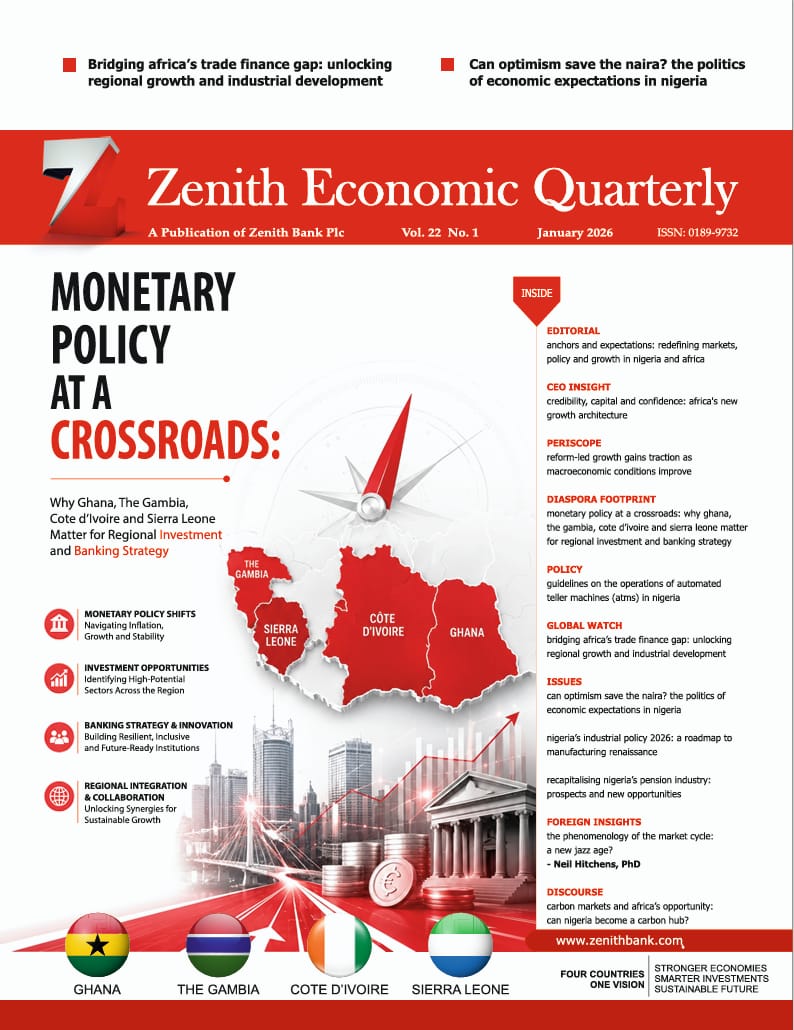 https://www.digital.zenithbank.com/ZEQ/ZEQ-jan-2026/index.html#p=1
The SSA Eurobond market in 2024 has been a tale of two halves. The first half saw a rollercoaster ride with successful issuances by countries like Côte d’Ivoire and Kenya, buoyed by multilateral investments and early whispers of a US rate cut. However, the unexpected strength of the US economy and the Federal Reserve’s policy reversals sent shockwaves through the market, highlighting the fragile nature of investor confidence.
Looking ahead, Nigeria’s Eurobond performance in H2 2024 will depend on a complex interplay of global and domestic forces. The government’s ability to generate foreign reserves, manage its debt burden, and enact sound economic policies will be critical in attracting investment and maintaining economic stability.
Nigeria’s Eurobond story so far in 2024 has been one of mixed signals. While the average yield climbed over 50 basis points,
indicating investor caution, the 2025 bond defied the trend with price appreciation. This lone bright spot could be due to its
approaching maturity, a natural tendency for bonds to return to face value.
Looking ahead, Nigeria’s Eurobond performance in H2 will be a delicate balancing act. Recent reforms offer a glimmer of hope. The Central Bank’s efforts to unify exchange rates and boost official FX market activity could be a game changer. A more transparent FX system has the potential to lure back investors hesitant about the naira’s stability and foreign reserve management. Early signs are
promising – Nigeria’s foreign reserves have held steady this year, as opposed to the declines seen in the last three years. Additionally, a cautious uptick in foreign portfolio inflows suggests investors are taking note of these improvements.
However, whether this translates to sustained demand for Nigerian Eurobonds remains to be seen. The key will be for Nigeria to maintain its reform momentum and demonstrate a clear path towards addressing its debt challenges. Can Nigeria successfully navigate this tightrope and emerge as an attractive Eurobond destination in H2? Only time will tell.
Nigeria: A Mixed Bag of Opportunities and Uncertainties
Recent reforms have garnered attention from credit rating agencies like Moody’s and Fitch, prompting them to review Nigeria’s outlook from stable to positive. This positive nudge could attract investors looking beyond the recent defaults in the SSA region, like Ghana’s, but with a cautious eye.
However, the completion of the Dangote refinery offers a brighter spot. Refining its oil will improve investor confidence by reducing reliance on imported fuel and potentially boosting government revenue. This can ease pressure on foreign exchange reserves, a positive for investors seeking a financially stable issuer.
Further signs of progress include projected improvements in non-oil revenue and a narrowing budget deficit. These indicate a
movement towards fiscal consolidation, another factor attracting investors. However, the sustainability of these positive developments is a key question mark. Long-term commitment to reforms will be critical. Any backtracking, like a return to unconventional monetary policies, will raise red flags and dampen investor enthusiasm.
Another major concern is the opaque nature of Nigeria’s external reserves. The CBN’s reporting of only gross figures hides obligations tied to the reserves, leaving the true level of liquidity shrouded in mystery. This lack of transparency is
a major turn-off for investors and could negatively impact Eurobond’s performance.
Finally, Nigeria’s high debt burden cannot be ignored. Rising domestic borrowing costs and a large existing debt stock limit the government’s financial flexibility and crowd out private sector investment. This not only hinders overall economic growth but could also potentially scare off investors if they perceive a heightened risk of default. The government’s ability to manage its
fiscal deficit will be under close scrutiny. Efforts to diversify the economy, reduce reliance on oil revenues, and enhance tax collection will be vital.
The Delicate Dance with Investors
Nigeria’s Eurobond performance in H2 will depend on a delicate balancing act. The government’s commitment to reforms, its ability to manage inflation and forex, and transparency surrounding finances will be crucial factors. Overall trends in emerging market debt will also play a role, impacting investors’ appetite and demand for Nigerian bonds.
While challenges remain, opportunities exist for Nigeria to leverage its Eurobonds if it implements sound economic policies and addresses security and political stability concerns. Investors will be closely monitoring Nigeria’s economic indicators, policy decisions, and geopolitical developments to gauge the future trajectory of its Eurobond market. There’s reason for cautious optimism, but the path forward for Nigerian Eurobonds remains a tightrope walk.
Nigeria’s Fiscal Policy Outlook
The dawn of 2024 brought a wave of sweeping reforms that have reshaped Nigeria’s economic landscape, significantly impacting its citizens and businesses. As these reforms took hold, global economic forces further complicated the picture, amplifying the country’s existing inflation challenges. Central to these changes were the removal of fuel subsidies and the unification of exchange rates, both of which have had profound effects on the economy.
The government’s twin reforms of fuel subsidy removal and exchange rate unification triggered a sharp depreciation of the naira. This depreciation, in turn, intensified inflationary pressures and led to a more restrictive interest rate environment, both
of which have weighed heavily on economic growth. Additionally, the removal of the exchange rate peg created problems of FX illiquidity and eroded investor confidence. However, recent Moody’s ratings suggest that these issues have begun to improve.
The exchange rate unification reform, which caused a significant depreciation of the naira, compounded the inflationary effects of the fuel subsidy removal. This created a challenging environment for the Central Bank of Nigeria (CBN), as it struggled to stabilize prices.
As a result, headline inflation surged from 22.22% in April 2023 to a staggering 33.69% in April 2024. By May 2024, inflation had climbed further to 33.95%, with food inflation reaching 40.66%—the highest level in nearly two decades. Despite the CBN’s efforts to curb inflation through continuous rate hikes, raising rates to 26.25% in 2024, inflation remained stubbornly high, underscoring
its supply-side dominance.
In Q1 2024, Nigeria’s GDP grew modestly by 2.98%, driven primarily by significant gains in the financial services sector (31.24%) and the mining sector (6.30%). However, oil production in May 2024 averaged only 1.25 million barrels per day (mbpd), falling short of the budgeted 1.78 mbpd. This shortfall was largely due to pipeline vandalism and high production costs. Amid these economic shifts, monetary authorities have also expanded the money supply. Broad money supply surged from N55.5 trillion in May
2023 to N98.9 trillion in May 2024, marking a 78.2% year-on-year increase, a 4.5% increase in H1’24 (as of May). This expansion followed the transition to a new government, reflecting the ongoing adjustments in Nigeria’s economic policies. The economic
reforms implemented in 2024 have introduced significant challenges and brought about modest gains for Nigeria’s economy.
Fiscal Policy – Caught in the Web
From 2023 through the first half of 2024, Nigeria’s fiscal environment experienced significant shifts driven by pivotal reforms and economic challenges. Key reforms included the removal of fuel subsidies, hikes in electricity tariffs, and adjustments to exchange rates, all occurring amidst fluctuating oil prices, rising debt levels, and increased debt servicing payments.
Key Reforms and Revenue Performance
The government’s decision to eliminate fuel subsidies and unify exchange rates had notable impacts on revenue performance. These reforms were expected to ease the fiscal burden by redirecting resources previously allocated to subsidy payments. Also, the unification of exchange rates led to substantial revenue gains, evidenced by a 151.15% increase in Federation Account Allocation
Committee (FAAC) allocations, which rose from N872.55 billion in April 2023 to N2.19 trillion as of June 2024.
Higher oil prices, driven by global geopolitical tensions, also improved revenue performance. However, oil theft, insecurity, and operational inefficiencies hindered production efforts. Despite these setbacks, non-oil revenue exceeded targets, with significant growth in Corporate Income Tax (CIT) and Value Added Tax (VAT) revenues between Q1 2023 and Q1 2024. The finance and insurance information and communication, mining and quarrying and manufacturing sectors were major contributors to this growth.
Debt and Fiscal Challenges
Despite these revenue windfalls, Nigeria’s debt stock and debt servicing profile deteriorated significantly. By Q1 2024, the country’s debt obligations had soared to N121.67 trillion, up from N49.85 trillion in Q1 2023. The government aims to reduce the budget deficit to around 3.9% of GDP (N9.18 trillion) in 2024, down from 6.1% in 2023. This goal relies heavily on increased oil
prices and improved revenue collection.
As we navigate the remainder of 2024, the Nigerian economy’s path will be shaped by a blend of global influences and domestic resilience. The world watches as Nigeria strives to balance growth and stability, harnessing the potential of reforms and leveraging global economic trends to carve a path towards sustainable development. In this intricate dance of economics, every step, every decision, echoes with the promise of a brighter, more prosperous future.
As of Q1 2024, the growing public debt and associated servicing costs continue to constrain fiscal space for critical infrastructure investments and essential public services.
For 2024, the budget proposes a revenue target of N18.32 trillion, with N7.94 trillion expected from oil and N3.52 trillion from non-oil sources. Historically, actual revenue has averaged less than 70% of the total budgeted amount. Achieving the 2024 oil revenue target will depend on several factors, including OPEC quotas, international oil prices, security conditions in oil-producing regions,
and broader geopolitical dynamics.
The proposed budget for 2024 is N28.78 trillion, which includes N8.77 trillion in recurrent expenditure and N9.99 trillion in capital spending.
The main constraints for 2024 include low revenue realization, high debt servicing costs, and poor fiscal discipline. Addressing these issues through targeted fiscal reforms is essential for improving Nigeria’s economic stability and growth prospects.
Outlook
Nigeria stands at a critical inflection point, necessitating decisive strategic actions beyond superficial plans. A coherent economic framework is completely important. The servicing of external debt in 2024 is projected to face substantial challenges due to exchange rate volatility and the potential devaluation of the naira.
This growth will be driven by a rebound in business activities within the non-oil sector as the effects of the twin reforms—fuel subsidy removal and exchange rate unification—begin to fade. Additionally, improved oil production and favourable oil prices in the global market are expected to contribute to this growth.
Public debt is projected to rise further in 2024 as the government aims to finance a fiscal deficit of N9.18 trillion. This increased reliance on domestic borrowing raises significant concerns about competition for limited local capital with the private sector, especially in an environment of rising interest rates. Such competition could drive up the cost of capital for businesses, potentially stifling private sector growth.
Also, the new proposed minimum wage rate will also aggravate the debt burden. Effective implementation of proposed fiscal reforms is critical for improving fiscal performance and fostering economic growth. Key reforms include addressing redundancy in public service functions, ensuring prudent management of government assets, introducing a spending framework for subsidy
removal and forex reform windfall, and creating a national portal for tracking government spending at all levels.
While fiscal policies may introduce short-term shocks, it is crucial that acquired debt is utilized to promote sustainable growth. Additionally, there needs to be a balance in monetary policies, which are currently contractionary with rising interest rates. To mitigate the adverse effects, complementary measures such as adjusted tax tariffs, increased government expenditure, and enhanced transparency in the policy framework are essential.
Monetary Outlook
Nigeria’s monetary authorities faced the dual challenge of maintaining domestic price stability and external stability amidst prolonged negative external sentiment and waning investor confidence. These issues kept the Central Bank of Nigeria (CBN) on high alert throughout the year.
The Central Bank Governor, Dr. Yemi Cardoso reiterated the three key monetary policy objectives outlined in the National Policy Council Report: anchoring the money market rate to the Monetary Policy Rate (MPR), transferring the CBN’s quasi-fiscal roles to relevant authorities, and transitioning to a unified and market-determined exchange rate.
The situation evolved significantly when the new administration swiftly adopted a market-reflective exchange rate by allowing the naira to float against other currencies in the FX market. This reform aimed to promote greater price discovery and ensure a willing-buyer-willing-seller basis for FX transactions.
In response to rising inflation, the MPR committee, led by Cardoso, increased the MPR from 18.75% in July 2023 to 26.25% in the first half of 2024. This orthodox measure was intended to rein in domestic inflation, reduce the negative real rate of return, and attract foreign portfolio inflows. However, despite these efforts, the general price level remained stubbornly high, reaching its highest level in 18 years.
This weak transmission from monetary policy to inflation was not unexpected, as monetary policy is more effective in addressing demand-pull inflation. Nevertheless, there was a modest month-onmonth decrease in inflation. Additionally, the Standing Deposit Facility rate (SDF) was increased to 23.25% from 19.75% in July 2023, resulting in higher returns on bank deposits and subsequently higher stop rates at the Primary Market Auctions.
Money supply by the monetary authorities as broad money supply climbed rapidly from N55.5trillion in May 2023 to N98.9 trillion in May 2024 after the transition to a new government, representing about 78.2% y-o-y increase in money supply.
In 2022, foreign reserve were relatively stable, averaging around $38.82 billion. However, the situation worsened in May/June 2023 when the exchange rate began to depreciate dramatically, leading to a steady depletion of reserves, which stood at $32.74 billion by June 1, 2024.
Although the governor acknowledged the payment of some backlog, these initiatives, while commendable for providing short- to medium-term stability in the FX market, may only temporarily alleviate FX pressures. Moreover, they could potentially strain future expenditure and increase debt if the exchange rate volatility persists.
In 2022, foreign reserve were relatively stable, averaging around $38.82 billion. However, the situation worsened in May/June 2023 when the exchange rate began to depreciate dramatically, leading to a steady depletion of reserves, which stood at $32.74 billion by June 1, 2024.
Although the governor acknowledged the payment of some backlog, these initiatives, while commendable for providing short- to medium-term stability in the FX market, may only temporarily alleviate FX pressures. Moreover, they could potentially strain future expenditure and increase debt if the exchange rate volatility persists.
We anticipate that inflation may also moderate in H2 2024 due to high base effects. Nigeria continues to experience a negative real rate of return and needs to attract and retain foreign portfolio flows in Q3 2024. As a result, there is a need to offer high-yielding securities in the market.
We expect investors to increasingly allocate funds to these attractive money market securities, including Open Market Operations (OMO) instruments, treasury bills, and money market funds.
Our projection for interest rates suggests that the Central Bank of Nigeria (CBN) may maintain its hawkish stance and implement one additional MPR hike in 2024.
This anticipated rate hike aims to tighten the money supply and further drive down inflation. The decision to limit the hike to one instance takes into consideration its potential impact on businesses and overall economic growth.
Inflation – Cost Crunch: The Role of Reforms in Nigeria’s Inflation Hike
Inflation has become a pervasive topic among Nigerians in all spheres as businesses and individuals in the country faces significantly rising rates. The substantial inflation observed in 2023 and the first half of 2024 is primarily attributed to the market reforms initiated by the new administration since its inception in May 2023 among other prolonged and underlying structural deficits.
The increase in fuel price and the transition to a floating foreign exchange (FX) system have been major factors driving the increase in price levels, alongside other persistent underlying structural deficits. The skyrocketing fuel prices have notably impacted transportation and logistics costs, driving up overall inflation. Food inflation has hit record highs, becoming the main contributor to the inflation rate.
Inflation grew from 29.90% in January 2024 to 34.19% in June 2024. This sharp increase reflects the compounded effects of both fuel price hikes and the depreciation of the Naira under the managed float regime. Core inflation, which excludes volatile agricultural produce and energy prices, stood at 27.40% in June 2024, slightly up from 20.06% in June 2023. Year-on-year, core
inflation rose significantly by 7.34%.
Food inflation, a major contributor to headline inflation, reached 40.87% in June 2024, up from 25.25% in June 2024. On a year-on-year basis, food inflation surged by 15.62%. In response to the inflation surge, the Central Bank of Nigeria (CBN) has tightened financial conditions by raising the Monetary Policy Rate (MPR) four times, from 18.75% in 2023 to 26.25% in the first half of 2024.
Meanwhile, global trends and domestic policies influence Nigeria’s economic outlook. Recent reforms in unifying exchange rates and fiscal consolidation provide hope for economic stability. However, challenges such as high debt burden and rising borrowing costs remain, necessitating continued transparency and reform to maintain investor confidence. As we navigate the rest of 2024, Nigeria aims to leverage global trends and domestic resilience to achieve sustainable growth and stability.