























Nigeria’s recent inflation data for January 2026 show a continued cooling trend, with the headline consumer price index easing
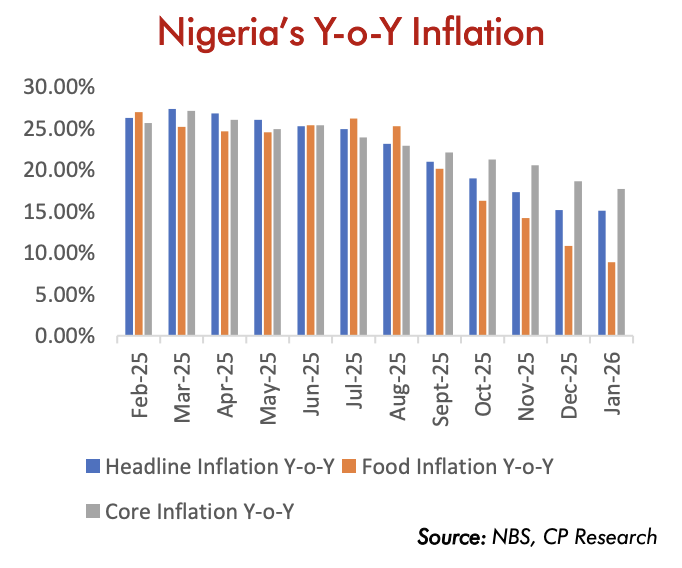
slightly to 15.10% year-on-year, down from 15.15% in December 2025 and marking the tenth consecutive monthly decline, the lowest level since November 2020. This moderation follows much higher rates earlier in the cycle, reflecting a broader disinflationary path driven by stabilising factors across the economy.
Highlights
Headline CPI (YoY): Headline inflation eased to 15.10% in January 2026 from 15.15% in December 2025.
Headline CPI (MoM): Monthly headline inflation came in at -2.88% in January 2026, compared with 0.54% in December 2025.
Food Inflation (YoY): Food inflation slowed to 8.89% in January 2026.
Food Inflation (MoM): Food inflation was -6.02% month-on-month in January 2026, down from -0.36% in December 2025.
Core CPI (YoY): Core inflation (all items less farm produce and energy) stood at 17.72% in January 2026.
Core CPI (MoM): Core inflation printed -1.69% month-on-month in January 2026, versus 0.58% in December 2025.
Food Inflation Returns to Single Digits, Driving Nigeria’s Disinflation Shift
Food inflation, a major driver of household costs and over half of the overall basket, has seen the most relief, dropping sharply
to 8.89% year-on-year, the first single-digit figure since May 2015, compared to 10.84% in December 2025 and a much
steeper 29.63% in January 2025, representing a 20.73 percentage point slowdown over the year. On a month-on-month basis, food prices actually contracted by -6.02%, an acceleration of deflation from -0.36% the previous month, marking one of the most significant monthly drops in over a decade and suggesting broader-based easing across non-food components within the month.
The deflation in food prices on a monthly basis and the overall disinflation stem primarily from improved agricultural supply
through bumper harvests and better availability of key staples, which reduced scarcity pressures, combined with greater
naira stability and appreciation that lowered import costs for goods and inputs, softer energy and logistics expenses that eased
transport and distribution burdens, and supportive government and Central Bank of Nigeria policies including monetary tightening, liquidity controls, and temporary import waivers on select food items to boost supply. These developments have aligned
Nigeria with similar food price slowdowns seen in peers like Ghana, Ethiopia, and Zimbabwe.
Core Inflation Remains Elevated, Testing the Durability of Disinflation
Core inflation in Nigeria, which strips out the more volatile components like food and energy prices to provide a clearer view of
underlying, persistent price pressures in the economy, stood at 17.72% year-on-year in January 2026 according to the latest
Consumer Price Index report from the National Bureau of Statistics (NBS).
This marked a noticeable slowdown from 18.63% in December 2025 and represented the seventh consecutive month of easing,
bringing it to its lowest level since October 2022. Compared to a year earlier, when it was 25.27% in January 2025, the drop of
about 7.55 percentage points highlights a significant moderation in non-volatile inflation trends.
On a month-on-month basis, core inflation actually showed deflation at -1.69% in January 2026, an improvement from the
0.58% increase seen in December 2025, indicating that underlying prices contracted rather than rose during the month. This
contributed to the broader headline inflation cooling to 15.10%.
These reductions reflect factors such as the stabilising naira, lower overall logistics and transport expenses spilling over from softer
energy prices, and the effects of tighter monetary policy by the Central Bank of Nigeria, which has helped curb demand-driven
pressures in services and goods.
However, the composition of disinflation still matters. Core inflation remains elevated at 17.72% YoY, well above the headline print,
although with improvement on a month-on-month basis, suggesting that while underlying pressures are easing in the near term, the core backdrop is still comparatively sticky.
Looking across components, inflation pressures remain concentrated in major consumption buckets: Food & Non-Alcoholic Beverages (6.04%), Restaurants & Accommodation (1.95%), Transport (1.61%), and Housing, Utilities & Fuels (1.27%) are the largest contributors to headline inflation on a year-on-year basis. As such, any renewed uptick in food prices or cost
pressures in key services and transport-related categories could quickly test the durability of the current disinflation trend.
Bottom Line
Nigeria’s headline inflation eased slightly to 15.10% YoY in January 2026 (from 15.15% in December), alongside a decline in the CPI to 127.4 (Dec: 131.2). Year-on-year inflation also remained markedly lower than the 27.61% recorded in January 2025. Short-term momentum improved sharply, with headline inflation swinging to -2.88% MoM (Dec: 0.54%).
The adjustment was led by food, as food inflation printed -6.02% MoM and 8.89% YoY, while core inflation came in at -1.69% MoM but stayed elevated at 17.72% YoY, well above the headline rate. Even with the softer monthly print, underlying pressures remain concentrated in core-heavy segments, particularly restaurants & accommodation, transport, and housing/utilities, which are among the largest contributors to headline inflation on a YoY basis.
Looking at the broader trend, inflation has steadily declined since its peak levels in 2025, with consistent monthly improvements supported by stable foreign exchange conditions, softer energy prices, and easing food costs, giving the central bank potential room for rate cuts in its upcoming meeting.