



























Nigeria’s headline inflation rate rose marginally to 15.69 per cent in April 2026 from 15.38 per cent recorded in March, reflecting renewed pressure on consumer prices despite signs of easing inflationary momentum across parts of the economy.
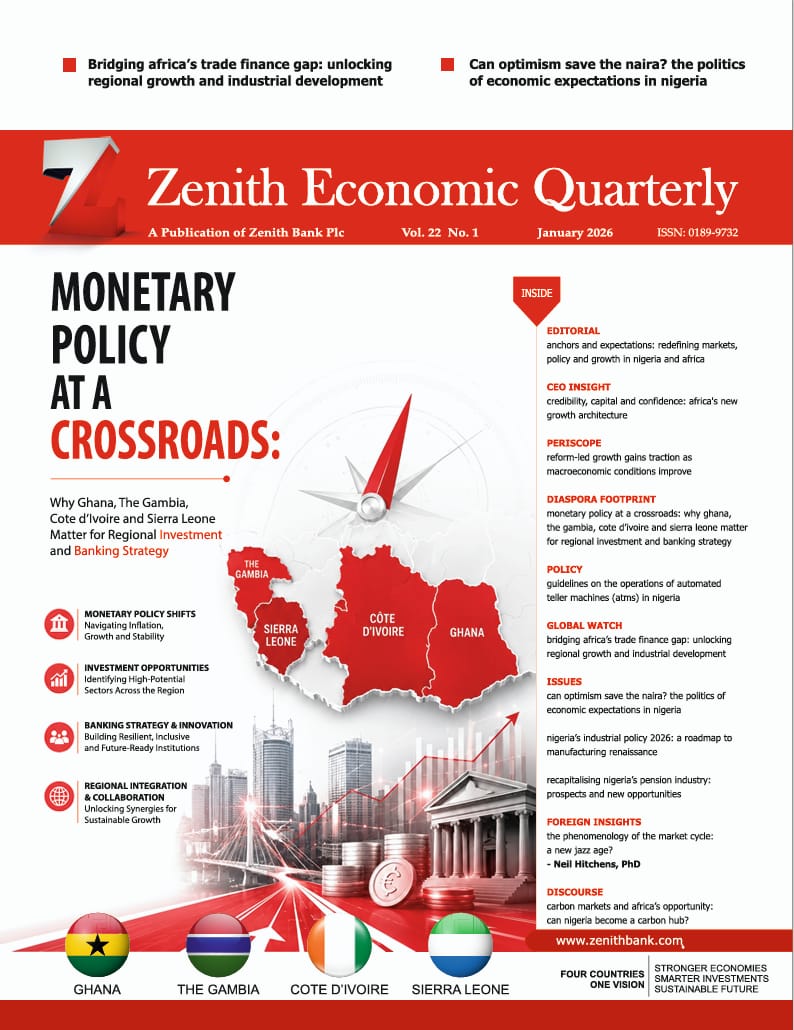 https://www.digital.zenithbank.com/ZEQ/ZEQ-jan-2026/index.html#p=1
The latest data released by the National Bureau of Statistics (NBS) showed that rising food prices, higher energy costs, and persistent supply chain disruptions continued to drive inflationary pressures nationwide.
However, on a month-on-month basis, inflation moderated significantly to 2.13 per cent in April from 4.18 per cent in March, indicating that although prices are still increasing, the pace of increase slowed considerably during the month under review.
On a 12-month average basis, inflation eased slightly to 19.16 per cent compared to 19.33 per cent recorded during the corresponding period last year.
Food inflation remained a major concern for households as prices of essential commodities such as millet, beans, tomatoes, garri, yam flour, beef, soybeans, and plantain continued to rise. Food inflation stood at 16.06 per cent year-on-year in April.
Core inflation, which excludes volatile agricultural produce and energy prices, slowed significantly to 15.86 percent from 26.05 percent recorded in April 2025, suggesting some moderation in underlying inflationary pressures outside food and energy-related components.
Economic analysts noted that the latest inflation figures come at a time of heightened geopolitical uncertainty in the Middle East, particularly tensions involving Iran, Israel, and the United States. The resulting volatility around the Strait of Hormuz has continued to pressure global crude oil prices, raising concerns over imported inflation, transportation costs, and energy prices within the Nigerian economy.
Money Market
In the money market, banking system liquidity weakened during the week, opening at ₦4.92 trillion before closing at ₦5.86 trillion.
The Open Buy Back (OBB) rate remained unchanged at 22.00 percent, while Overnight (OVN) rates rose by five basis points to close at 22.24 percent.
Analysts expect rates to remain around current levels in the near term.
Treasury Bills Market
The Treasury Bills market traded on an active but cautious note during the week, with strong investor demand focused mainly on the 6-May bill, which traded below the 16 percent level.
Market activity was also shaped by several Open Market Operations (OMO) auctions conducted by the Central Bank of Nigeria (CBN) to mop up excess liquidity from the financial system.
Despite elevated stop rates, investor participation remained strong across various tenors offered by the apex bank.
Towards the end of the week, market sentiment remained relatively calm, although mild bearish pressure emerged following aggressive liquidity absorption by the CBN.
Overall, average benchmark yields declined by five basis points week-on-week to close at 17.41 percent.
Bond Market
Trading in the Federal Government of Nigeria (FGN) bond market remained subdued as investors adopted a cautious approach ahead of the May bond auction.
The Debt Management Office (DMO)’s release of the May auction calendar, which favoured longer-dated instruments, triggered mild bearish sentiment across the fixed-income market.
Yields on benchmark instruments such as the 2032 and 2035 maturities hovered around the 16.75 percent to 16.95 percent range during the week.
By the close of trading, selling pressure intensified slightly on mid-tenor instruments as investors repositioned ahead of the auction.
Average benchmark yields in the bond market increased marginally by three basis points week-on-week to settle at 15.80 percent.
Eurobond Market
Nigeria’s Eurobond market witnessed significant volatility amid escalating geopolitical tensions involving the United States and Iran, as well as stronger-than-expected inflation data from the United States.
Concerns over possible disruptions around the Strait of Hormuz and uncertainty surrounding global trade discussions contributed to risk-off sentiment among investors.
As a result, average benchmark yields in the Eurobond market rose by 22 basis points week-on-week to close at 6.90 percent.
However, market sentiment received some support following the recent sovereign rating upgrade for Nigeria by S&P to “B”.
Currency Market
The naira weakened further against the United States dollar during the week.
At the Nigerian Foreign Exchange Market (NFEM) window, the naira depreciated by 0.71 percent week-on-week to close at ₦1,371.04/$.
Equities Market
The Nigerian equities market closed the week on a weaker note as the NGX All-Share Index declined by 0.76 percent to settle at 250,330.9 points.
Market capitalization also dropped to ₦160.4 trillion.
Trading activity was mixed, with volume traded declining by 24.57 percent to 784 million shares, while value traded increased slightly by 4.14 percent to ₦43.3 billion.
Despite the daily decline, the market maintained a positive weekly performance, posting a 2.27 percent gain driven by strong performances in stocks such as BERGER, SCOA, and DAARCOMM.
Overall, the Nigerian stock market has recorded an impressive year-to-date return of 60.87 percent, reflecting sustained investor interest in selected sectors of the market.