Nigeria’s Gross Domestic Product (GDP) grew by 4.07% year-on-year in real terms in Q4’25, compared to 3.98% in Q3’25.
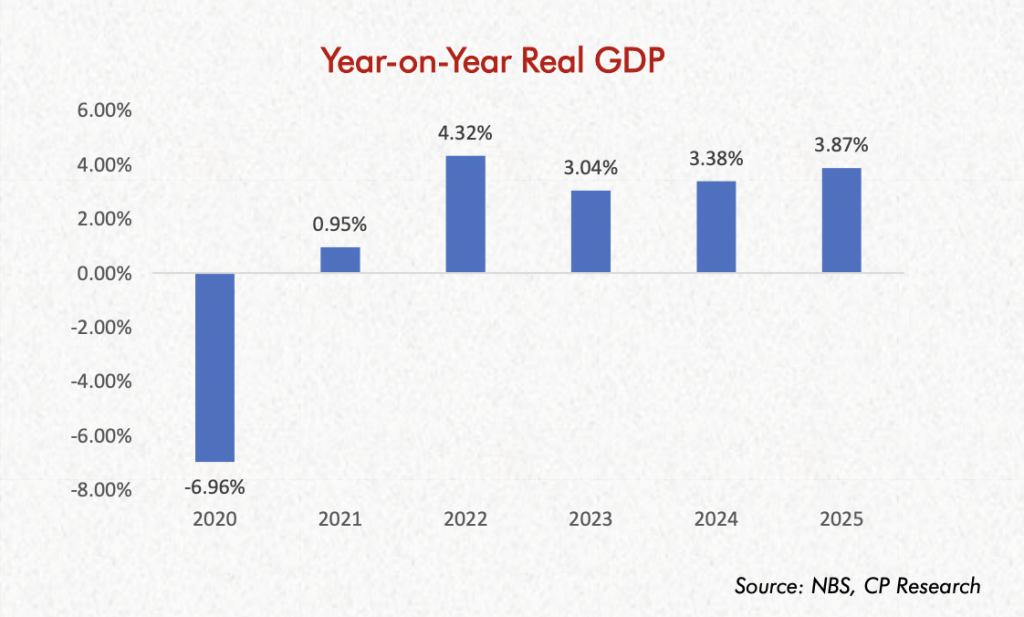
For the year ended, Real GDP grew by 3.87%, up from 3.38% in 2024.
In nominal terms, aggregate GDP stood at ₦122.81 trillion in Q4’25, up from ₦113.59 trillion in Q3’25, an increase of 8.12%. For the year ended 2025, nominal GDP stood at ₦431.81 trillion compared to ₦364.62 trillion in 2024.
Key Highlights
Overall Economic Growth: Nigeria’s economy grew by 4.07% in Q4’25, higher than 3.98% in Q3’25 and above the 3.76% recorded in Q4’24. For the full year, the economy expanded by 3.87% in 2025, compared with 3.38% in 2024, reflecting improved growth momentum.
Services Sector Dominance: The Services sector grew by 4.15% in Q4’25 and remained the largest contributor to GDP with a 55.92% share of total output.
Agriculture Sector Performance: Agriculture expanded by 4.00% in Q4’25, accounting for 28.66% of GDP, supported by improved crop activity relative to the prior year.
Industry Sector Recovery: The Industry sector grew by 3.88% in Q4’25, contributing 15.42% to GDP, reflecting stabilisation in manufacturing and oil production.
Oil Production Trends: Average crude oil production in Q4 2025 was 1.56 million barrels per day (mbpd). Oil GDP increased by 6.79% in Q4’25, compared with 2.08% in Q4’24. The oil sector accounted for 2.87% of total GDP.
Non-Oil GDP: Non-oil sectors contributed 97.13%, with non-oil GDP expanding by 3.99% year-on-year.
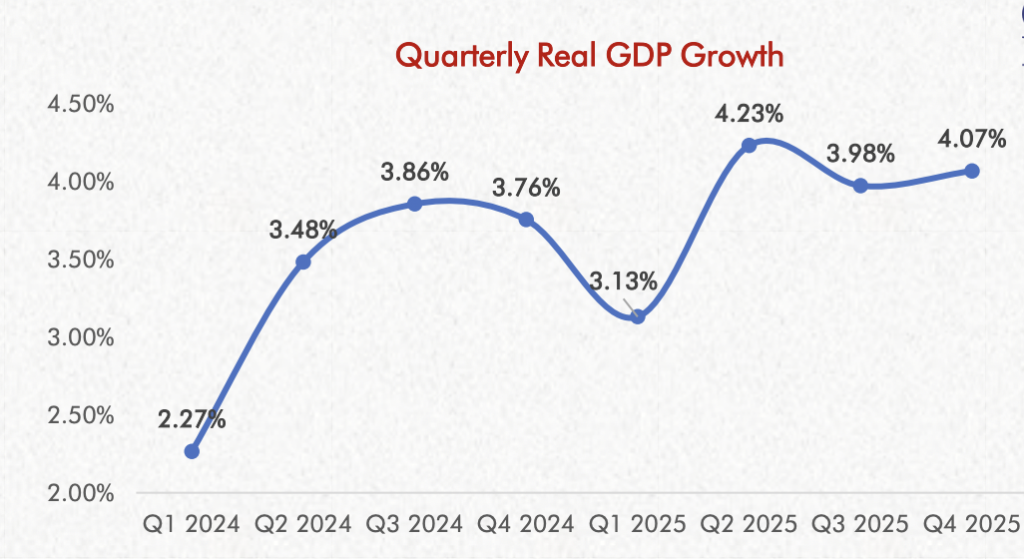
Nigeria’s economy expanded by 3.87% in full-year 2025, compared with 2.74% in 2024, marking a clear improvement in growth momentum.
On a quarterly basis, GDP growth progressed from 3.13% in Q1 to 4.23% in Q2, moderated to 3.98% in Q3, and closed the year at 4.07% in Q4. The pattern shows that growth accelerated into mid-year and remained near the 4% range through the second half. Unlike prior years, where performance was uneven across sectors, 2025 recorded a more balanced expansion.
From a macro standpoint, 2025 represents a transition to a higher growth base relative to 2024. The expansion was broad-based rather than concentrated in a single sector. Services provided scale, agriculture provided stability, industry provided recovery support, and oil added cyclical upside. Sustaining growth above 4% will depend on productivity gains in services, cost normalisation in industry, and continued stability in oil production.
The Nigerian economy’s performance from the second quarter of 2025 through the end of the year shows a continuation of the multi-year
pattern in which non-oil sectors provide the bulk of output and growth, while the oil sector delivers episodic contributions that can swing
headline GDP outcomes.
The non-oil sector remained the principal driver of GDP growth in every quarter of 2025 and accounted for the overwhelming share of national output. The continuity of broad-based non-oil expansion through all quarters underscores that domestic consumption, services
demand and agricultural activity have become central to economic momentum.
The oil sector exhibited volatility across 2025, and its impact on headline GDP was uneven. The swings in oil sector contribution reflect the
continued sensitivity to operational disruptions and global market conditions.
For the year ended 2025, the oil sector accounted for a larger share of GDP growth and output than in 2024. The annual rate of growth in the oil economy was 8.50% in 2025, compared with 5.54% in 2024, and the oil sector’s contribution to total real GDP rose modestly relative to the prior year. By contrast, the non-oil sector’s share of GDP edged slightly lower on an annual basis but remained dominant at over 96% of aggregate output. The annual pattern confirms that while oil output growth strengthened in 2025, structural diversification of the economy remains well-advanced relative to earlier phases when crude dominated headline GDP.
Macroeconomic conditions in 2025 shaped sectoral performance and influenced the overall GDP outcome. The Central Bank of Nigeria’s Monetary Policy Committee (MPC) maintained a high policy rate for most of the year to contain inflation, which moderated gradually. The naira showed relative stability in late 2025, with narrower gaps between official and parallel market rates, thereby improving foreign exchange liquidity and reducing import inflation pressures.
Movements in the exchange rate and monetary policy affected consumption, production costs, and investment decisions, while fluctuations in global oil prices and domestic output influenced fiscal revenues.
Together, these macro variables reinforced the resilience of non-oil sectors as the primary drivers of growth, even as oil sector volatility continued to shape headline GDP outcomes.
GDP 2025: Sector Engines, Oil Swings, and the Economy’s Balancing Act
The Services sector was the largest driver of growth in Q4, delivering roughly 4.15 % expansion and contributing nearly 56% of GDP,
supported by telecommunications, finance, trade, transportation, and real estate. Services demand was influenced by improvements in consumer credit and digital transaction volumes, which underpinned activity even as inflation remained elevated relative to regional
peers, slowing but still above target. The resilience of services reinforced overall growth when other sectors faced headwinds.
The Agricultural sector expanded by 4.00% in Q4, with crop production accounting for the majority of agricultural GDP. Crops such as
cassava, maize, rice and yams accounted for the largest share of agricultural output, reflecting seasonal harvest gains and expanded cultivation areas. Agriculture contributed close to 28.7% of GDP in Q4, cushioning volatility in growth, supported by favourable rainfall patterns and a good harvest season. Though security challenges and post-harvest losses continue to constrain efficiency in some
regions, agriculture’s linkages with trade and agro-processing strengthened non-oil growth.
The Manufacturing sector expanded 3.9% in Q4 and accounted for roughly 10.7% of GDP, supported by the production of consumer goods,
processed foods, beverages, and building materials. Annual manufacturing growth at 3.8 % in 2025 surpassed the 2024 outcome, reflecting
improvements in logistics and a more stable electricity supply in industrial hubs, as well as incentives for import substitution. However, capacity constraints, access to long-term credit and operating costs continued to weigh on competitiveness.
Construction activity grew alongside manufacturing, driven by private real estate investment and infrastructure projects, stimulating demand for materials and equipment.
The Industrial sector played a measured but important role in Nigeria’s 2025 GDP performance, contributing roughly 15.4% of total output in Q4 2025. The sector expanded by about 3.9% year-on-year in Q4, supported by growth in manufacturing and a recovery in oil
output, while mining and quarrying reflected the year’s volatility in crude production. On a full-year basis, industrial growth strengthened relative to 2024, driven largely by the oil sector’s 8.50% annual expansion, alongside steady gains in manufacturing.
The Trade sector expanded by 3.8% in Q4, contributing roughly 18.6% to GDP and underpinning broader non-oil momentum. Trade benefited from sustained domestic consumption and naira stability.
Bottom line
Nigeria’s GDP growth in 2025 strengthened to 3.87% from 3.38% in 2024, with Q4 expanding 4.07% year-on-year. Growth was broad-based but structurally anchored in the non-oil economy, which accounted for over 96% of total output and expanded close to 4% for the year.
The growth story was driven by domestic production and services activity, while oil acted as a swing factor rather than the foundation of expansion. Sustained gains will depend on productivity, infrastructure, and the continued strengthening of non-oil value chains.
Nigeria enters 2026 with growth momentum anchored in the non-oil economy but exposed to structural and external risks. The key risk to the 2026 outlook is the gap between output growth and real income growth. Sustained expansion above 4% will require productivity gains, infrastructure improvements and stronger private investment. Without structural acceleration, growth may remain moderate, lagging behind population growth dynamics.
2026 presents a continuation of Nigeria’s transition toward non-oil-led growth. Stability in oil will support the macro framework, but durable expansion will depend on deepening industrial output, strengthening agriculture value chains and sustaining services momentum.