Tag: Children

  • NUT Directs Oyo Teachers to Embark on Indefinite Strike Over Abducted Colleagues, Pupils

    NUT Directs Oyo Teachers to Embark on Indefinite Strike Over Abducted Colleagues, Pupils

    The Nigeria Union of Teachers (NUT) has directed all public primary and secondary school teachers in Oyo State to withdraw their services from schools beginning Monday, June 1, 2026, until further notice.

    The directive, issued by the national leadership of the union, is in protest against the continued captivity of abducted teachers and pupils, whose rescue and safe release remain uncertain.

    According to the union, the prolonged detention of the victims has created fear and anxiety among teachers, discouraged parents from sending their children to school, and heightened tension across communities in the state.

    The NUT said the industrial action is aimed at drawing the attention of government authorities to the urgent need to intensify efforts toward securing the safe release of the abductees without further delay.

    The union urged all teachers to comply fully with the directive, remain law-abiding, and stay safe in their respective homes throughout the period of the strike.

    It also reaffirmed its solidarity with the abducted teachers, pupils, and their families, stressing that lawful engagements with relevant government authorities would continue until the victims regain their freedom.

    The union concluded by assuring members that it remains committed to protecting the welfare and security of teachers and learners across the country.

  • FirstBank Partners NTA, others on 2026 Children’s Day Engagements to Inspire Future Leaders

    FirstBank Partners NTA, others on 2026 Children’s Day Engagements to Inspire Future Leaders

     FirstBank, West Africa’s premier financial institution and the leading financial inclusion service provider, is set to commemorate Children’s Day 2026 with a series of sponsored nationwide engagements designed to educate, inspire, and empower children across Nigeria. Through its sponsorship of initiatives organised by the Nigerian Television Authority, Nigeria Future Leaders Festival, Lexicon the Bank reaffirms its commitment to nurturing the next generation of leaders and strengthening its role in sustainable community development.

    The celebrations will kick off with the sponsorship of the NTA Abuja Children’s Day in Abuja and the Youth Edutainment Theatre (YET) Festival in Lagos on 25 May, followed by support for the Nigeria Future Leaders Festival on 26 May. On 27 May, FirstBank will support multiple activities including the Lexicon Children’s Day Games, the NTA Channel 10 Lagos and the NTA Yola Children’s Day Party. Each of these programmes is designed to foster creativity, inclusion, and confidence among children from diverse backgrounds, while promoting learning and aspiration.

    Commenting on the Bank’s support for the initiatives, Olayinka Ijabiyi, Group Head, Marketing and Corporate Communications, FirstBank, noted that the engagements align with the Bank’s strategy on youth development and empowerment. “Children are the foundation of a sustainable and prosperous future. Our support for children on their special day is an intentional investment in nurturing creativity, building confidence, and empowering the next generation with opportunities they need to grow and thrive. We are happy to partner with the Nigerian Television Authority, Nigeria Future Leaders Festival and Lexicon on these engagements to create meaningful experiences that inspire tomorrow’s leaders across the country.”

    The sponsorship of the Children’s Day engagements aligns with FirstBank’s broader Sustainability framework, which prioritises education, health and welfare as key pillars of its impact strategy. The commitment is further reinforced through flagship youth-focused products such as KidsFirst, MeFirst, and Xplore First, which promote financial literacy, encourage savings culture, and empower young people at different stages of growth, ensuring that financial inclusion begins early and evolves with their needs. Beyond Children’s Day, FirstBank will also support the ReadBug Literature Festival 2026, which will be held in Abuja in July.

    FirstBank will continue to invest in initiatives that empower children, enrich families, and contribute to national development, ensuring that every engagement creates value-driven experiences and inspires brighter futures.

  • Akada Children’s Book Festival to Highlight African Stories and Authors at Fifth Edition

    event scheduled for Saturday, 23rd September 2023 at Starfield Montessori School, Lagos

    The Akada Children’s Book Festival (ACBF) will return to Lagos for its fifth year on Saturday, September 23, 2023. The festival which is the first and largest Nigerian book festival curated specifically for children will be held at the Starfield Montessori School in Lekki, Lagos. Themed “Through the Pages”, the event will spotlight a diverse lineup of authors and illustrators who are sharing their stories of Africa and their heritage, culture, and communities through children’s literature.

    The ACBF is a showcase of children’s books written by African authors or books from around the world written for a diverse audience of children. The name of the festival “Akada” was derived from the Yoruba word which means “a lover of literacy and books”. The annual event provides a visible platform for the work of indigenous authors and encourages broad public engagement in children’s books and audiences for both Nigerian and international literature.

    Speaking at the press conference to unveil the 2023 edition, Mrs Olubunmi Aboderin Talabi, renowned author and convener of the festival said, “The festival encourages the culture of reading for pleasure from an early age, and it improves access to age-appropriate, non-academic books. ACBF excels at hosting engaging activities in which families can participate together, by providing an avenue for parents, children, and teachers to discover new books. The 5th annual edition of the Akada Children’s Book Festival will showcase 41 original titles by local authors and Illustrators, approved after rigorous selection by an 8-person editorial board. Books to be featured this year range from children’s picture books for toddlers to chapter books for teens, and the festival allows those books to be read and talked about.

    The ACBF is a valuable resource for children, parents, and educators. The festival provides a unique opportunity for children to meet their favourite authors, learn about different cultures, and explore the world of books. The festival will feature a variety of activities, including author-led book readings, book chats, featured books, story time, book exhibitions, a chess tournament, a sip n paint, an art exhibition, a young authors’ spotlight, insightful sessions for parents and teachers, and professional workshops for writers, illustrators, and publishers.

    The ACBF also offers a variety of workshops and sessions that can help children develop their literacy and technical skills. These will include sessions led by expert voices such as Abiola Bashorun, Author, “Learning How to Learn in A-to-Z Ways”; Busola Dakolo, Photographer; Titilola Vivour-Adeniyi, Executive Secretary, Lagos State Domestic and Sexual Violence Agency; Ifedolapo Peter-Ajakaiye, Author, Money Matters; Enimien Inegbedion, Founder, Arcadia Montessori; and Zeal Akaraiwe, CEO, Graeme Blaque Group.

    Noma Sodipo, Author of A Pre-School Alphabet Book, one of the featured books in this year’s edition underpinned the importance of the festival for early childhood education, saying “Young children need to be inspired to use their imagination and their senses. Books are very important, especially colourful books, during children’s early years. When they hold a book, turn the pages, and read, they are learning important motor, social, and emotional skills.

    It is a thing of joy to see more homemade Nigerian stories because not a lot of people tell our stories”, Dara Oluwatoye, media personality and host of the 2023 edition of the festival, further highlighted.  “When you increase access to books and stories that children can relate to, where their reality is reflected, they become more engaged. Introducing certain topics like money, manners, and communication skills through the books, where they see a version of themselves, they’ll be able to replicate such behaviour in real life.

    With free admission, the festival is a great opportunity for parents and educators to learn about the importance of reading and writing African stories for children; and is an opportunity for children to learn about African stories and authors. A must-attend event for everyone who cares about children’s literacy, the ACBF is supported by IweMi, PepsiCo, Cool FM, Leadway Assurance, STEM-METS, The Learning Place, Parkview International Kindergarten School, and the Nurturing Tree Nursery School.

  • Improving Access to Childcare Could Boost Nigeria’s Private Sector Productivity– IFC/NGX Report

    Improving Access to Childcare Could Boost Nigeria’s Private Sector Productivity– IFC/NGX Report

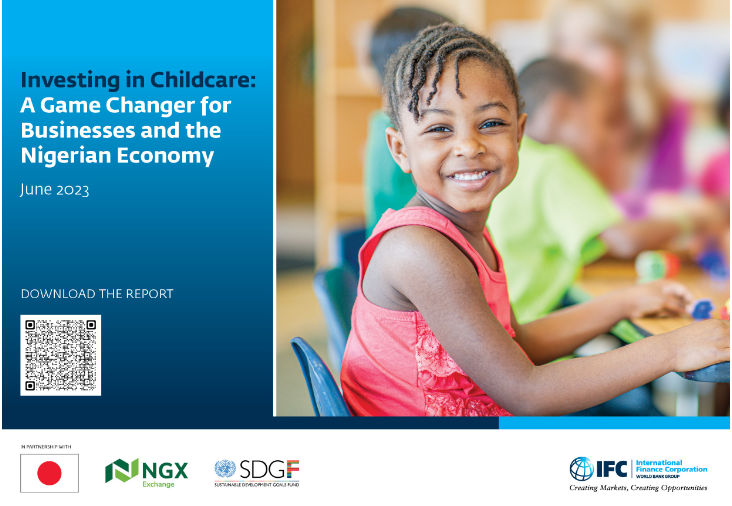
    Improving family-friendly workplace policies in Nigeria, including access to quality childcare for parents, could boost private sector productivity and benefit employees, children, and businesses in the country, according to a report published today by IFC and the Nigerian Exchange (“NGX” or “The Exchange”) Limited.

    The new report, Investing in Childcare: A Game Changer for Businesses and the Nigerian Economy, found that only 5 percent of Nigeria’s private sector employers invest in childcare despite 67 percent of working parents reporting that they were more productive at work when they had easier access to childcare.

    According to the study, investing in childcare by offering on-site or near-site childcare services, or the financial support to access childcare, presents an opportunity for employers to improve employees’ productivity, reap the efficiency improvements, and boost business outcomes.

    The report estimates that by 2025, the demand for childcare services in Nigeria’s private sector is likely to increase by 10 percent. However, childcare providers face barriers to scale and meet the growing demand, especially because they lack access to formal capital and investments. The study found that 76 percent of childcare providers faced challenges in accessing formal financing, highlighting an opportunity for partnerships and investments in addressing market gaps.

    Commenting on the report, Temi Popoola, Chief Executive Officer, Nigerian Exchange (NGX) Limited, said that access to effective and affordable childcare is vital to ensuring a productive, engaged, and inclusive workforce. “This report presents a compelling business case for stakeholders, both in the capital market and the broader private sector, to step up actions and collaborate on crucial measures to improve workplace solutions for childcare, as it will benefit companies, employees and the overall economy,’’ he said.

    “Childcare and family-friendly work policies are often overlooked aspects of social and economic development—but they shouldn’t be,” said Dahlia Khalifa, IFC Director for Central Africa, Liberia, Nigeria and Sierra Leone. “This report reinforces the value in expanding family-friendly workplace policies in Nigeria to support social and economic development.”   

    Launched on the sidelines of the Africa CEO Forum in Abidjan, the report assessed the needs and challenges of 7,000 stakeholders, including employees, employers, and childcare providers. Demand for childcare in Nigeria is forecast to increase rapidly along with the country’s population.

    The report’s research covers six commercial hubs in Nigeria: Enugu, FCT-Abuja, Kano, Lagos, Ogun, and Rivers. The report was funded by the IFC-led Nigeria2Equal Initiative, launched in 2020 in partnership with Nigerian Exchange (NGX) Limited to increase women’s participation in the private sector. Through the initiative, IFC and NGX are working with private sector companies listed on the Exchange to implement gender-smart solutions that reduce gender gaps across leadership, employment, and entrepreneurship.

  • SpecSMART Set to Open Office in Nigeria

    SpecSMART Set to Open Office in Nigeria

    A top-class optometry clinic, SpecSMART, is set to offer its high-quality primary eye care, quality frames, quality lens variants, and contact lens fitting to Nigerians, as it debuts in Lagos on Friday, 12th August, 2022.

    The world-class Eye clinic will be launched at the Ikoyi Plaza Mall, Awolowo Road, in Ikoyi, Lagos, and will be providing fully automated quality eye examination and eye care services to Nigerians cost-effectively.

    Dr. Clarence Nwokocha, Practice Head and Medical Director, SpecSMART, said when launched, the clinic will provide quality affordable eye care services to everybody requiring eye care.

    It will enable access to over 1,000 frames ranging the home brands to premium brands, international designer sunglasses of high standard, and quality and stylish frames for kids and youths at affordable prices.

    There will also be on-the-spot fitting of standard prescription lenses within 30 minutes, fully automated world class medical suite for quality eye examination, free registration for all patients, and delivering a wide and comprehensive eye care service every day of the week, for flexibility of appointments.

    Other services include 24 hours automated appointment scheduler via SpecSMART website platform, 12-hour online customer care service. Working hours are 12 hours Mondays to Saturdays and 9 hours on Sundays.

    There are affordable eye care plans/packages according to customers’ budgets and preferences ranging from the silver plan to the Diamond plan. Also, there are plans for children, for seniors from age 60 and above, and plans for families

  • Feature: CBA Foundation calls out in-laws that Dehumanize Widows

    Feature: CBA Foundation calls out in-laws that Dehumanize Widows

    by Ony Kachi

    After Mrs kumbaya (name changed to protect her identity) lost her husband at work in 2005, she was accused of killing him. The accusation did not come from her husband’s brothers but his sister, who had earlier lost her own husband. It took the combined hard work of the brothers to get their sister off the back of her fellow widow. They told their sister pointedly that she too could face the same accusation she was levelling against their sister-in-law, since her husband was deceased too.

    This real incident underlines one of the greatest puzzles of the twenty-first century: How people who themselves or their mother or children or relatives are victims or could be victims of the dehumanising treatment of widows condone, live with, encourage and perpetuate the horrendous denigration inflicted on widows by their in-laws. The continued existence of this kind of situation of dog eat dog, or rather man’s inhumanity to man, makes one wonder if Aristotle also considered (Nigerian) in-laws when he asserted that man is a rational animal. There is absolutely nothing rational about the dehumanisation widows are subjected to by their in-laws in this clime.

    A man, who through marriage has become one with the woman he marries, dies, leaving behind his wife and five children (three boys and two girls – this fact is only being added to show that the gender of the children may not even be a factor in how the widow is treated). Almost immediately his siblings and other blood relatives swoop on whatever assets of his they can lay their hands on. If a family meeting is convened, it is not to discuss the welfare of their late brother’s wife and children, who all bear the family name as part of their extended family. No, that is an agenda item for meetings convened by angels, not in-laws of widows. What in-laws of widows convene family meetings for is to make sure they have not missed out any of the assets their late brother could have had. That is how kind in-laws are to a widow.

    If Mrs Kumbaya thought her case was going to be different because her brothers-in-law defended and protected her from their sister, then she apparently may have ascribed angelic virtues to her husband’s brothers. For, as it turned out, that act of defence and protection from their sister was the only kindness the brothers of Mrs Kumbaya’s late husband extended to her. They never helped or asked after her and her children’s welfare after that. Not even when things became so difficult that she could no longer pay her house rent and ended up on the street.

    Maybe Mrs Kumbaya should even count herself lucky. Stories abound of widows who had been abused, molested, raped or “shared” by in-laws as part of the property left behind by their late brother. There are stories of widows, falsely accused of killing their husbands, being locked up by in-laws in police cells and the keys thrown into the sea, as it were. What about widows forced to drink the water used to wash the corpse of their husband as proof that they had no hand in their husband’s death. Or the ones forced to spend days and nights in the same room with the corpse of their husband.

    Nigeria is not exactly a safe haven for women. What with the prevalence of harmful cultural orientations and practices against the female gender, such as preference of the male child to the female child, female circumcision, FGM (female genital mutilation), forced marriage and denial of inheritance, succession and other rights the male gender takes for granted. Generally, Nigeria is not a friendly environment for women, least of all widows considered to be a highly vulnerable group. In fact, Nigeria is said to be one of the least safe places for women in the world with a survey by the Thomson Reuters Foundation conducted in 2018 ranking Nigeria as the ninth most dangerous country in the world for women.

    The dehumanising treatment of widows is part of what the Violence Against Persons (Prohibition) Act, passed in 2015, was intended to stop. The Act, more commonly referred to as the VAPP Act or law, categorises emotional, verbal and psychological abuse as offences and is considered by many legal experts and advocacy groups to be a comprehensive tool for addressing all forms of violence and abuse against all persons. The law seeks to do so by providing maximum protection from violence of various forms against all persons irrespective of tribe, socio-economic class, religion and gender and offering effective remedies (financial compensation) for victims of violence and appropriate punishment (globally acceptable deterrents) for offenders.

    It is not known how much of the general population, including in-laws who routinely dehumanise widows, is aware of the VAPP law. While ignorance of the law offers no excuse in a court of law, it is imperative that more enlightenment be created on the existence of the VAPP Act and all its provisions against many of the inimical practices that in-laws perpetrate against widows in the name of culture. Maybe, just maybe, some in-laws, who are themselves uncomfortable with those practices but take part because of family and community pressure, could be emboldened by knowledge of the Act to become advocates and campaigners against such practices.

    Back to Mrs Kumbaya, for those concerned about her and what must have happened to her after she ended up on the street. They can heave a sigh of relief that the good Lord sent his angel in the form of the Chinwe Bode-Akinwande Foundation (CBA Foundation) and they took her off the street. Mrs Kumbaya now lives in an apartment rented for her by the Foundation, which also supplied her a mattress, other household items and food stuff.

    The CBA Foundation, founded in 2015, the same year the VAPP Act was enacted, is a strong advocate for the enforcement of the Act. Along other civil society groups, it is pushing for the domestication of the Act in states of the federation that are yet to enact a similar act. Rigorous enforcement of the VAPP law across the federation will undoubtedly accelerate the mission of the Foundation, which is to promote “the protection of [underprivileged] widows and their vulnerable children in Nigeria, to promote immediate and lasting hope, confidence and courage in their lives.” The Foundation pursues its mission under its 5-point agenda of women empowerment/capacity building, health intervention, nutrition, quality basic education and a self-employment scheme.

    This piece is not intended to demonise in-laws. The writer is himself an in-law by multiples. It is to call for a change of heart and attitude in society, particularly among in-laws, towards widows, knowing that we, our mothers, daughters, neighbours, friends are or could become widows. In-laws should join public-spirited people across the country in supporting the CBA Foundation in its advocacy for enforcement of the VAPP law and in providing succour for underprivileged widows and their vulnerable children.

    There are many Mrs Kumbayas out there but the resources and reach of angels such as CBA Foundation are limited. Men and women of goodwill, including in-laws who have now seen the light, can extend the Foundation’s resources and reach by supporting it in its mission. Contact the Foundation today by sending an email to them at: cbafoundationng@gmail.com.