Tag: Country Head

  • Zoho Corporation Unveils Nathu La, a Designed-in-House Server, in a Move Towards Technological Sovereignty

    Zoho Corporation Unveils Nathu La, a Designed-in-House Server, in a Move Towards Technological Sovereignty

    The server will help the company bring down the total cost of ownership by 20-30% and power consumption by 12-18%, in turn reducing inference cost.

    Zoho Corporation, a global technology company and parent company of Zoho and ManageEngine, announced the launch of Nathu La, a designed-in-house server and a pivotal step in the company’s journey towards building its full technology stack, from the hardware layer to software applications.

    With Nathu La, Zoho has achieved equivalent performance with 12-18% lower power consumption and 20-30% lower total cost of ownership (TCO), thereby reducing inference costs. The Nathu La server, comprising Intel® Xeon® 6 processors, was developed collaboratively with Intel, leveraging their enablement capabilities and technical expertise.

    “Zoho Corporation has invested in building its own technology stack from the ground up over the last three decades. The Nathu La server launch is in line with that goal,” said Kehinde Ogundare, Country Head, Zoho Nigeria. “With our strategy of using contextual, right-sized models, running on our own platform, on our own servers, in our own data centres, we are compounding the benefits accrued from owning and operating our entire technology stack. This ensures that our solutions are more sustainable and accessible for businesses. These long-term R&D investments we are making at every layer of the stack are aimed at delivering customer value.”

    Building the Full Technology Stack

    The design philosophy behind Nathu La is rooted in the Open Compute Project (OCP), emphasising modularity, thermal efficiency, and ease of maintenance. This enables Zoho’s data centres to significantly reduce total cost of ownership and power consumption.

    Zoho plans to host its applications on the Nathu La server platform, enabling the company to optimise the full software-hardware stack for its specific workloads, reduce costs, improve performance, and strengthen data governance for its global customers. This will also help bring down inference costs for Zoho’s AI usage.

    Developed Hardware Engineering Talent

    In 2020, Zoho established a small R&D team in Nagpur, a Tier 2 town in India, focused on projects such as server design and systems engineering. Members of the Nathu La R&D team include hires from SETU – short for Student’s Engagement for Transformative Upskilling – an initiative designed to build a pipeline of industry-ready engineers, with a focus on advanced learning in Electronics System Design and Manufacturing (ESDM).

    The initiative directly addresses the growing need for stronger foundational engineering skills in an era increasingly influenced by AI-assisted development. By prioritising hands-on innovation and first-principles problem-solving, SETU helps cultivate deeper research capabilities, creativity, and applied engineering expertise. To date, over 300 students have been trained through the programme, some of whom have joined Zoho.

    What’s Inside

    The Nathu La server motherboard and chassis platform is the result of five years of R&D across hardware, firmware, and systems management. Based on Intel® Xeon® 6 Processors, the server is designed to optimise performance for virtualisation (VM), High Performance Computing (HPC), AI inference, and storage applications. This results in improved performance of Zoho applications for end users.

    The server features customised power delivery subsystems, an in-house DC-SCM (Data Centre Secure Control Module) design, and modular chassis options compatible with diverse end-user environments, offering flexibility across deployment types.

    All modular components – including the DC-SCM and NIC (Network Interface Card) – were designed in-house by Zoho’s hardware engineering team and assembled through electronics manufacturing partners, enabling tighter integration and quality control across the platform. Over five patents have been filed covering advanced thermal management and cost-optimised server architecture designs.

    Moving Towards Technological Sovereignty

    Nathu La is engineered with hardware-rooted security at every layer of the stack. The platform’s indigenous IP-driven approach reduces dependency on external entities for security audits, firmware updates, and licensing continuity.

    The solution aligns with open-source software principles and reflects Zoho’s broader commitment to building sustainable, secure, and scalable digital infrastructure. It also supports the growing global focus on digital sovereignty, local innovation ecosystems, and high-performance computing capabilities.

  • Zoho Nigeria champions women’s digital empowerment at the Guardian Women Festival

    Zoho Nigeria champions women’s digital empowerment at the Guardian Women Festival

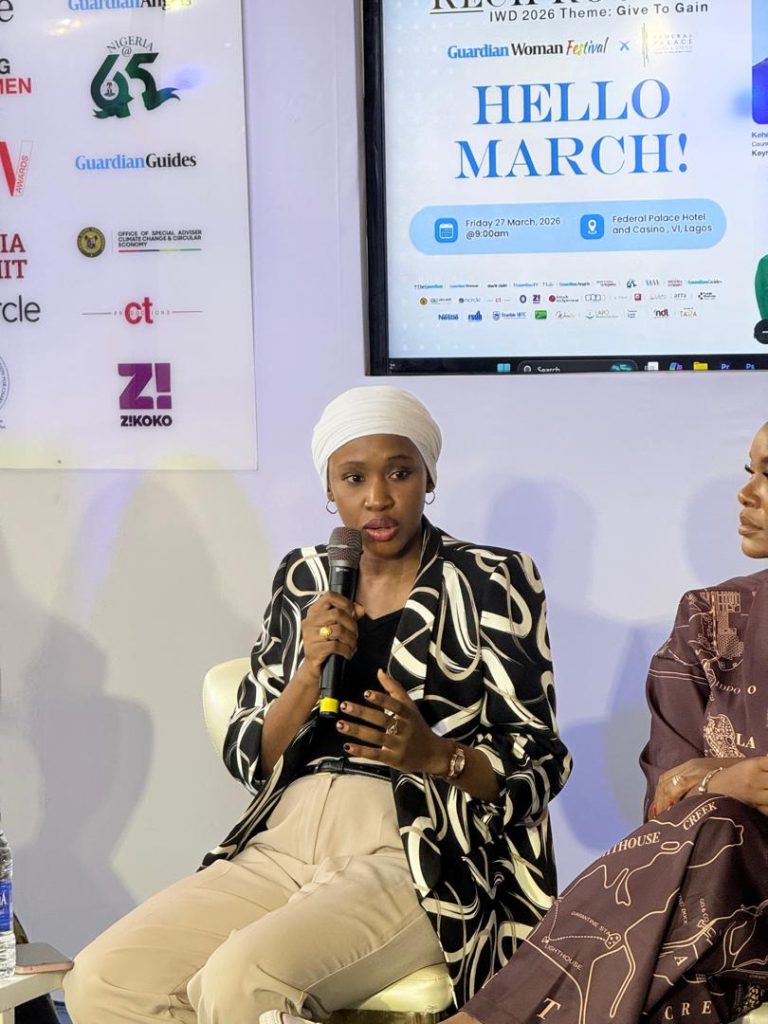
    Zoho Nigeria partnered with Guardian Newspapers for the Guardian Woman Festival, a month-long initiative celebrating women’s contributions to business, governance, and social development while promoting digital empowerment for female entrepreneurs.

    Held at the Federal Palace Hotel in Victoria Island, Lagos, the festival focused on the theme “Reciprocity,” encouraging the exchange of value, networks, and digital innovation to strengthen women-led businesses and foster collaboration.

    During the event, Kehinde Ogundare, Country Head of Zoho Nigeria, delivered a keynote address titled “Give Value, Gain Growth: Women Driving Reciprocal Innovation in the Digital Economy”. In his remarks, he highlighted the urgent need to bridge the digital gap for female entrepreneurs.

    While Nigeria has the highest concentration of women-owned businesses in Africa, fewer than 30% currently use digital tools to manage or grow their operations. Ogundare noted that technology does not replace the strengths women already bring to business, such as relationship building and community engagement. Instead, it amplifies them, enabling entrepreneurs to reach wider audiences and scale more efficiently.

    “The difference is not talent. Not capital. Not ambition. It is digital adoption,” said Ogundare during his keynote. “Smart tools create smart businesses. Smart businesses create strong economies. When women entrepreneurs and leaders have access to the right tools, the possibilities for growth are limitless.”

    Zubaida Aliyu, Sales Manager at Zoho Nigeria, also brought her expertise to the festival’s panel session on ‘Women in the Business of Digital Innovation’. She highlighted how women are uniquely positioned to create shared value in digital spaces by building platforms that encourage knowledge sharing, mentorship, and collaboration.

    Aliyu also challenged organisations that continue to view women’s digital inclusion primarily as corporate social responsibility rather than a strategic business priority.

    “Tech creates a level playing field,” she said, noting that digital platforms remove limitations related to location and infrastructure size. Addressing organisations that overlook the economic value of inclusive digital strategies, she added, “They are leaving money on the table — they need to think of it as a strategy not charity”.

    Through its participation in the Guardian Woman Festival, Zoho reaffirmed its commitment to providing affordable and accessible enterprise-grade technology to businesses of all sizes. By helping women transition from manual effort to digital efficiency, Zoho aims to support entrepreneurs build scalable enterprises and ensure their sustained success in Africa’s digital economy.

  • Zoho Marks 30 Years Supporting One Million Organisations and 150 Million Users Globally

    Zoho Marks 30 Years Supporting One Million Organisations and 150 Million Users Globally

    Zoho Corporation, a global technology company, today marked its 30th anniversary with the announcement of two major company milestones. Zoho Corporation, consisting of consisting of Zoho (cloud business solutions), ManageEngine (IT management), Qntrl (business process management) and TrainerCentral (e-learning platform), is now a trusted technology provider to one million paying customers and more than 150 million users globally. Today’s announcement follows significant year-on-year customer (32%) and revenue (20%) growth in 2025.

    Recent customers to Zoho Corporation include: in the United States, Rapid Response Monitoring and Synergy Home Care; in India, Mercedes-Benz India, Force Motors, Joyalukkas and Union Bank of India; in the UK/European Union, Flora Food Group, Handl Tyrol and Atout France; in Middle East-Africa, Al-Ahli Saudi FC and Al Qadsiah FC; in LATAM, Gonher Batteries, and in Brazil, Creditas and Editora Globo.

    “Being bootstrapped, private, and built entirely in-house makes Zoho an outlier among competitors,” said Sridhar Vembu, Co-founder and Chief Scientist, Zoho Corporation. “But vendors don’t need our help, businesses do, which is why delivering customer value has, for 30 years, been Zoho Corporation’s North Star. Before any innovation, strategy, or guiding principle becomes a product, pivot, or policy, it must first affirm the question, ‘Will this help businesses?’ We are incredibly grateful that companies around the world have responded so positively to our customer-first approach over the past three decades, and will continue to meet the evolving needs of businesses with powerful, scalable, and affordable solutions.”

    Commitment to Africa

    Zoho Corporation has steadily expanded its presence across Africa, supporting organisations of all sizes as digital transformation accelerates across the continent.

    “Africa represents one of the most dynamic and entrepreneurial business environments in the world,” said Kehinde Ogundare, Country Head, Zoho Nigeria. “Over the years, we have seen growing demand from African businesses seeking technology that is flexible, affordable and built for long-term value rather than short-term gain. Our continued investment reflects our belief in Africa’s innovation potential and our commitment to supporting local businesses with tools that help them scale sustainably.

    Zoho’s long-term approach aligns closely with the needs of African organisations, providing a unified technology platform without the cost and complexity often associated with enterprise software.

  • How Nigerian companies are leading a more responsible digital transformation

    How Nigerian companies are leading a more responsible digital transformation

    By Kehinde Ogundare

    Artificial intelligence is everywhere–in polished social media posts, in the recommendations that guide our viewing habits, and in the bots that handle customer queries before a human agent steps in. On LinkedIn, AI-assisted writing has become standard practice. A year ago, more than half of English long-form posts that went viral were estimated to have been written by or assisted by AI. If that’s the norm on the world’s biggest business network, it’s no surprise that AI is driving conversations in Nigerian boardrooms as companies move from experimentation to embedding AI into their daily operations.

    Part of the package

    The Nigeria Data Protection Act (NDPA), modelled on the European Union’s General Data Protection Regulation, together with the Nigeria Data Protection Commission, requires companies to build privacy into their systems from the outset rather than adding it later. This clear regulatory framework has evolved alongside a rapid rise in AI adoption.

    New research from Zoho on responsible AI adoption highlights the impact of the regulations. As per the report, 93% of Nigerian companies have already started using AI in their daily operations; 84% have tightened their privacy controls after adoption, and 94% now have a dedicated privacy officer or team, which is well above global averages.

    The survey, conducted by Arion Research LLC among 386 senior executives, shows just how deeply embedded AI has become in Nigeria. One in four companies already uses it across several departments, and nearly a third report advanced integration. Financial services firms are pioneers in this sector, using AI to automate client interactions, streamline operations and sharpen their marketing, while staying compliant with data protection rules.

    The NDPA has helped make privacy part of business planning. Four in ten companies now spend more than 30% of their IT budgets on privacy. Regular audits, privacy impact assessments and explainability checks are becoming standard practice.

    Skills, compliance and capacity

    Rapid adoption brings challenges. More than a third of businesses say that their biggest obstacle is a lack of technical skills, and another 35% cite privacy and security risks. Instead of outsourcing, most are building capacity in-house: nearly 70% of companies are training staff in data analysis, more than half are improving general AI literacy, and 40% are investing in prompt engineering for generative tools.

    The understanding of the NDPA regulation, which came into force in 2023, has also improved. 65% of organisations see compliance as essential. Many voluntarily apply data-minimisation and transparency standards even when not required to do so, aligning more closely with international norms and easing collaboration with global partners.

    Privacy is increasingly influencing business decisions — from investment priorities to system design. Companies are asking tougher questions: is specific data essential? How can exposure be limited? How can fairness and transparency be proven? 

    Trusted systems

    As privacy becomes part of how technology is built, companies are being more cautious about the tools they use because they now want systems that protect customer data, with clear boundaries between data and model training, straightforward controls, and reliable records for compliance teams.

    Demand for business software that balances productivity with privacy is also growing. Zoho, among others, has seen strong customer growth as more organisations are looking for platforms that support responsible data handling.

    The study identifies three main reasons behind AI adoption: to make work more efficient by automating routine tasks, to support better decision-making by identifying patterns sooner, and to improve customer engagement through faster, more relevant interactions. But none of this can succeed without trust. Nigeria’s experience shows that privacy and innovation can reinforce each other when they’re built together.

    There’s still work to do because some industries are moving faster than others, and smaller businesses often face the biggest hurdles in time, cost and skills. Enforcement is also patchy; while the law is clear, application across sectors and geographies is a work in progress.

    The next steps are more practical, requiring investment in skills – from data analysis and AI literacy to sector-specific training – and for governance to be put in place, with clear responsibilities, written policies, and a plan for managing errors or breaches. Privacy impact assessments should become part of every new system rollout, enabled by technology.

    As AI becomes fundamental to doing business, Nigerian companies that build it carefully and responsibly will be better able to compete at home and abroad.

    Kehinde Ogundare is the Country Head, Zoho Nigeria

  • Zoho One Introduces a Unified and Intelligent Platform Experience for Modern Workplaces

    Zoho One Introduces a Unified and Intelligent Platform Experience for Modern Workplaces

     Zoho Corporation, a global technology company has announced numerous enhancements to Zoho One, its all-in-one business software platform. The latest update introduces a reimagined user experience designed to make collaboration easier, improve security, and deliver deeper intelligence across all 50+ applications. With this release, Zoho One offers a more connected and context-aware environment for organisations of all sizes.

    “The Zoho One update reflects how work has evolved from using individual applications to operating within a unified platform,” said Kehinde Ogundare, Country Head, Zoho Nigeria. “Zoho One customers are not simply licensing apps; they are choosing a solution that allows Zoho to handle the technology while they focus on productivity. The enhancements announced today deliver a cohesive experience built on unified integrations, context, and data.”

    Since its launch in 2017, Zoho One has grown to support more than 75,000 organisations worldwide, with customers using an average of 22 applications within the suite. The platform’s extensive integrations, privacy-focused architecture, and consolidated technology stack ensure reliability and consistency for businesses looking to streamline operations.

    A Reimagined User Experience

    Zoho One’s new interface places context at the centre of the user journey and removes traditional boundaries between applications. Spaces now organise tools by purpose—such as PersonalOrganisation, and Department-specific groups—enabling employees to access what they need without switching between apps. A centralised search bar spans the entire ecosystem, allowing users to find information or trigger workflows instantly.

    An enhanced Action Panel provides a full view of upcoming meetings, unread messages, pending tasks, and other key updates, helping employees remain informed regardless of which app they are using. The updated Dashboard consolidates data from Zoho and third-party apps into one central hub that can be customised using pre-existing or bespoke widgets.

    The platform also introduces Vani, a new visual-first collaboration space that supports brainstorming, planning, and creation through diagrams, whiteboards, mind maps, and integrated video calling.

    Native Integrations for Better Security and Efficiency

    Zoho One continues to strengthen its position as a unified business operating system by offering native integrations across Zoho’s suite and with third-party applications. This reduces external entry points and supports faster anomaly detection. With Zoho Directory included, administrators also gain a secure platform for managing workforce identity and access within the same unified system.

    central integrations panel enables administrators to monitor and configure all connections. Foundational integrations bring application-specific portals—Zoho or third-party—into a single unified portal. Practical tasks such as domain verification and authentication can now be configured more easily.

    The new Smart Offboarding feature introduces outcome-based integrations, allowing organisations to transfer department ownership, manage employee device data, and determine data access rights within a single workflow, ensuring smooth transitions.

    Contextual Intelligence Powered by Zia

    Zia, Zoho’s AI assistant, is now accessible throughout Zoho One, providing unified intelligence that supports decision-making and improves productivity. Zia can aggregate and contextualise information from various platforms, including third-party systems such as Google Workspace, and present it as clear, actionable insight.

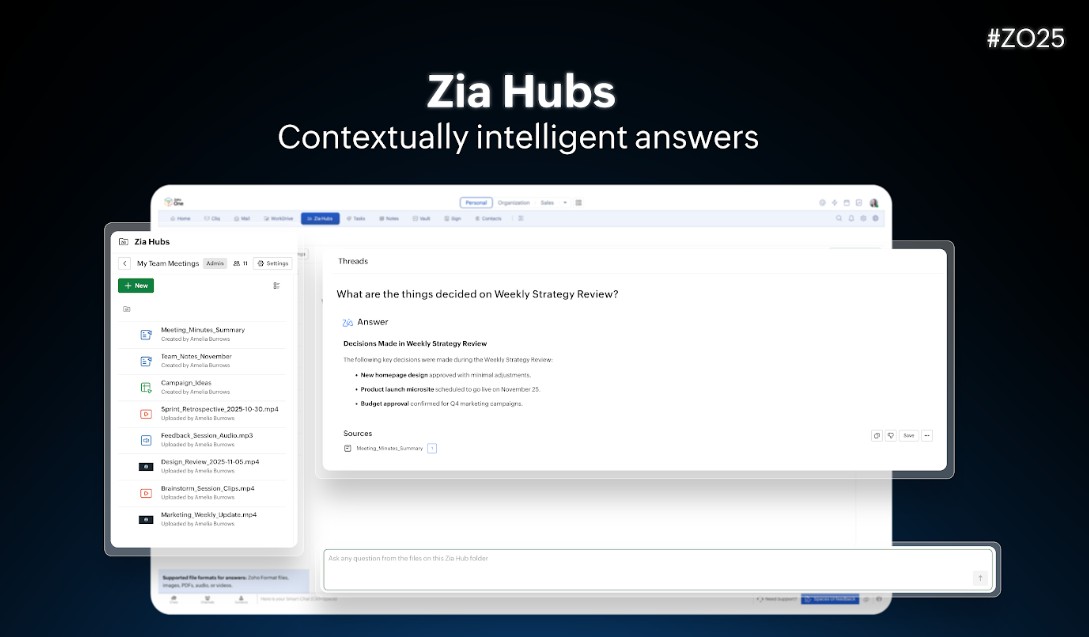
    Zia Hubs, the platform’s intelligent content management system, now has a dedicated space where contracts, meeting recordings, and other important assets are automatically organised. Through Zia Search, employees can quickly surface relevant information without navigating multiple locations.

    Ask Zia, available from the bottom toolbar, enables prompt-based searches across Zoho One, providing quick visibility into schedules, tasks, recent interactions, and other key details.

  • Zoho Partners with Babcock University to Empower and Upskill the Youth Through the Young Creators Program

    Zoho Partners with Babcock University to Empower and Upskill the Youth Through the Young Creators Program

    Zoho, a global technology company, has partnered with Babcock University through the Babcock Centre for Executive Development (BCED) to empower students with hands-on digital skills in low-code application development. Through the Young Creators Program, Zoho trained over 50 students across disciplines—including Computer Science, Business, and Information Technology—to build business-ready applications using Zoho Creator, the company’s low-code development platform.

    The three day workshop introduced students to practical problem-solving using the latest advancements in cloud technology, enabling them to design and develop custom business solutions without advanced programming knowledge. The program also fostered a deeper understanding of how low-code tools can support entrepreneurship and digital transformation.

    “As part of our commitment to supporting local talent development in Nigeria, we are excited to collaborate with Babcock University to equip students with future-ready digital skills,” said Kehinde Ogundare, Country Head, Zoho Nigeria. ” Through the Young Creators Program, we aim to empower young innovators to build solutions that solve real business challenges while strengthening the local technology ecosystem.”

    This initiative also marks the beginning of a broader strategic collaboration between Zoho and BCED. Both organisations will continue to work together to deliver additional training programs, interactive workshops and innovation-focused events. Discussions are also underway to add Zoho’s apps to BCED’s entrepreneurship curriculum, ensuring that students learn how they can apply digital solutions for various business problems.

    “We are committed to preparing our students for leadership in a rapidly evolving digital economy,” said Dr. Ayodeji Ajibade is the Director of the Babcock Entrepreneurship Development Centre (BEDC) at Babcock University in Nigeria. “Partnering with Zoho strengthens our mission by providing students with access to industry-standard tools and practical learning experiences that bridge the gap between classroom knowledge and real-world application.”

    The Young Creators Program forms part of Zoho’s global effort to promote digital literacy and support innovation among young people. Launched in 2022, the program has trained more than 2000+ students around the world, providing them with the tools and confidence to pursue careers and entrepreneurial ventures in the technology space.

  • Zoho Expands AI Access with Free Agentic Tools for Businesses

    Zoho Expands AI Access with Free Agentic Tools for Businesses

    Zoho, a global technology company, today announced the launch of new agentic AI features across three key product categories—collaboration, customer experience, and human resources. These new capabilities are designed to help businesses enhance productivity, automate routine tasks, and focus on higher-value work. The features are available immediately at no additional cost across Zoho’s suite of business applications.

    The announcement builds on Zoho’s broader AI strategy, which includes Zia Hubs, a system that enables AI access to unstructured company data, and Zia LLM, Zoho’s proprietary large language model developed specifically for business use. Alongside Zia, Zoho’s long-standing AI assistant, these innovations form the foundation of the company’s agentic AI approach—helping businesses gain deeper insights and efficiency from their data across Zoho’s platform of more than 55 integrated applications.

    “Businesses are increasingly eager to leverage AI but often face obstacles such as high implementation costs, data readiness challenges, and fragmented systems,” said Kehinde Ogundare, Country Head, Zoho Nigeria. “Zoho’s unified, homegrown technology stack eliminates these barriers by allowing advanced AI features to be deployed automatically and at no extra cost. Our customers don’t need to invest in third-party integrations or additional tools—the technology simply arrives and works. This approach makes AI adoption practical, affordable, and impactful for businesses across the continent.”

    The new agentic features build on Zoho’s existing AI ecosystem, which already includes Zia Agents, Zia Agent Studio, and Agent Marketplace. These intelligent tools allow users to perform complex, cross-functional actions such as creating contracts from multiple files, checking team availability before scheduling meetings, or automatically converting sales queries from Zoho Mail into CRM leads without manual effort.

    Within Zoho Workplace, the company’s collaboration suite, AI upgrades have been introduced across Mail, Cliq, Sheet, and Tables. The enhanced Ask Zia assistant can now process multi-step commands spanning multiple applications, while Zoho Tables introduces AI Base Creation to help users instantly generate complete data structures from a short prompt. Additional AI-powered features such as Keyword Extraction, Sentiment Analysis, and Language Detection simplify data management and analysis.

    In the customer experience category, Zoho Desk, used by over 100,000 businesses globally, now includes pre-built Zia Agents like the Resolution Expert, which records and learns from support ticket resolutions to improve future service. Meanwhile, Zoho Sign, a secure digital signature platform, now offers Agreement Intelligence, enabling users to draft and query contracts using Ask Zia without relying on third-party tools.

    In human resources, Zoho Recruit introduces new agentic AI features that improve candidate matching and assessment creation. Zia’s Candidate and Job Match features analyse CVs and job descriptions to ensure better hiring outcomes, while AI-Assisted Assessment Generation automatically creates complete tests tailored to each role—saving time and ensuring fair, efficient evaluations.

  • Listicle: Six Strategies to Grow Your E-Commerce Business in Nigeria

    Listicle: Six Strategies to Grow Your E-Commerce Business in Nigeria

    By Kehinde Ogundare

    Nigeria’s e-commerce landscape is evolving rapidly. From fashion and electronics to groceries and beauty products, more Nigerians are shopping online than ever before. According to DataReportal, the country had 103 million internet users as of January 2024, and online retail sales continue to grow as more people gain access to affordable smartphones and digital payment systems.

    However, while opportunity is expanding, so is competition. Thousands of small businesses now sell across Instagram, WhatsApp, and local marketplaces. For many, the challenge is no longer getting online, it’s standing out and building sustainable growth.

    Below are six strategies that can help e-commerce entrepreneurs in Nigeria compete more effectively, connect with customers, and scale sustainably.

    1. Focus on a niche, not the crowd

    The internet offers endless reach, but success often lies in narrowing your focus. Instead of trying to appeal to everyone, identify a specific audience whose needs you understand deeply—whether that’s fitness enthusiasts, new parents, or tech-savvy students.

    Niche targeting allows you to tailor your message, pricing, and product experience. It also helps small businesses build loyalty and word-of-mouth credibility in markets where advertising budgets are limited.

    2. Build relationships beyond social media

    Social platforms are powerful but unpredictable. Algorithms change, engagement fluctuates, and visibility can vanish overnight. That’s why it’s essential to diversify how you stay connected with customers.

    Email newsletters, community groups, or loyalty programmes provide more direct and reliable touchpoints. Use these channels to share updates, answer questions, and offer genuine value—not just promotions. Consistent, thoughtful communication builds trust that outlasts social trends.

    3. Use data to understand customer behaviour

    Every click, search, and abandoned cart tells a story. Tracking customer behaviour—through analytics dashboards, feedback forms, or even simple observation—can reveal why shoppers drop off and what keeps them coming back.

    For example, you might discover that most users exit your site during checkout due to limited payment options. Adding mobile money or bank transfer features could increase conversions immediately. Data-driven decisions help eliminate guesswork and improve user experience.

    4. Create content that answers real questions

    Many Nigerian shoppers research extensively before buying online, especially from lesser-known brands. Publishing clear, helpful content—such as FAQs, size guides, or product comparisons—can bridge the trust gap.

    A small skincare brand, for example, could post educational pieces on ingredients and routines, while a gadget store could share short explainers on choosing the right devices. When people find answers through your content, they are more likely to view your business as credible and dependable.

    5. Explore automation and AI for efficiency

    Artificial Intelligence is reshaping how small businesses operate globally—and Nigeria is no exception. From customer support chatbots to inventory management and personalized recommendations, automation can simplify repetitive work and improve decision-making.

    Even basic AI tools can help analyse trends, spot buying patterns, and free up time for strategic tasks. The goal isn’t to replace human connection but to enhance it by focusing your energy where it matters most—understanding and serving your customers.

    6. Build credibility through customer voices

    Nigerians value peer opinions. Reviews, testimonials, and user-generated content often carry more weight than brand messaging. Encourage satisfied customers to share feedback or showcase how they use your products.

    Displaying honest reviews on your website or social pages signals transparency and confidence. People are far more likely to trust a brand that others vouch for, especially in a marketplace crowded with new entrants.

    Building for the long term

    Sustainable e-commerce growth in Nigeria isn’t about chasing every new platform or pouring money into ads—it’s about clarity, consistency, and connection. By focusing on real customer needs, learning from data, and building trust at every step, businesses can create lasting impact in one of Africa’s most dynamic digital markets.

    Kehinde Ogundare is the Country Head of Zoho Nigeria

  • Nigeria Emerges as Global Model for Responsible AI Adoption- Research

    Nigeria Emerges as Global Model for Responsible AI Adoption- Research

    Nigeria has been spotlighted as a potential global leader in responsible Artificial Intelligence (AI) adoption, according to a new research report published by Arion Research LLC and sponsored by Zoho. The report, titled “The AI Privacy Equation: The Nigerian Model of Responsible AI Adoption”, surveyed 386 Nigerian business leaders and offers fresh insights into how the country manages the balance between technological innovation and privacy protection.

    The findings reveal that Nigerian businesses are embracing AI at an impressive pace and embedding privacy protection at the very core of their digital transformation strategies. An overwhelming 93 per cent of surveyed organizations have already begun their AI journey, with nearly a third achieving advanced integration across their operations. More significantly, 84 percent of respondents reported that their organizations had strengthened privacy safeguards since adopting AI—a trend that runs counter to global patterns where privacy is often compromised in the race toward innovation.

    This transformation is driven by strong leadership at the highest levels, with over half of surveyed executives pointing to CEOs and senior management as the primary champions of AI adoption and privacy integration. The financial services sector, in particular, is emerging as a frontrunner, representing almost one-third of surveyed organisations and demonstrating sophisticated approaches to balancing innovation with regulatory compliance.

    Beyond leadership, Nigerian organisations are investing substantially in people and skills to support this shift. Nearly 70 per cent are prioritizing data analysis capabilities, while more than half are focusing on building AI literacy across their workforce. The report also highlights how Nigerian businesses are allocating significant portions of their IT budgets to privacy infrastructure, appointing dedicated privacy officers, and conducting regular impact assessments—practices that are establishing a new benchmark for responsible AI adoption.

    “The Nigerian Model proves that emerging economies need not sacrifice privacy for innovation. By demonstrating that leadership commitment, technological advancement, and privacy protection can reinforce one another, Nigeria is charting a path that other markets worldwide can learn from and replicate,” said Kehinde Ogundare, Country Head, Zoho Nigeria.

    The report goes on to outline key recommendations for stakeholders. It calls on government and regulators to enhance policy frameworks and create regulatory sandboxes that encourage innovation while safeguarding privacy. For Nigerian organisations, it emphasises the importance of building strategic AI governance systems, embedding privacy-by-design principles into every stage of implementation, and scaling workforce training to meet the demands of the digital economy. The report highlights Nigeria’s leadership position for international partners and investors and urges support for capability development initiatives, partnerships, and cross-border knowledge sharing.

    With its combination of rapid adoption, leadership-driven strategies, and a firm commitment to privacy, Nigeria is positioning itself as a technology adopter and a potential exporter of global best practices. Arion Research concludes that this balance between innovation and protection places the country on a path to becoming an international reference point for responsible AI adoption.

  • Zoho Launches Zia LLM, and Expands AI Suite with Agents and Studio Tools

    Zoho Launches Zia LLM, and Expands AI Suite with Agents and Studio Tools

     Zoho, a global technology company announced the launch of Zia LLM—the company’s proprietary large language model, a no-code agent builder, Zia Agent Studio, over 25 deployable Zia agents, and a Model Context Protocol (MCP) server to open up Zoho’s vast library of actions to third-party agents.

    “Today’s announcement emphasises Zoho’s longstanding aim to build foundational technology focused on protection of customer data, breadth and depth of capabilities because of the business context, and value,” said Kehinde Ogundare, Country Head, Zoho Nigeria.

    “Our LLM model is trained specifically for business use cases, keeping privacy and governance at its core, which has resulted in lowering the inference cost, passing on that value to the customers, while also ensuring that they are able to utilise AI productively and efficiently.”

    Zia LLM: Custom-Built AI for the Enterprise

    Zoho has successfully launched its own large language model, Zia LLM, built completely in-house by leveraging NVIDIA’s AI accelerated computing platform. Trained with Zoho product use cases in mind—ranging from structured data extraction, summarisation, RAG, and code generation—Zia LLM comprises three models with 1.3 billion, 2.6 billion and 7 billion parameters, each separately trained and optimised for contextual applicability that benchmark competitively against comparable open source models in the market. The three models allow Zoho to always optimise the right model for the right user context, striking the balance between power and resource management. This focus on right-sizing the model is an ongoing development strategy for Zoho. In the short term, Zoho will scale Zia LLM’s model sizes, starting with the first set of parameter increases by the end of 2025.

    While Zoho supports many LLM integrations for users, including ChatGPT, Llama, and DeepSeek, Zia LLM continues Zoho’s commitment to data privacy by allowing customers to keep their data on Zoho servers, leveraging the latest AI capabilities without sending their data to AI cloud providers. The model is currently testing for internal use cases across Zoho’s broad app portfolio, and will be available for customer use in coming months.

    Zoho also announced two proprietary Automatic Speech Recognition (ASR) models for speech-to-text conversion for English and Hindi. Optimised to perform on a low computer load without compromising on accuracy, the models benchmark up to 75% better than comparable models across standard tests. Zoho will expand language support for ASR models to enable more inclusive AI adoption across diverse regions. It will also introduce a reasoning language model (RLM).

    Prebuilt Agents, Agent Studio and Marketplace Designed for Real-World Impact

    To enable immediate adoption of agentic technology, Zoho has developed a roster of AI agents contextually baked right into its products. These agents can be used across various business activities, handling relevant actions based on the role of the user. These include Customer Service Agent for Zoho Desk that can process incoming customer requests, understand the context, and either answer directly or triage them to a human rep, providing an efficient first line of assistance.

    Ask Zia, Zoho’s platform-wide conversational AI assistant, is bolstered with additional BI skills, tailored to data engineers, analysts, and data scientists, while supporting all users within an organisation. It can build end-to-end data pipelines for engineers, analyse data, create reports and dashboards in an interactive conversation mode for analysts, or help jump start building ML models for data scientists.

    First announced earlier in 2025, Zoho has further simplified the Zia Agent Studio experience to be fully prompt-based (with the option to use low-code) and includes ready-made access to over 700 actions across Zoho’s products. Agents built by users can be deployed autonomously, triggered by button click, with rule-based automation, or even summoned within customer conversations.

    At the time of deployment, an agent can be provisioned as a digital employee, maintaining the user access permission structure defined within the organisation. Admins can perform behavioural audits as well as performance and impact analyses on digital employees, ensuring that every agent is working as effectively as possible and within clear guardrails.

    Several pre-built agents are now available for users, such as Candidate Screener, which identifies and ranks the most suitable candidates for a specific job opening based on role requirements, skills, experience, and other key attributes; Deal Analyser, which can analyse deals and provide insights such as win probability, next best action, and follow-up suggestions, and Revenue Growth Specialist, which suggests opportunities for upsell and cross-sell for existing customers.

    These agents are available in Agent Marketplace from where customers can easily deploy them. Ecosystem partners, ISVs, and individual developers will be able to create agents and host them on the Zia Agents Marketplace in coming months.

    The company plans to add more skills to Ask Zia, allowing it to act as an assistant to Finance teams, Customer Support teams to start with. Support for the Agent2Agent (A2A) protocol will be implemented, allowing Zia Agents to interact and collaborate with each other, as well as collaborate with agents on other platforms.

    Interoperability and Governance

    Zoho’s adoption of the Model Context Protocol (MCP) allows clients to securely access and interact with workflows and actions across over 15 Zoho applications. MCP is  available in early access, and integrations via Zoho Flow extend its reach to third-party tools. Zoho Analytics now also supports a local MCP server, allowing for advanced contextual AI use cases while preserving data security and compliance.

  • Feature- Tech tools Nigerian startups can use to boost efficiency as they scale

    Feature- Tech tools Nigerian startups can use to boost efficiency as they scale

    By Kehinde Ogundare

    Business growth should feel energising — not like a daily struggle. When operations begin to scale, the software systems need to scale as well, and adapt to the new processes and needs of the growing organisation. For many Nigerian startups, with rising costs, lean teams, and limited time, staying organised becomes a challenge. Growth demands structure, not just ambition.

    The good news? A wide range of affordable and accessible tech tools can help businesses reduce costs, streamline operations, and unlock capacity. Whether it’s managing finances, people, or customers, small teams now have the means to operate at enterprise-level efficiency.

    Here are top 10 practical ways the right tools can boost productivity and help cut operational expenses:

    1. Finance and spend management

    Tracking expenses through manual spreadsheets and scattered receipts is inefficient and prone to error. It creates blind spots in budgeting and slows down level-headed decisions.

    To simplify the process, spend management tools help to consolidate all expense data into one place. They categorise spending, flag unusual activity, and streamline approvals. For example, a startup organising multiple events each quarter could use spend management software to budget per project, track payments in real time, and generate reports with a few clicks. This allows for better planning, clearer oversight, and tighter financial control.

    2. Project and task management

    As teams grow or operate remotely, task coordination becomes harder. Without clear roles, priorities, and timelines, delays and duplicated work are inevitable.

    Project management platforms such as Zoho Projects help align workflows with shared timelines, task ownership, status updates, and performance tracking. Such tools increase transparency and ensure everyone stays focused on the right tasks. For example, a tech startup juggling client work and product development can visualise workflows, prioritise tasks, and measure productivity, all in one place. Using such software also encourages accountability and helps teams meet deadlines.

    3. Customer relationship management (CRM)

    Customer engagement and consistent follow-up often determine long-term success. However, managing contact data and communication manually across tools, spreadsheets, and inboxes quickly becomes unmanageable.

    CRM tools such as Bigin centralise customer records, automate follow-ups, and offer insights into sales performance. This makes it easier to manage relationships, respond faster, and refine your sales and marketing strategies based on what is working. A retail business, for example, could use CRM tools to segment customers, send targeted offers, and track conversion rates, turning first-time buyers into repeat customers.

    4. Data storage and cloud access

    Relying on physical infrastructure for file storage is expensive and limits flexibility. Cloud storage offers an affordable and secure alternative, giving startups a secure, central location for all business files.

    It allows teams to access documents anywhere, collaborate in real time, and avoid the confusion of outdated file versions. With many tools offering free tiers or scalable plans, cloud storage is one of the simplest and most cost-effective upgrades a startup can make. It’s especially useful with distributed teams or partners working across regions or time zones.

    5. Social media and marketing management

    Social media is a powerful way to reach new customers, but managing it manually is time-consuming. Creating content, scheduling posts, and responding to comments can drain internal resources.

    Social media management tools help to plan content ahead of time, monitor performance, and stay consistent across platforms. Automation removes the drudgery of manual work, while analytics help refine your messaging and reach. For instance, a beauty brand or lifestyle brand can schedule campaigns around product launches and holidays while keeping an eye on which content drives the most engagement.

    6. HR and people operations

    Tasks like recruitment, onboarding, leave tracking, and managing payroll quickly pile up. Without dedicated HR support tools, these responsibilities can distract from core business goals.

    With centralised employee records and self-service portals, HR tools reduce admin time and ensure staff get the support they need. A small agency, for instance, could use them to simplify leave tracking and ensure timely salary payments, avoiding disputes or bottlenecks. This builds a more professional internal structure without needing a full HR department.

    7. Workflow and process automation

    Hours can be wasted on manual admin: copying data between systems, sending reminders, and generating reports. Automation tools remove that burden by connecting everyday apps and triggering tasks based on simple rules.

    Whether it’s sending alerts, updating spreadsheets, or managing approvals, automation tools work in the background to keep operations ticking over. For example, when a new sale is recorded, the system could automatically update inventory, notify the finance team, and schedule a customer welcome email.

    8. Cybersecurity tools

    Data breaches and cyberattacks are not just a risk to large corporations. Even small businesses are vulnerable, and accidental data loss can have serious consequences.

    Cybersecurity solutions, such as encrypted storage, secure password managers, and access control systems, help safeguard business and customer data. For startups, building trust with users starts with protecting their information. Tools that alert teams to suspicious activity or restrict access to sensitive files can prevent costly breaches and keep your reputation intact.

    9. Website builders and analytics

    A professional online presence is essential, especially in competitive industries. Modern website builders allow businesses to create responsive, user-friendly sites without coding experience.

    This ensures that potential customers find you easily – and that you understand how they engage with your content. For early-stage businesses, this can mean the difference between visibility and invisibility. Analytics help you learn what pages convert best, which campaigns drive traffic, and how to optimise your digital marketing spend.

    10. Integrated business systems

    Startups often adopt a mix of standalone tools for different tasks. But as operations expand, switching between disconnected apps becomes inefficient and error-prone.

    Integrated platforms bring everything – from CRM and finance to HR and analytics – into a single ecosystem. With connected tools and shared dashboards, teams collaborate better and make faster decisions. Imagine a logistics startup being able to track deliveries, issue invoices, and review driver performance all from one interface. It cuts down on confusion, improves customer service, and saves time across the board.

    The bottom line

    Whether you’re managing expenses, improving collaboration, or enhancing customer service, the right tech tools can unlock new levels of efficiency.

    You do not need a large team or deep pockets to build a business that runs smoothly. With the right systems in place, you can reduce admin, improve visibility, and focus on what really matters: growing the business.

    As technology tools become more accessible, now is the time to assess what you’re using— and whether those tools are helping you move forward or slowing you down.

    Kehinde Ogundare is the Country Head of Zoho Nigeria

  • Feature- Prioritising Security: The Bedrock of Stronger Workplace Collaboration in Nigeria

    Feature- Prioritising Security: The Bedrock of Stronger Workplace Collaboration in Nigeria

    By Kehinde Ogundare

    In Nigeria’s dynamic and often demanding business landscape, robust workplace collaboration is no longer a luxury—it is a necessity for sustainable growth and resilience. As per a study, 86% of employees believe that a lack of collaboration can lead to workplace failures; its significance cannot be overstated. As enterprises in 2025 increasingly adopt digital tools to enhance teamwork, one critical foundation must support this transformation: unwavering security.

    Today, the need to prioritise security goes far beyond protecting sensitive data. It is about fostering trust and laying a solid foundation upon which effective, innovative collaboration can thrive—especially in an era marked by ever-evolving cyber threats.

    Security: The Hidden Pillar of Effective Collaboration

    Collaboration flourishes in an environment grounded in confidence and safety. When employees trust that their tools are secure against the sophisticated cyber threats of 2025, they are more likely to share information freely and engage deeply. A secure environment nurtures the psychological safety required for open and meaningful contribution.

    Conversely, environments that lack adequate security measures not only deter open collaboration but also expose businesses to data breaches, operational disruptions, and the erosion of client and stakeholder trust—risks no forward-thinking enterprise can afford.

    Therefore, security must be treated as a core strategic priority rather than an afterthought. This involves implementing best practices such as strict data access controls based on the principle of least privilege and comprehensive data protection measures—encryption, vulnerability management, and safeguarding data at rest, in transit, and in use. Such a commitment becomes the foundation for enduring, high-performing collaboration.

    Integrated Platforms: Enabling Secure, Seamless Collaboration

    Striking the right balance between agile collaboration and stringent security requires a deliberate, policy-driven approach. Nigerian businesses should adopt integrated platforms where security is built into the very core of the solution. These platforms offer a unified environment for communication, project management, and data sharing—underpinned by a comprehensive data security policy that includes clear protocols for data handling, processing, and privacy.

    Here, the value of an all-in-one, inherently secure software suite becomes evident. Solutions that are both affordable and designed with embedded security features empower businesses to protect critical data while facilitating efficient teamwork. Features like data classification, minimal storage of sensitive information, and built-in compliance tools ensure that security is always active—shielding organisations from complex modern threats.

    Moreover, these platforms streamline communication and task management, reducing meetings considered ineffective. By providing coordination and information flow, they foster stronger collaboration and drive sustainable growth in Nigeria’s competitive market.

    Building a Secure Future for Collaboration

    The path to truly collaborative workplaces begins with an unshakable commitment to security. It is an investment that yields significant returns in the form of increased efficiency, stronger team cohesion, and increased stakeholder trust.

    For business leaders, the mandate is clear: make security an integral, non-negotiable element of your collaboration strategy. Doing so not only protects your present operations from an increasingly hostile cyber landscape but also establishes a resilient foundation for future innovation and growth.

    The future of work in Nigeria is undoubtedly collaborative. Its long-term,however, will be determined by how securely that collaboration is built and maintained.

    Kehinde Ogundare is the Country Head, Zoho Nigeria

  • Zoho Launches Ulaa Enterprise, a Secure and User-Friendly Browser for Modern Workplaces

    Zoho Launches Ulaa Enterprise, a Secure and User-Friendly Browser for Modern Workplaces

    Zoho Corporation, a global technology company, today announces Ulaa Enterprise, an enterprise-ready version of the company’s privacy-focused browser tailored specifically to the security and visibility needs of enterprise organisations. With Ulaa Enterprise, companies can prevent threats at the browser level while striking a balance between potent security, ease-of-use, and extensive control features, all without the complexity of third-party tools or virtual environments.

    Security for the Modern Workplace

    Modern browsers have become central to enterprise operations, with employees conducting critical tasks through browser windows—whether accessing SaaS applications, managing transactions, or handling sensitive corporate data. Ulaa Enterprise is built with a security-first approach, removing the need for external tools or virtual desktops and reducing complexity for IT teams.

    “The browser is now the primary workspace and also the most exposed attack surface in organisations. Yet, many solutions fail to combine robust security with simple usability,” said Kehinde Ogundare, Country Head, Zoho Nigeria. “Ulaa Enterprise is our response to this challenge—empowering African businesses with a secure, easy-to-deploy, and policy-driven browser experience that protects both data and productivity.”

    Enterprise-Grade Features

    Ulaa Enterprise includes centralised policy management, enabling administrators to define access rules, limit downloads, manage extensions, and control user behaviour across individuals and teams. This ensures consistency and compliance across the organisation without the need for patchwork third-party tools.

    The browser also enforces data loss prevention (DLP) mechanisms at its core. This includes blocking unauthorised uploads, screen captures, downloads, and copy-paste actions involving sensitive information, helping prevent data breaches before they occur.

    IT departments benefit from complete visibility into browser activity. Through detailed audit logs and real-time monitoring, teams can identify risks and enforce granular security policies without being reactive. This improves control while maintaining operational fluidity.

    AI-Powered Support from Zia

    Zia, Zoho’s AI-powered assistant, is integrated within Ulaa Enterprise to enhance browsing safety and productivity. Zia’s ZeroPhish feature proactively identifies and blocks phishing attempts by analysing URLs and webpage behaviour before a user interacts with the threat.

    Additionally, Zia categorises websites intelligently, blocking unsafe or inappropriate content to ensure secure browsing experiences. It also streamlines productivity by organising tabs based on user behaviour, helping employees focus on what matters most.

    Built for IT and End Users

    Ulaa Enterprise is easy to deploy and manage, avoiding the need for resource-heavy virtualisation or complicated infrastructure. It is designed for minimal IT overhead, with policies that can be rolled out instantly and seamlessly.

    The browser’s ethical monitoring capabilities allow organisations to ensure security without compromising employee trust. Monitoring is targeted and transparent, aligning with workplace fairness standards.

    Built on Chromium, Ulaa Enterprise offers a familiar interface while embedding robust, built-in security features. It supports all major operating systems and platforms, including Android and iOS, ensuring consistency across devices and teams.

    Since its launch in 2023, Ulaa browser’s downloads and monthly active user base have increased by 2.5 times.

    Pricing and Availability

    Ulaa Enterprise is currently available starting at NGN1,602 for each device per month, or NGN16,015 for each device per year. For more information on pricing, please visit: http://ulaa.com/enterprise/pricing. To request a demo, please visit: http://ulaa.com/enterprise/request-demo.

    Zoho’s Commitment to Ethical AI and Privacy

    Zoho builds its AI tools with a focus on value, privacy, and practicality. Its AI models are never trained on customer data, and the company does not retain any customer information. Zoho’s AI features are contextually relevant and cost-efficient, designed to assist without adding financial or operational burdens for users.

    Importantly, Zoho has no advertising-based revenue model, even in its free products. The company owns and operates all its data centres, ensuring full control over data privacy and security. Globally, more than 100 million users rely on Zoho’s suite of applications every day—including Zoho itself.

  • Zoho Launches AI Capabilities in Low-Code Development Platform, Zoho Creator for Faster, Easier App Creation

    Zoho Launches AI Capabilities in Low-Code Development Platform, Zoho Creator for Faster, Easier App Creation

    Zoho Corporation, a global technology company, today announces the launch of new services and features within Zoho Creator, the company’s low-code application development platform. This milestone reflects Zoho’s commitment to investing in AI capabilities that offer real-time, practical, and secure advantages to business users.

    Zoho Creator’s new AI assistant, CoCreator, facilitates faster, simpler, and more intelligent app building by using voice and written prompts, process flows and business specification documents. Powered by Zia, Zoho’s AI assistant, CoCreator drives shorter go-to-market timeframes and democratises app creation for users of varying  skill levels—all without requiring add-ons to a customer’s existing subscription. 

    Zia has served as  a bridge across Zoho’s entire product suite, including Creator, since its launch in 2015. As artificial intelligence becomes increasingly central to business operations, Zoho’s complete ownership of its tech stack and deep AI integration provides customers with a higher level of contextual AI across all company workflows compared to competitors. This empowers users with a system that truly understands their data and anticipates its usage.

    “Since we introduced Creator in 2006, our mission has been to make app development simpler and faster, without compromising on functionality,” said Kehinde Ogundare, Country Head, Zoho Nigeria. “AI now takes us to the next level, shortening the time from an idea to an app. Today’s announcement significantly raises the baseline on speed of quality app creation with deep capabilities, without adding costs.”

    Among the newly-launched capabilities is the Idea-to-App Generation feature, allowing businesses to utilise ZohoAI or OpenAI to develop full-fledged applications including contextual integrations, automations, permission sets and insightful dashboards. By using text or voice prompts, process flow diagrams, or systems documentations like software requirement specifications (SRS), Creator will provide domain-specific suggestions, ideas for relevant fields, and modules tailored to a customer’s business

    Contextual component generation AI enhances existing applications by offering prompt-based form generation. Zia also proactively suggests contextual fields within forms, a functionality missing from many low-code development platforms. Developers of all skill levels can generate and optimise code blocks contextually within apps using Zia’s prompter, and also annotate existing code blocks for future maintenance.

    Further advancing business capabilities, users can rapidly transform unstructured data from various file types and databases into custom applications and remove inconsistencies using the AI-driven data cleansing and modelling feature. Additionally, the newly-introduced AI Skills enables businesses to build apps with specialised skills that interpret natural language instructions in the business context and automate complex chains of actions intelligently. This feature is currently available in early access and will be widely available from June 2025.

    Additional enhancements now available include document uploads that allow extraction of relevant information into an application that can then be queried easily; voice-based app generation from mobile devices; and deploying custom AI models for deploying capabilities like OCR, prediction, and object detection.