















Tag: Delta Airlines

  • Feature: Delta Grounds Lagos Flight, Passengers Stranded — But Where Is the Social Media Fury?

    Feature: Delta Grounds Lagos Flight, Passengers Stranded — But Where Is the Social Media Fury?

    By Fred Chukwuelobe

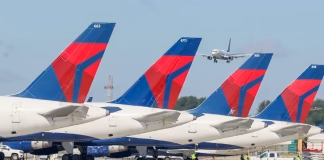
    Passengers scheduled to travel aboard Delta Airlines flight DL055 from Lagos to Atlanta were left stranded at the Murtala Muhammed International Airport, Lagos, after the American carrier abruptly cancelled the flight scheduled to depart at 11:45 a.m.

    According to information gathered from some of the affected passengers, the airline attributed the cancellation to a technical issue involving the operating aircraft in Atlanta, United States. In aviation, such situations are not unusual. Airlines across the world routinely delay or cancel flights whenever there are concerns about the airworthiness or safety of an aircraft. Safety, after all, remains the cornerstone of global aviation practice. No responsible airline is expected to operate equipment considered unsafe for passengers, crew, or cargo.

    However, beyond safety, there is another critical obligation airlines owe passengers – communication, transparency, and care during disruptions.

    What appeared striking in the Delta situation was not merely the cancellation itself, but the seeming absence of proper communication and passenger management. Some affected passengers alleged that they received little or no direct explanation from the airline and were simply advised to contact their booking agents. At the airport, the only visible personnel attending to passengers appeared to be staff of the Nigerian Aviation Handling Company (NAHCO), while Delta representatives remained largely invisible.

    Premium passengers, according to one of them whom I was seeing off, were only contacted at the airport upon arrival for check-in. They were informed that they would be accommodated on subsequent flights, subject to seat availability, or be downgraded to Economy Class. Economy passengers, however, were reportedly left to fend for themselves, struggling in queues in search of information about what to do next.

    Yet, despite the frustration, the atmosphere at the airport remained unusually calm.

    There were no angry social media livestreams. No celebrities recording emotional videos. No trending hashtags calling for a boycott of Delta Airlines. No loud accusations that the airline was “wicked,” “insensitive,” or “incompetent.” The passengers simply endured the inconvenience quietly. If it were a Nigerian carrier, many passengers would have been demanding to be flown first in subsequent flights and holding the airline staff “hostage.” But now they are silent.

    That silence raises uncomfortable but important questions about public attitudes toward airlines in Nigeria.

    If the same incident had involved a Nigerian carrier, particularly a major indigenous airline, social media would almost certainly have erupted in outrage. Videos would flood TikTok, Instagram, Facebook, and X within minutes. Influencers and celebrities would issue emotional condemnations. Commentators would portray the airline as evidence of everything allegedly wrong with Nigeria.

    Why then do many Nigerian passengers react differently when foreign airlines are involved?

    This is not an attempt to excuse delays or cancellations by local airlines. Passengers have every right to express dissatisfaction whenever airlines fail to meet their obligations. Flight disruptions can be stressful, expensive, and emotionally draining. Airlines – whether Nigerian or foreign – must be held accountable for how they treat passengers during such situations.

    But fairness demands consistency.

    Delays and cancellations are not uniquely Nigerian problems. They are part of global aviation realities. Weather conditions, technical faults, operational limitations, air traffic congestion, crew issues, and safety concerns disrupt flights daily across Europe, America, Asia, and Africa. What matters is how airlines manage the disruptions and how regulators enforce passenger rights.

    Only recently, an Air Peace flight from London Gatwick to Lagos suffered a bird strike, forcing the airline to ground the aircraft for mandatory safety inspections and maintenance. The airline communicated with passengers, provided hotel accommodation, and rebooked affected travellers on subsequent flights. Yet the incident generated massive social media outrage, amplified by celebrities and influencers, including Nollywood actress, Funke Akindele and an earlier video by reality TV personality, Tacha.

    The same level of public outrage is rarely directed at foreign carriers operating in Nigeria, even when passengers experience similar or worse treatment.

    This double standard deserves serious reflection.

    Why are Nigerian airlines subjected to intense public hostility while foreign operators often receive patience, understanding, or even silence? Is it an inferiority complex rooted in colonial mentality? Is it fear of visa implications or perceived repercussions from foreign countries? Or is it simply a deeply ingrained belief that foreign brands are automatically superior, regardless of how they behave?

    These are uncomfortable questions, but they must be asked honestly.

    The Nigerian Civil Aviation Authority (NCAA) also has a responsibility to ensure fairness and accountability across the board. Regulatory oversight should not appear selective. Foreign airlines operating in Nigeria must be subject to the same scrutiny and consumer protection standards as indigenous carriers. Passenger rights are universal and should not depend on the nationality of the airline involved.

    At the same time, Nigerians must resist the growing culture of indiscriminate social media demarketing targeted almost exclusively at local operators. Constructive criticism is legitimate. Deliberate campaigns designed to damage indigenous airlines while excusing foreign carriers are not.

    Nigeria cannot aspire to build globally competitive aviation brands if its own citizens consistently undermine them at every opportunity while romanticising foreign competitors that often operate under the same industry realities.

    Aviation is a difficult business worldwide. Delays happen. Technical faults happen. Cancellations happen. What should matter is professionalism, transparency, passenger care, and regulatory accountability — not the nationality of the airline involved.

    (c) Fred Chukwuelobe, fnipr

  • Feature: FG needs to back up Air Peace with a robust Aviation Policy

    Feature: FG needs to back up Air Peace with a robust Aviation Policy

    by Ayo Akinfe

    To turn Air Peace’s recent success into a long term sustainable cash cow, Nigeria’s government needs to back it up with a robust aviation policy

    [1] When you have a population of 200m, are located in the middle of your continent and your populace loves travelling, you should have one of the most lucrative aviation industries in the world. Indeed, Nigeria should be an African aviation hub

    [2] Nigeria is a currently a mono-economy. When 95% of government revenue comes from crude oil sales, we have no choice other then to look for alternative sources of income if we do not want to perish as a people

    [3] By my calculations, Nigeria needs to find an additional $30bn annually from alternative sources and for me, aviation has got to be one of the cash cows at the top of the list. Why? Because it is a readily available resource, there is a ready-made market available and we actually have the expertise to deliver on it

    [4] In 2019, just before Covid, Ethiopian Airlines generated revenue of about $4bn. A well-run Nigerian national carrier with several different facets targeted at the diverse sectors of the market could easily double that. It simply has to be a goal we set ourselves

    [5] Air Peace has stepped into the void created by the lack of a Nigerian national carrier. The Lagos to London flights have created panic among exploitative operators like BA and Virgin, forcing them to slash their fares in response

    [6] To make sure things stay this way, we need laws pegging the cost of the London-Lagos route to that of the London-New York route. Both are the same distance, take the same amount of time and possess the same large volume of passengers

    [7] One area where we can develop a unique niche in which we are the global market leader is the private jet sector. There are about 12 jets in the presidential fleet and most of our general overseers own at least one Gulfstream or Bombardier private jet. If we start off with a fleet of say 20 donated private jets and buy an existing couple of airlines with a combined capacity of say 100 planes, we are good to go

    [8] Nigeria is Africa’s most populous nation, in the centre of the continent and the seventh most populated country on earth. We simply have to turn the nation into an aviation hub where everybody flies through when they want to travel to the African continent

    [9] Over the long term, if Air Peace wants to compete with the likes of KLM, Lufthansa, Emirates, BA, Virgin, Air France, etc globally, it needs to become acquisitive. Ethiopian Airlines, Kenya Airways, Egypt Air, Ghanaian Airways, etc, all need to be in its sights

    [10] A well-run Nigerian airline could easily replace oil as our national cash cow. Figures do not lie so if you look at the revenue generated by major airlines prior to Covid-19, you will realise that our obsession with oil is nothing but a mental illness of sorts. See – Delta Airlines ($44.9bn), American Airlines ($44.5bn), Lufthansa ($42.3bn), Air France ($31.3bn). Our fixation with crude is just psychological

  • Exclusive Chat with Chef Millie Peartree at the GTCO Food and Drink Festival

    Exclusive Chat with Chef Millie Peartree at the GTCO Food and Drink Festival

    Chef Millie Peartree, known as the “Queen of Repurpose”, is a Bronx-based, world-renowned chef, taste-maker, and restaurateur who has spent the last decade perfecting her craft. It wasn’t until she entered her first baking contest that she realized her baking (and now culinary) talent would evolve into a successful and innovative culinary enterprise. Millie has a knack for creating unconventional tasting menus and experiential activations using well-known products not often considered cooking ingredients. With the ability to cook for many consumers, her talents lend themselves well to on-site activation demos, tastings, sampling, and branding opportunities. She has worked with some of the nation and world’s most widely recognized brands and celebrities, including MLB, Rolex, PepsiCo, Jay-Z & Beyonce, MTV, Delta Airlines, NY Mets, Alicia Keys, Dole, Band-aid and many more.

    She was one of the facilitators of the Masterclass at the 2023 GTCO Food and Drink Fair in Lagos, Nigeria. Our team had a chat with her, please find below excerpt-

    NW: How did you start this business?

    CMP: I started my culinary career. It was shortly after my mom passed away. And it was more transitional to continue to create memories that my mom made with me and that I did with my little brothers and sisters. So from there, it just skyrocketed. And I feel like it’s a blessing to be able to do what you love. So I’m really excited that I can continue my journey through cooking.

    NW: What made you actually choose soul food as your area of expertise and not any other type of cuisine?

    CMP: Well, I chose the area of soul food because- number one, it is part of my culture, my heritage, and what I grew up eating. But most importantly, I wanted to continue to create those happy memories through food and pretty much in remembrance of my mom. So it just only felt natural. So I cook and serve the food that I know. And with that, I bring her in spirit every time I make one of her dishes.

    NW: What was your most Creative challenge thus far?

    CMP: The creative towels are one of my most creative challenges, or one of my hardest obstacles, per se, or I created an event for a rapper named Young Jeezy. And we were at the venue, and the stove didn’t work. So instantly, I had to use someone’s stove in an apartment. Luckily, it was in a building where people live. And you know, you have to work on instinct sometimes, when you’re hired to do a service, you know, you have to show up and get the job done. Like nobody really cares what doesn’t go on. They just know that they want their job done. That was one of those situations where I had to be the most instinctive and it worked out for the best.

    Listening to the audience with rapt attention

    NW: As a first-time visitor to Nigeria, what inspired you to try Nigerian okra in your recipe, as you showed us during the Masterclass?

    CMP: Well, I grew up eating okra. So the first time I actually had fried okra was at a gas station in Beaufort, South Carolina, I was going to visit my aunt. And in the States, we have gas station favourites and street food. And in New York, our gas station favourites, I like hot dogs. And that was the first time I actually had it. But my mom made it all the time, she made a southern version of okra and tomatoes, which is more sautéed with just peppers and onions, and we ate it over rice. So it was only natural for me to take another recipe and recreate it into something that I wanted to again and remember it’s of the recipe so my mom made in my household growing up. I have not had the Nigerian okra Soup. However, I’m going to try it before I leave.

    NW: What Nigerian delicacy have you tasted since you arrived that you have never tasted before?

    CMP: Well, one of the things I had here so far that I’ve never had before I’ve had the snails, which was a delicacy like we call it and it was very good. And it had a good ocean taste to it. So you knew it was fresh like wherever the purveyor wasn’t they got these snails from it tastes like the seas I knew it was fresh. It was absolutely delicious. This is my first time in Nigeria on the continent is Africa as a whole my first time here.

  • Feature: Proposed Aviation Masterplan for Nigeria

    Feature: Proposed Aviation Masterplan for Nigeria

    By Ayo Akinfe

    Has any of the presidential candidates come up with an aviation masterplan as part of their manifesto?

    [1] When you have a population of 200m, are located bang in the middle of your continent and your populace love travelling, you should have a one of the most lucrative aviation industries in the world. Indeed, Nigeria should be an African aviation hub

    [2] Nigeria is a currently a mono-economy. When 95% of government revenue comes from crude oil sales, we have no choice other then to look for alternative sources of income if we do not want to perish as a people

    [3] By my calculations, Nigeria needs to find something like $30bn from alternative sources during the course of 2023 and for me, aviation has got to be one of the cashcows at the top of the list. Why? Because it is a readily available resource, there is a ready-made market available and we actually have the expertise to deliver on it

    [4] In 2019, Ethiopian Airlines generated revenue of about $4bn. A well-run Nigerian national carrier with several different facets targeted at the diverse sectors of the market could easily double that. It simply has to be a goal we set ourselves

    [5] For starters, analysts believe something like 60% of the world’s airlines will go bust as a result of the coronavirus pandemic. This means a lot of them are available on the cheap, so Nigeria should be looking to purchase at least two going concerns and merge them into one aviation giant with a global reach

    [6] One area where we can develop a unique niche in which we are the global market leader is the private jet sector. There are about 12 jets in the presidential fleet and most of our general overseers own at least one Gulfstream or Bombardier private jet. I think the presidency should donate its planes to this new carrier and the pastorprueners should be patriotic and do likewise. The donating of their aircrafts to the venture should purchase them a stake in the airline. For instance, if David Oyedepo hands over his five private jets, that should grant him a 10% stake in this new company

    [7] If we start off with a fleet of say 20 donated private jets and buy an existing couple of airlines with a combined capacity of say 100 planes, we are good to go. That recent $3.4bn loan we got from the IMF should be enough to fund this project and get the venture going. With the dire straits these airlines are in, they will happily hand over their assets for anything they can get

    [8] Nigeria is Africa’s most populous nation, in the centre of the continent and the seventh most populated country on earth. We simply have to turn the nation into an aviation hub where everybody flies through when they want to travel to the African continent. We have the potential to generate the passenger volume to make this a gold mine

    [9] We are all aware of how our people ruined Nigeria Airways, so as a safeguard, we should insist that any deal involves the professional managers of any purchased airline running the operation for the next 10 years at least, that the Nigerian government has no more than a 25% stake in the venture and that private sector operators like Allen Onyeama are Nigeria’s representatives on the board of directors

    [10] A well run Nigerian airline could easily replace oil as our national cashcow. Figures do not lie so if you look at the revenue generated by major airlines prior to this pandemic, you will realise that our obsession with oil is nothing but a mental illness of sorts. See – Delta Airlines ($44.9bn), American Airlines ($44.5bn), Lufthansa ($42.3bn), Air France ($31.3bn). Our fixation with crude is just psychological, kind of like the fear of the unknown.

  • Delta to block middle seats, limit onboard capacity through March 30, 2021

    Delta to block middle seats, limit onboard capacity through March 30, 2021

    …blocking seats into spring 2021 provides added confidence and reassurance for customers booking future travel plans.

    Delta will continue delivering on its industry-leading commitment to provide more space for customers as the only U.S. airline blocking middle seats for flights departing now through March 30, 2021.

    As more medical experts agree on the safety of air travel thanks to the multiple layers of protection provided under the Delta CareStandard, blocking seats into spring 2021 provides added confidence and reassurance for customers booking future travel plans.

    “Several independent studies have validated the effectiveness of the Delta CareStandard’s multi-layered protection, like advanced ventilation and an extensive cleaning regimen, which together significantly reduce the risk of flight-related transmission,” said Bill Lentsch, Chief Customer Experience Officer.

    “However, we recognize some customers are still learning to live with this virus and desire extra space for their peace of mind. We are listening and will always take the appropriate steps to ensure our customers have complete confidence in their travel with us.”

    The health and safety of our customers and employees remains our top priority. The Delta CareStandard encompasses more than 100 protective measures, such as sanitizing every flight, a comprehensive employee COVID testing program, and the use of industrial-grade HEPA filters that extract more than 99.99% of particles, including viruses.

    Taking the Stress Out of Flying

    Delta launched a new interactive map on delta.com that gives customers the power to search, view and click-to-book their desired destination all in one place, giving full control and a better understanding of current travel restrictions and what to expect upon arrival.

    The data is curated from government agencies and the International Air Transport Association to provide detailed insight into quarantine and testing requirements, travel forms and paperwork, local health information, local COVID-19 guidelines, and links to necessary forms and applications needed prior to travel.

    In addition to a new trip planning tool, we’re offering greater flexibility if you ever need to change your plans, including, No change fees for a U.S. domestic ticket or domestic award ticket, excluding Basic Economy fares. No change fees for all domestic and international tickets purchased through Dec. 31, 2020, even if scheduled to travel next year.

    Extending the use of travel credits through December 2022 for travel originally scheduled to depart before March 31, 2021 (if the ticket was purchased before April 17, 2020).

  • More flights, service return in July as Delta leads safety measures

    More flights, service return in July as Delta leads safety measures

    As economies reopen and border restrictions lift, Delta will add almost 1,000 flights system-wide in July, boosting service and nonstop connectivity to popular summer destinations and major business markets.

    Customers traveling or considering travel this summer can feel confident in a safe experience throughout the journey, from check-in to baggage claim. Delta has implemented several measures to encourage extra space and provide peace of mind at the airport, as well as committed to capping cabin seating at 60 percent in Main Cabin and 50 percent in First Class and blocking middle seats through Sept. 30, 2020.

    Pending a lift on border restrictions, Delta will resume service to customer favorite summer destinations – four-times weekly service from New York-JFK to Lisbon and daily service from JFK to Athens. Delta is also expanding its focus on hub-to-hub flying to coastal markets by adding four-times weekly service from Boston to Amsterdam and daily service from Seattle to Amsterdam. We will also restart Detroit to Paris-Charles De Gaulle service.

    Connectivity within Africa will also expand, pending government approval, with the resumption of service from New York-JFK to Accra, as well as service from Atlanta to Lagos.

    “Confidence in a safe travel experience is key to a successful recovery,” Joe Esposito, Senior Vice President – Network Planning said. “While we’re rebuilding our network at home and abroad, it’s even more critical that we provide the highest industry standard of safety, space and clean so when our customers are ready to travel, we’re ready for them”, he added.

    Customers also have the flexibility to change their plans without a fee for a year, for new flights purchased through June 30.

    Even with the modest growth in demand, Delta’s July schedule will be approximately 70 percent smaller than the same time last year, including reductions of about 65 percent for U.S. domestic travel and nearly 75 percent for international.

    As Delta looks ahead to the remainder of the summer travel season, the airline will stay focused on adding seat capacity, gradually rebuilding its footprint in local markets, and resuming high-demand service suspended due to travel restrictions.

    Delta will continue to add more nonstop connectivity between top markets, with a focus on major hubs like Atlanta, Detroit, Minneapolis, and Salt Lake City. For customers looking to vacation closer to home this summer, Delta is adding capacity to popular leisure markets like Florida and throughout the West Coast, as well as more transcontinental flying for business travelers.

    While seating is capped to ensure more space between customers this summer, we will look for opportunities to up-size to a larger aircraft type or add more flying on routes with increasing customer demand.

    With non-essential travel guidelines between the U.S. and Canada extended into July, Delta will continue to operate a limited schedule for those with critical travel needs. Minneapolis, Detroit and New York-JFK serve as Delta’s main gateways to destinations like Montreal, Toronto, Calgary and Winnipeg. Delta will also continue service to Vancouver from Seattle.

    Delta has also temporarily consolidated operations in some markets served by multiple airports, as well as suspended flying to select U.S. cities while customer traffic is significantly reduced.

  • Delta commits $1 billion to become first carbon neutral airline globally

    Delta commits $1 billion to become first carbon neutral airline globally

    Airline sets vision for meaningfully reducing emissions and advancing sustainability

    Starting March 1, 2020, Delta Air Lines is committing $1 billion over the next 10 years on its journey to mitigate all emissions from its global business, going forward.

    The airline will invest in driving innovation, advancing clean air travel technologies, accelerating the reduction of carbon emissions and waste, and establishing new projects to mitigate the balance of emissions.

    “There is no substitute for the power that travel has to connect people, which our world needs today more than ever before. As we connect customers around the globe, it is our responsibility to deliver on our promise to bring people together and ensure the utmost care for our environment,” said Ed Bastian, Delta’s CEO.

    “The time is now to accelerate our investments and establish an ambitious commitment that the entire Delta team will deliver.”

    Delta’s approach to tackling carbon reduction and sustainability reflects the focus and rigor it has become known for, and that it used to build a financially secure airline.

    This announcement comes as Delta pays $1.6 billion in profit sharing to employees this Valentine’s Day, and reflects its long-standing approach to placing a high value on supporting all stakeholders and communities worldwide.

    “There’s no challenge we face that is in greater need of innovation than environmental sustainability, and we know there is no single solution. We are digging deep into the issues, examining every corner of our business, engaging experts, building coalitions, fostering partnerships and driving innovation,” Bastian said.

    “We are on a journey, and though we don’t have all the answers today, we know that our scale, along with investments of time, talent and resources will bring meaningful impact to the planet and ensure the sustainability of our business for decades to come.”

    The aviation industry accounts for roughly 2 percent of global carbon dioxide emissions. Delta’s carbon footprint is its largest environmental impact, with 98 percent of emissions coming from its aircraft. Here is how the company is focusing its efforts to become carbon neutral:

    ·Carbon reduction: Reducing Delta’s carbon footprint through enterprise-wide efforts to decrease the use of jet fuel and increase efficiency. Areas of focus include an ambitious fleet renewal program, improved flight operations, weight reduction, and increased development and use of sustainable aviation fuels.

    ·Carbon removal: Investing in innovative projects and technology to remove carbon emissions from the atmosphere that go beyond the airline’s current commitments, and investigating carbon removal opportunities through forestry, wetland restoration, grassland conservation, marine and soil capture, and other negative emissions technologies.

    ·Stakeholder engagement: Building coalitions with our employees, suppliers, global partners, customers, industry colleagues, investors and other stakeholders to advance carbon reduction and removal goals and maximize our global impact.

    “When customers choose to fly Delta, they should feel they’re making a statement about taking care of our planet. Our commitment to carbon neutrality means flying with Delta represents far more than a great travel experience – it’s about joining arms to create a better world.”

    Delta’s carbon strategy will account for emissions across its business – both in the air and on the ground. Delta’s investment will create new projects and methods to reduce its carbon footprint, benefit global communities and make it easier for other organizations to explore similar options to address their own carbon footprints – all while minimizing reliance on today’s limited carbon offset markets. To support this strategy, Delta will allocate some of its financial commitment into investment vehicles, including a dedicated fund focused on achieving its carbon neutral ambition.

    Delta’s journey to carbon neutrality and its $1 billion investment build on its industry-leading voluntary sustainability efforts.

    The Delta Environmental Sustainability Principles will guide the airline’s efforts to advance its path to carbon neutrality and its overall sustainability. They are:

    • Action – Makeprogress continually by leveraging the tools of today even as we work to drive progress on a global scale. Embed environmental impact as a consideration in every business decision.
    • Innovation – Investigate, enable and advance new projects, innovative technologies, and operational efficiencies to substantially reduce and mitigate emissions and our overall environmental footprint.
    • Collaboration – Engage with employees, suppliers, global partners, customers, investors and other stakeholders with the understanding that environmental protection must be a shared goal.
    • Evolution – Be nimble in evolving and adjusting in response to the latest scientific findings and technological developments.
    • Transparency – Continue to publicly report on our goals and progress, aligned with leading disclosure frameworks and standards, and track efforts and achievements through our robust governance structure.

    2020 will see a number of milestones that demonstrate Delta’s progress and commitment, and that Delta will share broadly as each of them launch. Powered by its 90,000 people around the world, Delta is the U.S. global airline leader in products, services, innovation, reliability and customer experience.

    From being the first and only U.S. airline to voluntarily cap greenhouse gas emissions at 2012 levels, to adding more than 80 new aircraft in 2019 in an effort to renew its fleet with aircraft that are 25 percent more fuel efficient than the aircraft they are replacing, Delta has been undertaking a multi-year effort to achieve more sustainable air travel. As part of its commitment, Delta has partnered with industry innovators to advance the development and production of sustainable aviation fuels, including its recent partnership and offtake agreements with Northwest Advanced Bio-Fuels and Gevo. The airline also has partnered with the international advocacy organization Global Citizen on Global Goal Live: The Possible Dream event, to help reach United Nations Sustainable Development Goals, focusing on sustainability, gender equality and human capital.

    Delta was the No. 1 airline named among America’s Most Sustainable Companies by Barron’s in 2020, and has been awarded the Vision for America Award by Keep America Beautiful and the Captain Planet Foundation’s Superhero Corporate Award. Delta has also earned a spot on the FTSE4Good Index for five consecutive years and the Dow Jones Sustainability North America Index for nine consecutive years.