Tag: Nnewi

  • NNPC Strengthens National Healthcare with MRI Machine Handover to Nnewiย Hospital

    NNPC Strengthens National Healthcare with MRI Machine Handover to Nnewiย Hospital

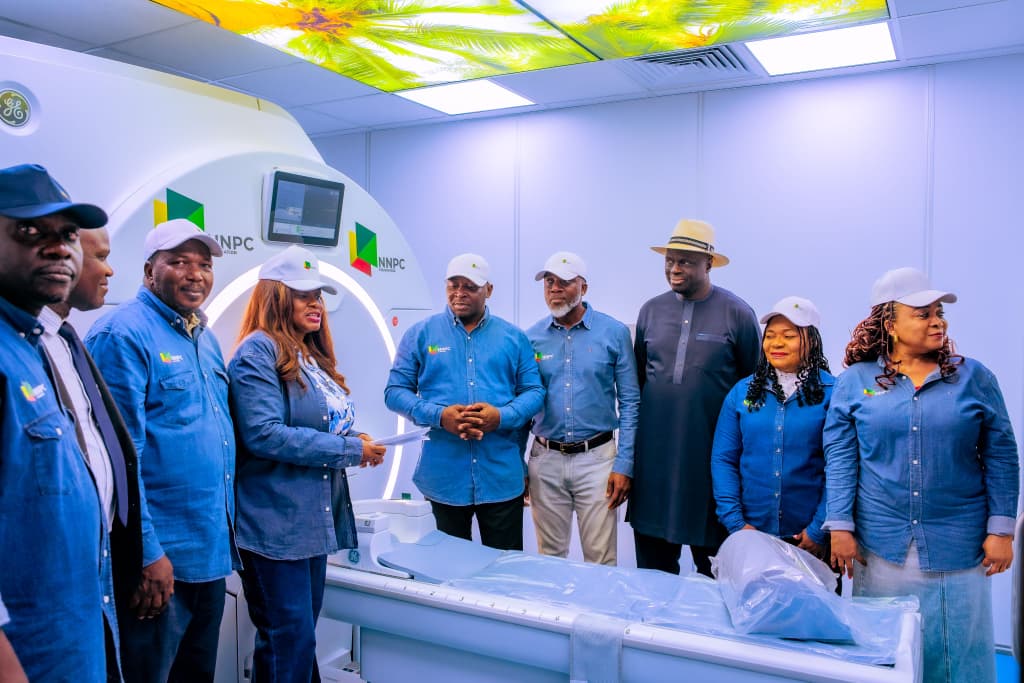
    NNPC Foundation, the Corporate Social Responsibility (CSR) arm of NNPC Ltd., has commissioned and handed over a fully installed 1.5 Tesla Magnetic Resonance Imaging (MRI) System to the Nnamdi Azikiwe University Teaching Hospital (NAUTH), Nnewi, Anambra State. 

    The intervention, which is in furtherance of NNPC Ltdโ€™s commitment to improving healthcare access and strengthening medical infrastructure across Nigeria, is expected to significantly improve access to advanced diagnostic imaging services for millions of Nigerians across the South-East (Anambra, Enugu, Imo, Abia and Ebonyi States) as well as neighbouring Delta State. 

    The intervention involved the delivery, installation, calibration, testing, and commissioning of the state-of-the-art 1.5 Tesla MRI Machine alongside critical supporting infrastructure, including RF shielding systems, chillers, backup UPS systems, electrical installations, specialized imaging accessories, ventilation systems, CCTV and oxygen monitoring systems, intercom communication facilities, and other patient comfort technologies designed to ensure optimal operation of the facility. 

    Prior to the intervention, patients requiring advanced MRI diagnostic services often faced prolonged waiting periods, exorbitant costs, and the burden of travelling long distances in search of functional imaging centres. 

    Speaking during the commissioning ceremony held at the Igwe Orizu ICT Centre, NAUTH Permanent Site, Anambra State, on Friday, the Group Chief Executive Officer of NNPC Ltd., Engr. Bashir Bayo Ojulari, represented by the Managing Director of NNPC Foundation Ltd./Gte, Mrs. Emmanuella Arukwe, described the intervention as a strategic investment in healthcare access, diagnostic precision, and improved patient outcomes, noting that the facility aligns with the Companyโ€™s commitment to building sustainable systems and impactful national institutions. 

    โ€œThe installation of the MRI in NAUTH exemplifies our commitment as our intent is to build enduring institutions, sustainable systems and legacies. This intervention aligns with our conviction that access to quality healthcare underpins human dignity, longevity and economic productivity,” the GCEO stated. 

    โ€ŽHe described the Companyโ€™s social investments as viable currencies that strengthen the relationship between the Companyโ€™s core mandate of providing and managing energy for Nigerians and meeting stakeholdersโ€™ expectations. 

    โ€ŽIn his remarks, Anambra State Governor, Prof. Charles Soludo, who was represented by the Commissioner for Health, Dr. Afam Obidike said the intervention would enhance safe and precise diagnosis and treatment for patients across the South-East region. 

    โ€ŽHe also commended NNPC Foundation for donating the MRI facility to the state, noting that the intervention would significantly improve access to quality healthcare services for the people. 

    โ€ŽAlso speaking was the Executive Vice President, Business Services, NNPC Ltd., Mrs Sophia Mbakwe, who was represented by the Chief Supply Chain Officer, NNPC Ltd., Engr. Isokariari Telema reiterated the Companyโ€™s commitment to responsive and equitable social investments aimed at positively impacting the lives of Nigerians.ย 

    โ€Žโ€œIn over forty years of its existence, NNPC has stayed the course in impacting lives positively across Nigeria โ€“ supporting with infrastructural development, social amenities, educational sponsorships, and a host of other projects and initiatives that have underscored our values of Integrity, Excellence and Sustainability.โ€ 

    โ€ŽOn his part, the Chief Medical Director, NAUTH, Prof. Joseph Ugboaja, lauded the leadership of NNPC Ltd. for recognising the strategic importance of healthcare to national prosperity and well-being, while assuring the Foundation of the hospitalโ€™s commitment to maximising the MRI facility for public benefit.ย 

    โ€Ž”For too long, patients in our catchment area have had to travel long distance to access this level of diagnostic precision, often at prohibitive costs. With this installation, we will eliminate that burden. NNPC Foundation has demonstrated that corporate social responsibility is not just a policy statement but a lifeline for the institutions like ours.” he concluded. 

  • Soludo condoles Victims of Nnewi Spare Parts Market Fire

    Soludo condoles Victims of Nnewi Spare Parts Market Fire

    In a sympathetic mood, Governor Charles Chukwuma Soludo of Anambra State consoled victims of the midnight fire that occurred at Ahแป‹a Mgbede, opposite the New Motor Spare Parts Market in Nnewi, on Tuesday.

    The Governor was saddened about the tragic occurrence that resulted in substantial loss of property and source of income for the entrepreneurs in the market, a terrible situation in the country’s present economic climate.

    According to the Governor’s Chief Press Secretary, Christian Aburime, Soludo applauded the efforts of Anambra State Fire Service and other emergency responders who worked tirelessly to put out the fire to minimize further damage.

    The governor further urged market leaders and business owners across the state to always adhere to fire safety regulations and have firefighting equipment in their possession to avert disastrous circumstances in case of fire outbreaks.

  • Feature- #MakeNigeriaBetter: Ondo State

    Feature- #MakeNigeriaBetter: Ondo State

    As we step up our review of what each of Nigeriaโ€™s 36 states can bring to the table, today we examine Ondo State, the territory with the largest tropical rainforest area in the country

    Ayo Akinfe

    [1] Ondo State has the largest tropical rainforest area in Nigeria, so it is no surprise that it is the countryโ€™s largest cocoa producer. Known as โ€œthe food of the gods, cocoa needs the canopy of the tropical rainforest to grow. Ondo State should thus have an economy centred around cocoa growing, processing and chocolate production. I am sure most Nigerians do not know that Ondo is also Nigeriaโ€™s fifth largest crude oil producer after Akwa Ibom, Rivers, Bayelsa and Delta states

    [2] Can someone please explain why the Ondo State government has not built the world’s largest cocoa plantation in Owena. Nigeria is currently the world’s sixth largest cocoa producer with an output of about 245,000 tonnes and Ondo State is the largest producer in Nigeria. This Owena plantation should have an output of about 10,000 tonnes with the potential to rise to 50,000 tonnes

    [3] Then, the state government should build Africa’s largest cocoa-grinding plant in Ondo City. Emulating the vision of Alhassan Dantata, they should gather cocos beans from farmers over a 200-mile radius stretching to Ado Ekiti, Akure, Owo, Idanre, Ilesha and as far south as Ilaro. Beans will be ground into cocoa butter and powder at this plant employing as many as 1,000 staff

    [4] Our Ondo State governor should then approach chocolate companies like Nestle, Mars, Cadburys, Barry Callebaut and Lindt & Sprรผngli, asking them to build a chocolate processing plant at Ore, the gateway between eastern and western Nigeria. This will make Ondo State the agro-processing capital of Nigeria. It will be a game changer that alters the state of the Nigerian economy forever

    [5] To process chocolate, you need other things like sugar, milk, peanuts, cashews, coconuts, shea nuts etc. Ondo State government should thus initiate plans to grow coconuts in its coastal areas in places like Aiyetoro, Mahin, Igbotu and Igbobini in Ilaje Local Government Area. Joint ventures should then be entered into with other states to produce other ingredients. For instance – Kwara (Sugarcane), Kano (groundnuts), Ogun (Cashews), Benue (Shea nuts). These states should then all be linked with a railway cargo network so goods can be transferred from one point to another with ease

    [6] Ondo State then needs to construct a cargo export terminal along the coast at Aiyetoro to export finished products. What I have in mind is the building of a packaging plant there so that Ondo State can actually export retail-ready finished products to anywhere in the world. To augment this, the Ondo State government should then ask investors if they are interested in building a cargo terminal at Akure Airport so their goods can be flown out if need be. Companies like Nestle, Mars, Cadburys, Barry Callebaut and Lindt & Sprรผngli build such terminals all over the world to ship their products

    [7] For me, however, Ore remains the joker in the pack. It is the gateway between eastern and western Nigerian and simply has to become one of the most industrialised cities in Nigeria. Ore must become an industrial hub similar to Nnewi and Aba. It should be developed into a major travel stopover joint, too with hotels, fairground rides, restaurants, etc

    [8] More importantly, Ore should have a battery warehouse built to halve the trip between Lagos and the southeast geo-political zone. That was how Cape Town in South Africa was built. It served as a halfway stop over point between Europe and Asia, halving the trips merchants needed to make

    [9] Our Ondo State government should then expand the production of cash crops like palm oil, kolanuts, rubber, timber, cassava and maize. Other parts of the world like Bahia in Brazil, Sumatra in Indonesia, Borneo in Malaysia, Entre Rios in Argentina, India’s Uttar Pradesh or Punjab in Pakistan generate as much as $50bn in some instances in foreign exchange earnings and that must be our goal in Ondo State. Malaysia for instance makes $10bn from palm oil exports alone

    [10] How many Nigerians know that Ondo State is sitting on $10bn worth of annual bitumen exports. Other juicy assets it has include the tourist attraction Idanre Hills and the Oluwa Glass Company. Ondo State could easily be self-sufficient without any federal allocation. Over the next five years, it should have export revenue projections that look like this: cocoa – $10bn; bitumen – $10bn; tourism – $10bn, palm oil – $5bn, timber – $5bn; transport – $5bn; kolanuts – $5bn; cassava – $5bn, glass – $5bn

  • NLNG Partners New Set of Health Institutions as Part of Hospital Support Programme

    NLNG Partners New Set of Health Institutions as Part of Hospital Support Programme

    Nigeria LNG (NLNG) today signed Memoranda of Understanding (MOU) with three hospitals to complete the second phase of its multi-billion-naira Hospital Support Programme (NLNG HSP).

    The NLNG Hospital Support Programme (HSP) is NLNG’s national Corporate Social Responsibility (CSR) initiative aimed at boosting the healthcare delivery system in 12 federal university teaching hospitals and health institutions across the six geopolitical zones in the country. The programme started in 2022 with the signing and implementation of MoUs with six hospitals in the first phase.

    For the second phase, NLNG’s Managing Director, Dr. Philip Mshelbila, signed MoUs with the respective medical directors of the Federal Medical Centre Asaba for the renovation and equipping of Neonatal Wards and Intensive Care Unit; Abubakar Tafawa Balewa University Teaching Hospital Bauchi, for the construction and equipping of laboratory complex; and Nnamdi Azikiwe University Teaching Hospital, Nnewi, for the renovation and construction of an oxygen plant.

    In a welcome address at the ceremony, Dr. Mshelbila recalled that the HSP initiative was conceived on the back of the COVID-19 pandemic when NLNG donated numerous intensive care medical equipment to medical institutions across Nigeria. According to the NLNG boss, one of the fundamentals of the HSP programme is to foster partnerships that support infrastructural development and encourage immediate utilisation of the facilities to deliver quality healthcare services to Nigerians.

    The NLNG boss said, โ€œThrough this MoU, we will be able to channel our collective efforts towards addressing the healthcare needs of our people, promoting healthcare delivery, and driving positive change in the lives of vulnerable individualsโ€.

    โ€œThe hospitals involved in todayโ€™s MoU have a proven and long-standing tradition of providing quality healthcare services to all sections of society. This MoU will amplify our collective impact, leveraging our resources, expertise, and locations to the outcomes of the Hospital Support Programme,โ€ he added.

    Digitaries at the event include NLNGโ€™s Deputy Managing Director, Mr Olakunle Osobu; NLNGโ€™s General Manager, Finance, Mrs Fatima Adanan; Chief Medical Director (CMD), Federal Medical Centre, Asaba, Dr. Osiatuma Azubuike; CMD, Nnamdi Azikwe University Teaching Hospital (NAUTH), Nnewi, Prof. Joseph Ugboaja; and CMD, Abubakar Tafawa Belewa University Teaching Hospital (ATBUTH), Prof. Yusuf Jibrin.

    Beneficiaries of Phase 1 of the Hospital Support Programme include Lagos University Teaching Hospital (LUTH), Lagos; University of Abuja Teaching Hospital (UATH), Gwagwalada; Aminu Kano Teaching Hospital (AKTH) Kano; University of Benin Teaching Hospital (UBTH), Benin; University of Calabar Teaching Hospital (UCTH), Calabar; and Niger Delta University Teaching Hospital (NDUTH), Yenagoa.

    Projects already delivered in Phase 2 include the equipping of the renal centre at the University of Port Harcourt Teaching Hospital (UPTH), Port Harcourt; the renovation and equipping of an accident and emergency unit and theatre at University of Uyo Teaching Hospital (UUTH), Uyo; and the construction and equipping of a twin theatre suite at Jos University Teaching Hospital (JUTH), Jos.

    NLNG has commissioned eight of the projects so far.

    The Hospital Support Programme is a multi-billion-naira scheme by NLNG to reshape the healthcare landscape and enhance medical training within teaching hospitals nationwide. All the completed projects are already in active use. 

    Nigeria LNG Limited (NLNG) is a significant player in the energy industry globally and in Nigeria and is one of the single-largest contributors to sustainable development in the country.

  • NASENI EVC Reiterates Commitment To Delivering On Presidential Priorities, Inaugurates Staff Welfare Committee

    NASENI EVC Reiterates Commitment To Delivering On Presidential Priorities, Inaugurates Staff Welfare Committee

    The Executive Vice Chairman and Chief Executive Officer of the National Agency for Science and Engineering Infrastructure (NASENI), Mr. Khalil Halilu, has charged the management staff of the Agency to put forward ideas on how NASENI can effectively support the priorities of President Bola Ahmed Tinubu such as large-scale switching of petrol and diesel-powered vehicles to alternative fuels to reduce the cost of living for Nigerians.


    He stated this as he began receiving briefings from the Managing Directors of the Agencyโ€™s ten (10) Development Institutes, situated in Enugu, Minna, Awka, Okene, Nnewi, Kano, Jalingo, Akure, Ilesha and Nasarawa.

    According to Halilu, โ€œOur Institutes are the engines of NASENIโ€™s innovation and these briefings by each Institute are critical as we work together to craft the future of NASENI, as it relates to delivering on the Presidentโ€™s socio-economic agenda.โ€

    In addition to the Managing Directors, Team Leads of various NASENI projects, as well as the Agencyโ€™s Research Directors, also made presentations to the EVC on their various projects and efforts.

    The briefings, which commenced on Monday September 18, 2023, are taking place ahead of the EVCโ€™s planned tour of NASENI facilities across the institutes scheduled to commence in October.

    Also on Tuesday, September 19, the EVC/CEO inaugurated a Committee to look into staff welfare, as part of steps to fulfil his pledge, upon assuming office, to ensure that NASENI becomes โ€œa public sector employer of choice in Nigeria.โ€

    The EVC tasked the Committeeโ€”made up exclusively of middle-level and junior staff of NASENIโ€”with producing a Human Resources (HR) revamp plan for NASENI. According to the EVC, โ€œOur junior staff are indeed the ones on the frontlines of our work, bearing the biggest burdens, and therefore deserving of special attention, support and welfare.โ€

    To round off the week, the EVC/CEO paid a courtesy visit to the Honourable Minister of Science and Technology, Chief Uche Nnaji, on Friday September 22, at the Ministryโ€™s Headquarters in Abuja.

    Commenting on the meeting, which discussed opportunities for collaboration in advancing research in methanol production, lithium mining, and natural medicine, the EVC/CEO said, both institutions were โ€œkeen to jointly commercialize existing research outputs,โ€ adding that โ€œI have no doubt that NASENI has a strong and committed partner, in the Federal Ministry of Science and Technology.โ€

    Also on Friday, Halilu met with a young Nigerian innovator based in Maiduguri, Borno State, Mustapha Gajibo, who specializes in converting petrol-fired vehicles to use gas and solar energy. โ€œThereโ€™s no limit to what young Nigerians can achieve in science and technology, and at NASENI we want to be a part of these inspiring stories from every corner of the country,โ€ said the EVC/CEO.

  • Feature: Mandate for the Minister for Manufacturing

    Feature: Mandate for the Minister for Manufacturing

    Personally, I am disappointed that President Tinubu did not appoint a dedicated minister for manufacturing with a mandate to turn the following cities into specialist industrial zones:

    Ayo Akinfe

    [1] Nnewi – Automobile manufacturing
    [2] Akure – Cocoa processing and chocolate
    [3] Orlu – Pharmaceuticals
    [4] Aba – Clothing and footwear
    [5] Abeokuta – Railway carriages and engines
    [6] Kano – Groundnut, neem, millet and sorghum processing
    [7] Damaturu – Dairy products
    [8] Port Harcourt – Shipbuilding, boatmaking and fishing equipment
    [9] Calabar – Aircraft assembly
    [10] Ajaokuta – Steel, machine tools and metal manufacturing
    [11] Asaba – Wood products and furniture
    [12] Lokoja – Hydroelectric power generation
    [13] Sokoto – Solar farm
    [14] Ikot-Abasi – Port handling equipment
    [15] Maiduguri – Solar panels and electricity transformers
    [16] Uyo – Windmills
    [17] Badagry – Coconut and cashew processing
    [18] Ilorin – Sugar production
    [19] Makurdi – Yam and cassava processing
    [20] Minna – Shea nut and kolanutย processing

  • Feature: The Policies that will enhance Alex Otti’s Term as a Governor

    Feature: The Policies that will enhance Alex Otti’s Term as a Governor

    There appears to be a lot of excitement around the election of economist and former Diamond Bank MD Alex Otti as the Abia State governor. Let us hope he comes up with several dramatic policies like these

    Ayo Akinfe

    [1] Nothing is as responsible for Nigeria’s current socio-economic woes as the federal revenue allocation formula. It has made us dependent on one primary commodity, stifled economic growth and inhibited productivity. I am hoping that Governor Otti will initiative the process that will eventually slay this dragon. If by say 2029, Abia State has a gross domestic product (GDP) of $200bn, it has no need whatsoever for the paltry Abuja handouts

    [2] Now, three Igbo cities dominate Nigeria’s retailing industry – Nnewi with automobile spare parts, Orlu with pharmaceuticals and Abriba with clothing and All these Abriba clothing and footwear retailers operate out of Aba in Abia State. I am expecting Governor Otti to come up with a public private partnership (PPP) plan that will create the world’s largest clothing and footwear manufacturing plants in Aba.

    [3] I envisage the Abia State government owning about a 25% stake in the venture. We should be looking at a company that competes with the likes of Bata, Adidas, Dior, Hermes, Nike, etc globally

    [4] Nike currently has a turnover of about $39bn. Why should we not have a genuine multinational manufacturer in Aba, maybe call it Isuagu Enterprises and aim to have a minimum annual turnover of about $10bn

    [5] At the moment, Innoson Motors in Nnewi is the only company in Nigeria that can mass-produce industrial goods. Governor Otti has to provide it with tax-breaks and government patronage, enabling it to diversify into other areas and open plants in cities like Umuahia, Ohafia, Arochukwu and Aba

    [6] Making industrialisation his watchword, Governor Otto should aim to woo manufacturers operating in key sectors such as boat and ship making, aircraft parts manufacturing, armament production, agricultural equipment like tractors, medical equipment like ventilators, electrical equipment like transformers, motorcycles and bicycles, consumer electronic goods like fridges, freezers and washing machines, railway carriages and engines and communication equipment like mobile phones, laptops, iPads and desktop computers

    [7] Governor Otti should also press the Nigerian Governors Forum to pass laws compelling their states to buy Isuagu Enterprises products. If we want the company to compete, it needs deep pockets, which means government patronage. This was the approach adopted in Japan with Toyota, Mitsubishi and Nissan and in the US with General Motors, Ford and Chrysler

    [8] Governor Otti should also get the Abia State University in Uturu to start offering City & Guild, OND or even a HND qualifications in retailing. In my opinion, retailers have been trained in a profession

    [9] Onitsha market is the largest in sub-Saharan Africa. We need to see another city built up to share the pressure. Maybe build somewhere like Isiala Oboro in Abia State into a purpose-built city as we did with Abuja

    [10] What is there no Igbo food company that manufactures readymade cuisines like Ofe Oha, Ofe Onugbu, Ofe Nsala, Ngwongwor, Isi Ewu, etc. Abia State government can take out say a 25% stake in such a company called maybe Ofe Nmanu Enterprises and get it to operate at the level of say Kellogg, Heinz, Cadbury, Nestle, etc

  • Feature: Transformative ideas for South- East Nigeria

    Feature: Transformative ideas for South- East Nigeria

    By Ayo Akinfe

    With Igbo traders now returning to their bases across Nigeria, it is time to cash in on this mass movement. I expect Peter Obi to come up with a plan that looks something like this

    [1] Get Innoson to purchase the rights of The Beetle from Volkswagen so it can manufacture electric cars in Nnewi

    [2] Establish a massive cattle ranch in Abia State to supply the leather for a shoemaking conglomerate in Aba

    [3] Get a pharmaceutical giant like Pfizer to open a plant in Owerri or Orlu

    [4] Expand on Rochas Okorochaโ€™s statue parks across Imo State to quadruple Nigeriaโ€™s tourism revenue

    [5] Convert the old Enugu Coal Mine into a conference centre, tourist attraction, restaurant hotel, theme park and underground swimming pool

    [6] Build the Third Niger Bridge from Illah to Nzam. I want to see something dramatic like the worldโ€™s first river crossing that is also an aquarium

    [7] Dredge the port of Onitsha and converting it into a massive inland port. I want to see a container port the size of say Felixstowe

    [8] Industrialise the Uburu salt lakes. I want to see manufacturing plants there that mass produce salt for the global market

    [9] Manufacture bomb-proof vehicles at the Ohafia military facility. In Afghanistan, the US is now using armoured personnel carriers that are IED-proof. There is no reason why we should not be their major supplier

    [10] Turn the Umuahia War Museum into an international tourist attraction like the Nazi Concentration Camps. Do you know how many people visit Treblinka every year?

  • NLNG begins commissioning of completed projects in university teaching hospitals across Nigeria

    NLNG begins commissioning of completed projects in university teaching hospitals across Nigeria

    Nigeria LNG (NLNG) Limited today began the commissioning of Phase 1 projects in its multi-billion-naira Hospital Support Programme (NLNG HSP) with the opening of a maternity centre at the University of Abuja Teaching Hospital (UATH), Gwagwalada.

    The Company will also commission new Intensive Care Units (ICUs) at the University of Benin Teaching Hospital (UBTH) and the Niger Delta University Teaching Hospital (NDUTH) in 2022 as part of the first phase of its HSP program. Six hospitals were selected in the first phase. The NLNG HSP targets 12 hospitals from the six geographical zones in the country.

    Other projects in the first phase due for commissioning in early 2023 include an Occupational Therapy and Neuromodulation Rehabilitation Centre at the Aminu Kano Teaching Hospital (AKTH), an Obstetrics & Gynecology Ward at the Lagos University Teaching Hospital (LUTH), and a Neurosurgical & Stroke Centre at the University of Calabar Teaching Hospital (UCTH).

    Dignitaries at the event include the Minister of Health, Dr. Osagie Ehanire, represented by the Director of Hospital Services, Dr. B.O Alonge; NLNGโ€™s Managing Director and Chief Executive Officer, Dr. Philip Mshelbila; NLNGโ€™s Deputy Managing Director, Mr Olalekan Ogunleye; UATH Chief Medical Director, Professor Bissallah Ekele; Chairperson, Senate Committee on Women Affairs, Senator Betty Apiafi; Chairman House of Representative Committee on Health, Honourable Yusuf Tanko Sununu; the General Manager, External Relations and Sustainable Development, NLNG, Mr. Andy Odeh, among others.

    Commissioning the maternity centre, Minister of Health, Dr. Osagie Ehanire, commended NLNG for the partnership and commitment to raising the level of healthcare delivery in the country. He said NLNGโ€™s contribution of a Modern Maternity and Child Centre to UATH was in line with the principles of universal health coverage. He also called for more partnerships in the sector to fill gaps in healthcare delivery.

    Speaking on NLNGโ€™s commitment to Hospital Support Programme, NLNGโ€™s MD, Dr. Philip Mshelbila, said the programme was conceived following the Companyโ€™s COVID-19 intervention and its concern over the increasing pressure on the healthcare facilities in the country. He stated that the goal of the project was to boost the tertiary healthcare delivery system in 12 University Teaching Hospitals in the 6 geopolitical zones in the country, with attendant impacts on medical research and retention of in-country medical expertise.

    โ€œFirst hand, we have seen how investment in the health sector can change the face of healthcare delivery in Nigeria. We contributed significantly to fighting COVID-19 through the NNPC and other Oil and Gas Industry Partners COVID-19 Intervention Programme by donating numerous intensive care medical equipment to medical facilities across the country. At the Federal Medical Centre Yola, for instance, the equipment came in handy for the successful separation of a set of conjoined twins. This feat brought us at NLNG a lot of satisfaction as we saw the impact that our donation made in the lives of those innocent children and others who would utilise the equipment. We believe we can expand this impact by investing more in facilities across the country,โ€ he said.

    He stated further that each facility in the programme was based on the results of needs analyses which were carried out in conjunction with the respective hospitals, to determine NLNGโ€™s intervention area for each of the chosen Teaching Hospitals.

    The newly commissioned UATH Maternity Centre consists of a 10-bed delivery suite, a 10-bed post-natal ward, two operating theatres, 10-bed Special Care Baby Unit (SCBU), consulting rooms, doctors and nursesโ€™ rooms, a laboratory, a pharmacy, medical records office, a Close-Circuit Television (CCTV) system, Ultrasound scan room and other administrative offices.

    The NLNG HSP is the second part of NLNGโ€™s national Corporate Social Responsibility (CSR) initiative. The first part was the University Support Programme (USP) for the construction/rehabilitation of modern engineering laboratories, equipped with cutting-edge equipment in six universities which have since been completed.

    The other six university teaching hospitals to benefit from the HS Programme in Phase Two in 2023 through 2024 are Abubakar Tafawa Balewa University Teaching Hospital (ATBUTH), Bauchi; Jos University Teaching Hospital (JUTH); Nnamdi Azikiwe University Teaching Hospital (NAUTH), Nnewi; Federal Medical Centre, Asaba; University of Uyo Teaching Hospital (UUTH); and University of Port Harcourt Teaching Hospital (UPTH) in Rivers State.

    NLNG is an incorporated Joint Venture owned by Federal Government of Nigeria, represented by Nigerian National Petroleum  Company (49%), Shell Gas B.V.  (25.6%), TotalEnergies Gaz & Electricite Holdings (15%), and Eni International N.A. N. V. S.ร r.l (10.4%).

  • Feature: The Incorporation Policy needed in Nigeria

    Feature: The Incorporation Policy needed in Nigeria

    by Ayo Akinfe

    I look forward to Tinubu marking his return from this successful health trip with a policy pronouncement that his administration will get the following corporations up and running within a year

    [1] NNPC
    My stance on this has always been clear. Privatize the NNPC with the government holding say a 25% stake in it. Then expand its operations to cover manufacturing, automobile assembly, food processing, petrochemicals, power generation, railway equipment manufacture, etc. Within a year, the NNPC should be floated on the New York and London stock exchanges with a market capitalisation of at least $200bn

    [2] Man of God PLC
    Nigeriaโ€™s clergymen are some of her wealthiest citizens. I want to see the likes of Enoch Adeboye, David Oyedepo, Chris Okotie, Chris Oyakilome, Biodun Fatoyinbo, Suleman Johnson, etc merge all their commercial operations and form a company that can play the same role the Catholic Church played in 18th century Europe. The Catholic Church was the biggest operator in the Trans-Atlantic Slave Trade. Man of God PLC should also be a huge player in sectors that include rail franchises, airline operators, manufacturing, automobile assembly, food processing, petrochemicals, power generation, railway equipment manufacture, solar energy production, etc

    [3] Dangote Industries
    Alhaji Dangote is the closest thing we have to an industrial entrepreneur in Nigeria today. He is investing in oil refineries, sugar, cement, rice, tomato paste production and other types of food processing. Dangoteโ€™s three key sectors are power, food and housing materials. I want to see a massive expansion in its operations

    [5] Atilogwu Enterprises
    By any standards you want to use, Ndigbo are Africaโ€™s most enterprueneral people. It is time all these small operators merged into one conglomerate. Just imagine if you had one giant corporation manufacturing all of Nigeriaโ€™s pharmaceuticals, clothes & shoes and automobile spare parts. Atilogwu Enterprises should have three massive manufacturing plants in Nnewi, Aba and Orlu employing at least 5,000 people each producing car parts, clothing and drugs respectively

    [5] Nigerian Airlines
    Despite the failures of Nigerian Airways, Arik Air and MedView Airlines, I remain optimistic that we can crack the aviation nut. Air Peace gives me hope that there are still people out there like Allen Onyeama who know how to do things properly and are not just motivated by short-term greed. We should merge all our domestic airlines into one and get it to function in a manner similar to Ethiopian Airlines or Egypt Air

    [6] Otedola and Adenuga Corporation
    Femi Otedola and Mike Adenuga are two moguls with massive presence in the telecommunications and energy industries. Of late, they have begun investing in the power sector. I want to see them merge their operations and take the power sector in particular to unprecedented heights. Do you know that theoretically, two lone nuclear reactors running on small pellets could power the entire planet, safely and cleanly? It is called nuclear fusion. I would like to see these two invest billions of dollars in such ventures

    [7] Alakija Womens Enterprises
    Africaโ€™s wealthiest woman, Folorunso Alakija serves as testimony to the phrase that anything a man can do, a woman can do too (or better). Being a feminist, I am delighted that at least one is our leading entrepreneurs is a woman. Mrs Alakija is also into energy so I would like her to also be part of the power revolution. For me, she should also be the worldโ€™s largest manufacturer of womenโ€™s products like sanitary towels and be the largest supplier to companies like Mary Kay

    [8] Innoson Manufacturing Company
    Nigerians take pride in the fact that we have a local company that assembles cars but hey, it is not yet uhuru. Innosonโ€™s products are manufactured in China and the company’s cars cannot be exported to Europe as they will fail EU emissions tests. We need to turn Nnewi, Aba, Ohafia, Enugu, Benin and Auchi into huge manufacturing sites, kind of like Detroit and produce cars for distribution all over Africa

    [9] Arewa Enterprises
    During the First Republic, Ahmadu Bello dreamt of a Northern Nigeria that was economically self-reliant. He opened facilities like the Mokwa Cattle Ranch, the Jebba Sugar Mill, Arewa Textiles, etc, with a view to catching up with southern Nigeria. Given that northern Nigeria accounts for 72% of her land mass and is the main producer of agricultural produce, this dream is still realisable. Northern Nigeria is also home to most of our rivers that can easily used for power generation. Arewa Enterprises should set itself a target of zero unemployment across northern Nigeria

    [10] Odua Group of Companies
    As far as I am concerned, Nigeria has only ever produced one visionary leader and that is Obafemi Awolowo. The group he founded today is still in existence and runs some of his legacies like Cocoa House. It is time to start building on his foundation. I would like to see the Odua Group of Companies take the power revolution to new heights as Awolowo would have done with something dramatically futuristic. Why are we still relying on fossil fuels? For decades, scientists have viewed nuclear fusion as the Holy Grail for clean, abundant and sustainable power. Based on the same principle that powers the stars, including our own sun, a couple of nuclear reactors running on small pellets could power our planet without the risk of a catastrophic meltdown and zero greenhouse gas emissions. I want to see Nigeria lead the world with this kind of technology

  • Feature: CBA Foundation Empower Underprivileged Widows Through Their Social Enterprise Initiative

    Feature: CBA Foundation Empower Underprivileged Widows Through Their Social Enterprise Initiative

    If indications from two separate but related events that were held few months ago are anything to go by, then one of Nigeriaโ€™s most vulnerable groups may be on the verge of experiencing better times. The events, hosted in two separate states/regions and split by a 20-day interval, held at a time when self-splurging by many young Nigerians was at octane levels, and saw young men and women behind an NGO that caters to the welfare of underprivileged widows and their vulnerable children, passionately putting the widowsโ€™ needs above their wants.

    The NGO, CBA Foundation, its dedicated and passionate staff, some supporters and donors came out in their numbers on two dedicated days to give widows in selected communities in Lagos and Anambra a treat. The Lagos outreach benefitted, in a unique way, widows in six communities in Ibeju-Lekki, namely: Badore, Iberekodo, Museyo, Magbon Alade, Okunola Ilado and Magbon Iga.

    CBA Foundation seized the opportunity of the outreach to launch a new initiative it tagged Social Enterprise Initiative. The Initiative, which is aimed at ensuring the long-term sustainability of all efforts to protect and promote the welfare of widows as well as their children, is to cater to the financial, mental and physical health needs of beneficiaries. The Initiative is designed to provide comprehensive support, including health interventions, skill acquisition, business set-up, food and drinks, clothes and shoes.It also includes general support for all affected widows.

    The Founder/CEO of CBA Foundation, Mrs. Chinwe Bode-Akinwande explained the reason for the Foundationโ€™s shift to the new Initiative: โ€œWe have been doing outreaches and it has been non-stop, but the essence of this Social Enterprise Initiative is for the widows to have something that will sustain them even for a longer period, something that will give them hope, knowing that they have a sustainable source of livelihood and activities that remind them that they need to keep going.โ€

    Continuing, she reveals when the idea for the new initiative began: โ€œWhen the lockdown came during the peak of covid 19, we realised that there was a need again to have something sustainable for these women. With the Social Enterprise Initiative, we identify the skills they need to possess, and what they are passionate about, we also empower them with the necessary training and then set them up with all they need for the business. At the end of the day, they wonโ€™t have to wait daily for the CBA Foundation to give them food or clothing.โ€

    Mrs. Bode-Akinwande noted that the Initiative had been informed by a rigorous analysis of the data in their database, gathered over the years on widows whom they have reached out to and the support they have been receiving from both individual and corporate donors. She said that they had dimensioned all the critical issues from widows with critical needs, where the Foundation needed to begin its interventions, to widows who needed to be set up in business and to several widowsโ€™ children who needed to be reinstated back in school.

    She also remarked that plans were underway at the Foundation to take the skills acquisition training further, beginning with adire-making (tie and dye). She announced that the Foundation would have a line of products that would be its adire pattern, displaying its unique signature. When sold, the net proceeds would be ploughed back into the Foundation as a constant stream of income.

    The idea, the Foundationโ€™s CEO stressed, would inspire the widows who show a keen interest in adire-making as they would be involved and exposed to its value chain which is essential to optimising their execution after their training. So, the adire-making training followed with tutorials on the step-by-step processes involved in it, materials needed and how to identify them, necessary safety precautions, various tie and dye techniques, packaging and distribution and how to make a living from adire-making.

    For widows with impaired vision at the event, they were able to have free consultations with an ophthalmologist, get free eye tests and free reading glasses, courtesy of a partnership between FirstBank and Vision Spring. What followed when beneficiaries had the free reading glasses fitted and could see clearly were scenes similar to ones where people had experienced supernatural miracles. The ecstatic joy was palpable.

    Take 59-year-old, Hassanat Oyewunmi, for example. Tears of joy rolled freely from her eyes as she remarked that her farsightedness challenge had been addressed. She confessed excitedly that she felt โ€œbetter, much better now with the glasses, and I can even see everyone clearly. It is good to know that we are not forgotten.โ€

    Olabode Sadiat, 62, could not contain her joy as she wore her glasses and pointed in the distance, while indicating that she could see everything in her line of sight. She had suffered from a blurry vision that made reading her Bible difficult. โ€œNothing is more painful than not being able to read your Bible,โ€ she had noted following the medical intervention.

    The widows also received food, drinks, clothing and other materials that were distributed during the outreach. They were also given a final charge by Mrs Bode-Akinwande in which she reminded them that they were not alone and could always count on the support of the CBA Foundation.

    In all, 165 widows across the six communities of Ibeju-Lekki benefitted when the Lagos outreach was held. The Anambra outreach, on the other hand, benefitted 75 widows from four communities in the Nnewi area of the state.

    Food items and financial empowerment constituted the bulk of the support CBA Foundation gave the Anambra widows to celebrate the festive season. The Anambra initiative has enjoyed tremendous support from a donor who has been consistent over the past four years. The Founder of the Foundation expressed gratitude to the donor while remarking that the outreach is a source of enablement for the underprivileged widows and their children[KOT1] .

    She continues: โ€œWe give hope to the hopeless. We are driven to support underprivileged widows to have a positive outlook on life despite the problems they experience by losing their loved one, mostly the breadwinner of the family.โ€

    Both Lagos and Anambra outreaches were in some sense CBA Foundationโ€™s way of giving underprivileged widows a โ€œDecember to Rememberโ€ treat annually. Of course, that treat would at best be modest compared to how people who were not in any known vulnerable categories took care of themselves and themselves alone. Even with the best of intentions, CBA Foundation could only work with donations received from donors and supporters at a time of the year when most (young) people were dedicating more resources to the self-splurging that December has come to represent.

    While it may not be in oneโ€™s place to dictate to others how they should spend the money they have worked so hard to make, one cannot help but try to point them to ways they could better dispense their hard-earned cash that would be in their enlightened self-interest. Or what sense is there in spending on oneself so lavishly and ostentatiously as though spending was going to go out of fashion at any moment only to provoke the have-nots to make one the target of their misdirected anger in a society that is largely dysfunctional?

    A similar question should be addressed to the government and public officials: What sense is there in expending huge public resources on projects that have no direct bearing on the welfare of vulnerable groups when it only widens the gap between the haves (including public officials) and have-nots and exacerbates the conditions that heighten security concerns among the haves? At what point will the government, public officials and the privileged class start acting in their enlightened self-interest by committing genuine efforts to narrow the gap between those who have and those who can only wish?

    It is high time public officials and the privileged began building strong coalitions and partnerships with groups and organisations that have been working to protect and support as well as advocate for the vulnerable for years now. They must begin to key into and support the organisationsโ€™ laudable initiatives that show great potential in helping to narrow the frightening gap.

    CBA Foundationโ€™s Social Enterprise Initiative represents one of such laudable initiatives. It is a well-thought-out initiative capable of transforming the existing arrangement for care and support of vulnerable groups such as underprivileged widows and their children and taking their welfare to the next level. The Government, individuals as well as corporate organisations must join hands with the Foundation if the Initiative is to have any chance of success.

    Through its avowed commitment to โ€œtouching lives, giving hope…โ€ not in mere words and empty promises but genuine and visible action on the ground (see ample examples captured on its website: www.cbafoundation.org), CBA Foundation has already demonstrated its readiness to do more with additional support. It has shown that it is living true to its #CareIsAction DNA and can thus be trusted with more support. The Social Enterprise Initiative, therefore, will be delighted to have interested partners (individuals and corporate bodies) to send an email to: cbafoundationng@gmail.com to partner with the Foundation in the drive to take the welfare of underprivileged widows to the next level where its long-term sustainability is guaranteed.


     [KOT1]Maโ€™am, shouldnโ€™t we mention the name of the donor?

  • Feature- Assault: The Albatross of LASUTH Healthcare workers

    Feature- Assault: The Albatross of LASUTH Healthcare workers

    By Olutayo IRANTIOLA

    The spate of physical violence in our society has increased tremendously, daily; the media is inundated with the news of all forms of assaults. It seems as if people have not taken lessons from all this reportage as it keeps rising astronomically. Unfortunately, this ugly trend has not spared healthcare workers and this is a dangerous position that must be discouraged.

    The World Health Organization (WHO) defines workplace violence as, โ€œIncidents where staff are abused, threatened, or assaulted in circumstances related to their work, including commuting to and from work, involving an explicit or implicit challenge to their safety, well-being, or health.โ€ WHO considers both physical and psychological harm, including attacks, verbal abuse, bullying, and both sexual and racial harassment, to be workplace violence.

    In a study conducted by theย New England Journal of Medicine, there are 4 types of violence that can occur in the workplace. The first type is by perpetrators who have no association with the workplace or employee. In the second type, the assailant is a customer or a patient of the workplace or employee. The second type of violence, usually committed by the patient, their families, or their friends, is most prevalent against healthcare workers. A third type is when the attacker is a current or former employee of the workplace. The fourth type occurs when the perpetrator has a personal relationship with the employee but not with the workplace.

    Also, in an article published byย BMC Health Services Research, titled, โ€œManifestations of verbal and physical violence towards doctors: a comparison between hospital and community doctorsโ€ by Tamar Nevo et al, doctors often are a target for workplace violence. About a quarter of emergency room doctors reported that they were the victims of physical abuse over the previous year. In a study conducted at Michigan University, 89% of the violent incidents were by patients, 9% by family members, and 2% by friends of the patient.

    The primary reasons for violence directed at the medical staff are long waiting times, dissatisfaction with treatment, a hurtful comment by a staff member, or the influence of drugs and alcohol on the attacker.

    According to the U.S. Department of Labor,ย 12% of the injuriesย sustained by registered nurses are from violent acts. These injuries can be deadly. Last year in Nigeria, the National President of Nigerian Association of Resident Doctors (NARD), Dr. Aliyu Sokomba, Secretary-General, Dr. Bilqis Muhammed, and Publicity and Social Secretary, Dr. Egbogu Stanley, the association condemned the recent attack on members who were performing their legitimate duties in Maitama District Hospital, Abuja and Nnamdi Azikiwe University Teaching Hospital, Nnewi.

    The recent happening at the Lagos State University Teaching Hospital (LASUTH) wherein the relative of a patient, who was presented with a gunshot injury, assaulted the staff has brought the discourse to the fore again. In the process of trying to resuscitate the patient, the relative attacked 3 nurses and a doctor in the line of work. In fact, one of the nurses had a deep cut on the head, while one was almost stripped naked. However, the security personnel of the hospital later got him apprehended and arrested.

    With the significant rise in the population of Lagos, both in numbers and in age, the waiting time to see a doctor gets longer in both the emergency room and the wards. These frequent acts of violence against employees can have on their morale over time. โ€œEmergency care is one of the specialties that do have a high burnout rate. How many other places do you go to work, and itโ€™s commonplace and almost accepted that people are going to swear and scream at you? Eighty percent of the emergency physicians say that patients threaten them or threaten to return to the emergency department to harm them. The cumulative effect of both kinds of violence does wear and it creates burnout. I think itโ€™s contributing to nurses leaving the profession.

    Although the hospital has put up โ€œzero toleranceโ€ signs, patients and their relatives do not adhere to this instruction. With the various ways of escalating the pain of patients and their relatives to the hospital management, people still find it easier to be violent rather than engage with the management team. Every day across the country, people are verbally and physically abusing staff.

    The apprehended relative of the patient has been taken to court and the law would take its due course. All hands are on deck waiting for the verdict. It is wise to state that everyone needs to be calm even in the face of utmost provocation and seek other methods of dispute resolution rather than resorting to violence.

    According to the Chief Medical Director of the hospital, Professor Adetokunbo Fabamwo, with the level of innovative solutions that LASUTH is bringing to Lagosians through its dedicated healthcare workers, it can only be done in an atmosphere free of chaos and agitation. Violence against healthcare workers is unacceptable. It harms the psychological and physical well-being of the staff but also affects their job motivation.

    โ€œThe management of the hospital, under any circumstances, would not tolerate any assault against her staff going forward. The hospital provides for checks and balances within the hospital which are available to treat situations if they occur, and the hospital on several occasions appealed to aggrieved members of the public to seek redress through various channels.

    The hospital is committed to providing quality healthcare services to our patients and their relatives and we urge everyone to cooperate with our staff to facilitate their care,โ€ he added.

    As a responsible workplace, LASUTH has continued to investigate workplace violence incidents, risks, or hazards; provide training and education to employees who may be exposed to workplace violence hazards and risks; meet record-keeping requirements; and prohibit acts of discrimination or retaliation against employees for reporting workplace violence incidents, threats, or concerns.

    It has become expedient, therefore, for policymakers, hospital managers, and supervisors should work collaboratively to minimize workplace violence and ensure the safety and psychophysical stability of all healthcare workers in Lagos and the nation at large.

    Olutayo Irantiola is an astute PR Consultant and Public Affairs Analyst. He can be reached via peodavies @hotmail.com and he blogs on www.peodavies.com