Tag: students

  • NIPR Lagos Unveils PRFest 2026, Sets Stage for Week-Long Celebration of Public Relations Excellence

    NIPR Lagos Unveils PRFest 2026, Sets Stage for Week-Long Celebration of Public Relations Excellence

    The premier and leading chapter of the Nigerian Institute of Public Relations (NIPR), Lagos State Chapter, has officially unveiled the 2026 edition of Lagos PRFest, a flagship event designed to celebrate excellence in public relations, promote professional development and reinforce the role of strategic communication in nation-building.

    The unveiling took place during the Chapter’s Monthly Meeting/PR Clinic held on Thursday, June 4, 2026, at the Eko FM Multipurpose Hall, Agidingbi, Ikeja, Lagos.

    Speaking at the unveiling, the Chairman of the Lagos State Chapter of NIPR, Samuel Ayetutu, PhD, fnipr, described PRFest as one of the chapter’s most significant professional initiatives aimed at bringing together communication professionals, business leaders, policymakers, academics, students and other stakeholders to engage on issues of national importance.

    According to him, the 2026 edition is particularly significant as it focuses on the critical intersection of security, nation-building and public trust at a time when strategic communication has become indispensable to national development and social cohesion.

    Dr. Ayetutu urged members of the Institute and communication professionals across the country to actively participate in the festival, noting that PRFest provides an invaluable platform for learning, networking, mentorship, industry collaboration and professional growth.

    “Public relations practitioners have a crucial role to play in fostering trust, promoting responsible communication and strengthening the relationship between institutions and the public. PRFest 2026 will provide a unique opportunity for stakeholders to collectively examine these responsibilities and contribute to national development,” he stated.

    While providing updates on the progress made so far in planning the programme, the Planning Committee Chairman, PRfest 2026, Bolaji Abimbola, disclosed that the committee was working diligently to deliver a memorable and impactful festival. He assured members that all arrangements were being put in place to ensure a successful event that would meet the expectations of participants and stakeholders.

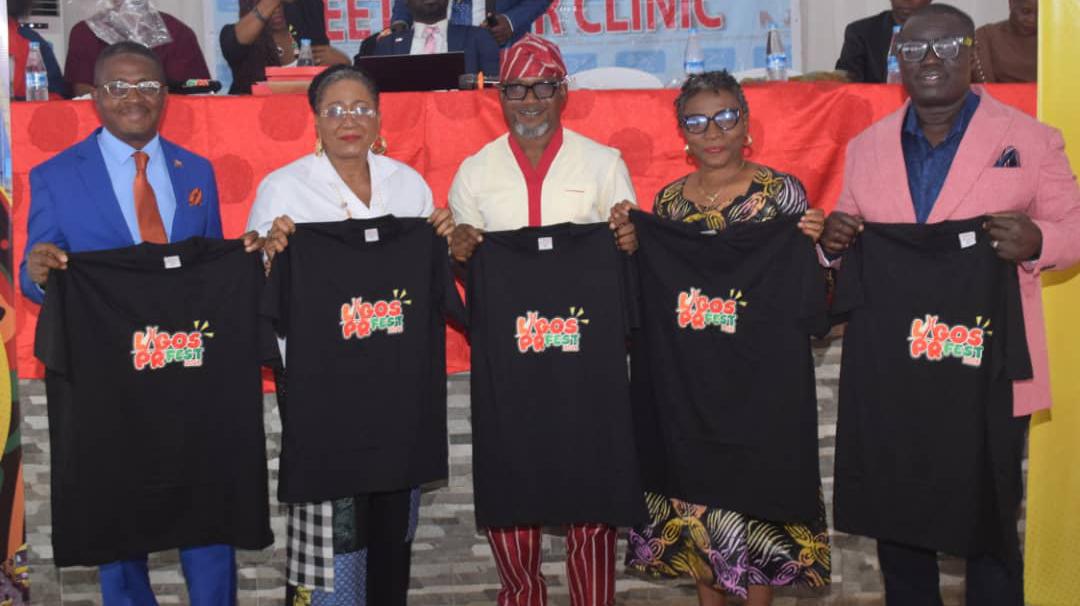
    The chapter chairman and selected leaders in the Chapter subsequently unveiled the theme and programme of activities for Lagos PRFest 2026, scheduled to hold from Friday, July 3 to Thursday, July 9, 2026, under the theme:

    “Security, Nation Building and Public Trust: Fostering Collective Responsibility through Strategic Public Relations.”

    The week-long festival will feature:

    • Sports and Fitness Event
    • PR Mentorship and Leadership Clubs Launch
    • Practitioners’ Hangout and African Night
    • Media Tour of Lagos
    • Annual Conference Lecture
    • Annual General Meeting (AGM)

    The Lagos State Chapter of NIPR invites members, communication professionals, corporate organisations, government agencies, students and other stakeholders to participate in the various activities lined up for the festival, while also expressing confidence that the programme will further strengthen the public relations profession by promoting meaningful conversations around public trust, national security and collective responsibility in nation building

  • Airtel Africa’s Segun Ogunsanya and Rain Oil’s Godrey Ogbechie Lay Bare Failure, Faith and Grit at Imperfectly Awesome 4.0

    Airtel Africa’s Segun Ogunsanya and Rain Oil’s Godrey Ogbechie Lay Bare Failure, Faith and Grit at Imperfectly Awesome 4.0

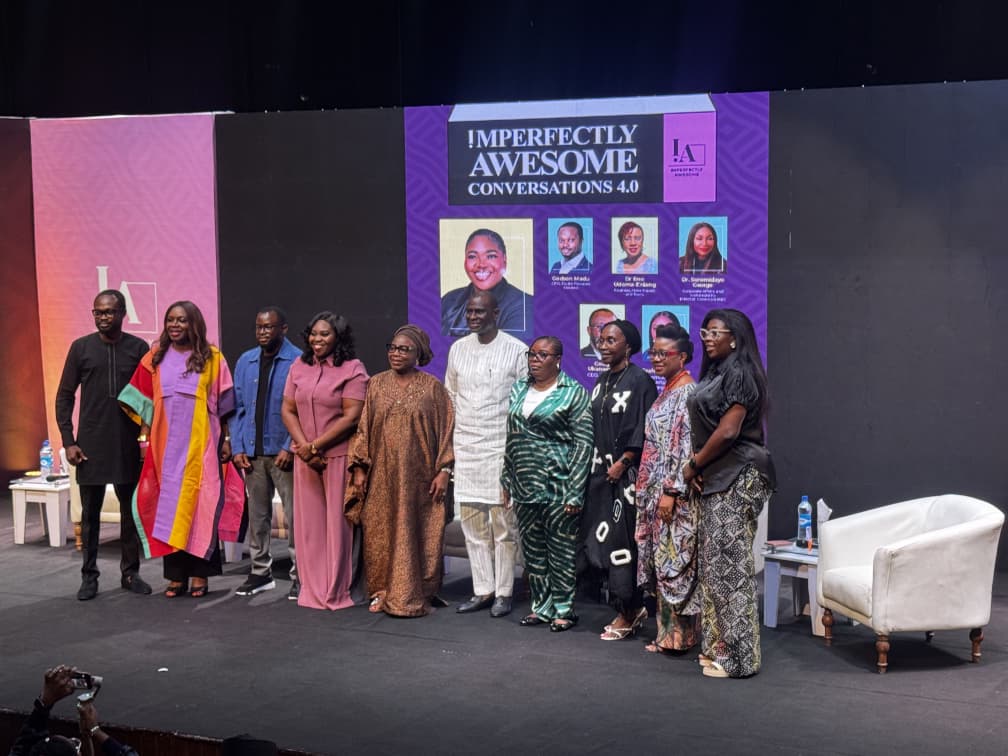
    It was 3:00 p.m. on Sunday, May 3rd and the Muson Centre wasn’t hosting a conference. It was hosting a confession. Imperfectly Awesome Conversations 4.0. Gathered were CEOs, bankers, students and dreamers under one dare: be enough.

    Keynote speaker, Dr Segun Ogunsanya, former Managing Director of Airtel Nigeria and Africa and Chairman of Airtel Africa Foundation, opened by protesting “gender bias” and then ripped up the playbook on strength.

    “None of us arrived here perfectly put together,” he told the hall. “We arrived looking renewed, reshaped. Some look bruised. There’s imperfection everywhere. Whether you are rich, whether you are poor, whether you are a student.”

    Then came the line that stopped the room: ‘Life is full of things. It fluctuates. So please start practising how to cry… ”

    For Ogunsanya, resilience isn’t a comeback story. “It’s actually bouncing forward, not back. People say you bounce back. When you are resilient, you bounce forward… Resilience doesn’t shout. It whispers, try again, try again.”

    He said the strength to try again “may come from your faith, if you are very spiritual, whether it’s from God, Jesus or Allah. But most importantly, resilience doesn’t mean you don’t struggle. It means you choose not to stop. Because when you stop, you drown. The dancing stops.”

    He dragged the audience to Barcelona, Spain, for a pitch that almost didn’t happen. “I was expected to deliver clarity, structure… The presentation date and venue were set for Spain, in Barcelona. I put everything in my excuse. I called the airline. They said they couldn’t let me fly… The momentum slowed. But the pressure remained very high.” In that moment, he said, “Resilience… was not pushing at all. It was the need to stay steady… It meant reframing setbacks, data, not defeat… Temporary disruption doesn’t equal permanent failure.”

    On tenacity, he got personal. “I became CEO for one of the 14 countries in Africa. After nine years… I was the only black CEO of a Fortune 100 company. But I nearly quit. I nearly did. But I stayed.”

    He recalled launching 4G when “some say 4G is not important in Africa. Customers are not ready for it. Devices do not support 4G. Stakeholders also changed. Priorities changed… Tenacity is what happens when you refine your approach rather than abandon it… You can’t suffer invisibly. You cannot stop.”

    Authenticity, he said, is non-negotiable. “To succeed in life, you must be an authentic person. You must be true to yourself. You don’t want to lie to yourself… Some people are just for everyone. If you can be true to yourself, God has something for everyone.”

    During Q&A, he was asked whether to choose the CEO track or entrepreneurship, and he refused the binary: “Both parts can make you very prosperous… There are many successful CEOs… There are also many unsuccessful entrepreneurs. You only serve the successful ones… It depends on how ambitious you are and how you define success. Success is not just about the dollar or the naira… Be clear of how you measure success and be clear as to what you are.”

    When pressed on what would have happened if he’d missed that Spain pitch, he delivered a gut-punch: “The true test of a leader is how many other leaders have you groomed. If you’re the only lodestar, you’re a very selfish leader.”Group Executive Director of Rain Oil Limited,

    Mrs Godrey Ogbechie stepped up with no script and no pretence. “Because the doctors are all over the place, the event anchor decided to add doctor to my name to elevate my profile this evening. But I am not,” she said, drawing laughter.

    “I have been thinking of doing a doctorate for the last seven years and have not even filled out an application form yet… And I am already 60 years old.”

    Why will she still do it? “My grandmother, who is one of my biggest inspirations, went back to school when she was over 70 years old… She wanted to read the Bible for herself.”

    Ogbechie told the room Tola had warned her: “She didn’t want to see my phone. She didn’t want to see my iPad. She didn’t want to see a script. She said I should just come and talk.” So she did – about hating her “masculine” voice, about being raised “like a boy” because “my father had five girls in quick succession. No boy… He kept telling people, oh, if you don’t have a male dog, you take a female dog to go hunting.”

    She spoke of responsibility after her father died at 72, leaving a last son. “Some of that responsibility is on my other siblings and me.”

    Her indictment of today’s work ethic was blunt. “That principle of hard work is what is lacking in these generations today… It doesn’t matter how much AI and things become easy. We must not forget the principles of hard work and consistently showing up… Please, kill yourself. Something must die… You must kill laziness, procrastination… Until a corn of wheat falls to the ground, it abided alone.” She ended with her own insecurities: “I used to refuse speaking engagements because I felt I didn’t have a pleasant-sounding voice… I used to think that my grammar is not perfect… As long as you’re making sense… those are some of the things I have started ruling myself out of.”

    Convener Dr. Tola Bamigbaiye framed the day’s thesis backstage. “We’ve been campaigning that we’re enough. In fact, being enough is the new currency we need to start spending in today’s world, especially when people demand perfection from us,” she said. “

    It’s okay to fall. It’s okay to fail… But failing is not the issue. It’s the ability to get up and learn from it… We expect that when they take learnings away from here, they can apply them to their immediate environment… The charge to everyone who attends today is to please take that learning, be a source of inspiration to someone else.”

    On resilience in 2026, she was clear: “We need to keep going… When we start off a journey, we never know where it’s going to stop. But when you keep going, you know that the end is in sight someday.” The hardest part of embracing flaws? “When people want to take a shortcut… But we always want to let people realise that the necessity pays.”

  • Ajeluorou’s Brides of Infidels Gives Human Face to Nigeria’s Insecurity Crisis

    Ajeluorou’s Brides of Infidels Gives Human Face to Nigeria’s Insecurity Crisis

    Nigerian journalist, poet and novelist, Anote Ajeluorou, has described his novel, Brides of Infidels, as a conscious literary response to Nigeria’s prolonged insecurity crisis, saying the work seeks to humanise the pain of victims and sustain national attention on a tragedy that has persisted for more than a decade.

    Ajeluorou spoke during a book reading and interactive discussion session held at the CRIMMD Museum and Library, Ajao Estate, Lagos, as part of the Book Trek Community Literacy Outreach programme. The event drew students, educators, writers, cultural practitioners and residents of the community.

    According to the author, Nigeria has steadily fallen behind the times in addressing security challenges that have remained unresolved for over 12 to 14 years. He lamented what he described as a culture of denial by government authorities, citing recent incidents in Kaduna State where worshippers were abducted by terrorists, an occurrence initially disputed by the state government before it was later acknowledged.

    He said such denial undermines public confidence and raises concerns about the government’s preparedness to protect citizens across the country. Ajeluorou explained that Brides of Infidels is his fictional attempt to interrogate this failure and to show how insecurity has truncated the lives of thousands of Nigerians.

    Drawing from his experience as a journalist, Ajeluorou said the idea for the novel emerged during the height of the Boko Haram insurgency, particularly following the abduction of the Chibok schoolgirls. He recalled closely following reports in newspapers and on social media at the time, noting that the scale of the violence and the seeming helplessness of victims compelled him to respond creatively.

    “As a writer, I felt the need to lend my own small voice to this raging national tragedy,” he said, adding that literature remains a powerful tool for raising cultural consciousness and ensuring that the suffering of victims does not fade into statistics.

    The novel centres on the story of a young girl from a northern Nigerian community whose education is violently interrupted when insurgents attack her village. Through her experience, Ajeluorou explores themes of displacement, forced marriage, sexual violence, loss and survival, while also reflecting on the broader impact of terrorism on families and communities.

    He stressed that the book is not limited to the experience of the girl child alone, but deliberately broadens its scope to include the neglected trauma of the boy child. Ajeluorou explained that some male characters in the novel are forcibly conscripted into fighting after their communities are attacked, handed weapons and compelled to kill under the threat of death.

    According to him, the story also exposes deeper layers of social injustice, including early marriage, generational poverty and health complications such as vesicovaginal fistula, which further marginalise women and fuel cycles of vulnerability.

    Ajeluorou was careful to separate religion from extremism, stating that Islam is a religion of peace and should not be blamed for the atrocities committed by terrorists. He argued that those who hide behind religion to justify violence cannot claim to share the same spiritual values they profess.

    He criticised government policies that emphasise the rehabilitation of bandits without giving equal attention to victims and traumatised communities. He also condemned the continued existence of the Almajiri system in northern Nigeria, describing it as a social failure that leaves children exposed to exploitation and radicalisation.
    He questioned the commitment of governments in affected regions to education, noting that initiatives such as the Almajiri schools introduced during the Goodluck Jonathan administration were abandoned after his exit from office. According to Ajeluorou, failure to prioritise education has allowed insecurity to thrive.

    Speaking directly to students at the event, the author urged them to value education, remain disciplined and avoid distractions that could derail their academic progress. He also cautioned parents against unmonitored smartphone use by children, warning that excessive phone engagement affects reading habits and academic focus.

    Founder of the CRIMMD Library and Museum, Dr. Raphael James, also addressed participants, shedding light on the vision and impact of the institution. Dr. James, a Nigerian archivist and historian, said the Centre for Research, Information Management and Media Development was established in December 2004 to provide young Nigerians with access to books, knowledge and historical resources.

    He noted that the organisation recently relocated to Ajao Estate, making the Brides of Infidels reading the first major literary event at the new location. While the library had operated for years without charging users, he explained that rising operational costs have made modest fees necessary to sustain its services.

    Dr. James said the library was founded to challenge the notion that Nigerians do not read, arguing instead that many lack access to books due to economic constraints. He revealed that the institution has helped nurture several outstanding individuals, including medical doctors, engineers, a pilot and one of Nigeria’s youngest ICAN qualifiers.

    He further disclosed that CRIMMD has expanded to include the Museum of Nigerian History, Nigeria’s pioneer private history museum, established to document, preserve and reinterpret Nigerian history. According to him, the museum not only houses artefacts but also conducts research aimed at correcting historical inaccuracies and strengthening national consciousness.

    Dr. James emphasised the importance of historical awareness, noting that a society that does not understand its past risks losing its sense of direction. He said CRIMMD’s interactive learning spaces and educational exhibits are designed to make history engaging for young people while fostering a deeper appreciation of Nigeria’s heritage.

    The event concluded with questions and reflections from participants, reinforcing the role of literature, libraries and cultural institutions in sustaining dialogue around insecurity, education and national responsibility.

  • Promasidor Marks International Day of Education, Restates Commitment to Education and Child Nutrition

    In commemoration of this year’s International Day of Education, Promasidor Nigeria, a leading food and beverage company, has reinstated its commitment to promoting education and child nutrition in the country through various initiatives.

    The company has been enhancing educational quality in schools across the country through its high-quality nutritional products and initiatives. Through the ‘Ikun Milk Day’ program, it has also provided its dairy products that contain essential nutrients to students.

    Against this backdrop, the Company’s Chief Executive Officer, Francois Gillet, emphasized the strong link between nutrition and education, stating that proper nutrition is critical to helping children reach their full potential by providing the nourishment they need to learn, grow, and thrive.

    The Promasidor boss affirmed that the company’s dairy products are fortified with key nutrients, including calcium, vitamins, and essential minerals, which are vital for bone development, cognitive function, and overall well-being.

    He stated that the company’s belief that improved nutrition directly contributes to better educational outcomes and long-term societal growth defines the quality of its products.

    For nearly a decade, Promasidor has empowered secondary school students nationwide through its flagship career guidance programme, “Harness Your Dream.” The initiative targets Junior Secondary School 3 (JSS 3) students at a critical stage when career-defining academic decisions are made, equipping young Nigerians with the knowledge needed to pursue sustainable, fulfilling career paths.

    This stems from the Company’s over two decades of mathematics subject development through its programme ‘Cowbellpedia TV Quiz Show.’

    Cowbellpedia,’ themed ‘Mega Minds’ in 2025 has recently been made more comprehensive to cover subjects, such as Science, Technology, Engineering, Mathematics (STEM); to reflect the broader areas of interest for students, with a bigger prize offering of up to ₦100 million, including cash rewards, laptops, other learning equipment, and products.

    The top winners were also offered an all-expense paid educational excursion to South Africa.

    This underscores the company’s mission to contribute meaningfully to the country’s educational development, a practical demonstration of how the private sector can help strengthen educational standards through collaboration.

    Promasidor Nigeria, with a portfolio of unique brands that include Cowbell, Loya Milk, Miksi, Top Tea, Onga Seasoning, Twisco, and Kremela, is committed to connecting with consumers through worthy initiatives.

  • FG mandates TIN for all taxable bank account holders from January 2026

    FG mandates TIN for all taxable bank account holders from January 2026

    The Federal Government has established a definitive timeline for stricter tax compliance, mandating that banks require a Tax Identification Number (TIN) from all taxable Nigerians maintaining bank accounts beginning January 1, 2026.

    Taiwo Oyedele, Chairman of the Presidential Committee on Fiscal Policy and Tax Reforms, disclosed the regulatory overhaul in a recent interview shared on his X account on Thursday. The move is central to the government’s new tax administration framework aimed at expanding the national tax net.

    Oyedele clarified that the enforcement is backed by Section 4 of the Nigerian Tax Administration Act (NTAA), which is set to take effect on the stipulated date. This provision legally requires a taxable person to register and obtain a TIN.

    “A taxable person is anyone who earns income through trade, business, or any economic activity. So banks must request a tax ID from taxable persons,” Oyedele stated.

    The Chairman was keen to address public concerns by outlining key exemptions. The mandatory TIN requirement will not apply to non-income earners, such as students and dependents, who will be exempted from needing a TIN to operate bank accounts.

    He warned that any taxable entity operating without a valid TIN may face restrictions in running their bank accounts in the near future. Mr. Oyedele added that individuals and businesses who have already been issued TINs will not need to re-register for a new one.

    The policy, according to the Presidential Committee Chairman, is not entirely new, having been introduced via the 2020 Finance Act. However, the new Nigerian Tax Administration Act provides the formal legal backing necessary for comprehensive enforcement across the banking sector starting in 2026.

  • Bare Fashion Evening Presents “The Runway Heist on Broadway” A Detty December Theatre-Style Fashion Spectacle

    Bare Fashion Evening Presents “The Runway Heist on Broadway” A Detty December Theatre-Style Fashion Spectacle

    Bare Fashion Evening is set to captivate Lagos this festive season with an extraordinary new edition titled “The Runway Heist on Broadway.” Scheduled for Sunday, December 14, at the prestigious Landmark Centre, Victoria Island, the event promises an electrifying fusion of fashion, theatre, music, and dance ushering in a refreshing creative direction for Nigeria’s runway culture.

    Positioned as a Detty December exclusive, The Runway Heist on Broadway reimagines the runway as a full theatrical stage, where models step beyond the traditional silent strut to embody expressive characters that drive a unified, Broadway-inspired narrative. This cinematic approach blends flamboyant metallics, fantasy aesthetics, dramatic cues, choreographed movements, and emotionally charged performances, bringing each designer’s work to life in unprecedented ways.

    The evening begins with a red carpet at 5:00 PM, followed by the main runway and theatre showcase at 6:00 PM. Guests will experience a seamless transition between fashion and performance art as young creatives present bold, story-driven collections interpreted through the expressive strength of the models. The showcase culminates in an exclusive after-party, where guests are required to attend with a handheld mask, preserving the theatrical mystique of the night.

    Bare Fashion Evening remains committed to championing emerging creatives, and this year’s edition amplifies that mission by positioning young designers and models at the forefront of a spectacular, narrative-led production. The event also targets a vibrant audience base that includes fashion enthusiasts, theatre lovers, students, influencers, young professionals, lifestyle creators, and supporters of Nigeria’s rising fashion talent.

    Tickets for the show are available in four categories 

    Broadway Lane (₦25,000)

    Broadway Circle (₦50,000)

    Broadway Diamond (₦100,000)

     Premium Broadway Lane Plus (₦50,000)

    Convener Jonarry Agraka described this year’s creative direction as a bold artistic leap, emphasizing that The Runway Heist on Broadway is a deliberate reminder that fashion transcends clothing — it is expression, storytelling, and performance. He added that this edition merges fashion and theatre on one stage to celebrate creativity in its purest form. According to him, his broader vision is to create a platform where young creatives within the ecosystem can be spotlighted by both local and international talent scouts, ultimately raising a new urban phenomenon.

    The Media Spokesperson further emphasized the heart of the production, stating, “Our models and designers are not just showcasing garments. They are bringing their journeys, their voices, and their art to Broadway. This edition is designed to elevate emerging talent and give audiences an immersive experience they will not forget.

    With its innovative blend of stagecraft, fashion artistry, and narrative depth, The Runway Heist on Broadway sets a new precedent for runway productions in Lagos. Bare Fashion Evening is once again pushing the boundaries of creativity, offering guests an unmissable December spectacle where style, drama, and storytelling converge under the spotlight.

  • Feature- Bending AI to Africa’s needs: the key to transforming classrooms

    Feature- Bending AI to Africa’s needs: the key to transforming classrooms

    By Niall McNulty

    The opportunities that artificial intelligence (AI) offer African teachers and students are immense; the AI education market in the Middle East and Africa is projected to hit $1.7 billion by 2030. Yet in Sub-Saharan Africa, where student–teacher ratios can reach 50:1 and many children still lack access to quality learning resources, the need for innovative solutions is urgent. What excites me most about AI in African education is the potential to address persistent inequalities in ways that haven’t been possible before.

    For too long, students in under-resourced schools have had fewer opportunities simply because their teachers lacked access to support, materials, or professional development. AI can change this dynamic fundamentally, making world-class support accessible even in the most remote classrooms.

    Across Africa, AI has the potential to drive change in schools, but only if it is shaped to fit the realities of African classrooms, rather than forcing classrooms to adapt to the technology. The real promise lies in AI’s power to personalise learning at scale, helping teachers meet the needs of every student in classes that are often large and diverse. When AI is guided by local priorities, cultural context and teacher expertise, it stops being a futuristic add-on and becomes a practical ally.

    The challenges

    Three obstacles stand out most clearly from our work across the continent.

    Connectivity remains a major challenge across much of Sub-Saharan Africa. Teachers want to use AI tools but can’t always access them when they need them most. That means that classroom tools need to have offline capabilities, such as pre-generated material, and tools need to work effectively with intermittent internet connections.

    Language barriers present another complexity. While many teachers are comfortable teaching in English, this is not their students mother tongue and they often need to explain concepts in local languages. We’re working on multilingual capabilities through researching the African language capabilities of leading AI chatbots, but this remains an ongoing challenge that requires careful cultural and linguistic adaptation.

    Perhaps most importantly, we’re hearing that teachers want more time to explore and experiment with AI tools. The demanding nature of teaching, particularly in resource-constrained environments, means that many educators struggle to find space for learning new technologies. If adoption is to succeed, professional development and time allowances must be built into the process from the start.

    Making AI familiar

    The beauty of AI integration in education lies not in expensive hardware or complex software, but in leveraging the tools teachers already have access to. Through our work across Sub-Saharan Africa, we’ve discovered that the most practical entry point is often the smartphone in a teacher’s pocket.

    Our WhatsApp teacher support AI chatbot project in South Africa demonstrates this perfectly. Teachers are already comfortable with WhatsApp; they understand how to send messages, and they can access support instantly without needing new apps or training on unfamiliar platforms. When a teacher in a rural classroom needs help differentiating a lesson for mixed-ability learners or wants quick feedback on a lesson plan, they can simply message our AI assistant and receive immediate, contextualised support.

    This approach works because it builds on existing digital behaviours rather than requiring teachers to learn entirely new systems. We’ve found that teachers who start with familiar interfaces, such as WhatsApp, develop confidence that naturally extends to other AI tools over time.

    Empowering educators as architects of learning

    At Cambridge, we believe the power of AI in education lies in a human-centred approach that starts “where teachers are,” respecting their agency and empowering them as architects of learning, not just consumers of technology.

    It is this human-centred approach that is key to helping students navigate change and use technology effectively. A recent Cambridge report, ‘Preparing learners to thrive in a changing world’, which captures the views of nearly 7,000 teachers and students across 150 countries, shows that while technology is widely embraced to support teaching and learning, over a third of teachers surveyed (34%) selected over-reliance on technology as the greatest challenge that technology might pose in preparing students for the future. In this age of AI, we believe that it is essential for students to develop a solid foundation of subject knowledge to help them interpret information critically and effectively.


    This insight is one reason we are especially focused on helping African education systems avoid the challenges other regions have faced with technology adoption. Our approach emphasises teacher training, infrastructure readiness, and gradual implementation, rather than rapid, large-scale deployments that too often fail to deliver their intended outcomes.

    We’ve structured our Getting Started with AI in the Classroom guide around practical scenarios that teachers encounter daily and our professional development programme for STEM teachers exemplifies this philosophy too.

    Rather than starting with “here’s how to use this AI tool”, we begin with “here’s how AI can solve real problems you face in your classroom”. Teachers learn to evaluate AI outputs critically, asking questions like: Does this explanation match my students’ cultural context? Are there biases in the examples provided? How can I adapt this suggestion to fit my teaching style?

    A future built for teachers

    Teachers in Africa are incredibly creative and adaptable, and we’re starting to see them use AI in ways that we never anticipated. They’re adapting tools to local languages, incorporating traditional knowledge systems, and developing approaches that reflect their deep understanding of their communities. This innovation from the ground up suggests that AI integration in African classrooms will look quite different from implementations in other parts of the world, and that’s exactly as it should be.

    Our vision is AI that helps preserve what’s best about African education while addressing its most persistent challenges. This means supporting the strong relationships between teachers and students, the collaborative learning approaches, and the community connections that characterise many African classrooms, while using AI to reduce administrative burden, enhance personalisation and provide teachers with better support.

    To make this vision real, three things are essential: deeper investment in teacher training, stronger collaboration with ministries and local tech innovators, and sustained infrastructure development to bridge connectivity gaps.

    Ultimately, I’m excited about a future where every African student has access to excellent education, supported by teachers who feel confident, well-resourced and professionally fulfilled. AI won’t create this future by itself, but it can be a powerful tool in the hands of dedicated educators working toward that goal.

  • Nigerian Students Embrace AI as a Study Partner, New Google Search Trends Reveal

    Nigerian Students Embrace AI as a Study Partner, New Google Search Trends Reveal

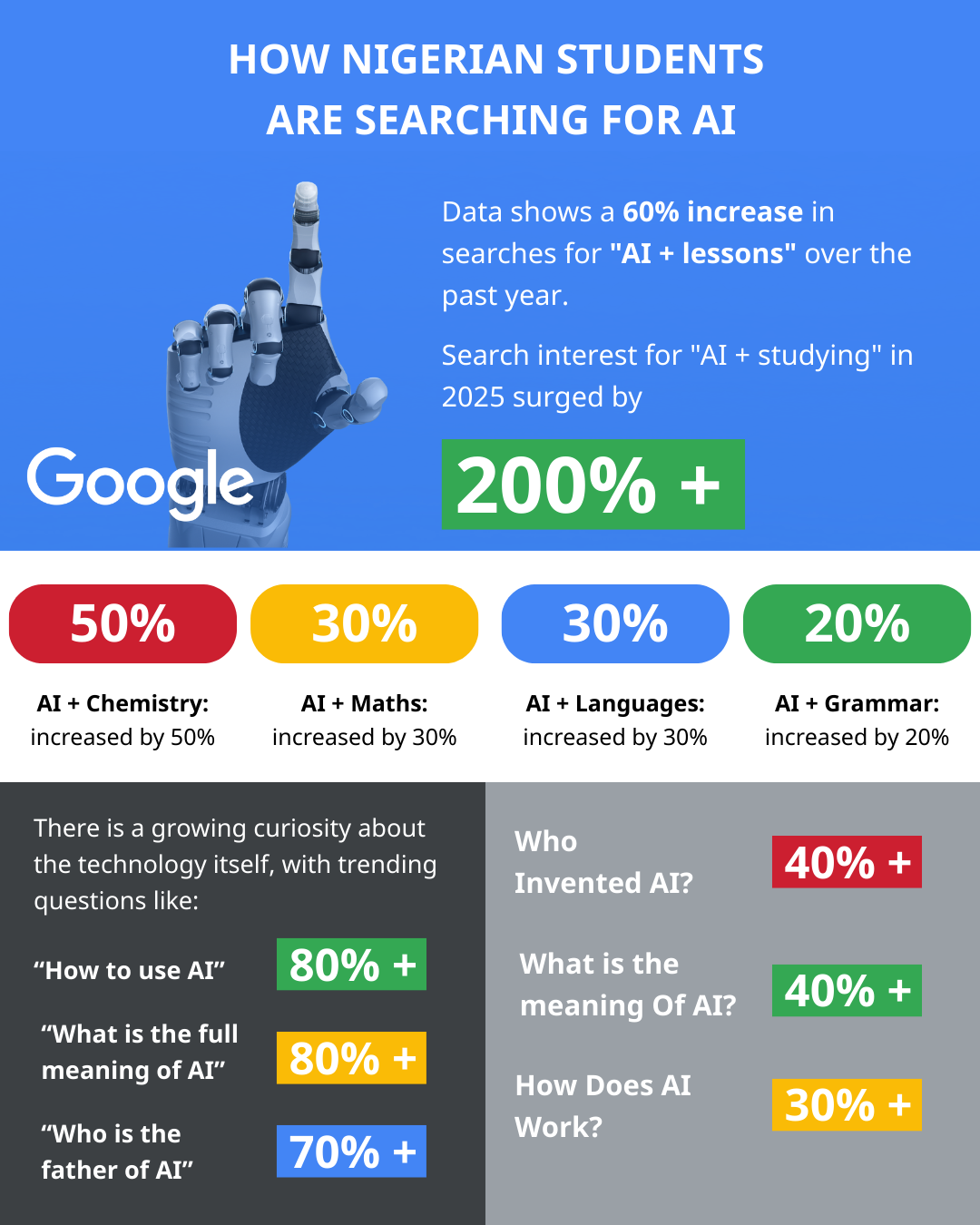
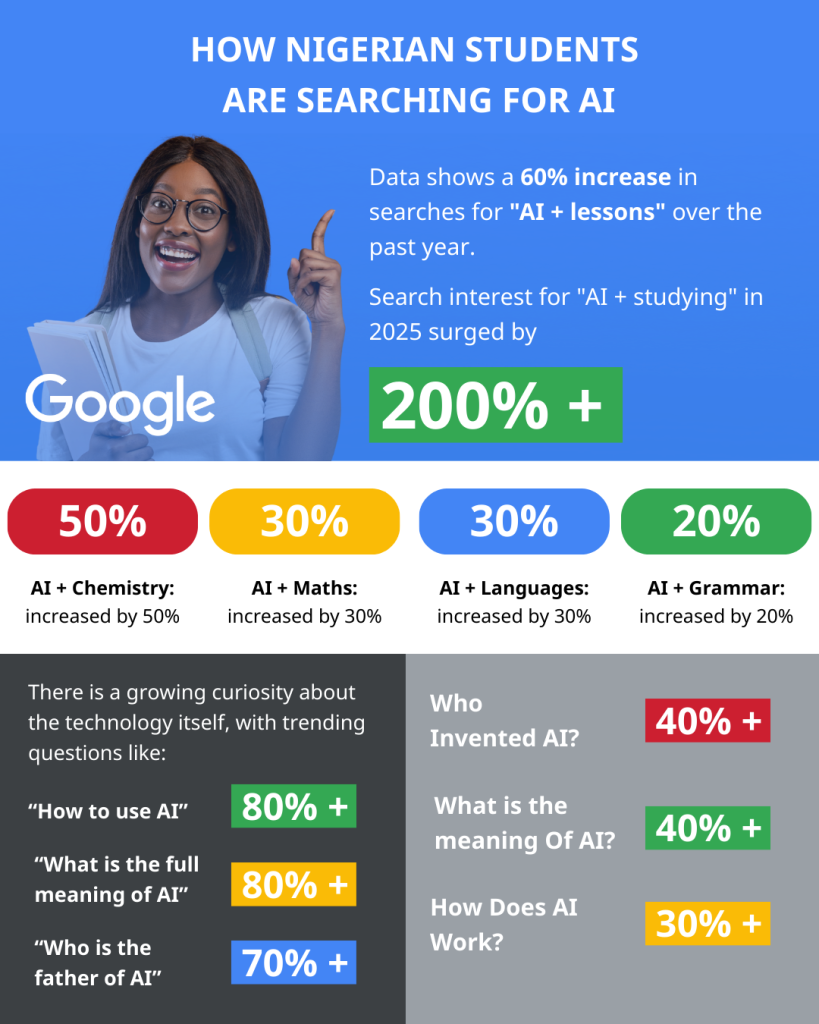
    As students across Nigeria head back to school, new data from Google Search trends reveals a significant shift in study habits, with a massive turn towards Artificial Intelligence (AI) for academic support. Search interest for “AI + studying” surged by over 200% compared to 2024, highlighting how students are increasingly leveraging AI tools as a primary resource for learning.

    This trend is part of a broader surge in AI curiosity in Nigeria. Search interest in AI reached an all-time high in 2025, growing by 60% over the past 12 months. Nigerians are not just asking what AI is, but how to use it to enhance their daily lives, particularly in education. The data shows a 60% increase in searches for “AI + lessons” over the past year.

    AI Integration Across Academic Disciplines

    Students are applying AI to a wide range of subjects. Over the last year, searches combining AI with specific school subjects have seen remarkable growth:

    • AI + Chemistry: increased by 50%
    • AI + Maths: increased by 30%
    • AI + Languages: increased by 30%
    • AI + Grammar: increased by 20%

    The nature of these searches indicates that students are seeking practical help. Top searched questions for mathematics include, “what is the best AI in the world for solving mathematical problems” and “how to use AI to solve math problems.” Similarly, top searches for studying in general include queries for “AI tutor for students,” “free AI tools for studying,” and “useful AI prompts for studying,” showing a clear demand for accessible and specialized AI-powered educational tools.

    Beyond the Classroom: Understanding AI and Preparing for the Future

    The interest in AI extends beyond homework and exam preparation. There is a growing curiosity about the technology itself, with trending questions like “how to use ai” (+80%), “what is the full meaning of AI” (+80%), and “who is the father of ai” (+70%) all rising in the past year.

    Significantly, as students use AI for their work, they are also becoming more aware of the ecosystem around it. Searches for “AI detection” have seen a massive 290% increase in the past 12 months, suggesting a growing conversation around academic integrity and the responsible use of AI tools.

    Looking towards future careers, “Generative AI” was a breakout search term over the past 12 months, often appearing alongside searches for “professional certification.” This indicates that students and young professionals are not only using AI to succeed in their current studies but are also actively looking to build skills that will prepare them for the future workforce.

    Olumide Balogun, West Africa Director at Google, said: “It’s inspiring to see Nigerian students so eagerly embrace AI to support their learning journeys. This back-to-school season, the data shows that students are not just using AI for answers, but as a tool to deepen their understanding of complex subjects, from chemistry to mathematics. This curiosity is key to fostering a new generation of innovators, and we are committed to providing tools that empower them to learn, grow, and succeed.”

  • Federal Government College, Ikirun Celebrates 30th Anniversary with its Alumni Community

    Federal Government College, Ikirun Celebrates 30th Anniversary with its Alumni Community

    Federal Government College (FGC), Ikirun, Osun State came alive as alumni, students, staff, and dignitaries celebrated its 30th anniversary on May 13, 2025. The commemorative event brought together past and present members of the school community to commemorate three decades of educational excellence, growth, and unity while reflecting on the school’s achievements, legacy, and reinforced a collective commitment to shaping the future of youngsters.

    The day began with a visit to the school premises by members of the alumni association, who were filled with excitement and nostalgia as they reunited and reminisced about their time at FGC Ikirun.

    The highpoint of the celebration was the generous donation of essential items by the alumni to their alma mater. The donated items, aimed at enhancing the extracurricular and academic experiences of current students, included: Brigade 6-set drum with a mace, an additional 7-set drum, Volleyball net, poles, and five (5) volleyballs and a selection of books for the school library

    The school principal, Dr Mrs. Augustina Buzugbe expressed immense gratitude for the donations, acknowledging the alumni’s continuous support and commitment to the school’s development. She also encouraged current students to emulate the success stories of the alumni.

    The formal proceedings began with an address by Adeoye Obakin, followed by an inspiring keynote delivered by Bolaji Olawoye. Both speakers emphasized the importance of alumni engagement and encouraged the students to aspire to excellence in their academic and personal pursuits. The school’s principal expressed heartfelt appreciation for the alumni’s continued support and urged current students to draw inspiration from their predecessors.

    The event was graced by the presence of notable alumni, including Tomi Olawoye, Odeleye Ayodeji, and Yusuff Aishat, whose presence added prestige to the occasion and demonstrated the strength and unity of the FGC Ikirun alumni community.

    The day was further enlivened by poetry recitations and a captivating cultural dance performance by the students. The display of talent and tradition delighted attendees and current students.

    In keeping with the spirit of giving, refreshments were shared with students and staff, creating a festive atmosphere of unity and joy.

    The 30th Anniversary celebration of FGC Ikirun was a resounding success. It served not only as a reunion for former students but as a reaffirmation of their lasting bond with the school. The event highlighted the role of alumni in advancing educational excellence and ensuring that the legacy of FGC Ikirun continues to thrive for generations to come.

  • Department of State Reports Record 1.12 million international students in the United States

    Department of State Reports Record 1.12 million international students in the United States

    From November 18-22, the Department of State, in partnership with the Department of Education, will celebrate International Education Week (IEW), an annual joint effort to highlight the benefits to students, families, and communities in the United States and abroad of international educational exchange.  This year’s theme, “Explore,” invites students, scholars, institutions, and others to explore international education opportunities that equip them with the skills and knowledge to succeed.

    Launching IEW today, the Department of State, in collaboration with the Institute of International Education (IIE), released the annual Open Doors Report, which measures and outlines trends in international student mobility.  Now in its 75th year, Open Doors reports more than 1.12 million international students studied at U.S. colleges and universities in the 2023-2024 academic year, a record high that underscores Secretary Blinken’s commitment to making the United States the top destination for international study.  The economic activity of international students also makes significant contributions to the U.S. economy, bringing in more than $50 billion in 2023, according to the Department of Commerce. To learn more about the Open Doors data, visit opendoorsdata.org.

    In addition to the Open Doors Report, the Department will highlight key aspects of international education throughout the week, including: #StudyWithUS efforts to recruit international students to study in the United States; foreign language-learning opportunities for U.S. citizens as well as English language opportunities for students in other countries; and alumni of international educational exchange who made a positive difference in their communities and countries.

    As part of IEW, approximately 1,700 high school students participating in the Congress-Bundestag Youth Exchange (CBYX), Future Leaders Exchange (FLEX), and Kennedy-Lugar Youth Exchange & Study (YES) programs will share about their countries and cultures in schools and communities across the United States. Last year, students from these programs conducted nearly 6,100 presentations during IEW, reaching more than 110,000 Americans.

  • NASENI and Imose Rollout Made-in Nigeria Laptops, Tablets

    NASENI and Imose Rollout Made-in Nigeria Laptops, Tablets

    The National Agency for Science and Engineering Infrastructure (NASENI) and Imose Technologies Ltd, an indigenous Nigerian company, are rolling out made-in-Nigeria laptops and tablets for use by Nigerians.

    The 14-inch laptops and 10.5-inch tablets are manufactured in the NASENI brand name.  This move aligns with the agency’s mission to drive indigenous industrialization, local content and to promote job creation in fulfillment of President Bola Ahmed Tinubu’s Renewed Hope Agenda, which emphasizes local content development and cooperation amongst economic players in order to revamp the economy.

    The NASENI Zedon X-Pro laptop comes with a Core i5 processor and a 14-inch screen which offers a blend of power, portability, and practicality, making it an attractive choice for a wide range of users including students, professionals, or anyone who needs a reliable laptop or tablet on-the-go.

    Similarly, the 10.5-inch tablet strikes a balance between portability and functionality, making it ideal for various use cases such as document editing, drawing, video streaming, or gaming.

    The Executive Vice Chairman/ CEO of NASENI, Khalil Suleiman Halilu, said the partnership is “a strategic move which aligns with the Agency’s 3Cs principles of Collaboration, Creation and Commercialization to work with like minds. We are working with Imose Technologies to bridge the technological gap by reducing importation bills.

    “We are transforming the Agency by making it a central player in Nigeria’s technology revolution by adopting, adapting and domesticating cutting-edge technologies. At NASENI, we are building a national brand that going forward, every household in Nigeria will have one NASENI’s product or the other,” Halilu added.  

    Also, Chairman of Imose Technologies, Osayi Izedonmwen said, “For ten years, we have had a relentless focus on solving uniquely Nigerian problems by championing the local manufacturing of mobile and computer devices to improve lives and transform local institutions.”

    Speaking further, “We are proud that NASENI has chosen to partner with us for the domestic production of laptops to bridge the digital divide and improve access to technology for education and work.”

    The NASENI and Imose Technologies brands share similar values and beliefs of innovation and nationalism. It is envisaged that government ministries, departments, agencies, public institutions and private organizations and consumers can buy NASENI laptops

  • “Africa will be the pivotal continent in the world, given its economic prospects”— Dr Akinwumi Adesina

    “Africa will be the pivotal continent in the world, given its economic prospects”— Dr Akinwumi Adesina

    Dr Akinwumi Adesina delivered an inspiring address to a diverse audience of diplomats, investors, academics, politicians, and media, emphasizing Africa’s untapped potential and abundant opportunities

    Financing is key to unlocking Africa’s development opportunities; Dr Adesina tells Chatham House: “Africa can no longer be ignored.”

    In a packed auditorium at the renowned Chatham House, African Development Bank President Group, Dr Akinwumi Adesina delivered an inspiring address to a diverse audience of diplomats, investors, academics, politicians, and media, emphasizing Africa’s untapped potential and abundant opportunities.

    In his presentation on Friday, “Envisioning Africa’s Economic Prospects,” Adesina explained the reasons behind his optimism and passion for Africa.

    The Bank Group president said Africa is a continent of tremendous opportunities. It is endowed with and characterized by a young, dynamic and vibrant workforce, massive renewable energy potential, abundant biodiversity resources, rapid regional integration and innovative solutions designed to unlock the continent’s vast natural capital.

    Adesina outlined the resilience of Africa’s economies despite global challenges, noting that the continent remains the second-fastest-growing region after Asia. He cited the Bank’s African Economic Outlook Report, which shows the  the continent’s  3.7% economic growth for 2024, increasing to 4.3% in 2025. The report which was launched during the Bank’s May Annual Meetings in Nairobi revealed that 15 countries achieved real growth rates of at least 5 percent, and half of the world’s 20 fastest-growing economies are in Africa.

    However, he said achieving strong economic prospects and resilience will require overcoming some significant headwinds, including tackling climate change and rising debt, and through critical global financial reforms.

    “As Africa’s economic resilience is bolstered, unlocking its economic prospects requires ensuring structural change of its economies, raising the productivity of agriculture, provision of electricity, accelerating infrastructure investments, supporting faster pace digitalization, unleashing economic and job opportunities for women and youth, and driving industrialization through greater mobilization of the private sector,” he stated.

    Addressing infrastructure and agricultural production, Adesina shared successes like the Bank’s flagship Technologies for African Agricultural Transformation (TAAT) programme, which has helped 13 million farmers to increase crop productivity. In Ethiopia, the distribution of 65 metric tons of heat-resistant wheat has led to self-sufficiency in wheat production, covering 2.2 million hectares.

    The event, attended by over 150 guests in person and hundreds more virtually, included diplomats from more than 18 African countries, the Commonwealth Secretariat, international financial institutions, private and corporate investors, startups, civil society, students and academics from some of the UK’s leading academic institutions and international media houses.

    Adesina acknowledged challenges such as youth unemployment, poverty, debt vulnerability, and political instability but dispelled perceptions of Africa as a risky investment destination. He referenced a 14-year Moody’s Analytics study showing Africa’s low infrastructure loan default rate at 1.9 percent, compared to between 4.6 and 12.4 percent in other regions around the world.

    He reiterated the Bank’s advocacy for an independent African credit rating agency to counteract misperceptions that lead to underinvestment due to excessive risk premiums. Quoting the United Nations Development Programme, Adesina said fairer credit ratings for African countries could save at least $75 billion annually in debt service payments.

    “The trajectory for Africa will be much stronger as we tackle these challenges, as well as improve security and expand more concessional financing and private sector financing,” he emphasized.

    Repositioning the Bank to do more

    Adesina recalled the Bank Group shareholders’ recent approval of a $117 billion callable capital increase, raising the Bank’s total authorized capital to $318 billion to preserve its AAA credit rating and enhance its lending capacity. The approval announced during the just concluded 2024 annual meetings of the Bank will align the institution with the changing global financial architecture and enhance its support for the continent.

    “We’re going to be bigger, bolder, and better,” he declared, predicting Africa’s rise as a pivotal global region.

    Reflecting on the Bank’s achievements, Adesina highlighted the Bank’s successful launch of sustainable hybrid capital, marking the first such issuance by a multilateral development bank in line with the G20 Capital Adequacy Framework recommendations to boost lending capacity. The transaction won global commendation, including from the G7 finance ministers and central bank governors.

    Adesina also cited the Bank’s Alliance for Green Infrastructure In Africa (AGIA), which the G7 has backed with a $150 million contribution. AGIA is working to leverage $3 billion in private sector investment for green projects.

    He also mentioned the $20 billion Desert-to-Power project in the Sahel to generate 10,000 megawatts of solar power for nearly 250 million people across 11 countries. When completed, it will be the largest solar zone in the world. In addition, Adesina and the President of the World Bank Group Ajay Banga recently announced a joint effort by their two institutions to connect 300 million Africans to electricity by 2030.

    The Bank Group president praised the recent International Monetary Fund approval of $20 billion Special Drawing Rights channeling for hybrid capital in line with proposals by the African Development Bank and the Inter-American Development Bank.

    “The African Development Bank is mobilizing more private sector investments into Africa. We supported the $24 billion LNG (Liquified Natural Gas) project in Mozambique, which will provide over $66 billion in revenue for Mozambique and make it the third-largest exporter of LNG in the world. We supported the $19.5 billion Dangote Refinery Complex, the largest single-train refinery in the world and the largest ammonia plant globally. We supported the $13 billion OCP phosphate company in Morocco, the largest phosphate fertilizer plant in the world,” he said.

    He said these achievements have fuelled the Bank’s ambitions as reflected in its new ten-year strategy (2024-2033), which outlines the vision of an Africa that is prosperous, inclusive, resilient and integrated.

    “Africa can no longer be ignored. I fully expect Africa to be the pivotal continent in the world, given its economic prospects,” he said.

    He said that the future of energy transition for a world primarily powered by renewable energy will depend on Africa, which accounts for 25 percent of global biodiversity and contributes substantially to providing key minerals. According to African Development Bank estimates, Africa’s natural capital stood at $6.2 trillion in 2018, with mineral and fossil fuel resources alone valued at $290 billion and $1.05 trillion, respectively.

    He said Africa must work out how to tap the potential of its youth, turning this asset into an economic dividend.

    “We are supporting universities of science and technology, expanding training in science, technology, engineering and mathematics, centers of excellence in biotechnology and material sciences, as well as technical and vocational training. We have committed $700 million to education and skills development, which has supported 4,000 tertiary education and training facilities, and provided 1.7 million African youths with access to science, technology, engineering and mathematics education, providing critical digital skills in computer coding.”

    He added that the African Development Bank is also focusing heavily on women. “The African Development Bank’s flagship initiative, Affirmative Finance Action for Women in Africa (AFAWA), is de-risking financial institutions to lend to women. It is working with 169 financial institutions in 43 countries and has so far approved $1.7 billion in financing for 18,300 women-led businesses. Our goal is to mobilize $5 billion for women-led businesses.”

    He also mentioned the Africa Investment Forum, founded by the Bank group and seven other partners, saying it continues to provide a transparent platform for investors interested in Africa to meet, assess projects, evaluate risks, seek counter-risk mitigants, as well as address political risks to investors. Since the establishment of the Africa Investment Forum in 2018, it has attracted investor interests in Africa worth over $180 billion.

    He expressed optimism that Africa’s prosperity is within reach and it will emerge as a pivotal continent: “Africa is critical to the future of the world. It’s a vision Africa deserves and it’s a vision we’ll achieve.”
  • Rite Foods Teams Up with iCreate in Recycling Awareness Campaign

    Rite Foods Teams Up with iCreate in Recycling Awareness Campaign

    Rite Foods Limited, under its Rite Recycle initiative, in collaboration with icreate, is proud to announce the “iCreate Club Programme”, an initiative campaign designed to educate and empower children on the importance of recycling and its role in building a more sustainable world.

    This impactful campaign will engage students across public and private schools in Lagos, Nigeria, through a two-pronged approach:

    A book reading tour will span 50 public schools, using a specially-written Rite Foods storybook, titled “Don’t Waste Your Waste” to introduce the concept of recycling to young minds.

    Students will be challenged to transform used Rite Sausage Roll wrappers and cartons into innovative STEAM-based creations, fostering their creativity and environmental awareness.

    Finalists from participating schools will showcase their remarkable creations at a grand finale event held at NECA House Events Centre on July 6th, 2024. The grand finale will feature an exhibition of the finalists’ work, judged by esteemed professionals, with exciting prizes awarded to the winners.

    This initiative emphasizes the significance of recycling in preserving our planet, inspiring responsible waste management practices from a young age. It encourages students to apply Science, Technology, Engineering, Arts, and Mathematics concepts in their creative recycling projects while promoting collaboration between schools, students, and the community.

  • AOT 5.0 – Governor Sanwo-Olu, Tijani and other Stakeholders Debate Policies For Lagos Creative Economy

    AOT 5.0 – Governor Sanwo-Olu, Tijani and other Stakeholders Debate Policies For Lagos Creative Economy

    The fifth edition of the Art of Technology Lagos (AOT) conference climaxed on Friday with relevant players from the public and private sectors engaging in 2-day insight-packed discussions to debate policies and initiatives that will pave the way for shaping Lagos’s creative and tech economy landscapes.  

    Babajide Sanwo-Olu, Executive Governor of Lagos State who played host to the event lauded the Eko Innovation Center, curators of the conference for bringing together pioneers, professionals, students and enthusiasts to steer the tech and creative industries in Lagos State and Nigeria to greater heights.

    “This year, we convene under the theme Creative Economy and a Digital Lagos, as it reflects our dedication to a transformative journey where the fusion of technology and artistic expression will propel us into a global innovative hub in shaping Lagos’s creative and tech economy landscapes.  AOT 5.0 is a gathering that serves as a melting point of visionaries, innovators and leaders who are committed to propelling Lagos into the digital future, and I commend the Eko Innovation Center, Ministry of Science and Technology and other organisers for making this conference a reality”, Governor Sanwo Olu stated.

    Speaking at the conference, Bosun Tijani, Nigeria’s Minister of Communications, Innovation and Digital Economy, said that Lagos State is blessed with ingredients for the application of science, creativity and technology to drive the growth that we need to see as humans as the state is home to one of the most vibrant creative sectors in the world. The minister further challenged participants and stakeholders to see the fifth edition of the conference as a call to action and an opportunity to collaborate towards leveraging innovation, creativity and technology for the development of Lagos State and Nigeria.

    Tubosun Alake, Lagos State Commissioner for Innovation, Science and Technology, and convener of the Art of Technology annual conference said that “data requires us to do more in the creative sector and with the right application of technology, we can harness the tech and creative ecosystem for growth in the State and Nigeria. 

    Digital art platforms allow artists and creatives to expand their creativity beyond traditional mediums with the use of technology. Creative industries like film, music, fashion, design, and advertising amongst others, use technology to amplify their art forms and solve problems in their various niche, thereby significantly impacting the economy; this is poised for further growth in the coming years.

    Highlights of the 2-day AOT 5.0 conference explored synergies between creativity and technology; a deal room where creative tech entrepreneurs pitched their solutions to judges and investors; collaborative networking and engagement with industry stakeholders and experts who unearthed strategies for steering the creative economy of the state to greater heights, as well as empowerment of creatives by equipping them with tools to navigate the evolving landscape.

    Art of Technology Lagos (AOT) is an annual tech conference curated by the Eko Innovation Centre, and sponsored by the Lagos State Government – the economic and technology epicentre of Nigeria. With the fifth edition of the conference, Eko Innovation Center has yet again demonstrated its commitment to solving the most pressing development and institutional challenges with technology and innovation.

  • Merck Foundation releases First Diabetes Animation film titled “Sugar Free Jude”

    Merck Foundation releases First Diabetes Animation film titled “Sugar Free Jude”

    Merck Foundation, the philanthropic arm of Merck KGaA Germany launched The First Diabetes Animation Movie “SUGAR FREE JUDE” with the aim to Fight Diabetes and Raise Awareness about its Prevention and Early Detection, moreover, to Promote Healthy Lifestyle, amongst children and youth in Africa and beyond.

    Watch the “Sugar Free Jude” Animation movie- click here

    Senator, Dr. Rasha Kelej, CEO of Merck Foundation shared, “I am very happy to release the first animation film about fighting Diabetes “ Sugar free Jude” after rehearsing children book of the same story and for the same purpose, therefore, in partnership with the African First Ladies. Through our new animation video of our children storybook, we want to encourage our communities to stop sugar, exercise regularly, eat healthy and never smoke, this is the only way to eradicate diabetes and hypertension and reduce its complications.

    All our animation films will help to take this message not only to children but also to adults, in a very entertaining way. We will soon launch it in French, Portuguese and local languages  too.”  

    The animation movie is the adaptation of Merck Foundation’s children storybook ‘Sugar Free Jude’, a story of a schoolboy, Jude, whose daily life is affected when he is diagnosed with Type 2 Diabetes due to his excessive sugary drinks and sweets intake on a daily basis. Jude was able to manage his health condition with the support of his family, friends and teachers at school and he became the advocate to fight diabetes in his school and community.

    “I urge everyone to share our animation movie on possible platforms like Social Media, TV Stations, websites and waiting areas of Hospitals & Clinics, schools and clubs, to support our efforts in fighting diabetes in Africa every day,” added Senator Rasha Kelej.

    Diabetes is an increasing problem in sub-Saharan African region. Type 2 diabetes, the most common form, is becoming more prevalent owing to rising rates of obesity, unhealthy diet, physical inactivity and urbanization. As per the recent data, 24 million adults in the age group of 20-79 years live with diabetes in Sub-Saharan Africa, which has been estimated to rise to 33 million and 55 million by 2030 and 2045 respectively, in addition to the high rate of undiagnosed cases.

    Moreover, Merck Foundation Nationwide Diabetes Blue Points Program in partnership with the African First Ladies, Ministries of Health, Medical Societies and Academia helps improve access to equitable and quality diabetes and hypertension care nationwide in African Countries.

    “I am very proud to share that as a part of our Nationwide Diabetes Blue Points Program, out of our total 1570 scholarships that Merck Foundation provided, 735 scholarships of one-year Diploma and two-year’s Master Degree in Diabetes, cardiovascular preventive, Endocrinology, Cardiology and Obesity & weight management have been provided for doctors from 43 countries. This includes Master Course in Diabetes Management for French, Portuguese and Spanish speaking countries, ensuring geographical coverage to help transform the landscape of diabetes care in Africa and beyond”, emphasized Dr. Rasha Kelej.

    Merck Foundation’s pan African TV program “Our Africa”, that is conceptualized, produced, directed, and co-hosted by Senator, Dr. Rasha Kelej, CEO of Merck Foundation and features African Fashion Designers, Singers, and prominent experts from various domains with the aim to raise awareness and create a culture shift across Africa, has special episodes dedicated for diabetes awareness and promoting healthy lifestyle.

    Merck Foundation has also released three Songs in three languages named ‘NO more Diabetes, Sugar Free’ in English, ‘Dites non au Diabète’ in French and ‘Chega de Diabete’ in Portuguese. And has also released the remix of the three languages.

    Moreover, Merck Foundation has announced the Call for Applications for their “Diabetes & Hypertension” Media, Film, Song and Fashion Awards 2023 in partnership with African First Ladies. The Four awards have been announced for Media, Musicians, Fashion Designers, Filmmakers, students and new potential talents in these fields. The theme of the awards is to promote a healthy lifestyle and raise awareness about the prevention and early detection of Diabetes and Hypertension. “I invite all our talented artists and media representatives to apply for these awards at submit@merck-foundation.com”, concluded Dr. Rasha Kelej.