Tag: Wale Edun

  • Nigeria’s Inflation Drops to 15.15% in December 2025 as Food Prices Ease; Structural Hurdles and Data Credibility Concerns Persist

    Nigeria’s Inflation Drops to 15.15% in December 2025 as Food Prices Ease; Structural Hurdles and Data Credibility Concerns Persist

    Nigeria’s headline inflation rate continued its downward trajectory in December 2025, falling to 15.15%, marking a significant milestone in a 12-month disinflationary trend. While the moderation offers much-needed relief to Nigerian households, economic analysts and policymakers are highlighting a complex landscape defined by shifting statistical methodologies and a growing dilemma between consumer affordability and farmer profitability.

    Easing Cost of Living Driven by Food Deflation

    The primary driver of the December moderation was a sharp decline in food inflation, which fell to 10.84%. Notably, month-on-month food prices saw a contraction of 0.36%, the single most impactful factor in easing the cost-of-living pressures that have gripped the nation over the past year.

    The Coordinating Minister for the Economy, Mr. Wale Edun, has indicated that the federal government is actively addressing the structural challenges required to sustain this momentum, focusing on stabilizing the agricultural value chain.

    Statistical Credibility and Core Inflation Divergence

    Despite the positive headline figures, the report highlights emerging concerns regarding the National Bureau of Statistics’ (NBS) recent changes to the methodology for computing the Consumer Price Index (CPI). These adjustments have sparked a “credibility gap” among investors and analysts, even though they have not materially altered the overall 12-month downward trend.

    Furthermore, Core Inflation rose to 18.63% (up from 18.04% in November). This rise, occurring despite exchange rate stability, suggests persistent structural pressures in non-food sectors and highlights a potential inconsistency with broader macroeconomic fundamentals.

    The Farmer’s Dilemma: Affordability vs. Viability

    A critical policy challenge has emerged from the success of falling food prices. While consumers are benefiting, the sharp decline in returns is eroding the investment viability for farmers. With rising input costs for fertilizers and machinery, there is an urgent risk that agricultural producers may be discouraged from future planting, threatening long-term food security.

    Key Inflation Highlights (December 2025)

    • Headline Inflation: 15.15% (Extended 12-month decline)
    • Month-on-Month Inflation: 0.54% (Down from 1.22% in November)
    • Food Inflation: 10.84% (With a monthly price contraction of 0.36%)
    • Core Inflation: 18.63% (Indicating upward pressure in services and energy)
    • Primary Drivers: Food, housing, fuel, and transport account for 72% of total inflationary pressure.

    Structural Constraints to Sustainable Stability

    The report identifies several “legacy constraints” that continue to undermine long-term price stability:

    • High energy and logistics costs.
    • Insecurity impacting agricultural output in key regions.
    • High interest rates and restricted access to credit.
    • Prohibitive import duties on essential manufacturing inputs.

    Strategic Recommendations

    To ensure the current disinflation trend is sustainable, the following actions are recommended:

    1. For Government: Introduce a Minimum Guaranteed Pricing framework for staple crops to protect farmers, address insecurity in farming belts, and lower duties on production inputs.
    2. For NBS: Strengthen technical capacity and analytical rigour to rebuild public and investor confidence in statistical outcomes.
    3. Policy Coordination: Foster closer alignment between fiscal and monetary authorities to ensure that structural interventions complement monetary tightening without stifling local production.

    Conclusion

    The December 2025 data confirms that Nigeria is on a path toward moderation. However, the government must move swiftly to bridge the gap between consumer relief and producer profitability while ensuring the transparency of national economic data.

  • 2026 budget hangs in balance as FG admits deep revenue gaps, senators demand answers

    2026 budget hangs in balance as FG admits deep revenue gaps, senators demand answers

    Serious doubts have emerged over the credibility of Nigeria’s 2026 budget projections after the Federal Government admitted that it realised just ₦10 trillion out of the ₦40 trillion revenue targeted for the 2025 fiscal year, forcing senators to question persistent borrowing, overlapping budgets and weak capital project execution.

    The concerns dominated an interactive session between the Senate Committee on Finance and the Federal Government’s economic management team on Monday in Abuja, as lawmakers began scrutiny of the 2026–2028 Medium-Term Expenditure Framework and Fiscal Strategy Paper (MTEF/FSP).

    At the centre of the interrogation was Wale Edun, the Minister of Finance and Coordinating Minister of the Economy, who acknowledged that revenue performance in both 2024 and 2025 fell significantly short of projections, creating structural pressure on budget implementation and spilling capital spending into subsequent years.

    “We projected about ₦40 trillion in revenue for 2025, but actual federal government cash revenue is roughly ₦10 trillion,” Edun told senators.

    “That gives us funding capacity for only about 30 per cent of the budget, meaning nearly 70 per cent of capital projects will roll over into 2026.”

    The admission effectively confirmed that Nigeria is operating multiple budgets within a single fiscal year, an outcome senators across party lines described as unsustainable and unacceptable.

    Former Gombe State governor, Senator Danjuma Goje, called the situation “ugly,” warning that it undermines fiscal discipline and public confidence.

    “Are projects in the 2024 budget fully paid for? The 2025 budget has not really been implemented. How do we return to normal budgeting instead of running three budgets at the same time?” Goje asked.

    Other lawmakers, including Senators Ireti Kingibe, Victor Umeh and Aminu Iya Abbas, pressed the finance team to explain how over ₦17 trillion borrowed within the first 10 months of 2025 was deployed, given the massive revenue shortfall and stalled capital projects.

    Available data presented at the session showed that Nigeria borrowed about ₦17.36 trillion during the period, ₦15.8 trillion domestically and ₦1.56 trillion externally, raising fresh concerns about debt sustainability amid weak revenue inflows.

    Edun also clarified President Bola Tinubu’s earlier claim that revenue targets had been met by August 2025, explaining that the statement referred strictly to non-oil revenue, not total government income.

    “In 2024, we estimated revenue at ₦25.9 trillion, but actual receipts were about ₦8.27 trillion. In 2025, the pattern repeated,” Edun said. “This historical trend shows clearly that we must adopt a far more realistic revenue framework going into 2026.”

    Senator Adams Oshiomhole added a labour-market dimension to the debate, warning that poor capital budget performance was choking job creation.

    “How do we create jobs when capital projects are not implemented? Once the capital budget fails, the system fails to generate employment,” he said.

    While defending the government’s approach, the Chairman of the Federal Inland Revenue Service, Zacch Adedeji, argued that budget revenues remain projections until cash is realised, noting that loans embedded in budgets do not automatically translate into available funds.

    However, senators pushed back strongly, with the Senate Committee on Finance formally tasking the FIRS to raise its 2026 revenue target from ₦31 trillion to ₦35 trillion, signalling lawmakers’ insistence on more aggressive domestic revenue mobilisation.

    Sani Musa, Committee chairman, said the Senate would not consider the 2026–2028 MTEF/FSP until a comprehensive public hearing is conducted to probe revenue performance for the 2024 and 2025 budgets.

    “We must understand why revenues consistently underperform before projecting new figures for 2026,” Musa ruled, adding that a three-man ad hoc committee would engage the finance ministry and the Accountant-General to ensure contractors are paid for verified 2024 projects before the budget expires on December 31.

    Under the proposed framework, the Federal Government plans a ₦54.5 trillion budget for 2026, with projected revenue of ₦34.33 trillion, implying a deficit of about ₦20 trillion and debt service obligations estimated at ₦15.9 trillion.

    The MTEF assumes crude oil production of 1.84 million barrels per day at a benchmark price of $64.85 per barrel, an exchange rate of ₦1,512/$, and GDP growth of 4.68 per cent, assumptions defended by Edun, Budget Minister Atiku Bagudu and Petroleum Minister Heineken Lokpobiri.

    But lawmakers remain unconvinced, especially given that the MTEF arrived late at the National Assembly, contrary to the Fiscal Responsibility Act timeline.

  • FG, SEC, NGX Group Forge Unified Direction on Capital Gains Tax Reform

    FG, SEC, NGX Group Forge Unified Direction on Capital Gains Tax Reform

    The Federal Government has inaugurated the National Tax Policy Implementation Committee (NTPIC), marking a deliberate shift toward a more predictable and market-aligned rollout of the newly enacted capital-gains-tax (CGT) provisions. The move follows extensive technical engagements with key capital-market institutions, including the Securities and Exchange Commission (SEC) and Nigerian Exchange Group (NGX Group), reflecting policymakers’ recognition of the market’s role in sustaining liquidity, price discovery and long-term capital formation.

    Chaired by leading tax and fiscal-policy expert, Joseph Tegbe, the committee has been tasked with steering the implementation process toward clarity, investor protection and policy coherence. Its mandate includes ensuring transparent guidelines, broad stakeholder consultation and an execution framework that minimizes market disruption while reinforcing confidence among domestic and foreign investors.

    Tegbe said the government would avoid policies that risk disrupting market activity or business investment. “Implementation of the new tax laws will be fair, transparent and humane. We will not roll out these policies in a way that cripples businesses or investors. Stakeholder engagement will be central to this process,” he said at the inauguration.

    The shift follows sustained engagements by NGX Group and the SEC, during which market operators outlined the potential implications of a rapid CGT rollout on liquidity, investor sentiment and the market’s competitiveness at a time when Nigeria is seeking deeper pools of domestic and foreign capital.

    Temi Popoola, GMD and CEO of NGX Group, commended the government’s approach, noting that the group, in collaboration with the SEC, has consistently advocated for a data driven approach that balances fiscal objectives with the need to preserve market depth. “We support the modernisation of Nigeria’s tax system, but reforms of this scale must be carefully calibrated to protect liquidity, sustain participation and maintain competitiveness,” he said. “Our engagements with government have focused on ensuring that implementation supports the capital market’s role in long-term investment and economic growth”. Popoola added that global competitiveness hinges not only on policy intent but also on the precision of execution, particularly for emerging markets seeking cross-border flows.

    The government’s consultations intensified after the Honorable Minister of Finance and Coordinating Minister of the Economy, Wale Edun, visited NGX Group, where market operators outlined the potential unintended consequences of an abrupt CGT rollout.

    Analysts view the inauguration of the NTPIC as a constructive signal to investors, indicating that authorities intend to anchor fiscal reforms in evidence and consultation, rather than speed alone.

    Both SEC and NGX Group have pledged continued collaboration with the committee to ensure that the eventual CGT implementation supports confidence, broadens participation and aligns with long-term capital-market development objectives.

  • Grenada, St. Kitts PMs, Nigeria’s Finance, Trade Ministers, Gov, Others Laud Dangote Industries at 2025 IATF

    Grenada, St. Kitts PMs, Nigeria’s Finance, Trade Ministers, Gov, Others Laud Dangote Industries at 2025 IATF

    ……Polypropylene inquiries surge as visitors throng Dangote stand at Algiers

    Prominent leaders including the Prime Minister of Grenada, Dickon Mitchell; the Prime Minister of Saint Kitts and Nevis, Dr Terrance Drew; Nigeria’s Minister of Finance and Coordinating Minister of the Economy, Wale Edun; Minister of Industry, Trade and Investment, Dr Jumoke Oduwole; and the Governor of Zamfara State, Dauda Lawal, were among the personalities who commended the socio-economic impact of Dangote Industries Limited’s investment across Africa at the ongoing 2025 Intra African Trade Fair (IATF) holding at Algiers, capital of Algeria.

    At the Dangote Group exhibition stand, one of the most visited at the continent’s leading trade and investment forum, the majority of inquiries centred on polypropylene (PP), a key product of the Dangote Petroleum Refinery. Polypropylene is a versatile thermoplastic polymer used in a wide variety of products, ranging from food containers to automobile parts. It is valued for its strength, low weight, and resistance to heat and chemicals.

    The Grenada and St. Kitts and Nevis Prime Ministers, Nigeria’s two ministers and the Zamfara State governor, who led separate delegations to the Dangote stand on Friday, commended the far-reaching impact of the Dangote Group in its various investments in Nigeria and Africa, which have boosted economic development across the continent. They were received by Engr. Mansur Ahmed, Special Adviser and Representative of the President of Dangote Group, Aliko Dangote, and Group Head, Commercial Foods, Dangote Industries Limited, Garba EL-Suleiman, and other key executives of Dangote Industries.

    As a Premier Partner of the fourth edition of IATF2025, Dangote Group is showcasing its diverse operations spanning cement, fertilisers, petrochemicals, refined petroleum products, sugar, salt, and logistics. The company operates over 18 subsidiaries across sectors vital to Africa’s industrial and economic transformation. The Dangote Special Day is scheduled to take place on Saturday during the fair.

    Organised by Afreximbank, in collaboration with the African Union Commission and the AfCFTA Secretariat, and hosted by the People’s Democratic Republic of Algeria, the biennial IATF seeks to boost intra-African trade and promote investment opportunities throughout the continent.

    This year’s edition features participation of production and service companies, alongside an investment and trade forum highlighting Africa’s potential for economic integration. During the week-long fair, more than 2,000 exhibitors, including businesses from the African continent and globally, are showcasing their goods and services to visitors and buyers while exploring opportunities and exchanging trade and market information, which is projected to translate into over US$44 billion in trade and investment deals.

    According to the Group Chief Branding & Communications Officer, Dangote Industries Limited, Mr. Anthony Chiejina, “Our partnership with IATF is built on a shared vision of commitment to advancing Africa’s economic growth. Having experienced the tangible impact of IATF2023, we are proud to build on that momentum as a Premier Partner for IATF2025. This platform continues to drive meaningful connections and opportunities across the continent, and we look forward to contributing to its success once again in Algiers.” The Fair is billed to run from 04 September to 10 September.

  • Professor Benedict Oramah recognised for long service as Export Trading Group (ETG), TRACE, KCB and CBZ toast award

    Professor Benedict Oramah recognised for long service as Export Trading Group (ETG), TRACE, KCB and CBZ toast award

    African Export-Import Bank (Afreximbank) hosted the third edition of the Pan-African Business and Development Awards in association with the Business Council for Africa (BCA) on Wednesday June 25, 2025, at a colourful Gala Dinner attended by more than 400 dignitaries including business and political leaders from Nigeria, across Africa and the diaspora.

    The Pan-African Business and Development Awards, held annually during the Afreximbank Annual Meetings, are designed to celebrate and recognise transformative businesses and financial institutions within the African continent and in the diaspora in keeping with the Bank’s vision for a Global Africa.

    Export Trading Group (ETG), operational in nearly 20 countries on the continent, won the Global Africa Business Leader Award, 2025 for fostering economic growth across the continent and enhancing food security by connecting smallholder farmers with regional and global markets, improving livelihoods and boosting intra-African trade, reflecting Afreximbank’s mandate of fostering trade and economic growth across the continent. The company’s investments in storage, logistics, and processing infrastructure have helped reduce post-harvest losses and increased value addition.

    This year, TRACE, the multimedia platform dedicated to the entertainment and empowerment of people of African descent, won the Diaspora Business of the Year award for its impact in strengthening continental and diaspora ties through the vehicle of entertainment. Its mission is to uplift African identity through music, education, and storytelling. TRACE’s platforms reach and support over 5,000 artists and 1,000 brands annually. It employs hundreds across Africa, contributing hundreds of millions of dollars in value.

    Two banking giants were recognised in the Afreximbank Financial Institutions Award2025. KCB Group Plc, Kenya’s largest bank by assets emerged winner of the award for banking institutions with more than $500m capital while CBZ Bank, also Zimbabwe’s largest Bank emerged winner of the Afreximbank Financial Institutions Award-2025 for banking institutions with less than $500m capital.

    KCB, which won in the same category in 2024, was recognised for facilitating local and cross-border trade finance through various products as well as mitigating risks inherent in trade on behalf of its customers. One of the first East African banks to enhance financial inclusion and economic growth, it has positioned itself as an enabler for businesses and consumers to transact efficiently across African borders.

    CBZ Bank from Zimbabwe has played a pivotal role in bridging the trade finance gap in Africa by leveraging strategic partnerships, introducing innovative products, and executing a comprehensive pan-African vision. During the 31st Afreximbank Annual meetings held in Nassau, The Bahamas last year, CBZ Bank and Afreximbank inked two deals totalling $80 million consisting of US$60 million line of credit and $20 million Afreximbank Trade Facilitation Programme (AFTRAF) facility signalling their continued collaboration aimed at promoting economic development.

    In a speech delivered on behalf of Professor Benedict Oramah, President and Chairman of Board of Directors at Afreximbank, the Bank’s Senior Executive Vice President, Denys Denya, said: “This Awards event is our way of saying thank you to everyone who, regardless of size or significance of your role, has contributed to furthering the course of development in Africa. I would like to take this opportunity to congratulate you. With these awards, we reaffirm our commitment to the shared goal of transforming the African economy and restoring the dignity of Africans, regardless of their geographic location.”

    Arnold Ekpe, former group CEO of Ecobank Transnational Incorporated and chair of the BCA, in his remarks, commented on the importance of recognising and celebrating institutions that contribute to Africa’s development, which he said, “has become the defining essence of Afreximbank.”

    A major highlight of the awards ceremony was the recognition of four long serving Afreximbank staff members for their dedicated service of between 25 and 30 years. This esteemed group included Professor Benedict Oramah who was honoured for over three decades at the Bank with ten years spent at the helm as President and Chairman of Board of Directors.

    Presenting the long service award to Prof. Oramah, Wale Edun, Nigeria’s Minister of Finance and Coordinating Minister of the Economy said: “Tonight, we acknowledge not just a remarkable career, but a transformative journey spanning three decades. Under your leadership, the bank hasn’t just scaled; it has soared, championing strategies that have fundamentally reshaped trade and development across Africa. Nigeria is incredibly proud of your achievements, your leadership, and your unwavering commitment to the economic prosperity of our continent. You are a true son of the soil; a shining example of what dedication and vision can accomplish.”

    The Pan-African Business and Development Awards are hosted by Afreximbank in association with the BCA. The awards series was launched in 2023 to recognise those organisations and leaders that epitomise the pan-African spirit by leading the way in building substantive and transformative cross-border businesses.

  • Nigeria: African Development Bank and partners agree to fast-track implementation of Special Agro Industrial Processing Zones programme

    Nigeria: African Development Bank and partners agree to fast-track implementation of Special Agro Industrial Processing Zones programme

    the agreement emerged from a two-day meeting in Abuja, on 7 – 8 October, attended by senior government and bank officials and representatives of financing partners and the private sector

    The African Development Bank Group has reached an agreement with participating Nigerian state governments to speed up implementation of a programme designed to develop eight new agro-industrial zones in the country. The agreement emerged from a two-day meeting in Abuja, on 7 – 8 October, attended by senior government and bank officials and representatives of financing partners and the private sector.

    The Nigeria Special Agro Industrial Processing Zones (SAPZ) programme, launched in 2022, aims to create new hubs that integrate the production, processing and distribution of targeted crops and livestock to achieve food security, increase incomes, improve livelihoods, and support economic diversification. By significantly reducing dependence on food imports and boosting exports, SAPZs are expected to boost the country’s foreign exchange reserves.

    To implement the first phase of the SAPZ project in seven states and the Federal Capital Territory, the programme has mobilized $538m in co-financing from the African Development Bank Group, the International Fund for Agricultural Development (IFAD), the Islamic Development Bank (IsDB) and the Federal Government of Nigeria.

    Nigeria’s Minister of Finance and the Coordinating Minister of the Economy, Wale Edun who attended the meetings, said, “With inflation coming down, the reserves growing and the exchange rate stabilizing, success is being seen under the macroeconomic stabilization efforts of President Bola Tinubu. That is why the SAPZ programme cannot and must not disappoint.”

    Minister of Agriculture and Food Security, Abubakar Kyari, said, “The need to align all our efforts at the federal and state levels as well as with our development partners is germane, so that the momentum we gain here translates into tangible outcomes for the target beneficiaries, particularly those in rural areas where the SAPZs will have their greatest impact.”

    According to the Director General of the African Development Bank’s Nigeria Country Department, Dr. Abdul Kamara, the meetings were aimed at strengthening collaboration among key stakeholders, including the private sector. Participants shared ideas and lessons learned, goals, and agreed on practical next steps to accelerate the implementation of Phase 1 of the programme. The next phase of the programme will expand to include other state governments.

    Emphasising the urgency of overcoming delays that have dogged programme implementation, the Senior Special Adviser to the Bank President on Industrialisation, Prof. Banji Oyelaran-Oyeyinka, said the rapid implementation and take-off of SAPZs provides a solution to the declining contribution of manufacturing and manufacturing exports to Nigeria’s GDP.

    The second day of the meeting featured a workshop that brought together officials from the federal and state governments, representatives of partner institutions, and private sector investors to discuss the programme’s financial, procurement and operational processes, as well as an accelerated implementation plan. The federal and state governments committed to implementing transparent and competitively driven procurement processes, including the independent selection of vendors.

    The sessions, moderated by Dr. Victor Oladokun, Senior Advisor on Communications and Stakeholder Engagement to the president of the African Development Bank, also provided a platform to highlight the complementary roles of stakeholders. While governments and financing institutions are expected to play a catalytic role, the private sector will focus on investing in the construction and operation of the key components of the zones: Agro Industrial Processing Hubs (AIHs) and Agricultural Transformation Centres (ATCs).

    The first phase of the Nigeria SAPZ programme is expected to unlock about $1 billion in private sector investments, benefiting an estimated 1.5 million households, including private agribusinesses, agro-processors, smallholder farmers, agripreneurs, and agrodealers, and creating a minimum of 400,000 direct jobs and 1.6 million indirect jobs, especially for women and youth.

  • External reserves shed $343m in nine days, says CBN

    External reserves shed $343m in nine days, says CBN

    Nigeria’s foreign exchange reserves dipped by $342.97m to $36.53bn in nine days, data from the Central Bank of Nigeria on Sunday showed.

    The decline in the country’s foreign exchange reserves comes amid the recent sale of $876.26m to meet demands from importers and other users through the Retail Dutch Auction System.

    It also precedes the Nigerian government’s move to issue a $500m domestic dollar bond.

    Last week, the Minister of Finance and Coordinating Minister of the Economy, Wale Edun, said the $500m domestic dollar bond would enhance external reserves and help stabilise the foreign exchange situation in the country.

    He said, “This historic issuance will provide essential foreign exchange liquidity and boost reserves, which will help stabilise the exchange rate, manage inflation, and eventually lower interest rates. It will also lay the foundation for increased investment by both domestic and foreign direct investors.”

    He further stressed that the bond was a strategic move to channel funds into sectors that would catalyse economic growth in the country.

    The government plans to issue its dollar-denominated domestic bond on Monday, as it hopes to raise $500m from local and foreign investors.

    This dollar bond is the first of its kind in the country, with the bond offering bullet repayment at maturity in US dollars and full repayment of the principal amount at the end of the five-year term.

    Investors can subscribe with a minimum amount of $10,000, with additional investments in multiples of $1,000 thereafter.

     This move is expected to attract local and foreign investors and provide much-needed support to the external reserves.

    As of August 15, 2024, the reserves stood at $36.53bn, down by approximately 0.93 per cent from $36.87bn recorded on August 7, 2024.

    On August 7, 2024, the reserves were recorded at $36.87bn. Over the next few days, the reserves steadily decreased, with August 8 showing a slight dip to $36.84 billion, marking a decline of approximately 0.06 per cent.

    By August 9, the reserves had further diminished to $36.83 billion, representing a more modest daily decline of 0.05 per cent.

    The decline became more pronounced over the following days, with August 12 witnessing a drop to $36.62bn, a decrease of 0.57 per cent from the reserves recorded three days earlier.

    This was followed by another decline on August 13, when reserves stood at $36.57bn, reflecting a further 0.14 per cent reduction.

    By August 14, the reserves had decreased slightly to $36.54bn, showing a minimal drop of 0.02 per cent, highlighting the continued strain on the reserves.

    The period culminated on August 15, 2024, with reserves hitting $36.53bn, a total decline of 0.26 per cent from the previous day and marking a cumulative decrease of 0.93 per cent over the nine days.

    This persistent decline comes after four months of about $4bn growth in the external reserves.

    It further highlights the struggle faced by Nigeria’s financial authorities in maintaining reserve levels amid ongoing economic pressures, including the need to meet import demands and debt obligations, as well as manage liquidity for the naira’s stability.

    At last month’s Monetary Policy meeting, the CBN governor announced that the external reserves were $37.05bn but this was confirmed to be inaccurate.

    He said at the meeting, “As of July 18, 2024, external reserves stood at US$37.05bn, compared with US$34.70bn as of June 2024. This represents 11 months of import cover for goods and services.”

    However, checks by our correspondent showed that the external reserves as of that date were $35.93bn, $1.12bn short of the amount announced to the public by the governor.

    Culled from The Punch

  • World Bank approves $2.25bn loan for Nigeria

    World Bank approves $2.25bn loan for Nigeria

    The Federal Government has received significant funding from the World Bank worth $2.25bn.

    The international lender announced the approval of two significant financial operations aimed at bolstering Nigeria’s economic stability and supporting its vulnerable populations.

    According to a statement from the bank on Thursday, the combined package, totalling $2.25bn, comprises the $1.5bn Nigeria Reforms for Economic Stabilisation to Enable Transformation Development Policy Financing Program and the $750 million Nigeria Accelerating Resource Mobilization Reforms Program-for-Results.

    This financial infusion is intended to provide immediate financial and technical support for Nigeria’s urgent economic stabilization efforts.

    It also aims to enhance the country’s non-oil revenue generation and safeguard oil revenues, thereby promoting fiscal sustainability and enabling the delivery of quality public services.

    The statement from the bank read, “The World Bank has today approved two operations: $1.5 billion for the Nigeria Reforms for Economic Stabilisation to Enable Transformation Development Policy Financing Program and $750 million for the Nigeria Accelerating Resource Mobilisation Reforms Programme-for-Results.

    “This combined $2.25 billion package provides immediate financial and technical support to Nigeria’s urgent efforts to stabilize the economy and scale up support to the poor and most economically at risk. It further supports Nigeria’s ambitious, multi-year effort to raise non-oil revenues and safeguard oil revenues to promote fiscal sustainability and provide sufficient resources to deliver quality public services.”

    Last month, the government was set to receive fresh loan funding from the World Bank, with approval expected for loans totalling $2.25bn on June 13, 2024.

    The Minister of Finance, Wale Edun, announced last month that the nation had qualified for processing a loan, described as ‘virtually a grant’ of $2.25bn from the World Bank at a one-percent interest rate, at the spring meetings of the International Monetary Fund and the World Bank.

    The package, approved by the Board of Directors of the World Bank, offers a 40-year term with a 10-year moratorium and a nominal one per cent interest rate.

    He stated, “We have qualified for the processing just this week to the Board of Directors of the World Bank of a total package of $2.25bn of what you can call ‘the closest you can get to a free lunch’- virtually a grant. It’s for about 10- 20 years moratorium and about one per cent interest.”

  • IFC Managing Director, Makhtar Diop, to Visit Nigeria to Discuss Advancing Private Sector Development

    IFC Managing Director, Makhtar Diop, to Visit Nigeria to Discuss Advancing Private Sector Development

    Makhtar Diop, Managing Director of the International Finance Corporation (IFC), will visit Nigeria from June 3rd to 6th to meet with senior government officials and private sector leaders to highlight IFC’s commitment to support sustainable private sector growth and job creation in the country.

    Mr. Diop’s visit to Nigeria will take place at a critical time when private sector support is increasingly pivotal in revitalizing the country’s economy. His engagements will focus on enabling private sector-led expansion in Nigeria’s manufacturing, energy, agribusiness, industrial, technology and creative sectors and how IFC can deepen its support for the country’s growth strategy.

    In Abuja, Mr. Diop will meet with His Excellency, President of Nigeria, Bola Tinubu; Minister of Finance and Coordinating Minister of the Economy of Nigeria, Wale Edun; and the Governor of the Central Bank of Nigeria, Olayemi Cardoso; and other senior government officials.

    In Lagos, Mr. Diop will hold strategic engagements with the private sector, including with business leaders across various sectors and women entrepreneurs, on fostering partnerships, unlocking opportunities, and scaling initiatives that support inclusive growth, job creation, and innovation.

    IFC has been engaging in Nigeria for more than 30 years and is scaling up its support for private sector development in the country — which is among IFC’s top 10 portfolios globally and IFC’s second largest portfolio in Africa, after South Africa. IFC has an active investment portfolio of $2.13 billion in key sectors in Nigeria, including manufacturing, agribusiness, energy, digital technology, infrastructure, and financial markets.

  • Nigeria Public Relations Week Kicks Off Monday

    Nigeria Public Relations Week Kicks Off Monday

    The much publicised maiden edition of the Nigerian Institute of Public Relations (NIPR) Week starts Monday April 22, 2024 in the hill city of Abeokuta, the Ogun State capital.

    The Ogun state governor Prince Dapo Abiodun, as the Chief Host, will welcome delegates from across the nation and guests from foreign countries to the June 12th Cultural Center, Abeokuta, venue of the NPR Week which has included in its program the Annual General Meeting of the Institute.  

    This historic gathering which kicks off on April 22nd to Friday, April 26th, 2024, promises to be the most significant congregation of public relations professionals in the nation’s annals, attracting policymakers, industry leaders, and distinguished members of the Global Alliance for Public Relations and Communication Management, representing over 126 countries.

    NPRWeek 2024 offers a diverse array of sessions and activities, meticulously curated to foster learning, networking, and ideas exchange among delegates. There will be a pre-conference forum on Monday organized to explore the roles of traditional institutions in modern day democratic governance. This will set the stage for insightful discussions and interactive sessions. Notable speakers, including Dr. Ike Neliaku and Malam Jibril Baba Ndache. They will engage with communication, public relations, marketing, and advertising students, offering invaluable perspectives and mentorship.

    Day 2, April 23rd, marks the commencement of the official conference proceedings. The opening ceremony, led by esteemed moderator Adesuwa Giwa, will feature luminaries such as Mr. Wale Edun, Nigeria’s Minister of Finance and Coordinating Minister for the Economy, and Hajia Furera Isma Jumare, Director General of the Jigawa State Investment Promotion, setting the tone for substantive discourse and collaboration.

    There will be breakout sessions that delves into pertinent topics, from public relations to public affairs consulting, to the future of AI in the field of Public Relations. Industry stalwarts like Mr. Kunle Elebute retired Chairman of KPMG Africa & Senior Partner KPMG Nigeria, who is also the Chairman, Gerrard Capital Advisory Services; and Mr. Celestine Achi, founder, Digital PRWire and CEO CIHAN GROUP, Nigeria will lead these session, sharing their expertise and insights with eager participants. There is a session for Public Affairs practice looking at its challenges in Nigeria. This session will feature technocrats in the industry that include: Mr. Ade Adefeko, Vice President Corporate & Government Relations Olams International; Mr Adetola Odusote, Partner, Public Affairs and Strategic Communications, CMC Connect LLP; Mrs Victoria Ndidiamaka Uwadoka, Public Affairs & Sustainability Lead for Nestle Nigeria, Mr. Sola Adebawo a Government Relations specialist; and Mr. Franklyn Ginger-Eke, CEO Rainbow Strategy Limited.

    Day 3 offers a unique focus on health and wellbeing for PR professionals, complemented by a celebration of Nigerian culture – Adire Day. Participants will engage in enriching discussions led by Dr. S.M Amosu and Dr. Fatima Ahmadu Secretary General of NIPR, promoting holistic wellness within the industry.

    As the event progresses, delegates will have the opportunity to explore the vibrant city of Abeokuta, immersing themselves in its rich history and cultural heritage. Guided tours of landmarks such as Olumo Rock and the Olusegun Obasanjo Presidential Library will offer a glimpse into Nigeria’s storied past.The last day, April 26th, sees the departure of delegates, marking the end of an unforgettable week of learning, collaboration, and camaraderie.

    In the words of Chief Yomi Badejo-Okusanya, Chairman of the NIPR Planning Committee, NPRWeek 2024 promises an extraordinary experience, replete with insightful dialogues, cultural immersion, and opportunities for forging lasting connections within the global PR fraternity.

    Don’t miss this historic opportunity to be part of NPRWeek 2024 – a landmark event shaping the future of public relations in Nigeria and beyond.For registration and program details, please visit the NPR website: https://nprweek.niprng.org.ng/

  • MAN Hails Federal Government’s Suspension Of The Expatriate Employment Levy (EEL)

    MAN Hails Federal Government’s Suspension Of The Expatriate Employment Levy (EEL)

    The Manufacturers Association of Nigeria (MAN), has commended the Federal Government of Nigeria for its decision to halt the implementation of the Expatriate Employment Levy.

    Segun Ajayi-Kadir, mni, Director General/Chief Executive Officer of the Manufacturers Association of Nigeria (MAN) said: “MAN had earlier made a representation to Mr President and copied to the Minister of Finance and Coordinating Minister of the Economy, Wale Edun; Industry, Trade and Investment, Dr Doris Uzoka-Anite and Interior, Hon. Bunmi Tunji-Ojo, to discontinue the enforcement of the levy and followed up with the aforementioned Ministers. Ajayi-Kadir also added that MAN deeply appreciates the swift intervention of the Minister of Finance and Coordinating Minister of the Economy. 


    We acknowledge the important role of the Minister of Industry, Trade and Investment. We equally recognize the support of the Chairman of the Presidential Committee on Fiscal Policy and Tax Reform,Taiwo Oyedele. Quite importantly, we commend the Minister of Interior for doing the needful in the interest of domestic and foreign private sector investors in Nigeria. There is no doubt that the anxiety that enveloped the business community following the introduction of the levy has abated. 


    Also, the international business community, particularly those with whom we have signed trade agreements, would be reassured of our commitment to creating a congenial business environment. 

  • CIoD Nigeria set to host its Annual Directors Conference in Abuja

    CIoD Nigeria set to host its Annual Directors Conference in Abuja

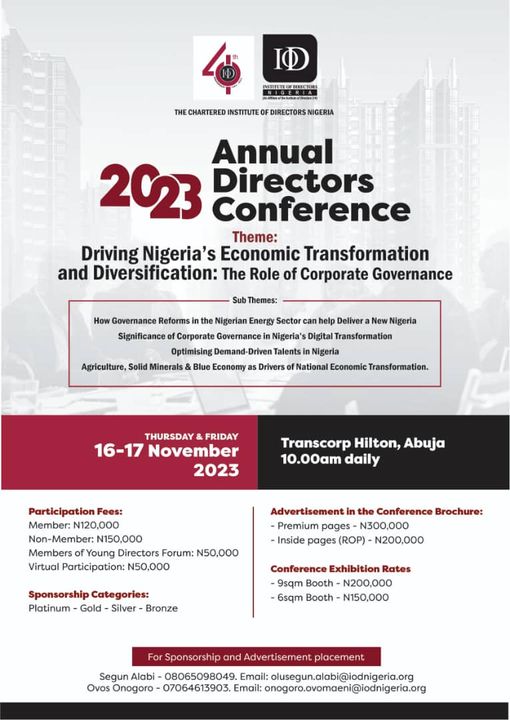
    The Chartered Institute of Directors Nigeria (CIoD Nigeria), the premier corporate governance Institute and a leading promoter of ethical professional standards in Nigeria, has concluded plans to host the 2023 edition of its Annual Directors Conference at the Transcorp Hilton Hotel, Abuja on Thursday 16 and Friday 17 November 2023 at 10 am daily. The theme for this year’s edition is Driving Nigeria’s Economic Transformation and Diversification: The Role of Corporate Governance.

    Mr. Dele Alimi, Director General/ Chief Executive Officer of CIoD Nigeria said: “This edition of the conference will be the largest gathering of Directors and boardroom executives in Africa, as it brings together boardroom gurus, trailblazing entrepreneurs and change-makers in the Nigerian economy. The Conference is intended to provide a platform for participants to learn unlearn,  relearn, network and unlock new growth opportunities.”

    According to the Institute, a special Business Meets Government Dinner will hold on Thursday, 16 November, 2023 at 6pm as part of the two-day conference, to create a networking platform for private sector organizations to interact with various Ministries, Departments and Agencies of government on possible collaborations and partnerships.

    The Director General added that, “Notable among expected guests at the conference are: President Bola Ahmed Tinubu, GCFR as Special Guest of Honour; Mr. Ernest Ndukwe as Chairman of the occasion; Mr. Olusegun Aganga as Keynote Speaker, Mr. Wale Edun; Hon. Doris Anite; Hon. Mamman Tahir as Guests of Honour and other notable personalities as discussants, speakers, and moderators”

  • Comercio Partners Weekly Markets Round-up

    Comercio Partners Weekly Markets Round-up

    President Bola Tinubu’s assurance of a strategic plan to enhance Nigeria’s foreign exchange liquidity offers a beacon of hope for economic stability. Addressing market challenges at the 29th Nigerian Economic Summit, Tinubu outlined priorities including poverty alleviation and anti-corruption measures, emphasizing the need for a results-driven public service. Minister of Finance, Wale Edun, projected an influx of approximately $10 billion in the short term, aimed at tackling forex backlog and shoring up the naira. This anticipated infusion, coupled with forthcoming initiatives like student loan program and consumer credit schemes, signifies a concerted effort to reinvigorate the economy.

    Despite these efforts, the forex market grapples with liquidity issues, resulting in further naira devaluation. Plans to broaden the official currency market to include bureaux de change and fintech firms indicate a recognition of the need for a more inclusive and agile system. The successful implementation of proposed reforms is eagerly anticipated, with a transparent and efficient forex market being pivotal in stabilizing the naira and attracting foreign investment. Collaborative efforts between public and private sectors, aligned with President Tinubu’s vision, will be key to Nigeria’s journey towards economic resilience. With a clear roadmap and united efforts, Nigeria is poised for a more vibrant financial future.

    Money Market

    During the past week, interbank market rates showed an upward trajectory, primarily driven by liquidity constraints resulting from CRR debits and the settlement of NTB auctions. Additionally, the recent policy change by the Central Bank of Nigeria, which removed the cap at the SDF window, continued to exert upward pressure on interbank rates. As a result of these factors, the Open Buy Back rate (OBB) saw a substantial week-over-week increase of 1,290 bps, reaching its peak at 14.40%. Simultaneously, the Overnight rate (O/N) experienced a significant rise of 1,255 bps, reaching 14.75%.

    We anticipate a slight decrease in rates, contingent on the possibility of SRA being credited into the system.

    Treasury Bills

    Amid tight interbank liquidity conditions in the money market, the Treasury Bills market adopted a cautious approach at the beginning of the week. This cautious outlook was further intensified by the NTB auction conducted on Wednesday, where the DMO offered ₦108 billion across 91-day, 182-day, and 364-day maturities, ultimately allotting ₦370.33 billion, surpassing the total subscription of ₦638.14 billion. The auction’s stop rates settled at 5.90%, 9.00%, and 13.00%, marking a departure from the previous rates of 3.67%, 5.11%, and 9.25%. 

    Following this auction, investor interest predominantly gravitated towards the recently issued 1-year Treasury bill (24-Oct-24), resulting in most transactions closing in the 12.70% range by the week’s end, while other longer-dated securities were being bid around the 11.50% range. Consequently, the average benchmark yield experienced an increase of 34 bps throughout the week, culminating at 6.73%.

    We expect a cautious approach in anticipation of SRA inflow.  

    FGN Bond Market

    The FGN Bonds market traded on a bearish mode all week as offers were seen on the mid to long end of the curve with only a handful of demand on the short end of the curve. Thus, average benchmark yield inched higher by 41 bps, closing the week at 15.05%.

    We foresee a continuation of this trend in the upcoming week.

    Eurobond Market

    The FGN Eurobonds kicked off the week on a positive note, buoyed by the Finance Minister’s announcement of an anticipated $10 billion injection into the economy, which sparked heightened buying interest. This bullish sentiment remained intact throughout the week, despite Federal Reserve Chair Powell’s guarded stance, the US posting better-than-expected Q3 GDP results at 4.90% (versus the projected 4.20% and the previous Q2 figure of 2.10%), and the US PCE figures aligning with market expectations at 3.70% (compared to the previous figure of 3.80%). The average benchmark yield concluded the week 81 bps lower at 11.85%.

    As we look ahead, we foresee a prudent approach in the forthcoming session.

    Currency Market

    The value of the Naira to the dollar appreciated by 227 bps week-on-week to print at ₦789.94/$ this week at the Investors and Exporters FX Window.

    Equities Market

    The local stock market displayed a bullish trend in the past week, as indicated by the daily increase of 8 bps in the NGX All-Share Index (NGXASI) and a weekly gain of 33 bps, closing at 67,136.58 points. Consequently, year-to-date returns surged by 31.00%. Additionally, the overall market capitalization, which settled at ₦36.89 trillion, recorded a week-on-week uptick of ₦126 billion. Interestingly, the market breadth stood at 0.93x, signifying 42 stocks declining versus 39 advancing.

    Upon analyzing the comprehensive trading statistics, the total trading volume expanded by 4.01%, reaching 214.15 million units, while the total traded value contracted by 18.84%, totaling ₦5.18 billion. On a week-on-week analysis, Access Corporation (169.82 million units), Fidelity Bank (144.21 million units), and United Bank for Africa (133.25 million units) were the stocks with the highest trading volumes, while GTCO (₦3.88 billion), ACCESSCORP (₦2.83 billion), and UBA (₦2.55 billion) were the top performers in terms of trading value.

    Looking forward, we anticipate a continuation of similar market dynamics in the upcoming trading session.

  • Feature: Nigerian Governors Forum should support the search for Chinese solutions to the country’s woes

    Feature: Nigerian Governors Forum should support the search for Chinese solutions to the country’s woes

    By Ayo Akinfe

    After 100 days and no coherent economic policy from the Tinubu administration, maybe it is to time for us to turn our attention to the Nigerian Governors Forum as we search for a Chinese solution to our woes

    [1] I am sure that like me, the rest of you do not know where the Tinubu administration stands on economic policy. Is it a Keynesian interventionist government or one that believes in laissez-faire free market economics?

    [2] If I were an investor looking at the Nigerian market, I would like to know policy direction before committing myself. How I wish I was in India to hear how Wale Edun would respond to all these questions

    [3] While we are waiting from answers from Abuja, maybe focusing on the states might be the way forward. To be fair, our federating units did strive to be economically independent during the First Republic. It was Major General Thomas Aguiyi-Ironsi’s Unification Decree 34 of 1966 that stripped the federating units of their authority and vested almighty powers in the federal government

    [4] Since then, we have just dug ourselves deeper into this oil dependency hole. Just to give you an example. In 1959, the federal prime minister Abubakar Tafawa-Balewa unveiled a budget of £50m but Obafemi Awolowo, the premier of the Western Region unveiled a budget of £55m. Can you imagine a Nigerian state governor coming up with a budget greater than the federal government today?

    [5] Well, as fanciful as this might sound, it is something that should happen. If say Bayelsa State has a thriving shipbuilding, boatmaking, submarine construction and maritime industry, it would generate a lot more than the paltry $28bn that is the federal government’s 2020 budget projection

    [6] Likewise, if Kogi State had leveraged its unique position as the location of the confluence of the rivers Niger and Benue and established thriving tourist, power generation, maritime transport, manufacturing, etc industries based on it having Ajaokuta within its domain, it would generate more money than oil brings in

    [7] As we all know, airports like Heathrow, Cairo, Dubai, Amsterdam and Addis Ababa have built themselves into economic powerhouses using their locations as regional hubs. Calabar is the gateway to central, east and southern Africa and were successive Cross River State governments alive to this, by now, the Calabar Airport would have been a regional aviation hub and a massive cash cow, generating something like $10bn a year

    [8] I can go on and on. If we take each of Nigeria’s 36 states, you will find that every one is sitting on a hidden gold mine that just needs to be tapped into. However, the oil doom destroyed our ability to think, dulled our capacity to be innovative, ruined our initiative and demolished the building blocks laid by people like Obafemi Awolowo

    [9] I am certain that we will bounce back from this stronger. You just need to see how much China has generated from the kung fu industry since 1931 to appreciate the fact that necessity is the mother of invention. In 1931, the Japanese invaded China, capturing Manchuria, imposing a ruthless colonial oppressive regime on them. This imperial control prevented the Chinese from carrying any weapons, so to defend themselves, local people had to learn martial arts. Just look at how much Bruce Lee and Jackie Chan alone generated for the sector between them since then

    [10] China has never looked back since the Japanese invasion. It was used as the catalyst for industrial growth. Fighting back against Japan ultimately led to the 1949 revolution and since then, China has just been on the up and up. I see the collapse in global oil prices as Nigeria’s Manchuria Moment. May petroleum never ever sell for more than $10 a barrel again. This will force us to come up with our own kung fu economic initiatives