Tag: West Africa

  • NCC Lauds Ministerial Initiative on Girls ICT Empowerment, Hosts 185 Students on Industry Excursion Tour

    NCC Lauds Ministerial Initiative on Girls ICT Empowerment, Hosts 185 Students on Industry Excursion Tour

    The Nigerian Communications Commission (NCC) has commended the Minister of Communications, Innovation and Digital Economy, Dr. Bosun Tijani, for championing initiatives aimed at empowering the younger generation with digital knowledge and skills, especially the Nigerian girls.

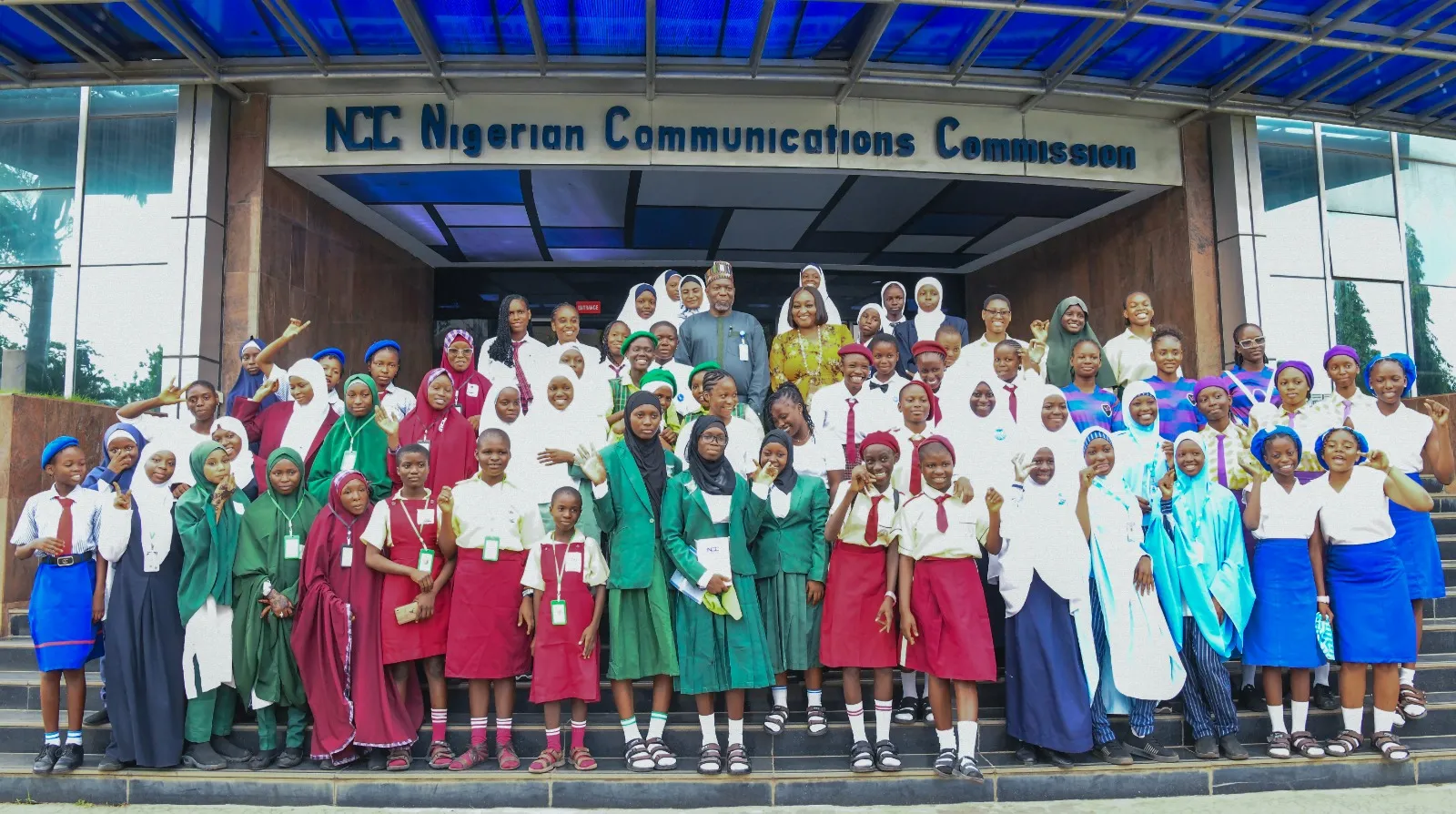
    Speaking while conducting 185 contestants of the 2026 National Girls in ICT (NG-ICT) Competition on a tour of the National Communication Museum domiciled at the Commission in Abuja on Thursday, the Executive Vice Chairman (EVC) of the NCC, Dr. Aminu Maida, said the initiative also aligns with the Commission’s digital literacy advocacy.

    According to a statement by the NCC Spokesperson, Nnenna Ukoha, the contestants were selected by the Ministry across the country’s geo-political zones for competition to promote digital inclusion and inspire greater participation of girls in Information and Communication Technology (ICT) and other Science, Technology, Engineering and Mathematics (STEM) disciplines.

    The visit to the Commission by the students formed part of activities organised by the Minister under the National Girls in ICT Programme, an initiative aimed at bridging the gender gap in the technology sector by equipping young girls with digital skills, mentorship opportunities and exposure to innovation.

    Maida, who was represented by the Director, Research and Development Department, Babagana Digima, noted that the museum tour was designed to create a link between the old and new generations in Nigeria’s telecommunications journey, helping young people appreciate the sector’s transformation from analogue systems to the current digital revolution.

    During the study tour, NCC officials guided the students through exhibits and historical artefacts that document key milestones in Nigeria’s telecommunications history and the evolution of the communications sector to date. He emphasised that understanding the industry’s history would inspire the participants to contribute meaningfully to the future of digital innovation in Nigeria.

    The EVC noted that exposing young people to the history of technological advancement and innovation is essential to building a new generation of leaders for Nigeria’s growing digital economy.

    “The whole idea behind this is that we are looking at the younger generation. We want to show them what communication is all about. This place is a museum meant to preserve the history of what has gone before and to keep the artefacts, ensuring that people see the evolution from the postal system to telegraphy, from analogue systems to the digital era.

    “This is essentially what we are showing them in the shortest amount of time and, of course, to excite the curiosity of the young ones. When they see what happened in the past and how it has progressed into the future, they can also take it up from here and think about what it will look like going forward. That is the whole essence of having them here,” he said.

    During the tour, the participants learned about generational trends in telecommunications development, dating back to 1886 when the colonial administration established first communication facilities primarily to support administrative functions.  They were also taken through the history of the country’s early telegraph services, which linked Lagos to other parts of West Africa and Europe through submarine cable connections.

    The tour highlighted the state of telecommunications at Independence in 1960, when Nigeria had only 18,724 telephone lines serving an estimated population of about 40 million people. The students were also briefed on various development plans that followed Independence, the operations of the former Department of Posts and Telecommunications (P&T) and Nigerian External Telecommunications (NET) Limited, as well as the establishment of the Nigerian Telecommunications Limited (NITEL) in 1985 to coordinate the provision of internal and external telecommunications services.

    A major highlight of the visit was the display of rare historical artefacts preserved at the NCC Museum. Among the exhibits were a Post Office Counter dating back to 1852, Sorting Racks introduced to Lagos in 1852, the Grand “T” Key used at the Lagos Post Office in the nineteenth century, leather mail bags dating back to 1863, Drop Bag fittings from the late 20th Century, a 511A Letter Scale from the mid-20th Century, an Improved Dynamometer Scale from the 1920, Telegram machines, Teleprinter T100, Cordless PBX, Digital Card Phone and others.

  • The Bourse Opens Green, Investors gained N 714.33 billion

    The Bourse Opens Green, Investors gained N 714.33 billion

    …The Naira depreciated by 0.05% to close at N 1362.84

    The index opened the week in positive territory, with the All-Share Index (ASI) gaining 0.46% to settle at 243,707.07 points. This positive start extends the recovery momentum seen at the end of the previous week, where the market rebounded into the green after a four day bearish streak.

    Market performance was buoyed by gains in FCMB, ARADEL, FIRSTHOLDCO, MTN. GTCO, and 27 other gainers.

    Consequently, the market’s (YTD) return advanced to 56.61%, while market capitalization appreciated by 0.46% to close at N 156.30 trillion. This upward movement translates to a \714.33 billion gain for investors.

    The market closed mixed today, with three sectors advancing, one declining, and one unchanged. The Oil Gas Index emerged as the day’s top performer, climbing 0.87% on the back of strong investor demand for heavyweights including OANDO, ARADEL, and

    ETERNA The Insurance Index also posted a strong session, ad%Æncing 0.62% as the sector’s gains were firmly anchored by INTENEGINS, CONHALLPLC, LINKASSURE, and SOVRENINS. Close behind, the Banking Index rose 0.59%, driven by positive momentum in FCMB, WEMABANK, ZENITHBANK, and GTCO. Conversely, the Consumer Goods Index suffered a notable hit, sliding 1.33% into negative territory as profit-taking was seen NB. Meanwhile, the Industrial Goods Index closed the trading session completely flat, showing no net movement for the day.

    MARKET ACTIVITY:

    Market activity was positive, as traded volume increased by 17.86% to 717.15 million units, while total value also moved up by 76.38% to settle at

    MARKET BREADTH:
    The market breadth, which measures investor sentiment through the Gainers/Losers ratio, fell to I .07x from 3.55x as 32 stocks appreciated, 30 stocks depreciated, and 69 stocks closed flat.

    The Naira went up by 0.05% to close at N1362.84

  • FirstBank, Visa Launch Naira Visa Debit Card to Accelerate Nigeria’s Cashless Payments Drive

    FirstBank, Visa Launch Naira Visa Debit Card to Accelerate Nigeria’s Cashless Payments Drive

    Affordable, widely accepted, and built for everyday spending, the Naira Visa Debit Card brings electronic payments within reach for millions of Nigerians

    First Bank of Nigeria Limited has announced the launch of its Naira Visa Debit Card, in partnership with Visa to extend accessible, reliable electronic payment capabilities to a broader segment of the Nigerian population.

    The card is targeted at everyday consumers who require a dependable payment instrument for routine domestic and international transactions. Accepted across POS terminals, ATMs, and online platforms through Visa’s payments network, the Naira Visa Debit Card is designed to reduce friction for customers transitioning from cash to electronic payments across retail, utilities, and digital commerce.

    The launch aligns with Nigeria’s ongoing drive toward a cashless economy, a policy direction that has gained significant momentum following successive Central Bank of Nigeria directives encouraging the adoption of electronic payment channels. The card is intended to serve customers across the country’s diverse economic segments.

    Speaking on the launch, Chuma Ezirim, Group Executive, eBusiness & Retail Products, FirstBank, said: “Everyday transactions should be simple, secure, and rewarding. The Naira Visa Debit Card is designed to make life easier for our customers, whether they are paying for groceries, settling utility bills, or shopping online. By extending reliable electronic payment access across Nigeria, we are helping more people transition confidently from cash to digital payments, supporting the nation’s cashless policy and empowering communities with greater financial inclusion.”

    Commenting on the strategic importance of the partnership, Andrew Uaboi, Vice President and Cluster Head, West Africa, Visa, noted: “A strong payments ecosystem is one that works for everyone. The Naira Visa Debit Card extends reliable electronic payment access to everyday Nigerian consumers, and this in addition to the cards in our portfolio continues to demonstrate what a truly comprehensive card portfolio looks like for the Nigerian market. Visa is proud to power this offering with FirstBank.”

    The launch of the Naira Visa Debit Card broadens Visa card portfolio at FirstBank that already includes products spanning credit cards and High-end premium lifestyle spending cards. The addition completes its offering across customer segments, ensuring that cardholders at every income level have access to a product suited to their needs.

    The Naira Visa Debit Card is available to all eligible FirstBank account holders through any of the bank’s branches nationwide.

  • FirstBank, Visa Expand Premium Card Portfolio with Visa Signature Launch

    FirstBank, Visa Expand Premium Card Portfolio with Visa Signature Launch

    Designed for Nigeria’s affluent segment, Visa Signature unlocks world-class benefits through Visa’s global network across travel, lifestyle, and premium merchant offers.

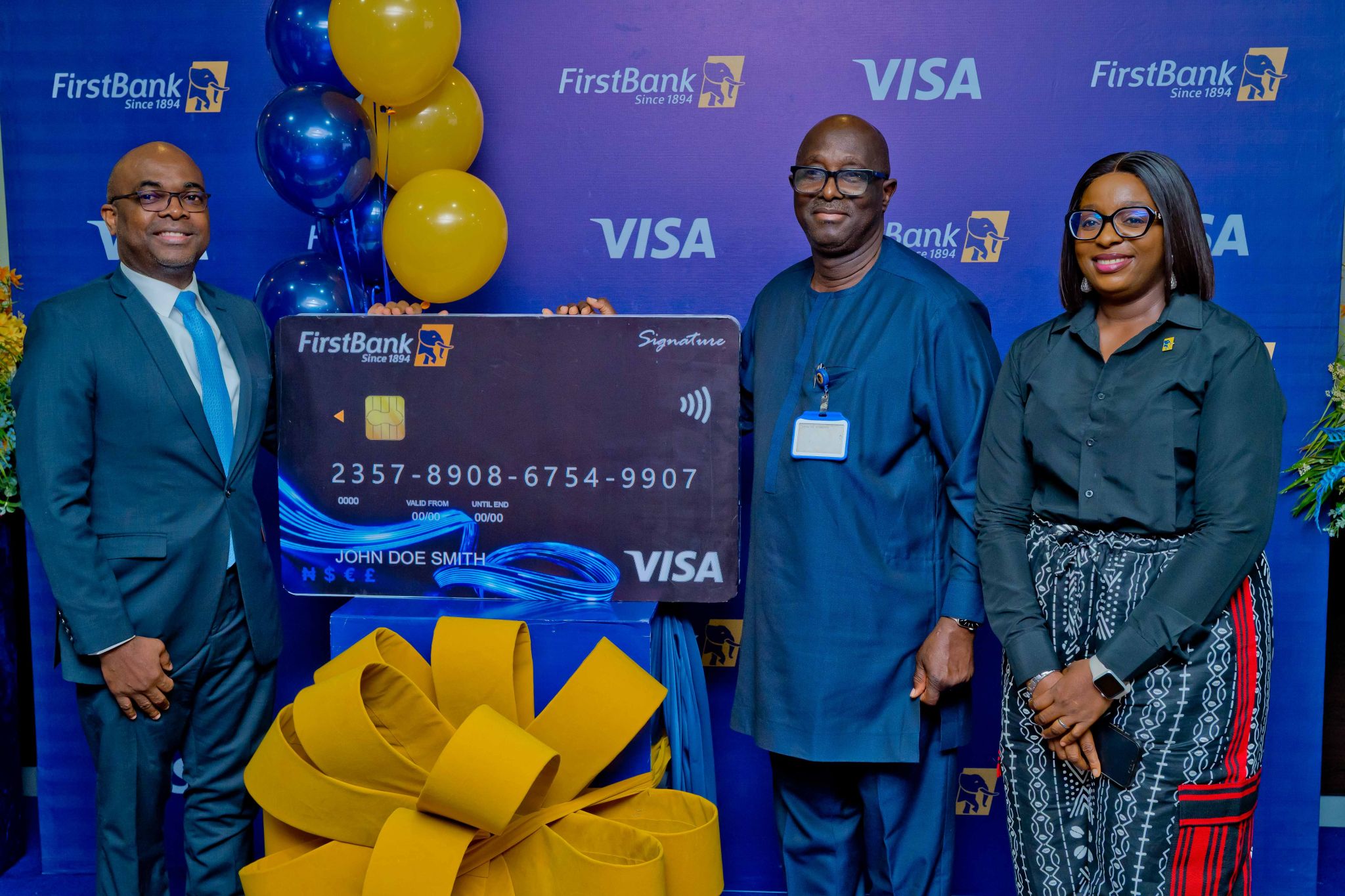
    First Bank of Nigeria Limited, in partnership with Visa, has announced the launch of Visa Signature, a premium card offering designed for Nigeria’s affluent segment. The card unlocks an exclusive portfolio of lifestyle benefits, global travel privileges, and curated merchant offers through Visa’s worldwide acceptance network, giving high-spending Nigerians a product built around how they live. 

    Visa Signature targets Nigeria’s top executives, business owners, and frequent international travellers who expect more from their financial products. Through Visa Global benefits and Visa Destination offers, cardholders gain access to preferential rates, premium experiences, and priority services across hundreds of partner merchants, hotels, airlines, and destinations around the world. The card supports both domestic and cross-border transactions, ensuring seamless payment experiences whether cardholders are in Lagos, London, or Dubai.

    Commenting on FirstBank’s ambition for its premium cardholders, Chuma Ezirim, Group Executive, eBusiness & Retail Products, FirstBank, said: At FirstBank, we are dedicated to creating financial solutions that reflect the evolving lifestyles of our customers. We understand that our premium customers aspire to experiences that reflect their global outlook. Visa Signature is crafted to meet those expectations, offering access to exclusive experiences, global connectivity, and lifestyle privileges that empower our customers to live without boundaries. We remain focused on creating value and reinforcing our position as the partner of first choice for Nigerians at home and abroad.”

    Highlighting the strategic importance of the FirstBank partnership, Andrew Uaboi, Vice President and Cluster Head, West Africa, Visa, noted: “Nigeria’s affluent consumers are among the most active and globally connected spenders on the continent. Visa Signature is designed to serve that profile with the depth of benefits and the breadth of acceptance they deserve. We are delighted to work with FirstBank in making this available to the Nigerian market.”

    The launch marks a strategic step for FirstBank in deepening its premium product offering. FirstBank’s existing Visa portfolio already serves millions of Nigerians across everyday retail, cross-border commerce, and online transactions through Visa Infinite, Visa Gold, Naira Credit, and Visa Prepaid cards. Visa Signature adds a dedicated tier for the affluent segment, giving this customer group the recognition and privileges their spending profile demands.

    Visa Signature is available to eligible FirstBank customers. Interested customers can visit any FirstBank branch nationwide or contact their dedicated relationship manager to apply.

  • Lagos unveils Industrial Policy 2025-2030, positions Lagos as leading Manufacturing Hub in Africa

    Lagos unveils Industrial Policy 2025-2030, positions Lagos as leading Manufacturing Hub in Africa

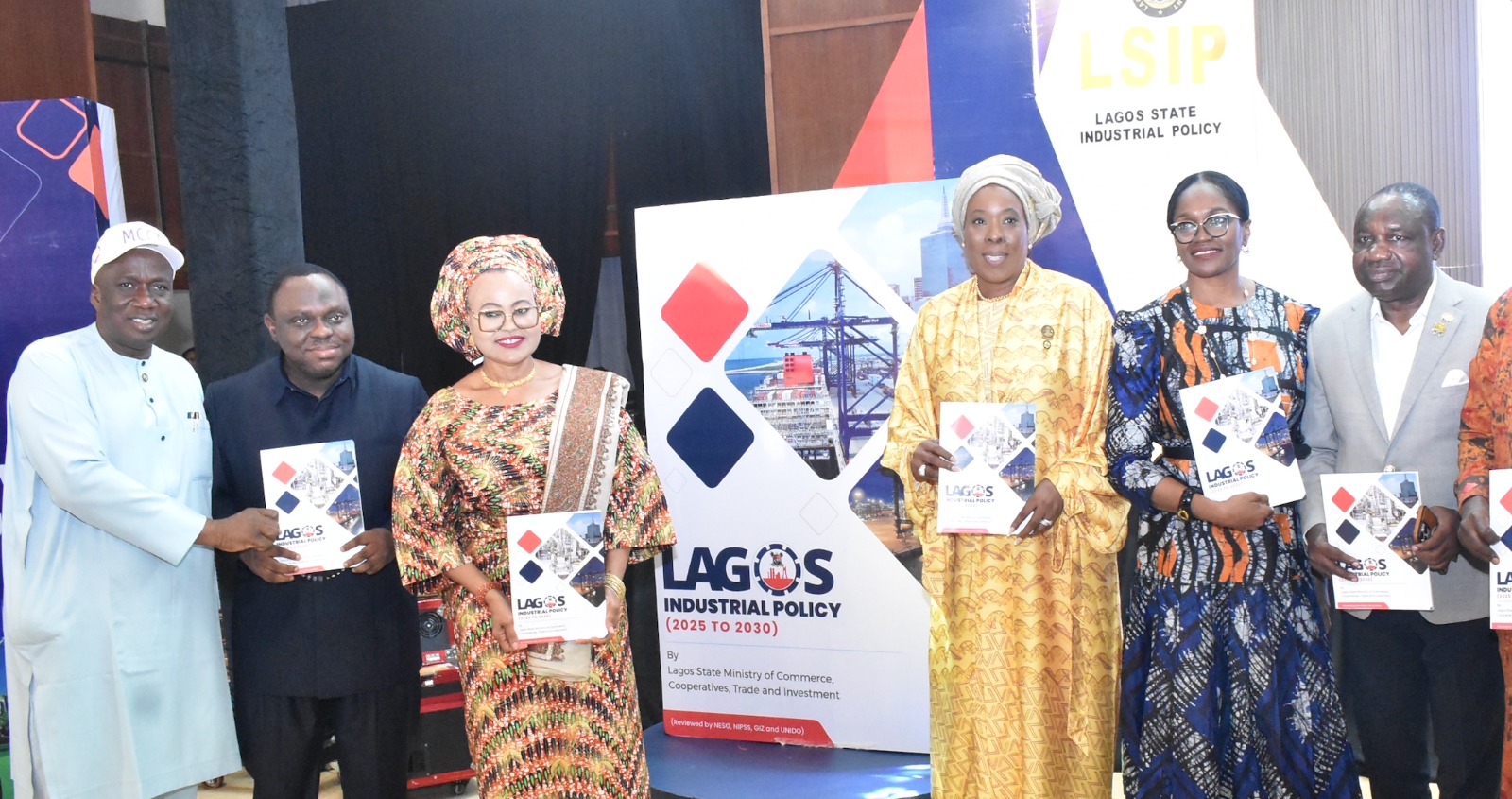
    Lagos State Government has unveiled its Industrial Policy 2025-2023 designed to transform the state’s industrial sector, attract local and foreign direct investment into priority sectors, and strengthen institutional coordination, translating the policy commitments into real outcomes for the people of the State.

    Lagos State Governor, Babajide Sanwo-Olu led eminent members of the diplomatic corps, senior government officials, captains of industries and others at the event held in Lagos on Thursday,

    Speaking at the ceremony, through the Secretary to the State Government, Barrister ‘Bimbola Salu-Hundeyin, Governor Sanwo-Olu stated that the new industrial policy is both urgent and compelling for a state that has long been the commercial heartbeat of Nigeria, and a vital gateway to West Africa.

    His words: “The global industrial landscape is changing rapidly. Supply chains are evolving, technology is redefining production systems, and competitiveness is increasingly determined by efficiency, by innovation, and by resilience, with scale alone no longer sufficient to secure the markets of the future.

    “To remain at the forefront, Lagos must do more than adapt. We must lead. This policy is our considered response to that imperative. It is designed to address longstanding structural challenges, to unlock new growth opportunities, and to ensure that our industrial sector becomes a powerful engine for inclusive economic development across this State.”

    According to the Governor, the policy is firmly anchored in the broader development vision, aligning seamlessly with the T.H.E.M.E.S Development Agenda, particularly in advancing a 21st‑century economy, in strengthening infrastructure, and in fostering sustainable growth. It is equally aligned with the Lagos State Development Plan 2052, which envisions Lagos as a globally competitive megacity driven by productivity, by innovation, and by industrial excellence.

    “At its core, the policy is built on clear and strategic pillars; prioritising industrial infrastructure development; committing to regulatory reform and the ease of doing business; strengthening access to finance and investment promotion; advancing skills development and workforce readiness; and promoting innovation, technology adoption, and sustainability.

    “From these pillars flow clear and measurable deliverables. We will expand and optimise industrial clusters and estates across the State. We will improve the efficiency of our port system, as is being done through the Lekki Deep Sea Port, and of our broader transport networks, to reduce the cost of moving goods. We will support small and medium‑scale manufacturers to scale their operations and to integrate into both regional and global value chains,” he said.

    Sanwo-Olu stressed that by prioritising key sectors, and by supporting Nigeria’s commitments under the African Continental Free Trade Area, AfCFTA, the Lagos Industrial Policy acts as an implementation engine that localises national ambitions, accelerates industrial productivity, and positions Lagos as a strategic gateway for Nigeria’s industrial expansion and global competitiveness.

    Representative of the Minister of State/Director, Industrial Inspectorate Department, Federal Ministry of Industry, Trade and Investment, Engineer Eyitope Aina Osinowo, affirmed that the Lagos State Industrial Policy 2025 to 2030 is closely aligned with Nigeria’s National Industrial Policy, translating federal priorities into targeted, State‑level actions that reflect the economic realities and the competitive advantages of Lagos.

    “By focusing on a competitive and productive industrial base, Lagos is providing a practical model that supports the Federal Government’s objectives of job creation and poverty alleviation through industrial growth. The Federal Ministry of Industry, Trade and Investment views Lagos State as a critical partner. We recognize that for Nigeria to achieve true industrialisation, we must our attention on strengthening infrastructure and others as reflected in the LSIP,” he said.

    Commissioner for Commerce, Cooperatives, Trade and Investment, Folashade Ambrose-Medebem, described the Industrial Policy 2025-2030 as more than a policy, but a covenant between the government and more than twenty‑five million Lagosians whose ambition powers this city every single day.

    “To the captains of industry in this hall, the State has done its part. Bring your capital, your capacity, and your conviction, and Lagos will reward each of them. To our partners in the financial sector, we say this. Lagos is, today and for the foreseeable horizon, the highest‑yielding industrial portfolio on this continent. Price it accordingly. Allocate to it accordingly. Underwrite it accordingly. To the academic community, we say this. Build with us the talent pipelines that this policy will demand, for an industrial strategy without skilled hands is a strategy on paper alone, and we did not labour over this policy to leave it on paper. To our friends in the development sector, we say this. Lagos is ready, more than ready, to convert technical assistance into measurable industrial output, and to do so on timelines that will repay your patience. To our brothers and sisters in the diaspora, we say this. The home you carry in your hearts is now ready for the investment you carry in your hands. Come home to invest. Come home to build. Come home to Lagos.”

  • Nigerians use Search and AI to develop new creative skills and master the arts in 2026

    Nigerians use Search and AI to develop new creative skills and master the arts in 2026

    Google today shared new data highlighting how people across Nigeria are turning to Search and AI tools to master the skills they need for their creative pursuits. The latest trends for March 2026 highlight a significant shift toward using technology as a practical assistant for artistic growth and personal hobbies.

    Nigeria has a long history as a major creative hub in Africa, and its influence is visible globally. The nation is famed for its creative culture, from a critically acclaimed Afrobeats scene to the global success of Nollywood blockbusters. Nollywood is currently the fifth-largest movie and entertainment industry in the world and has seen its gross value grow to $8 billion. This creative output is highly exportable, and research shows that over 70 per cent of watch time for content produced by Nigerian channels comes from outside the country. Similarly, the Afrobeats genre has gained a massive international fanbase with songs being streamed more than 13 billion times in a single year on platforms like Spotify. These achievements highlight a rich legacy that young Nigerians are now building upon with new digital tools.

    This movement is a highly deliberate strategy to master new skills and explore global opportunities. The latest search data shows that Nigerians are masterfully using technology to develop their artistic talents. Interest in learning painting has grown by 90 per cent over the past year, while searches for calligraphy have emerged as a breakout trend this month, as people find new ways to express themselves through art . These trends demonstrate Nigerians’ everyday resourcefulness as they use accessible technology to bridge skill gaps.

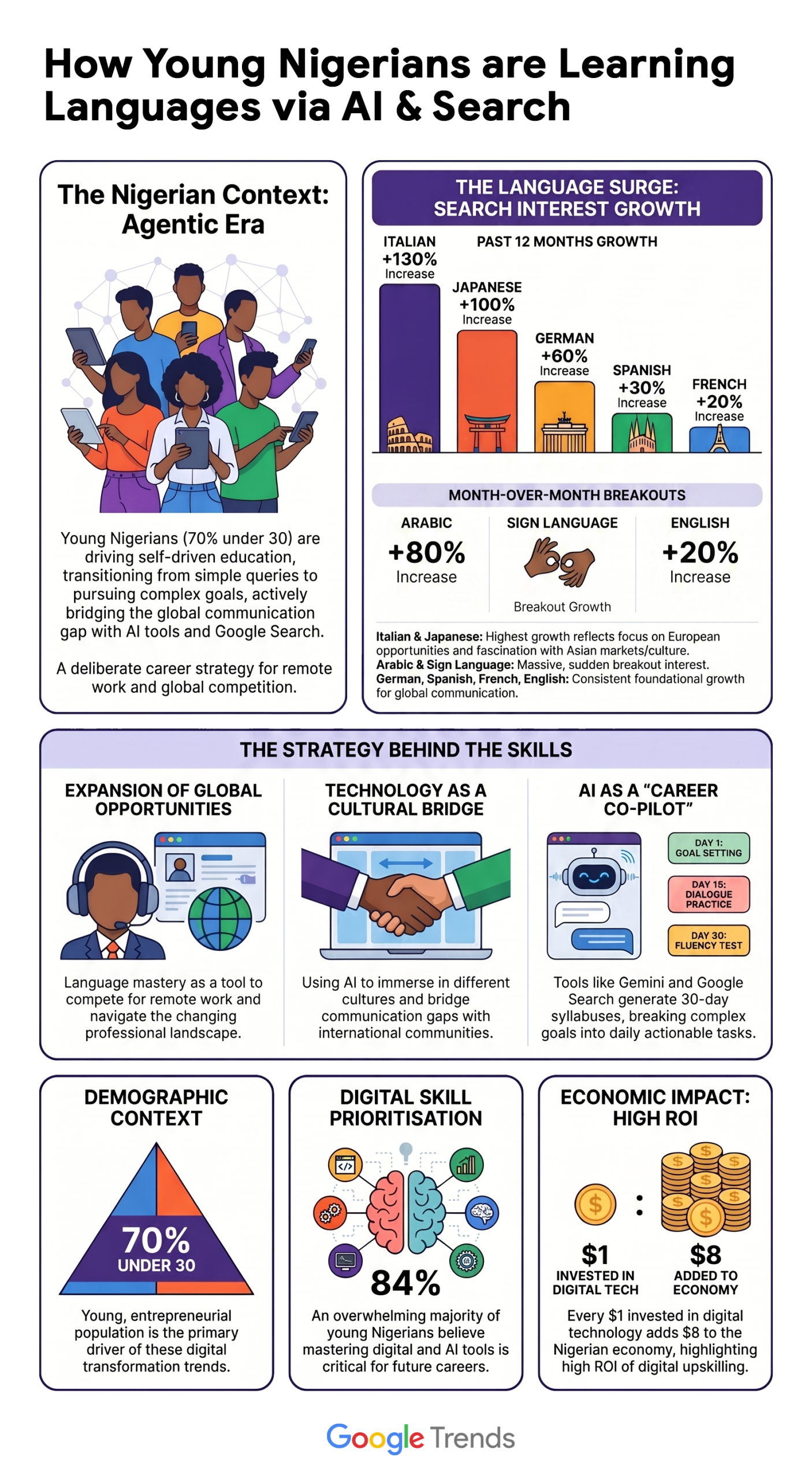
    Musical pursuits are also seeing strong momentum in the data. People are turning to their phones to master musical instruments, with searches for learning the guitar increasing by 80 per cent recently. The creative exploration extends to advanced technology as people look for AI musical tools like Lyria 3, which has become a breakout trend this year. Personal mastery also includes learning new languages to connect with the world. Interest in learning Italian has risen by 130 percent and interest in Japanese has doubled over the last twelve months. These activities demonstrate how technology serves as a practical tutor for artistic growth and international connection.

    The move toward mastering new creative skills is happening within a growing digital economy where every dollar invested in technology creates an eight-dollar return for the nation. Industry analysts at Public First have noted that digital technologies are spearheading growth and development in Nigeria. Their research underscores the value of digital transformation by estimating that every dollar invested in digital technology generates over eight dollars in economic value . This investment supports a young population that is already making significant contributions as the ICT sector recently contributed over 16 percent to real GDP.

    Students and parents are also finding new ways to use these tools for school and creative work. Searches for AI tutors have become a breakout trend and interest in chemistry combined with AI tools has doubled in the last year . General school support is also seeing growth as homework related searches rose by 70 percent this month . These search trends are supported by infrastructure projects like the Equiano subsea cable which provides twenty times more network capacity than previous systems . Better connectivity supports economic growth as a one percent increase in connectivity is associated with a 5.7 percent increase in GDP .

    “It is inspiring to see how Nigerians are creatively and purposefully using AI to unlock new opportunities for learning and growth. The surge in creative arts and language mastery shows a nation that is actively shaping its future with technology. Nigerians are using Search and AI as 24/7 tutors to master high demand skills and connect with the world. This everyday resourcefulness is helping our entrepreneurial population achieve their highest ambitions.” says Taiwo Kola-Ogunlade, Head of Communications & Public Affairs, West Africa, Google.

    Google remains committed to providing the helpful technology that turns these ambitions into everyday skills for everyone across the country . Through products like Search and Workspace knowledge workers in Nigeria are already saving over 22 million hours every week . This time saving is equivalent to a 4.7 billion dollar improvement in productivity across the nation . The surge in AI literacy which has grown by 840 percent demonstrates a purposeful move by Nigerians to integrate technology as a critical sidekick in their professional and creative lives .

  • Zenith Bank Plc acquires Paramount Bank Kenya Limited

    Zenith Bank Plc acquires Paramount Bank Kenya Limited

    Zenith Bank Plc has announced the completion of its acquisition of the entire issued share capital of Paramount Bank Kenya Limited, following the receipt of all requisite regulatory approvals in Kenya and Nigeria.

    This acquisition marks a significant step towards our long-term strategic growth agenda and a strong inroad into the East African markets. It further reinforces the Bank’s position as a leading financial institution in Sub-Saharan Africa and affirms the Bank’s mantra of following our customers’ businesses.

    In a statement released on 7 April 2026, the Lagos-based bank confirmed that it had acquired 100 percent of Paramount Bank’s issued share capital following approvals from regulators in both Nigeria and Kenya. The deal, first announced in November 2025, represents Zenith’s first direct foothold in East Africa, a region increasingly targeted by West African financial institutions.

    The bank described the transaction as a “significant step” in its long-term growth ambitions, noting that it reinforces its position as a leading financial institution across sub-Saharan Africa. It added that the acquisition aligns with its strategy of supporting customers as they expand across borders, particularly into high-growth African markets.

    Regulatory clearance for the deal was granted by the Competition Authority of Kenya in January 2026, after determining that the acquisition would not substantially reduce competition within the sector. The regulator classified the transaction as a notifiable merger because its value exceeded KSh1 billion, equivalent to approximately $7.7 million at current exchange rates.

    In approving the deal, the authority stated that the deal was “unlikely to lead to a substantial prevention or lessening of competition,” but imposed a key condition requiring Zenith to retain all 78 employees of Paramount Bank for at least 12 months. The provision is intended to safeguard jobs during the transition period.

    Final approvals were also secured from the Central Bank of Kenya and the Central Bank of Nigeria, clearing the way for the transaction’s completion.

    Although Paramount Bank ranked 33rd out of 39 licensed banks in Kenya as of December 2024, analysts view the acquisition as a strategic entry point into a competitive but fast-growing market. Kenya’s banking sector has attracted increasing interest from regional players, including Nigerian lenders such as Access Bank Plc, United Bank for Africa, and Guaranty Trust Holding Company.

    Zenith’s expansion builds on its existing presence across West Africa and its international operations in the United Kingdom, the United Arab Emirates, China, and South Africa. By acquiring Paramount, the bank gains immediate access to local capabilities in corporate and retail banking, SME lending, trade finance, and bancassurance.

    Customers of the Kenyan lender have been assured of continuity in the short term, with the potential for enhanced products and services as integration progresses. The combined entity is also expected to leverage growing trade links within East Africa and tap into the region’s accelerating adoption of digital banking.

    The acquisition underscores a broader trend of African banks deepening regional integration, as competition intensifies for market share in key economic hubs across the continent.

  • Starsight partners BII to advance clean energy growth in West Africa through US$15 million funding

    Starsight partners BII to advance clean energy growth in West Africa through US$15 million funding

    the funding will drive clean energy growth in Starsight’s existing West African operations, with Nigeria earmarked to receive the majority of the funding

    • Capital will be deployed in Starsight’s existing West African operations to support growth, strengthen operations and scale energy solutions for commercial and industrial users.
    • Majority of the funds will assist in improving power security in Nigeria, where the unstable grid and reliance on diesel self-generation remain key characteristics of the energy sector.
    • The collaboration demonstrates BII’s confidence in Starsight’s long-term commitment to delivering reliable, affordable and sustainable power across the region.

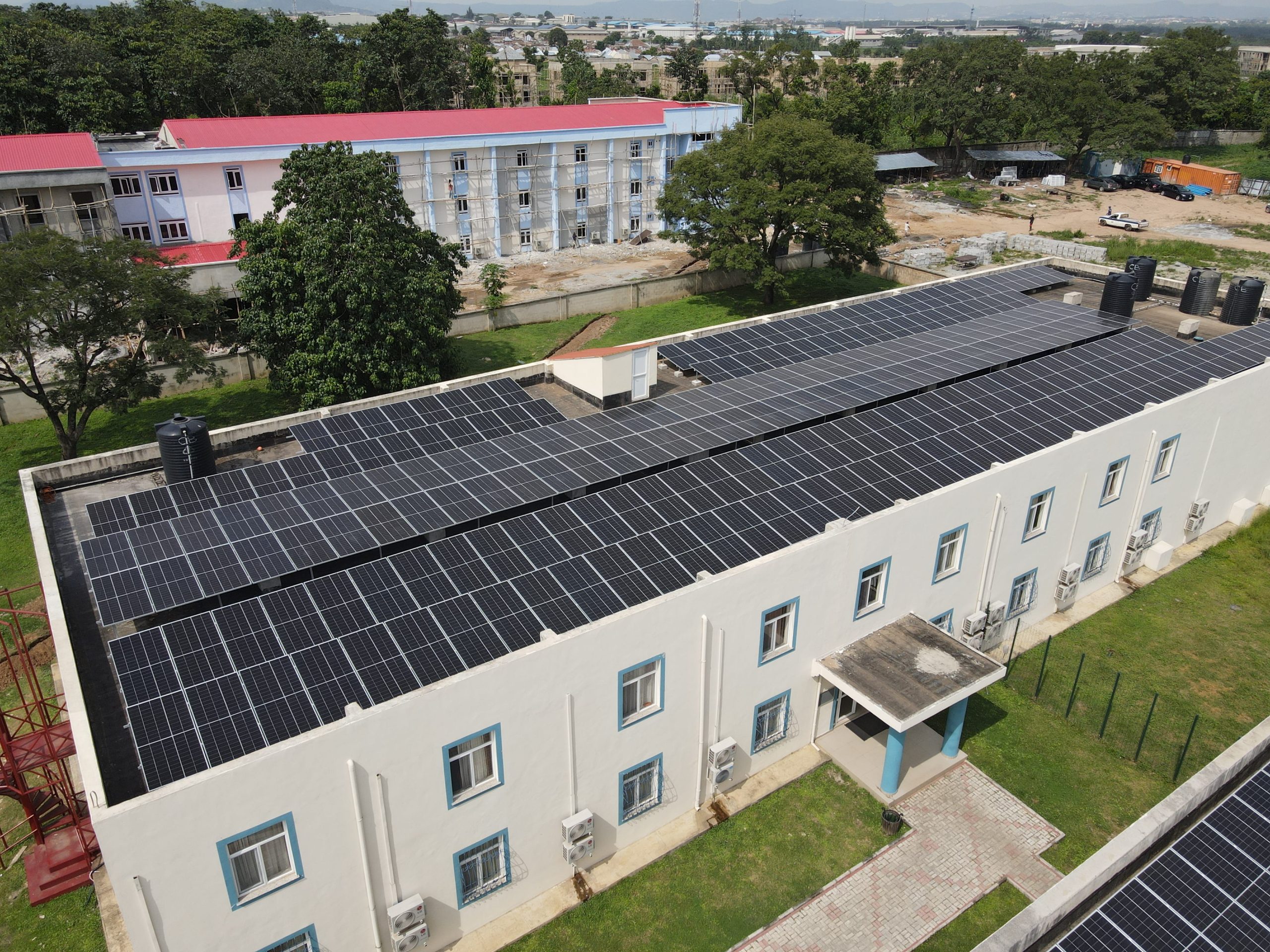
    Starsight Energy Africa Group, a leading provider of clean energy solutions for commercial and industrial (C&I) customers across Sub-Saharan Africa, has secured USD15 million mezzanine debt funding from British International Investment, the UK’s development finance institution and impact investor.

    The funding will drive clean energy growth in Starsight’s existing West African operations, with Nigeria earmarked to receive the majority of the funding. It will finance a substantial growth pipeline of renewable solar energy projects whilst also ensuring best-in-class service is maintained to existing clients including asset replacement.

    The deployment of the funding within Starsight fits well with BII’s strategic objectives to support productive, sustainable and inclusive development. The collaboration between Starsight and BII also underscores a shared commitment to advancing sustainable infrastructure, supporting private sector growth, and driving measurable climate impact across West Africa.

    It has been estimated that up to 40GW of electricity in Nigeria is generated from diesel and petrol generators and Starsight’s funding round with BII is an important stride toward filling this vacuum with clean renewable energy for the C&I sector, says Paul van Zijl, Group CEO at Starsight.

    “Partnering with BII marks a significant milestone for the Starsight Energy Africa Group. This funding strengthens our ability to scale more rapidly in Nigeria and Ghana delivering reliable, clean energy solutions that support economic growth and improve energy resilience for our clients,” says Van Zijl.

    “BII’s mission is to support sustainable socio-economic development in emerging markets. Their decision to partner with us is an endorsement of the role we play in increasing energy access within these markets, delivering affordable, low-carbon solutions while simultaneously uplifting the communities in which we operate,” adds Van Zijl.

    British Deputy High Commissioner in Lagos, Jonny Baxter said: “The UK remains committed to supporting Nigeria’s transition to clean, reliable, and affordable energy. This investment by BII reflects that commitment in action. Expanding access to dependable renewable power for businesses across Nigeria will help unlock growth, strengthen energy resilience, and reduce dependence on costly and polluting diesel and petrol self-generation. It represents a practical step toward a greener, more sustainable future for both our countries.”

    Benson Adenuga, West Africa Regional Director and Head of Office, Nigeria, at BII, says: “Nigeria’s businesses need dependable and affordable power to grow. We identified Starsight’s strong track record, combined with its clean energy model, as a strong fit with BII’s mandate. Starsight’s commercial and industrial solar solutions directly address this challenge by reducing dependence on refined petroleum products and improving reliability. By backing scalable distributed renewable platforms like Starsight, BII is supporting clean energy expansion in West Africa and demonstrating confidence in the region’s potential for sustainable, inclusive growth.”

    Michael Chuchu, Group Commercial Director at Starsight, says that the BII funding will unlock new capacity in countries where energy stability has historically been a barrier to growth.

    “Nigeria remains our second-largest market and a core focus area for expansion. For our West African customers, this investment tangibly proves that Starsight is here to support their operations and provide energy certainty through environmentally responsible solutions.

    “With BII’s support, we’re set to pursue the next chapter of our growth journey,” Chuchu concludes.

  • Google Rolls Out Yorùbá and Hausa Language Support for AI Search Features in Nigeria

    Google Rolls Out Yorùbá and Hausa Language Support for AI Search Features in Nigeria

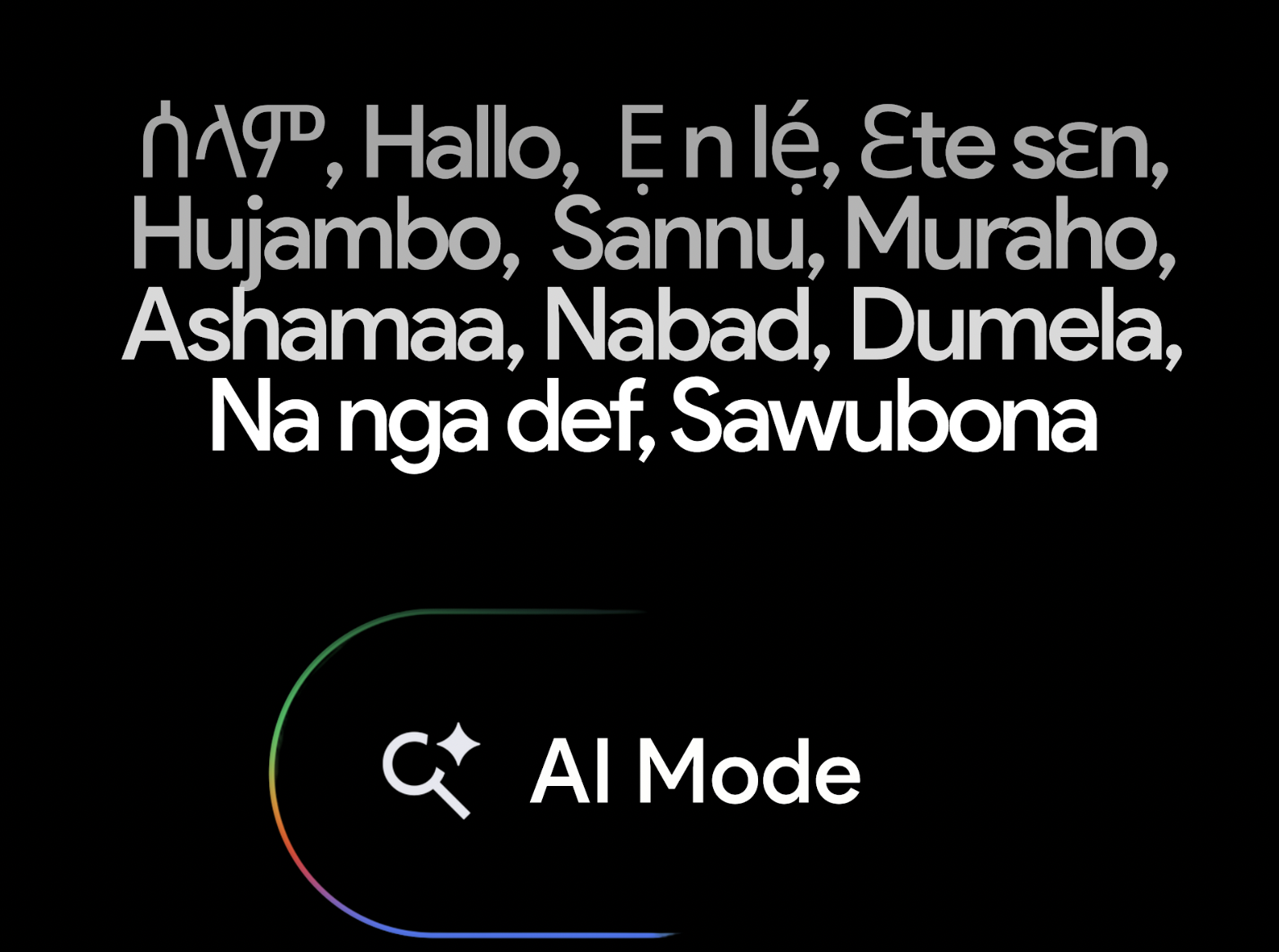
    Google has expanded the language capabilities of its artificial intelligence-powered Search features, AI Overviews and AI Mode, to include Yorùbá and Hausa, enabling millions of Nigerians to access AI-assisted information in their native languages.

    The development allows users who speak these languages to interact with Google Search in a more natural way, using their mother tongue to receive quick summaries of information and explore topics through conversational queries. The update means that users across Nigeria—from students in Kano seeking information in Hausa to traders in Ibadan asking questions in Yorùbá—can now benefit from AI-powered search experiences tailored to their language.

    According to Google, the expansion forms part of a broader effort to make artificial intelligence more inclusive across Africa. With the latest update, Google’s AI Search features now support 13 African languages, significantly widening access to digital knowledge and tools across the continent. By addressing language barriers, the company says the initiative ensures technology better reflects the identity, culture and communication preferences of the communities it serves.

    With enhanced functionality, users can ask complex questions in their preferred language using AI Mode, which provides deeper exploration of information and enables a more conversational, intuitive interaction with the web. The features also support both text and voice input, making them accessible to a broader range of users.

    Speaking on the development, Taiwo Kola-Ogunlade, Communications and Public Affairs Manager, West Africa at Google, said the expansion reflects the company’s commitment to building a truly global and locally relevant Search experience.

    “Building a truly global Search goes far beyond translation — it requires a nuanced understanding of local information,” he said. “With the advanced multimodal and reasoning capabilities of our custom version of Gemini in Search, we’ve made huge strides in language understanding, so our most advanced AI search capabilities are locally relevant and useful in each new language we support. This is about ensuring Nigerians can converse with Search in their mother tongues, making information more helpful for everyone.”

    The 13 African languages now supported by Google’s AI Search capabilities include Afrikaans, Akan, Amharic, Hausa, Kinyarwanda, Afaan Oromoo, Somali, Sesotho, Kiswahili, Setswana, Wolof, Yorùbá and isiZulu. Google said these languages were selected based on strong search activity across the continent and the need to ensure that AI-powered experiences reach communities where they can have the greatest impact.

    Users can access the features by opening the Google app on Android or iOS devices, or via the web, selecting AI Mode within the Search experience and typing or speaking their questions in their preferred language.

    The update marks another step in Google’s efforts to broaden access to AI-powered tools while strengthening digital inclusion across Africa, particularly in countries like Nigeria where indigenous languages remain central to everyday communication.

  • Showmax Unlocks Seamless Subscription Payments in Nigeria via Baxi by Onafriq

    Showmax Unlocks Seamless Subscription Payments in Nigeria via Baxi by Onafriq

    Showmax, Africa’s leading streaming service, has expanded its payment options in Nigeria through a partnership with Baxi by Onafriq, giving customers an easier and more convenient way to subscribe and stay connected to world-class streaming entertainment.

    Starting Monday, 22 December 2025, existing Showmax customers can log into the Baxi by Onafriq app, select and pay for any of Showmax plans including: Showmax Entertainment Mobile, Showmax Entertainment (All Devices), Showmax Premier League Mobile, Showmax Entertainment (All Devices) + Premier League Mobile, Showmax Entertainment Mobile + Premier League Mobile. This update allows customers to complete their entire subscription process within the Baxi app, delivering a more efficient payment experience.

    Alternatively, existing customers with verified mobile numbers can top up their Baxi by Onafriq app or through its Baxi POS agent device to load funds directly into their Showmax account. These funds can then be used to pay for a Showmax plan.

    For new customers, subscribing is also seamless. After creating a Showmax account on their mobile device, they will receive an OTP via SMS or WhatsApp, which allows them to verify their mobile number and immediately return to the app to top up and activate their subscription.

    Speaking on the announcement, Tope Oshunkeye, Executive Head of Marketing, West Africa, MultiChoice, said: “With these new payment options from Baxi by Onafriq, we are making streaming on Showmax more accessible, allowing our customers to pay quickly and securely through a trusted financial service provider. This is a significant step forward in our mission to deliver world-class streaming experiences for our customers”.

    “This launch is about making entertainment access seamless,” said Mxolisi Msutwana, Managing Director, Anglophone West Africa, Onafriq. “By automating the renewal process, we are not only providing greater convenience for customers but also helping to drive the adoption of digital payments across Nigeria.”

    With more people turning to digital services, Showmax is doubling down on its commitment to make it affordable and effortless for customers to access and stream the stories they love. By partnering with Baxi by Onafriq, a popular agent and digital payment network, Showmax is meeting subscribers where they already are.

    This December, Showmax is spreading festive cheer with its “Let it snow” festive season campaign which features a content slate of the latest Showmax Originals reality series, The Real Housewives Ultimate Girls’ Trip: Africa; a new season of fan-favourite drama series: Bel-Air S4; blockbuster movies including Mission: Impossible – The Final Reckoning; a special documentary Wizkid: Long Live Lagos that follows the Grammy winning Nigerian musician from Lagos to London; live football action from the Premier League and many more.

  • Google Search Trends Unpack Nigeria’s Fashion Renaissance Ahead of Lagos Fashion Week, Revealing a Cultural Blend of Vintage, Heritage, and Bold Expression

    Google Search Trends Unpack Nigeria’s Fashion Renaissance Ahead of Lagos Fashion Week, Revealing a Cultural Blend of Vintage, Heritage, and Bold Expression

    New Google Search trends released today confirm that fashion in Nigeria is a powerful mirror reflecting cultural history, self-expression, and a confident blend of the global and the local. The data, which shows a massive surge in searches for nostalgic silhouettes and traditional attire, arrives just as the city prepares for Lagos Fashion Week, beginning October 29th.

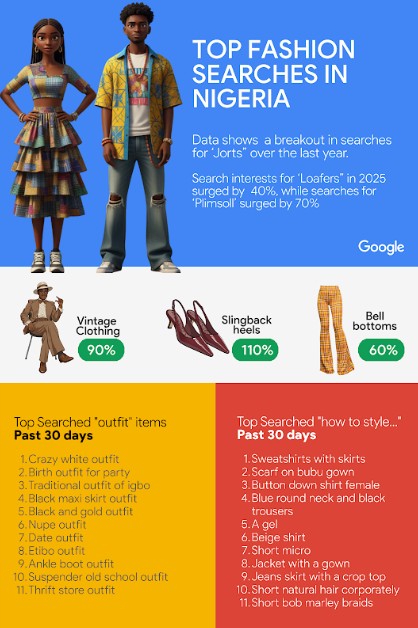
    The trends underscore that Nigerians are actively using fashion as a dialogue with the past. Search interest in vintage clothing increased by +90% in the past two months (August-September 2025 vs. the preceding year), with top related searches including “vintage scarf” and “vintage jacket.” This is mirrored by remarkable growth in searches for specific retro pieces: Zoot suit searches soared by +310%, while Tube top searches increased by +140%, and Bell-bottoms saw a +60% spike, signaling a vibrant, expressive return to bold styles of decades past.

    Celebrating Identity and Modern Fusion

    Beyond nostalgia, the data clearly demonstrates a deep-seated pride in Nigerian heritage, showing how contemporary style is being shaped by local culture. Top searches for “outfit” items included specific queries for “Traditional outfit of igbo” and “Nupe outfit.” This commitment to local identity is merged with modern styling, as seen in the trending “how to style” searches like “Scarf on bubu gown,” “Jacket with a gown,” and “Sweatshirts with skirts,” illustrating a generation seamlessly fusing classic Nigerian garments with global fashion conventions.

    Footwear is also seeing a dramatic shift toward confident, classic accessories, with search interest for the slingback shoe increasing by +110% in the past 30 days. Top queries like “yellow slingback heels” and “rosegold slingback heels” indicate an immediate adoption of statement pieces.

    “Fashion trends today are a powerful digital footprint of culture. The surge in searches for vintage styles, combined with a deep interest in traditional attire, shows a generation that is simultaneously embracing global nostalgia and celebrating local heritage,” said Olumide Balogun, Director, West Africa. “This dynamic mix—from the breakout popularity of the ‘Jort’ to the timeless sophistication of the slingback—is exactly the creative energy Lagos Fashion Week will showcase.”

    END

    ——

    Notes to the Editor: All percentage increases, unless stated otherwise, are based on Google Search data comparing the past 30 days (for slingbacks) or the period of August 1 – September 30, 2025, to the preceding comparable periods. “Breakout” searches are terms that had little to no prior search interest and have since experienced tremendous growth.

    Top Searched apparel items (Past 30 days)

    1. Gown
    2. Dress
    3. Skirt
    4. Suit
    5. Jeans
    6. T-shirt
    7. Jersey
    8. Kit
    9. Blouse
    10. Polo shirt
    11. Hoodie

    Top Searched “how to style…”

    1. Sweatshirts with skirts
    2. Scarf on bubu gown
    3. Button down shirt female
    4. Blue round neck and black trousers
    5. A gel
    6. Beige shirt
    7. Short micro
    8. Jacket with a gown
    9. Jeans skirt with a crop top
    10. Short natural hair corporately
    11. Short bob marley braids

    Top Trending apparel (Aug-Sept 2025 vs Aug-Sept 2024)

    1. Jorts (Breakout)
    2. Zoot suit (+310%)
    3.  Nightshirt (+180%)
    4. Tube top (+140%)
    5. Kilt (+80%)
    6. Negligee (+70%)
    7. Bell-bottoms (+60%)

    Top Searched “outfit” items

    1. Crazy white outfit
    2. Birth outfit for party
    3. Traditional outfit of igbo
    4. Black maxi skirt outfit
    5. Black and gold outfit
    6. Nupe outfit
    7. Date outfit
    8. Etibo outfit
    9. Ankle boot outfit
    10. Suspender old school outfit
    11. Thrift store outfit

    Top Searched “how to wear…”

    1. Jean jacket
    2. Palazzo joggers
    3. Tiara with hair
    4. Suspender
    5. Yoruba fila
    6. Hoodie cap
    7. Single breasted suit
    8. Flare tiny strap dress
    9. Lime green shoes
    10. Spinning belt
    11. Milk blazer

    Top Trending footwear (Aug-Sept 2025 vs Aug-Sept 2024)

    1. Wellington boot (+310%)
    2. Chukka boot (+100%)
    3. Ballet flat (+80%)
    4. Plimsoll (+70%)
    5. Hiking boot (+60%)
    6. Leg warmer (+50%)
    7. Loafer (+40%)
  • African Media Agency (AMA) Expands Operations to Ghana with appointment of Angela Akua Asante

    African Media Agency (AMA) Expands Operations to Ghana with appointment of Angela Akua Asante

    The pan-African communications agency strengthens its West African footprint with a new local operation in Accra, deepening its ability to provide market insight and communications expertise in one of Africa’s most dynamic economies.

     African Media Agency (AMA), a leading independent pan-African communications and public relations firm with offices in New York, Abidjan, Durban, and local presence in 30 African markets, is proud to announce the launch of its on-the-ground operations in Ghana, marking another milestone in its mission to offer localized, insight-driven communication across the continent.

    The move comes at a time when Ghana continues to assert itself as one of West Africa’s most stable, innovative, and forward-looking economies. According to the World Bank, Ghana’s GDP is projected to grow by 4.4% in 2025, driven by strong performance in services, agriculture, digital innovation, and renewable energy. The country has also become a rising hub for fintech, creative industries, and tech-enabled entrepreneurship, attracting regional and global investors eager to tap into its young, connected population.

    Establishing operations in Accra enables AMA to provide clients with a deeper understanding of Ghana’s evolving markets, from consumer behavior and media trends to policy and innovation landscapes. Supported by teams in 30 African countries, AMA combines market intelligence with strategic communication to help organizations build meaningful presence and impact.

    To lead this new chapter, AMA has appointed Angela Akua Asante as Senior Communications Consultant. This follows her fruitful collaboration with the agency since 2023 as an independent consultant on various pan-African health-related projects. 

    Ms. Asante is a highly experienced bilingual (French/English) Communications and Design Thinking Strategist who has led PR campaigns, content strategies, mediations, and media productions for the European Union and the Embassy of France in Ghana among others. Her extensive background includes working as the Ghana-based French-speaking correspondent for the BBC World Service’s BBC Afrique and covering four FIFA World Cup tournaments across men’s and women’s football.

    With her deep understanding of Ghana’s media and business landscape, Angela will head client strategy, media engagement, and partnership development, ensuring that AMA delivers culturally resonant and impactful campaigns.

    “Ghana has long been one of our most active markets: vibrant, entrepreneurial, and full of creative energy,” said Eloïne Barry, Founder and CEO of African Media Agency. “Our presence here strengthens our role as a partner for brands seeking to enter or expand across Africa. We go beyond communication, we provide the cultural fluency, networks, and insights needed to navigate complex markets and build sustainable trust.”

    AMA’s Ghana office will provide the agency’s full suite of services — from strategic communication and media relations to market research, digital content, and event management.

  • Lagos Free Zone remains the best investment destination for Nordic businesses in Nigeria – CEO, LFZ, Adesuwa Ladoja

    Lagos Free Zone remains the best investment destination for Nordic businesses in Nigeria – CEO, LFZ, Adesuwa Ladoja

    Lagos Free Zone, Nigeria’s first private special economic zone, centrally located in Lagos State and promoted by Tolaram, has been described as the best investment destination for Nordic companies in Nigeria.

    The Chief Executive Officer of the Lagos Free Zone, Mrs. Adesuwa Ladoja, disclosed this during the Nordic Nigeria Connect 2025 held in Lagos on Tuesday.

    Speaking during a panel discussion at the event, Ladoja explained that the Zone offers business predictability and proper organisation for investors who intend to do business in Nigeria, unlike other places where they are more likely to be confronted by infrastructural or regulatory barriers.

    She stated that for Nordic companies that see Nigeria as a potential hub for business, Lagos Free Zone remains the ideal destination as it offers the proper infrastructure, enabling environment, and logistics capacity needed to thrive.

    Mrs Adesuwa Ladoja

     “In Lagos Free Zone, we have a deep-sea port with state-of-the-art equipment. So, if you come to the Zone and have your business set up, it becomes easy for you to export, thus addressing the issue of delays and timing. With that, you can bring in your raw material seamlessly, effortlessly, all in the same place. So, with other access roads and coastal road being put in place, alongside plan to connect the axis through rail, many of these constraints would have been taken care of. Looking at it from a regulation perspective, we are creating our own single window where all the regulators you need to do your business are concentrated in the zone,” she added.

    She observed that the Tinubu administration’s two major policy reforms—the removal of fuel subsidies and the unification of the exchange rate—have created a more transparent, market-driven economy and brought back a sense of predictability in the investment climate for foreign investors. She maintained that the reforms have inspired cautious optimism in the economy, witnessing headwinds turning into tailwinds.

    According to her, sustained currency stability, low interest rates, and downward-bending inflation curves in the last 12 months are good signals that the private sector capital formation cycle is ripe for revival. She also explained that with young, entrepreneurial, and passionately creative people occupying the biggest pie in the population, Nigeria offers a vast consumer market and a production base with access to the 400-million-strong ECOWAS region.

    “This dynamic market, structural reform, and market stabilisation combination makes Nigeria one of Africa’s most appealing investment destinations today. However, the real potential is in being an early mover. As Nigeria’s infrastructure advances and its industries develop, those who establish a presence early will enjoy the greatest rewards,’ she added.

    She stated that the strength of the Nordic region, which can be found in specific sectors such as renewable energy, sustainable manufacturing, logistics, and digital solutions, remains highly complementary to Nigeria’s growth priorities as it unlocks enormous opportunities for collaboration that create shared value, drive innovation, jobs, and inclusive growth.

    She applauded Nordic countries for their leadership in clean technology, digital transformation, and responsible business practices, which align perfectly with Nigeria’s development aspirations.

    Other speakers at the panel discussion include Chief Executive Officer, APM Terminals Nigeria, Frederik Klinke; Executive Director/Chief Financial Officer, Development Bank of Nigeria, Ijeoma Ozulumba; Regional Director, West Africa, Norfund, Naana Winful Fynn; and Chief Executive Officer, Empower New Energy, Yerje Osmunden.

  • Margarita Festival Africa Returns to Lagos for its 10th Edition

    Margarita Festival Africa Returns to Lagos for its 10th Edition

    Celebrating a Decade of Culture, Cocktails & Community

    Margarita Festival Africa (MFAF), West Africa’s first and biggest margarita and tequila-inspired funfair, is set to return on November 30, 2025. The 2025 edition marks a historic milestone — the 10th edition across three nations and the 6th in Lagos, positioning MFAF as one of the most anticipated cultural festivals.

    Since its inception, MFAF has grown beyond cocktails to become a cultural hub for food, music, arts, and lifestyle, spotlighting Latin-inspired experiences while celebrating African creativity. Over the years, it has expanded from Lagos to Abuja, Accra, and Abidjan, while also hosting special editions like Margarita Day (2022 & 2025) and Cinco de Mayo (2022).

    This year’s edition promises an even more immersive experience, featuring:

    • Over 15 Margarita flavours and a tequila exhibition with global and local brands.
    • A marketplace with food, arts, crafts, and keepsakes.
    • Live music, circus acts, cultural performances, and the highly anticipated Margalympics cocktail competition.
    • An expanded Lime Folk community, creating year-round engagement with cocktail and culture enthusiasts.

    The Margalympics, now a signature pre-festival competition, will spotlight the best margarita makers across Lagos. Judges will tour nominated bars and restaurants in the weeks leading up to the festival, with the grand finale taking place live on the festival stage. Attendees will have the chance to taste and vote for their favorites, making it an exciting celebration of creativity, craftsmanship, and community.

    Speaking on the festival’s evolution, Wendz Connoisseur, Founder & Convener of Margarita Festival Africa, said:

    “What began as a dream to celebrate the margarita cocktail has become a thriving cultural movement that unites people across nations. Margarita Festival Africa is more than an event — it is a community, a celebration of culture, and a testament to how cocktails can bring people together. As we celebrate our 10th edition, we are excited to showcase the magic of Lagos while reinforcing Nigeria’s place as a cultural and tourism hub in Africa.”

    The 2025 edition is expected to draw over 1,500 attendees, including cocktail enthusiasts, foodies, cultural adventurers, and tourists. Beyond entertainment, the festival also carries a strong CSR mandate, including initiatives such as providing back-to-school kits for children of hospitality workers and supporting bartender grants through the LimeFolk Initiative.

  • The Coming of Age of the African Startup Ecosystem

    The Coming of Age of the African Startup Ecosystem

    From Unicorn Chasing to Sustainable Growth

    2024 marked a turning point for African startups. 

    While total disclosed funding fell to $2.2 billion – down 25% from the $2.9 billion raised in 2023 – the numbers alone don’t tell the full story. Beneath the slowdown lies a deeper transformation: a shift from chasing valuation milestones to building operationally resilient businesses that solve fundamental problems.

    The funding contraction mirrored global trends, as higher interest rates and tighter capital allocation reshaped venture capital markets. Yet Africa’s downturn was not purely negative. In the second half of 2024, the ecosystem saw renewed momentum from large-scale rounds, notably from Moniepoint (Nigeria) and TymeBank (South Africa). Unlike earlier unicorns that focused on aggressive user acquisition, these companies built their success on hybrid business models, blending digital technology with physical infrastructure.

    They were not alone. Fintech players like OPay (Nigeria), Wave Mobile Money (Senegal), and MNT-Halan (Egypt) have also demonstrated that control of both the digital layer and key offline touchpoints (agent networks, payment terminals, or physical kiosks) creates defensible advantages in African markets.

    image.png

    Why Operational-First Wins in Africa

    The African market’s structural realities (fragmented infrastructure, cash-heavy economies, and regulatory complexity) make purely digital solutions difficult to scale sustainably.

    In Kenya, Buupass tackled bus and rail ticketing by first digitising operators’ backend systems, eliminating paper-based inefficiencies and cash leakages before rolling out consumer-facing booking options. 

    To tackle this, they developed a Bus Management System (BMS) that digitised inventory, sales, and fleet tracking, enabling operators to modernize their backend systems. They also dealt with fragmented, offline-heavy travel ecosystems by forming partnerships with major players like Safaricom and M-Pesa, providing access to reliable hosting, digital payments, and trust validation, key to onboarding high-value clients like Kenya Railways. 

    Today, BuuPass processes approximately 12,000 transactions daily and has established partnerships with major transportation providers across Kenya, Uganda, Tanzania, Rwanda, and South Africa. Their growth came not from viral marketing or user acquisition funnels, but from solving fundamental operational challenges for transport operators.

    In West Africa, Logidoo approached cross-border trade by introducing consolidated cargo solutions through their relationship, cutting average transit times by roughly 40% along key China–West Africa and Europe–West Africa corridors.

    This improvement in shipping speed and cost-efficiency for clients demonstrated how operational excellence and better physical logistics design can unlock scale across cross-border trade.  

    Similar strategies are emerging in other sectors. These companies prove that solving operational bottlenecks can be more powerful than just building flashy products.

    Funding Shifts by Sector and Geography

    According to Africa: The Big Deal, fintech remained dominant in 2024, attracting about 47% of total startup funding, but the fastest-growing slices of investment went to logistics, mobility, and healthtech. Logistics startups, for instance, secured over $400 million across disclosed equity and debt rounds, reflecting investor appetite for infrastructure-heavy models.

    Geographically, Nigeria maintained its lead in funding volume, followed by Kenya, Egypt, and South Africa. However, emerging hotspots like Morocco, Senegal, and Tanzania posted year-on-year increases despite the continent-wide slowdown, most of these driven by targeted sector plays in logistics, mobility, and energy.

    The market correction exposed common weaknesses. Startups that scaled aggressively without building sustainable revenue streams struggled to survive the funding winter. A recurring failure pattern emerged: expanding to multiple markets before achieving operational stability in one, burning through capital on marketing rather than infrastructure, and relying on vanity metrics (downloads, active users) over unit economics.

    According to Hiruy Amanuel, Managing Director at Gullit VC, the ecosystem has developed its own success indicators, “I’ve learnt to be wary when early-stage startups rush to scale without focus or financial discipline. That kind of premature expansion, often without the infrastructure to support it, can be fatal. We’ve seen too many founders chase growth metrics or investor hype, only to fall apart because the fundamentals weren’t there.”

    Beyond Fintech

    Transport and logistics players are building their own fleets. Healthcare startups are embedding themselves into pharmacy and clinic networks. Agri-tech companies are setting up physical aggregation centers to secure supply chains. Even e-commerce platforms are moving into warehousing and last-mile delivery.

    This evolution signals something deeper: in African markets, technology works best when it complements, not replaces, the physical systems people already use.

    Looking Ahead…

    If 2015–2020 was Africa’s “unicorn era,” 2024–2027 is shaping up to be its “infrastructure era.” The next wave of winners will be companies that master operational execution while using technology to enhance reliability, transparency, and scale.

    The result is an ecosystem that’s becoming less dependent on external validation and more focused on creating lasting value within African markets. These trends indicate a maturing landscape that prioritizes solving real problems over chasing global tech trends.

    The success of companies like BuuPass, Logidoo, Moniepoint, and TymeBank provides a blueprint for the next generation of African startups. The winning formula combines technological sophistication with deep operational expertise, creating businesses that are both scalable and defensible.

    For founders, this means longer timelines to profitability but stronger defensibility once scale is achieved. For investors, it means assessing physical assets, partnerships, and local execution capabilities with as much rigor as product and code.

    Africa’s startup ecosystem is no longer solely defined by valuation milestones. Its coming of age is marked by companies that solve real problems, create lasting economic value, and build the scaffolding for future innovation. 

    And that, more than any unicorn headline, may prove to be the measure that matters most.