TeamApt Ltd, leading payment gateway service, Monnify, is now available as a plugin for Zoho Books, a comprehensive cloud-based accounting platform. With this plugin, businesses in Nigeria can simplify how they invoice and collect payments while offering end-to-end financial management, and improving operational efficiency.
With the Monnify plugin, available in Zoho Marketplace, businesses can generate invoices in Zoho Books and select Monnify as their preferred payment gateway. Customers are then directed to a secure Monnify checkout page where they can conveniently pay using Nigerian debit or credit cards, bank transfers, or other supported payment channels.
This plugin allows real-time reconciliation of payments within Zoho Books, helping merchants reduce administrative overhead and manual effort involved in recording payments and gain better visibility into their cash flow.
“We believe that payments should be seamless, efficient, and reliable,” said Ifeanyi Duru, Senior Vice President of Enterprise Network Sales at Moniepoint Inc. “The Monnify plugin for Zoho Books helps simplify how businesses receive payments while offering customers multiple options to settle invoices. With this, entrepreneurs and SMEs can focus on running their businesses with confidence that their collections and financial records are always in sync.
“At Zoho, our goal is to provide comprehensive, and connected financial ecosystem that reduces operational complexity for growing businesses,” said Prashant Ganti, Vice President of Global Product Strategy, Finance and Operations BU, Zoho. “As Nigerian businesses scale, they need their accounting and payment systems to work together seamlessly. With Zoho Books and Monnify, businesses can move from invoicing to collections without the friction, while maintaining accurate financial records with better visibility into their cash flow.”
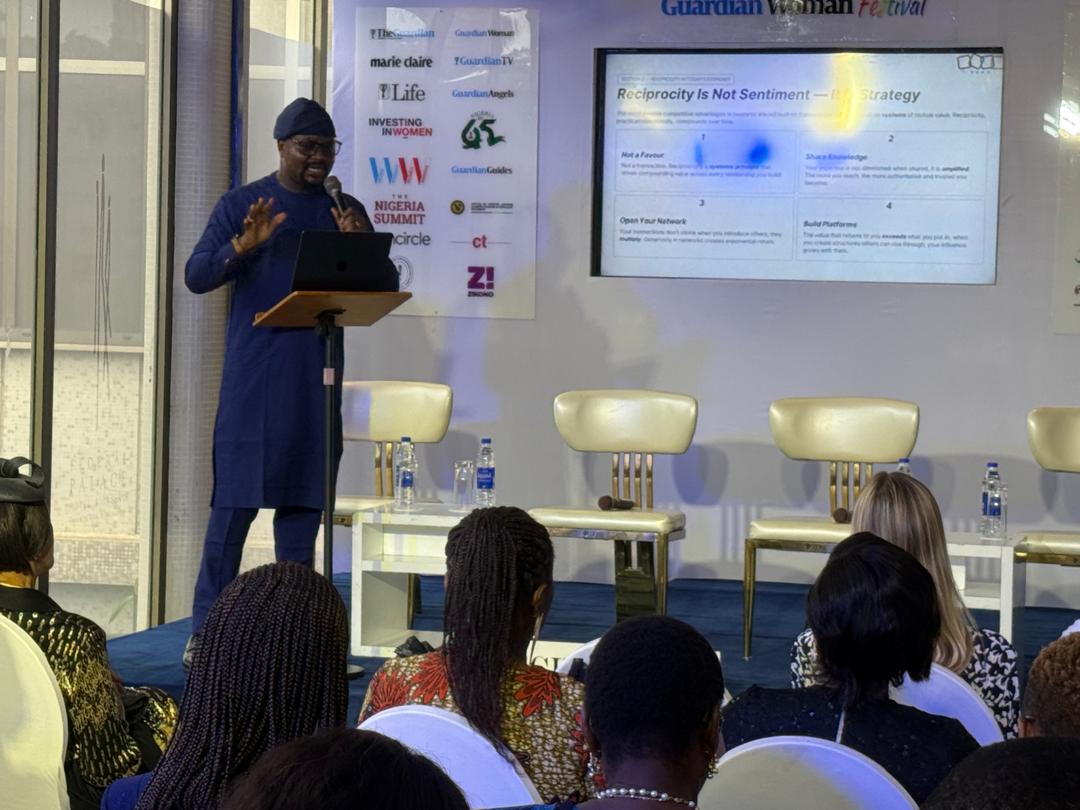
Zoho Nigeria partnered with Guardian Newspapers for the Guardian Woman Festival, a month-long initiative celebrating women’s contributions to business, governance, and social development while promoting digital empowerment for female entrepreneurs.
Held at the Federal Palace Hotel in Victoria Island, Lagos, the festival focused on the theme “Reciprocity,” encouraging the exchange of value, networks, and digital innovation to strengthen women-led businesses and foster collaboration.
During the event, Kehinde Ogundare, Country Head of Zoho Nigeria, delivered a keynote address titled “Give Value, Gain Growth: Women Driving Reciprocal Innovation in the Digital Economy”. In his remarks, he highlighted the urgent need to bridge the digital gap for female entrepreneurs.
While Nigeria has the highest concentration of women-owned businesses in Africa, fewer than 30% currently use digital tools to manage or grow their operations. Ogundare noted that technology does not replace the strengths women already bring to business, such as relationship building and community engagement. Instead, it amplifies them, enabling entrepreneurs to reach wider audiences and scale more efficiently.
“The difference is not talent. Not capital. Not ambition. It is digital adoption,” said Ogundare during his keynote. “Smart tools create smart businesses. Smart businesses create strong economies. When women entrepreneurs and leaders have access to the right tools, the possibilities for growth are limitless.”
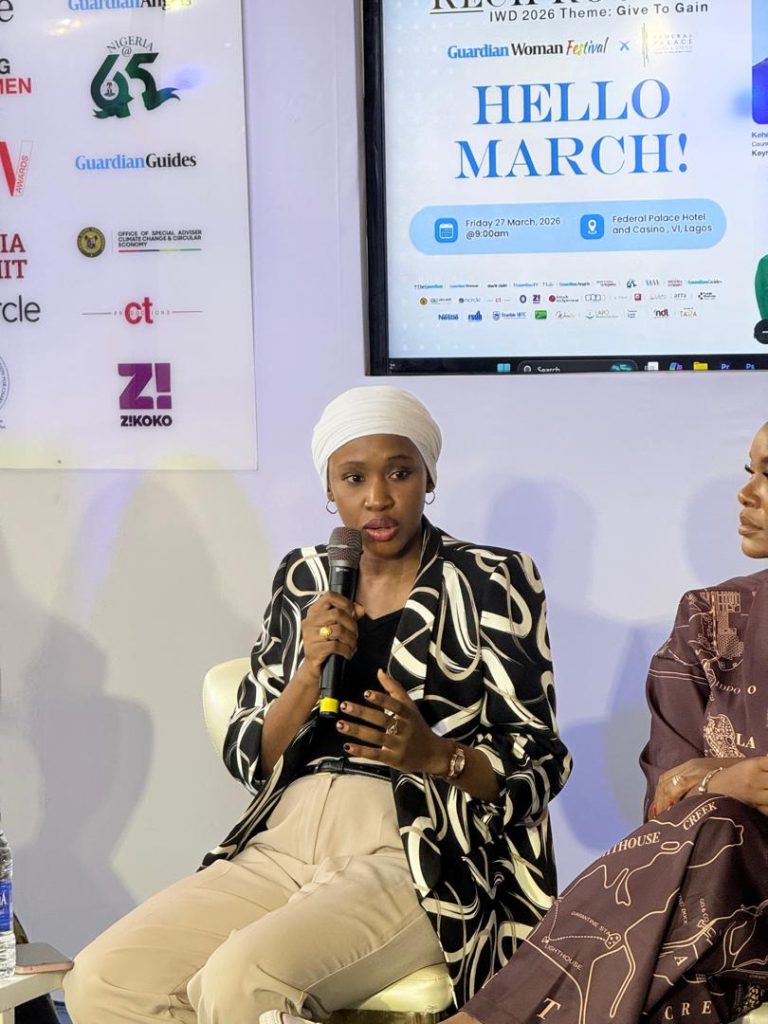
Zubaida Aliyu, Sales Manager at Zoho Nigeria, also brought her expertise to the festival’s panel session on ‘Women in the Business of Digital Innovation’. She highlighted how women are uniquely positioned to create shared value in digital spaces by building platforms that encourage knowledge sharing, mentorship, and collaboration.
Aliyu also challenged organisations that continue to view women’s digital inclusion primarily as corporate social responsibility rather than a strategic business priority.
“Tech creates a level playing field,” she said, noting that digital platforms remove limitations related to location and infrastructure size. Addressing organisations that overlook the economic value of inclusive digital strategies, she added, “They are leaving money on the table — they need to think of it as a strategy not charity”.
Through its participation in the Guardian Woman Festival, Zoho reaffirmed its commitment to providing affordable and accessible enterprise-grade technology to businesses of all sizes. By helping women transition from manual effort to digital efficiency, Zoho aims to support entrepreneurs build scalable enterprises and ensure their sustained success in Africa’s digital economy.
Zoho, a global technology company, has partnered with Babcock University through the Babcock Centre for Executive Development (BCED) to empower students with hands-on digital skills in low-code application development. Through the Young Creators Program, Zoho trained over 50 students across disciplines—including Computer Science, Business, and Information Technology—to build business-ready applications using Zoho Creator, the company’s low-code development platform.
The three day workshop introduced students to practical problem-solving using the latest advancements in cloud technology, enabling them to design and develop custom business solutions without advanced programming knowledge. The program also fostered a deeper understanding of how low-code tools can support entrepreneurship and digital transformation.
“As part of our commitment to supporting local talent development in Nigeria, we are excited to collaborate with Babcock University to equip students with future-ready digital skills,” said Kehinde Ogundare, Country Head, Zoho Nigeria. ” Through the Young Creators Program, we aim to empower young innovators to build solutions that solve real business challenges while strengthening the local technology ecosystem.”
This initiative also marks the beginning of a broader strategic collaboration between Zoho and BCED. Both organisations will continue to work together to deliver additional training programs, interactive workshops and innovation-focused events. Discussions are also underway to add Zoho’s apps to BCED’s entrepreneurship curriculum, ensuring that students learn how they can apply digital solutions for various business problems.
“We are committed to preparing our students for leadership in a rapidly evolving digital economy,” said Dr. Ayodeji Ajibade is the Director of the Babcock Entrepreneurship Development Centre (BEDC) at Babcock University in Nigeria. “Partnering with Zoho strengthens our mission by providing students with access to industry-standard tools and practical learning experiences that bridge the gap between classroom knowledge and real-world application.”
The Young Creators Program forms part of Zoho’s global effort to promote digital literacy and support innovation among young people. Launched in 2022, the program has trained more than 2000+ students around the world, providing them with the tools and confidence to pursue careers and entrepreneurial ventures in the technology space.
Zoho, a global technology company, today announced the launch of new agentic AI features across three key product categories—collaboration, customer experience, and human resources. These new capabilities are designed to help businesses enhance productivity, automate routine tasks, and focus on higher-value work. The features are available immediately at no additional cost across Zoho’s suite of business applications.
The announcement builds on Zoho’s broader AI strategy, which includes Zia Hubs, a system that enables AI access to unstructured company data, and Zia LLM, Zoho’s proprietary large language model developed specifically for business use. Alongside Zia, Zoho’s long-standing AI assistant, these innovations form the foundation of the company’s agentic AI approach—helping businesses gain deeper insights and efficiency from their data across Zoho’s platform of more than 55 integrated applications.
“Businesses are increasingly eager to leverage AI but often face obstacles such as high implementation costs, data readiness challenges, and fragmented systems,” said Kehinde Ogundare, Country Head, Zoho Nigeria. “Zoho’s unified, homegrown technology stack eliminates these barriers by allowing advanced AI features to be deployed automatically and at no extra cost. Our customers don’t need to invest in third-party integrations or additional tools—the technology simply arrives and works. This approach makes AI adoption practical, affordable, and impactful for businesses across the continent.”
The new agentic features build on Zoho’s existing AI ecosystem, which already includes Zia Agents, Zia Agent Studio, and Agent Marketplace. These intelligent tools allow users to perform complex, cross-functional actions such as creating contracts from multiple files, checking team availability before scheduling meetings, or automatically converting sales queries from Zoho Mail into CRM leads without manual effort.
Within Zoho Workplace, the company’s collaboration suite, AI upgrades have been introduced across Mail, Cliq, Sheet, and Tables. The enhanced Ask Zia assistant can now process multi-step commands spanning multiple applications, while Zoho Tables introduces AI Base Creation to help users instantly generate complete data structures from a short prompt. Additional AI-powered features such as Keyword Extraction, Sentiment Analysis, and Language Detection simplify data management and analysis.
In the customer experience category, Zoho Desk, used by over 100,000 businesses globally, now includes pre-built Zia Agents like the Resolution Expert, which records and learns from support ticket resolutions to improve future service. Meanwhile, Zoho Sign, a secure digital signature platform, now offers Agreement Intelligence, enabling users to draft and query contracts using Ask Zia without relying on third-party tools.
In human resources, Zoho Recruit introduces new agentic AI features that improve candidate matching and assessment creation. Zia’s Candidate and Job Match features analyse CVs and job descriptions to ensure better hiring outcomes, while AI-Assisted Assessment Generation automatically creates complete tests tailored to each role—saving time and ensuring fair, efficient evaluations.
Nigeria has been spotlighted as a potential global leader in responsible Artificial Intelligence (AI) adoption, according to a new research report published by Arion Research LLC and sponsored by Zoho. The report, titled “The AI Privacy Equation: The Nigerian Model of Responsible AI Adoption”, surveyed 386 Nigerian business leaders and offers fresh insights into how the country manages the balance between technological innovation and privacy protection.
The findings reveal that Nigerian businesses are embracing AI at an impressive pace and embedding privacy protection at the very core of their digital transformation strategies. An overwhelming 93 per cent of surveyed organizations have already begun their AI journey, with nearly a third achieving advanced integration across their operations. More significantly, 84 percent of respondents reported that their organizations had strengthened privacy safeguards since adopting AI—a trend that runs counter to global patterns where privacy is often compromised in the race toward innovation.
This transformation is driven by strong leadership at the highest levels, with over half of surveyed executives pointing to CEOs and senior management as the primary champions of AI adoption and privacy integration. The financial services sector, in particular, is emerging as a frontrunner, representing almost one-third of surveyed organisations and demonstrating sophisticated approaches to balancing innovation with regulatory compliance.
Beyond leadership, Nigerian organisations are investing substantially in people and skills to support this shift. Nearly 70 per cent are prioritizing data analysis capabilities, while more than half are focusing on building AI literacy across their workforce. The report also highlights how Nigerian businesses are allocating significant portions of their IT budgets to privacy infrastructure, appointing dedicated privacy officers, and conducting regular impact assessments—practices that are establishing a new benchmark for responsible AI adoption.
“The Nigerian Model proves that emerging economies need not sacrifice privacy for innovation. By demonstrating that leadership commitment, technological advancement, and privacy protection can reinforce one another, Nigeria is charting a path that other markets worldwide can learn from and replicate,” said Kehinde Ogundare, Country Head, Zoho Nigeria.
The report goes on to outline key recommendations for stakeholders. It calls on government and regulators to enhance policy frameworks and create regulatory sandboxes that encourage innovation while safeguarding privacy. For Nigerian organisations, it emphasises the importance of building strategic AI governance systems, embedding privacy-by-design principles into every stage of implementation, and scaling workforce training to meet the demands of the digital economy. The report highlights Nigeria’s leadership position for international partners and investors and urges support for capability development initiatives, partnerships, and cross-border knowledge sharing.
With its combination of rapid adoption, leadership-driven strategies, and a firm commitment to privacy, Nigeria is positioning itself as a technology adopter and a potential exporter of global best practices. Arion Research concludes that this balance between innovation and protection places the country on a path to becoming an international reference point for responsible AI adoption.
“Today’s announcement emphasises Zoho’s longstanding aim to build foundational technology focused on protection of customer data, breadth and depth of capabilities because of the business context, and value,” said Kehinde Ogundare, Country Head, Zoho Nigeria.
“Our LLM model is trained specifically for business use cases, keeping privacy and governance at its core, which has resulted in lowering the inference cost, passing on that value to the customers, while also ensuring that they are able to utilise AI productively and efficiently.”
Zia LLM: Custom-Built AI for the Enterprise
Zoho has successfully launched its own large language model, Zia LLM, built completely in-house by leveraging NVIDIA’s AI accelerated computing platform. Trained with Zoho product use cases in mind—ranging from structured data extraction, summarisation, RAG, and code generation—Zia LLM comprises three models with 1.3 billion, 2.6 billion and 7 billion parameters, each separately trained and optimised for contextual applicability that benchmark competitively against comparable open source models in the market. The three models allow Zoho to always optimise the right model for the right user context, striking the balance between power and resource management. This focus on right-sizing the model is an ongoing development strategy for Zoho. In the short term, Zoho will scale Zia LLM’s model sizes, starting with the first set of parameter increases by the end of 2025.
While Zoho supports many LLM integrations for users, including ChatGPT, Llama, and DeepSeek, Zia LLM continues Zoho’s commitment to data privacy by allowing customers to keep their data on Zoho servers, leveraging the latest AI capabilities without sending their data to AI cloud providers. The model is currently testing for internal use cases across Zoho’s broad app portfolio, and will be available for customer use in coming months.
Zoho also announced two proprietary Automatic Speech Recognition (ASR) models for speech-to-text conversion for English and Hindi. Optimised to perform on a low computer load without compromising on accuracy, the models benchmark up to 75% better than comparable models across standard tests. Zoho will expand language support for ASR models to enable more inclusive AI adoption across diverse regions. It will also introduce a reasoning language model (RLM).
Prebuilt Agents, Agent Studio and Marketplace Designed for Real-World Impact
To enable immediate adoption of agentic technology, Zoho has developed a roster of AI agents contextually baked right into its products. These agents can be used across various business activities, handling relevant actions based on the role of the user. These include Customer Service Agent for Zoho Desk that can process incoming customer requests, understand the context, and either answer directly or triage them to a human rep, providing an efficient first line of assistance.
Ask Zia, Zoho’s platform-wide conversational AI assistant, is bolstered with additional BI skills, tailored to data engineers, analysts, and data scientists, while supporting all users within an organisation. It can build end-to-end data pipelines for engineers, analyse data, create reports and dashboards in an interactive conversation mode for analysts, or help jump start building ML models for data scientists.
First announced earlier in 2025, Zoho has further simplified the Zia Agent Studio experience to be fully prompt-based (with the option to use low-code) and includes ready-made access to over 700 actions across Zoho’s products. Agents built by users can be deployed autonomously, triggered by button click, with rule-based automation, or even summoned within customer conversations.
At the time of deployment, an agent can be provisioned as a digital employee, maintaining the user access permission structure defined within the organisation. Admins can perform behavioural audits as well as performance and impact analyses on digital employees, ensuring that every agent is working as effectively as possible and within clear guardrails.
Several pre-built agents are now available for users, such as Candidate Screener, which identifies and ranks the most suitable candidates for a specific job opening based on role requirements, skills, experience, and other key attributes; Deal Analyser, which can analyse deals and provide insights such as win probability, next best action, and follow-up suggestions, and Revenue Growth Specialist, which suggests opportunities for upsell and cross-sell for existing customers.
These agents are available in Agent Marketplace from where customers can easily deploy them. Ecosystem partners, ISVs, and individual developers will be able to create agents and host them on the Zia Agents Marketplace in coming months.
The company plans to add more skills to Ask Zia, allowing it to act as an assistant to Finance teams, Customer Support teams to start with. Support for the Agent2Agent (A2A) protocol will be implemented, allowing Zia Agents to interact and collaborate with each other, as well as collaborate with agents on other platforms.
Interoperability and Governance
Zoho’s adoption of the Model Context Protocol (MCP) allows clients to securely access and interact with workflows and actions across over 15 Zoho applications. MCP is available in early access, and integrations via Zoho Flow extend its reach to third-party tools. Zoho Analytics now also supports a local MCP server, allowing for advanced contextual AI use cases while preserving data security and compliance.
Zoho, a global technology company, today launched Zia Hubs, a solution within Zoho WorkDrive that brings new forms of unstructured business data into the company’s broad portfolio of applications and AI services. Using Zia Hubs, organisations can now present any type of business content to Zoho’s powerful capabilities and services—including agentic AI, comprehensive analysis, and accurate, unified search—regardless of file format or structure.
“According toIDC, 80 percent of business data is unstructured,” said Kehinde Ogundare, Country Head, Zoho Nigeria. “Most unstructured data is text-based, meaning pertinent information lives within email conversations, social media posts, word processor documents, or audio and video transcripts. With Zia Hubs built into the full product suite, Zoho can provide customers with a deeper integration than any comparable software platform and nearly limitless potential uses for their data.”
Deeper Intelligence Accessing More Customer Data
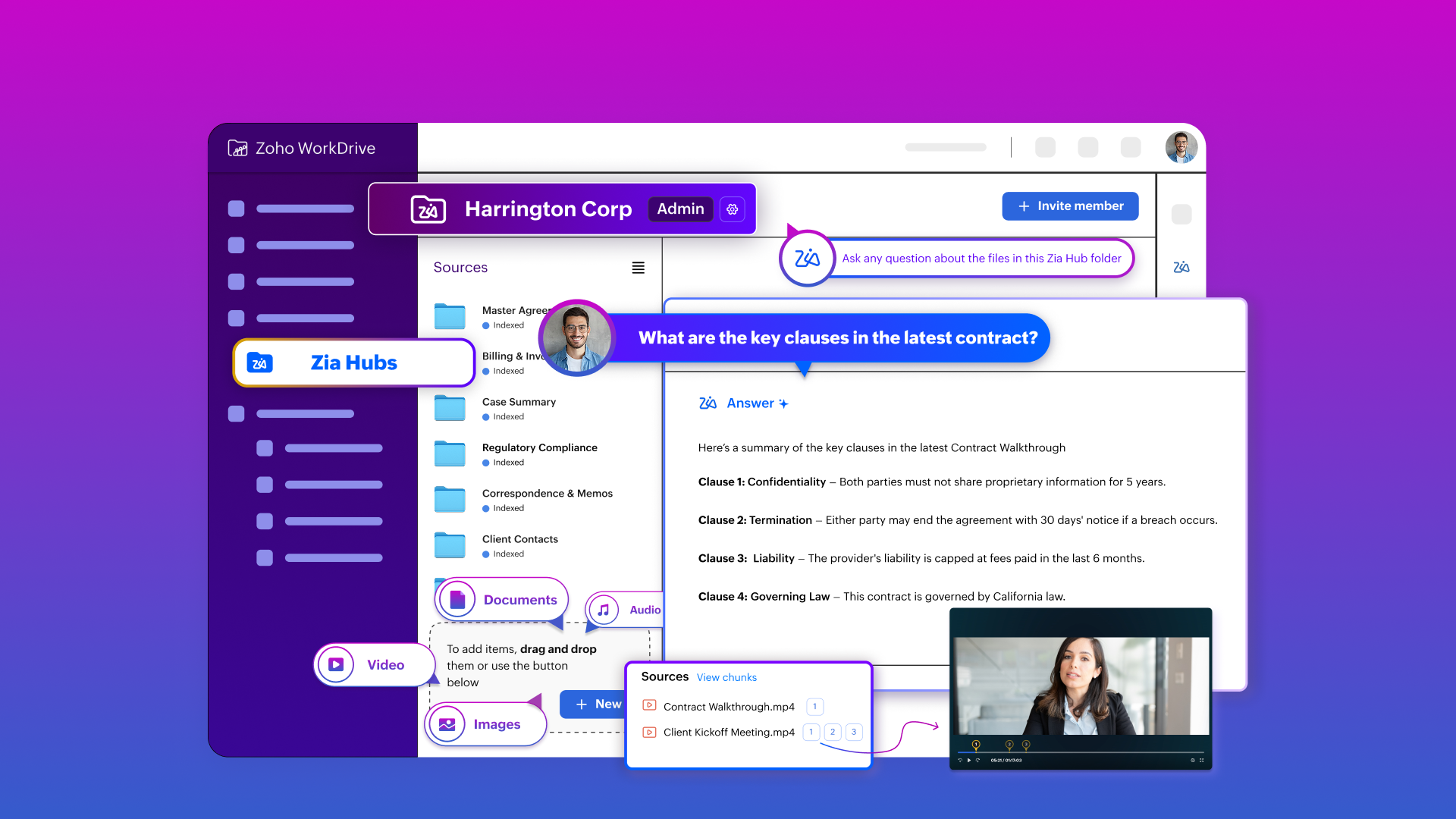
Launching as part of Zoho WorkDrive, Zia Hubs brings content intelligence to the company’s unified content management and collaboration platform. Designed with a high level of user control over what content AI is allowed to access, Zia Hubs enables users to organise project or task-specific content into dedicated hubs within WorkDrive. Each hub serves as a focused space where Zia, Zoho’s flagship AI, can understand and act on the content stored within. This includes a wide range of formats such as PDFs, documents, videos, and audio files.
Zia Hubs automatically organises uploaded content by grouping related information—such as section headings, supporting text, and visuals—to preserve context. For video and audio files, Zia generates transcripts and links key moments to relevant topics, making it easier to pinpoint exactly where something was said.
With Zia Hubs, users can surface the most relevant answers when asked a question, even across different content formats. Each response includes clear citations that link back to the original content, whether it is a document, spreadsheet, image, or a specific moment in an audio or video file.
Organisations can also create custom workflows with Zoho Flow, automating document storage processes for particular projects or specific teams. This ensures that Zia always has access to the latest necessary documents automatically.
Furthermore, content from third-party software—such as Docusign PDFs, RingCentral call logs, Zoom video files—are all readable by Zia, and can be automatically placed into a hub by building a workflow with Zoho Flow.
From Intelligent Content to Intelligent Action with Zia
Zia Hubs is a foundational element of Zoho’s long-term AI strategy. It lays the groundwork for a future where intelligent agents can act contextually on content across the company’s entire product suite. With full ownership of its technology stack spanning more than 55 products, Zoho is uniquely positioned to help organisations unlock deeper value from their business content compared to competitors.
Potential use cases for Zia Hubs include: a legal team’s content hub hosting a case’s relevant files: court files, correspondence, and research, allowing a lawyer to have Zia provide summaries with citations without having to manually scan lengthy files to gain insights; a company’s support center placing call logs into a hub, then querying Zia to identify trends, like, “Have we received an increase in calls regarding specific issues?”
Future updates to Zia Hubs will enable it to identify structured information within unstructured files and trigger specialised agents tailored to specific business needs. This will further establish Zia Hubs as the central content intelligence layer that activates AI-native workflows across the full Zoho ecosystem.
Disclaimer
All trademarks, product names, and company names cited herein are the property of their respective owners.
Availability and Pricing
Zia Hubs is scheduled for general release at the end of Q3 2025.
Zoho Artificial Intelligence Differentiation
Zoho remains steadfast in its commitment to AI innovation guided by principles of customer privacy and delivering true customer value. Its generic AI models across contextual, assistive, and agentic categories are not trained on consumer data, nor do they retain customer information, ensuring responsible AI use. Zoho focuses on practical AI tools that assist workers by right-sizing models and without inflating customer costs unnecessarily.
…New platform supports evolving enterprise customer needs after Zoho Projects registers 32% YoY growth in MEA in 2024, seeing more businesses migrate from third-party apps
Zoho Corporation, a global technology company, today announced the launch of Projects Plus, a flexible, collaborative new platform providing data and intelligence-driven project management for mid-sized and large organisations. Through native integration of four key Zoho applications—Projects, WorkDrive, Analytics, and Sprints—Projects Plus enables asynchronous collaboration, seamless file management, real-time business intelligence, and Agile or Waterfall workflows.
Zoho Projects has seen rapid growth, doubling its revenue in 2024, with 55% of new users migrating from Microsoft Projects and JIRA. Projects Plus builds on this success by focussing on better data democratisation, AI-powered insights, hybrid project management, and collaborative work management. As 18% of enterprise customers deployed both Zoho Projects and Zoho Analytics, Projects Plus directly addresses these needs by consolidating the two, and more, into a singular, efficient solution.
“The surge in digitalisation across the nation and the hybrid work culture have necessitated project management tools to be well ingrained in the overall software architecture of an organisation. With Projects Plus, which can be easily customised and integrated with other apps, we have brought together key tools like analytics, file management and collaboration, and the option to use blended project management methodologies, creating a value-packed offering not yet available in the market. Furthermore, Projects Plus synthesises the latest AI-driven tools, data-first analytics, and privacy-focused protections into software that anticipates the evolving needs of international enterprise organisations, expanding Zoho’s global reach,” said Kehinde Ogundare, Country Head, Zoho Nigeria.
Business Intelligence Leading to Project Democratisation
The shift toward Data-Driven Project Management (DDPM) is transforming how organisations make decisions. Instead of relying on intuition, businesses can now leverage real-time data and analytics to drive efficiency. Projects Plus captures insights across multiple dimensions—including time tracking, budgeting, task completion, and deliverability metrics—helping teams make smarter, data-backed decisions.
Predictive analysis plays a crucial role in this approach, using historical data to forecast risks, estimate project timelines, and anticipate resource needs. By analysing past trends, businesses can proactively plan and mitigate risks before they impact project success. Progress tracking has also evolved beyond traditional static tools like Gantt charts. With real-time dashboards, project managers now have dynamic, up-to-date insights that provide a comprehensive view of project status, allowing them to identify and address bottlenecks as they arise.
Additionally, quality control analytics ensure that every stage of a project meets predefined standards. By continuously monitoring data related to project deliverables, businesses can uphold high-quality outcomes, reducing errors and inefficiencies throughout the project lifecycle. With these enhanced analytical capabilities, Projects Plus enables organisations to shift from reactive project management to a more strategic, data-driven approach that improves execution and results.
Projects Plus integrates Zia, Zoho’s AI engine, to automate complex data analysis and provide predictive insights, helping project managers focus on strategic leadership. By analysing project performance data, businesses can identify inefficiencies and optimise processes, streamlining workflows to improve productivity. AI-powered insights also enable smarter resource allocation by identifying where resources are being underutilised or overburdened. This ensures that the right people are assigned to the right tasks, maximising efficiency across teams.
Forecasting and planning are also significantly enhanced through AI-driven analysis. With more accurate predictions about project timelines, costs, and potential risks, organisations can make proactive adjustments to avoid delays and cost overruns. This results in better project outcomes, improved resource management, and higher overall efficiency.
Pricing and Availability
Projects Plus is available immediately and priced at NGN7200 per user each month, when billed annually—27% lower than combining Projects, Sprints, Workdrive and Analytics when purchased separately. For regional pricing, go to https://www.zoho.com/projectsplus/
…New agentic platform will advance Zoho Corporation’s decade-long investment in AI to deliver unparalleled context and data-driven customer value
Zoho Corporation, a global technology company, today expands the scope of Zia with the announcement of Zia Agents, Agent Studio, and Agent Marketplace. Together, these solutions empower enterprises to access, build, and distribute intelligent, autonomous digital agents across their organisations. Beginning today, Zoho and ManageEngine will be previewing pre-built, task-specific Zia Agents, which will deploy across Zoho Corporation’s combined portfolio of 100+ products in the coming weeks.
“The speed of disruption and quality of innovation we’re seeing in our industry right now has encouraged me to focus on my passion area, technology. I will devote more time to hands-on technical work for the company, spearheading several deep R&D initiatives, beginning with AI,” said Sridhar Vembu, Zoho Corporation’s Co-founder and Chief Scientist. “Utilising Zoho’s deep engineering expertise, its own data centres, and shared data model, we will develop powerful and usable solutions that drive customer value while retaining our commitment to customer flexibility and data privacy.”
Zoho Corporation’s in-house AI has evolved over the past decade from proactive to prescriptive to generative to agentic:
Zia: Launched in 2015, Zia is Zoho Corporation’s foundational AI, facilitating all intelligent and contextual actions across the company’s ecosystem of apps. Zia possesses a vast and diverse skillset. New skills are being implemented regularly to boost customer experience and drive productivity.
Ask Zia: Launched in 2018, Ask Zia has developed into a system-wide conversational assistant that helps employees work smarter and accomplish tasks more effectively. For example, an account manager can review a report of customers at risk of churn, summarise the outcomes of each customer’s recent interactions, filter and summarise helpdesk tickets, analyse trends in their industry, and reach out to that customer for a meeting based on the employee’s upcoming travel schedule, without leaving the Ask Zia interface. Ask Zia is powered by Zoho’s unified data platform and will be contextually embedded across all applications.
Zia Agents: Today, Zoho Corporation has previewed some of the several dozens of pre-built Zia Agents that will be rolled out in the coming months, including an Account Manager Agent, SDR Agent, HR Agent, Customer Support Agent, IT Help Desk Agent, and a SalesCoach Agent. For customers, partners, and developers looking to create their own agents, Zoho is launching Zia Agent Studio, allowing them to build and deploy customised agents with inherited skillsets, which can then be distributed through Zoho’s Agent Marketplace.
Zia Agent Studio: Offering no-code and low-code experiences, Zia Agent Studio enables users to build autonomous agents with skills relevant to their specific needs. Zia Agent Studio users can also access a wide range of pre-existing Zia Skills, tools from across the Zoho ecosystem, data from a unified data platform, and a range of language models. These can be agents within a function (like an SDR agent or email support agent) or natively cross-functional agents (like an RFP agent or loan approval agent). They can be deployed on any Zoho application and summoned using Ask Zia. Moving forward, Zia Agents will be deployable in any third-party application as well. Additionally, Zia Agents with complementary skillsets can be combined using Zia Agent Studio, creating a single agent capable of cross-functional work.
Agent Marketplace: Agents created using Zia Agent Studio can be published in the Agent Marketplace. Zoho Corporation will offer a pre-built roster of agents, while the company’s ecosystem of partners and developers can build and distribute specialised AI agents through the marketplace, which can be reused and instantly deployed by organisations.
Organisational Differentiation
Today’s announcement follows record growth for Zoho Corporation, which onboarded 110,000 new customers globally in 2024. With over 850,000 customers globally in diverse industries, using a range of tools across Zoho and ManageEngine, Zoho Corporation’s AI solutions are informed by a vast range of functional data. This is a core differentiator for the company, putting it in a unique position to serve businesses with cutting-edge technology.
Technological Differentiation
Zoho Corporation’s distinct technological breadth and depth is a fundamental differentiator, particularly in AI development and deployment. Leveraging its shared data model, owned and managed tech stack, including global data centres, and a broad application portfolio, Zoho Corporation’s highly secure, privacy-compliant, usable, capable, and deeply knowledgeable AI agents deliver superior technology at a high value to its growing customer base.
Availability
These capabilities will begin to roll out to a limited set of customers, which will expand monthly.
Zoho, a leading global technology company, has unveiled the results of its study, “The State of Productivity and Collaboration in Nigeria, 2024”, which surveyed over 500 organisations with more than 50 employees across the country. The findings reveal critical workplace productivity challenges, including the overwhelming impact of data silos resulting from fragmented systems and inefficient app usage. The survey study also highlights the growing demand for unified platforms, which can help businesses streamline employee collaboration.
“Nigerian businesses have adopted a variety of cloud tools over the years to support their digital transformation journey. However, they are beginning to recognise that these disconnected tools often lack integration with their existing technology stack, creating silos that hinder collaboration and lead to productivity losses. As this issue gains attention, the demand for unified collaboration platforms with advanced AI capabilities has surged, as corroborated by the survey findings. In Nigeria, we’ve observed a notable increase in the adoption of Zoho Workplace, reflecting this trend. Zoho Workplace set the standard for a unified experience as early as 2017, well ahead of the industry giants. It offers not just a unified interface, but brings contextual data to the forefront, saving time, and enabling users to focus on what truly matters,” said Kehinde Ogundare, Country Head, Zoho Nigeria.
Key Findings from the Study
The study shows that 55% of Nigerian businesses have adopted a fully on-site work model, while 31% operate in a hybrid setup, and the remaining 14% were in completely remote roles. Most remote roles are held by individual contributors with limited collaboration requirements, while hybrid workers face significant barriers in maintaining effective communication.
The survey also revealed that 51% of employees use 1–5 apps daily, 35% use 6-10 apps, while 14% rely on more than 10 apps. App usage is higher among senior executives, with 81% of the C-Suite employees using more than 10 apps, while 72% of junior employees use 1-5 apps. The most commonly used tools are for productivity and collaboration (68%), followed by project management (47%), business intelligence (47%), and accounting (43%). Despite widespread app usage, only 50% of the respondents track their tasks in a unified view, with higher adoption rates among the C-Suite (78%) and senior leadership (63%).
Productivity Challenges and Opportunities
For the Nigerian workforce, the biggest collaboration challenge is poor WiFi/data connectivity (80%), across demographics. This indicates the need for solutions that have an offline mode and can work in lower data connectivity.
Other collaboration challenges are digital fatigue (54%), and information spread across too many apps (45%). For middle managers, the second biggest challenge, after poor WiFi, is communication with employees in a remote or hybrid setup. According to the respondents, the most effective way to improve productivity in Nigerian workplaces is to enable quick access to necessary information from different apps (78%), followed by adoption of new technologies like AI (72%), and the ability to communicate from within business apps (55%).
There is a clear demand for unified collaboration platforms bolstered with AI capabilities that can be integrated into existing software ecosystems. Such solutions will not only help in reducing the time taken to do the job, but can also reduce digital fatigue as one will not have to juggle multiple apps.
The Economic Outlook
As per the survey, 51% of the respondents said their organisation had adopted new technology to prepare themselves for the economic challenges. Those who said their companies had adopted new technology were more positive about the ability of their company to deal with the competition (rating 4 out of 5) than those who said their company had not adopted new technology (rating a little over 3 out of 5). However, largely, respondents feel their companies are adequately prepared to face economic challenges (57%).
In fact, according to the findings, slow adoption of emerging technologies like AI emerged as the most significant factor hindering their ability to stay ahead in a rapidly evolving market, cited by 46% of the respondents. Other reasons cited as causing competitive disadvantages were low adoption of digital tools (45%), and employees switching between too many apps (41%).
Zoho Workplace
Zoho Workplace is a unified collaboration platform that brings together communication, collaboration, and productivity applications, showing all relevant information and tasks in a single view. It comprises email, chat, online meeting, webinar, office suite (word processor, spreadsheet, and presentation), file storage, and social intranet.
Zoho, a global technology company, is partnering with She Code Africa (SCA), a leading non-profit organisation dedicated to empowering and upskilling African women in tech. With this partnership, Zoho will conduct Train the Trainer sessions for SCA Academy trainers to introduce them to Zoho Creator, the company’s low-code app development platform. These trainers will subsequently train more students, associated with SCA, to build powerful applications using low-code to solve actual business problems.
The upskilling sessions will be provided as part of the ‘Young Creators Programme’ (YCP) run by Zoho Creator. As part of the programme, Zoho will host 30 female trainers from the SCA Academy and will conduct a three-day in-depth training session about building enterprise-grade applications with low-code technology. The training will take place at the Zoho office in Lagos, Nigeria. The trainers will also receive free access to the Creator platform for one year, along with training material.
“At Zoho, we believe in supporting local communities by upskilling and hiring local talent, empowering local businesses with our technology, and promoting responsible and sustainable development. Our growth strategy, known as transnational localism, embodies these values. In continuation of this commitment to support progress at the grassroots, we are partnering with She Code Africa to equip Nigerian students with critical tech skills,” said Kehinde Ogundare, Country Head, Zoho Nigeria.
“The ‘Young Creators Programme’ aims to bridge the technical skill gap and support talent-building for our youth who will be the next generation of leaders and professionals. We are glad to partner with Zoho to help our trainers learn the latest advancements in low-code technology, and then pass on the knowledge to our other students,” said Maryblessing Okolie, Community Manager.
Launched globally in 2022, the Young Creators Programme is a training programme aimed at equipping future business leaders with advanced digital skills and fostering innovation in technology. The programme brings value by providing access to Zoho Creator’s powerful platform to help participants build custom applications in a simple and seamless manner without extensive programming knowledge. Beyond skill development, the programme boosts confidence, fosters personal growth, and opens doors to further opportunities in the technology industry. The programme has trained more than 2000+ students on Zoho Creator globally, enabling participants to earn programme completion certificates and exciting prizes.