






















by Dr. Toyin O. Jenyo


In the last few weeks, we have been learning about type II diabetes and obesity. We will be concluding this series today and we will be considering Obesity and Nutrition Paradigm.
Overweight and obesity are considered to be a result of energy imbalance between calories consumed and calories expended. This can be due to excessive consumption of calories by consuming energy-dense food or inadequate expending of calories due to a sedentary lifestyle (WHO, 2012). Possible genetic predisposition to obesity was also considered, for example, the aboriginal population.
Approaches to the treatment of obesity can be generally grouped under the three approaches to health, which are (a.) biomedical, (b.) behavioural and (c.) political economy. Biochemical and behavioural approaches tend to be the individual approach that utilizes investment nutrition paradigm principles of intervention. While the political economy approach can be considered as an environmental approach that applies the Human Rights Approach to the Nutrition Paradigm principles of intervention. (Birm, Pillay & Holtz, 2009; Johnson, 2009) The intervention principles of each approach are summarized below-
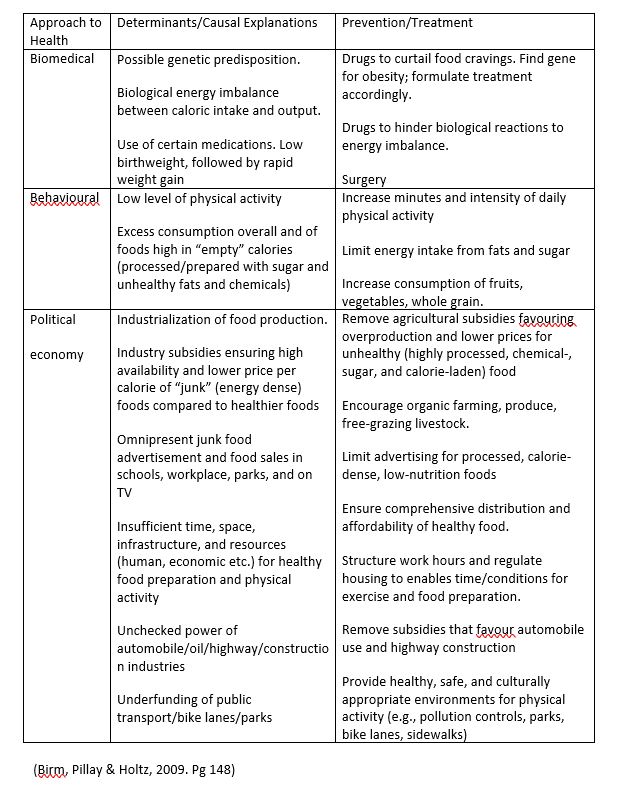
Some evidences show that the environmental approach will yield a sustainable desired result. For example, Cheadle et al cited in Wing et al, 2001, found strong correlations between fat intake and the percent of local grocery store shelf space devoted to low-fat versus regular milk and meat. The superiority of the environmental influence to genetic influence was also proved by the studies that compared Pima Indians, who live in rural Mexico and follow a traditional Pima lifestyle, with Pima Indians living in Arizona and follow a westernized lifestyle (Wing et al., 2001) The challenge here is how to make duty-bearers (or the object of the right) see healthy environment (favourable for a healthy lifestyle) as the right of the claim-holders (or the subject of the right) (Johnson, 2009).
The Way Forward
The environmental approach is relatively new in the prevention and treatment of obesity, there will be the need for more research to determine what the key environmental variables are, how best to change them, and the cultural influence on the possible changes. This is necessary because environmental variables are complex in nature.
The environmental approach is a wide-sector approach that needs input from scientists, public health experts, marketing researchers, and policymakers, therefore, the need to have adequate intervention studies (small focused interventions to examine the effect of specific environmental manipulations on outcomes (i.e., eating behavior, physical activity, and biological endpoints) to present for discussion.
To achieve sustainable control of obesity among the populace, the environment needs to be made favourable for the community members to make the healthy choice, therefore environmental approach needs to be implemented as a complement to the behavioural approach.
Conclusion
With the escalating rate of obesity in our society (its extension to developing countries and its association with poverty) despite behavioural intervention. The environmental approach will be a complement intervention that will empower the community members to make healthy choices on what to eat and physical activity. Thereby reducing the prevalence of obesity and type II diabetes subsequently.
Toyin Olawale Jenyo, MBBS(Ilorin) MPH(Liverpool) is a member of Fiji College of General Practice (FCGP). He is a Public Health Physician with vast experience in General Practice in four countries. He has more than 10 years’ experience in treatment and effective application of public health interventions in CDs and NCDs at PHC level. He has also been involved in training and mentorship of medical officers and medical students over the years of practice. He works at Olivet Medical Centre, Nakasi Suva, Fiji Islands