


























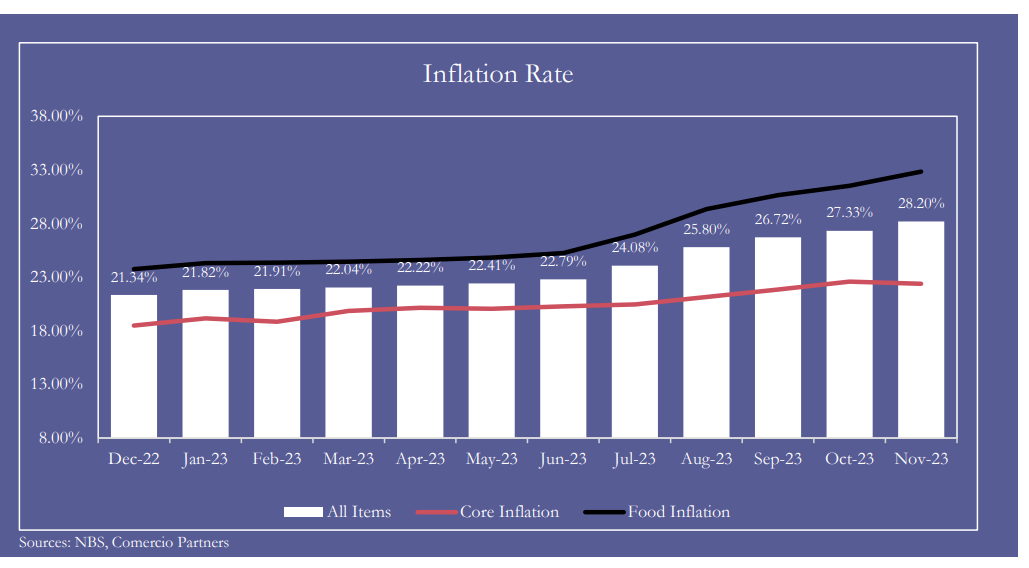
For the penultimate month of year 2023, Nigeria’s headline inflation continued its foreseen upward trajectory. However, the month-on-month percentage change for core inflation experienced marginal declines. Nevertheless, both subindexes contributed to the overall increase in the year-on-year figures for November.
 https://www.digital.zenithbank.com/ZEQ/ZEQ-jan-2026/index.html#p=1
Headline Inflation
In November 2023, headline inflation fell to 2.09% MoM, representing a 0.35% increase from the rate of 1.73% recorded in the preceding month. The 12-month average rate rose to 24.01%, 0.58% higher than 23.44% recorded in the previous month. The increase in month-on-month headline inflation was backed by core inflation alone.
Food Inflation
In November 2023, the month-on-month Food inflation rate fell by 0.51% from October 2023, registering at 2.42%, compared to the previous rate of 1.91%. The 12-month average rate rose to 27.09% in the month under review, 0.76% higher than 26.33% recorded in October 2023. The increase in Food inflation on a month-over-month basis was caused by increases in prices of Bread and cereals, Oil and fat, Potatoes, Yam and other Tubers, Fish, Fruit, Meat, Vegetables and Coffee, Tea and Cocoa.
Core Inflation
Core inflation, depicting All Items Less Farm Produces and Energy, rose to 1.53% MoM, up by 0.14% from 1.39% recorded in the prior month. The 12-month average rate rose to 20.35% in the month under review, 0.37% higher than 19.98% recorded in November 2023. The highest increases were recorded in prices of Passenger Transport by Road, Medical Services, Passenger Transport by Air, Actual and Imputed Rentals for Housing, Pharmaceutical products, Accommodation service etc.
Analyst’s Comments
Headline inflation for the penultimate month of year 2023, printed marginally higher than the preceding month. With food inflation printing above 30bps, this depicts further tightening of food supply within the Nigerian economy. Also, the persistent weakening of the Naira against the greenback aides higher importation costs. While we battle with the FX rate, global oil prices continue to fluctuate.
This volatility acts as a double-edged sword as Nigeria remains an importer of finished petroleum products. Adversely, the announcement of the first crude batch touching down Dangote refinery appears to spark hope in Nigerians once again, despite the delayed timeline. As we know, production and distribution of refined products will play a hand in improving fuel-related issues in the country. However, we do not see immediate positive effects from this as the firm would not be kicking off with fuel production activities first. Admittedly, with the rainy season coming to an end, Main Harvest activities are underway.
Conversely, we perceive high transportation costs trickling into food costs, which translates to high food inflation in the ensuing months. Conclusively, with a depleting FX reserve, high exchange rate and costly food distribution, we foresee
higher inflation rates in the ensuing months.