
















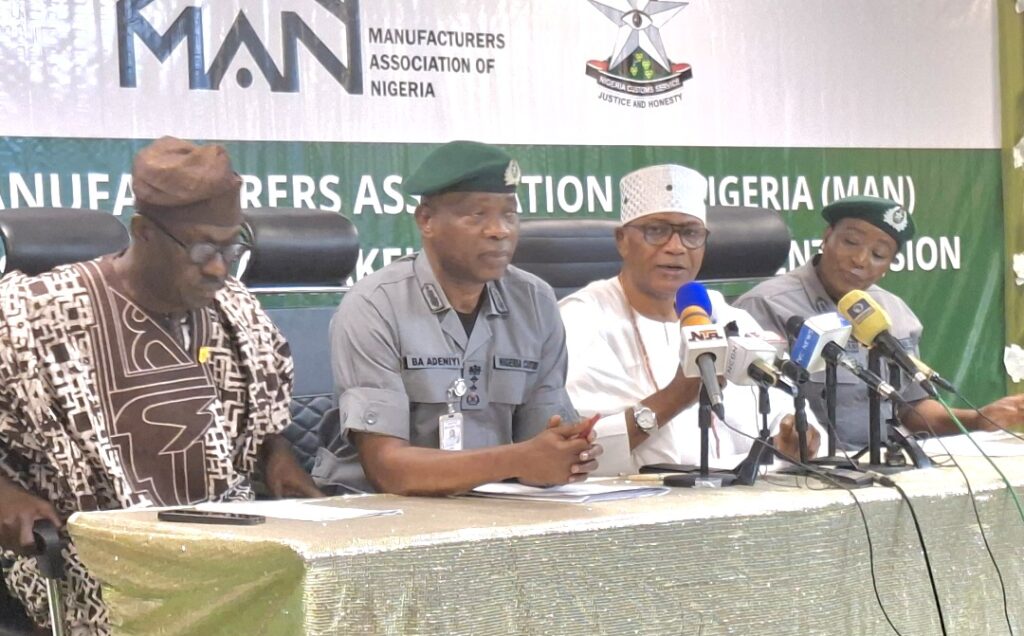
The Nigeria Customs Service (NCS) and the Manufacturers Association of Nigeria (MAN) today held a joint strategic engagement in Abuja, underscoring their commitment to strengthen collaboration in support of Nigeria’s industrial growth and economic development.
The meeting followed the directive of the Federal Ministry of Finance on the temporary suspension of the 4% Free on Board (FOB) charge. It provided an opportunity for comprehensive stakeholder consultations as required by the Nigeria Customs Service Act 2023, while also creating space to review wider issues affecting Nigeria’s manufacturing operating environment.
In a joint statement, both organizations described the exchanges as open, frank, and cordial, noting their shared commitment to aligning customs trade facilitation objectives with the development needs of the manufacturing sector.
Key Issues Discussed
During the session, MAN presented specific operational challenges confronting the manufacturing sector, including:
- Implementation of the 4% FOB charge as funding for NCS operations.
- Multiple checkpoints impeding trade facilitation.
- Multiple alerts in the clearance system.
- Glitches in the B’Odogwu platform.
In response, NCS highlighted ongoing Trade Facilitation Initiatives, such as the Authorised Economic Operator (AEO) Programme, Advance Ruling, and Time Release Study, reaffirming its commitment to balancing revenue generation with innovative measures that support legitimate trade and industrial growth.
Major Outcomes
The meeting produced concrete resolutions, particularly on the contentious 4% FOB charge. Following consultations with the Honourable Minister of Finance and Coordinating Minister of the Economy, the NCS announced strategic exemptions, including:
- Manufacturers already under Chapters 98 and 99 of the Customs Tariff – covering raw materials, spares, and machinery – will enjoy exemptions, with pre-release options available to prevent demurrage.
- Other manufacturers not yet on Chapters 98 and 99 will be onboarded to access the same exemptions, with MAN, NCS, and the Federal Ministry of Finance working together to expedite the process.
- Tripartite consultations will be held immediately to fast-track onboarding of eligible manufacturers.
- 4% FOB payments already made by manufacturers awaiting onboarding will be credited for future customs transactions.
- Exemptions also extend to:
- Government projects with Import Duty Exemption Certificates.
- Humanitarian and life-saving goods.
- Beneficiaries of the Presidential Initiative for Unlocking the Healthcare Value Chain.
- Commercial airlines’ spare parts.
The Manufacturers Association of Nigeria also commended the AEO scheme, with both parties agreeing that NCS will soon issue clear admission guidelines to enhance participation.
Broader Trade Facilitation Efforts
Beyond exemptions, discussions explored additional measures to improve trade efficiency, including:
- A one-stop shop framework to streamline regulatory processes.
- Reduction of unnecessary checkpoints that increase costs.
- Deployment of digital clearance systems to accelerate legitimate trade.
- Enhanced risk management and automated compliance systems to support ease of doing business.
Path Forward
Both institutions agreed to establish formal consultation mechanisms, ensuring:
- Regular dialogue on policy changes before implementation.
- Real-time feedback systems to monitor impacts on manufacturers.
- Periodic reviews to assess progress and identify new collaboration areas.
Emphasizing economic impact, both NCS and MAN reaffirmed their support for Nigeria’s diversification agenda, particularly through job creation, export promotion, foreign exchange conservation, and the development of industrial clusters under a predictable customs environment.
Joint Commitment
The Comptroller General of Customs, Bashiru Adewale Adeniyi, MFR, pledged sustained consultation, technology-driven solutions, and trade facilitation infrastructure to support industrial growth. Meanwhile, MAN President, Francis Meshioye, OFR, assured continued constructive engagement, compliance support, and contributions of sector-specific expertise to customs policy development.
“This engagement highlights a strengthened partnership between two critical institutions supporting Nigeria’s economic development,” both leaders affirmed. “The outcomes demonstrate that constructive dialogue produces superior results for all stakeholders while maintaining the highest standards of regulatory compliance and governance.”