























As Nigeria marks 26 years of uninterrupted democratic governance, stakeholders in the manufacturing sector have called for renewed commitment to industrial development, warning that the country risks falling further behind without decisive action to address longstanding structural constraints that undermine competitiveness and productivity.
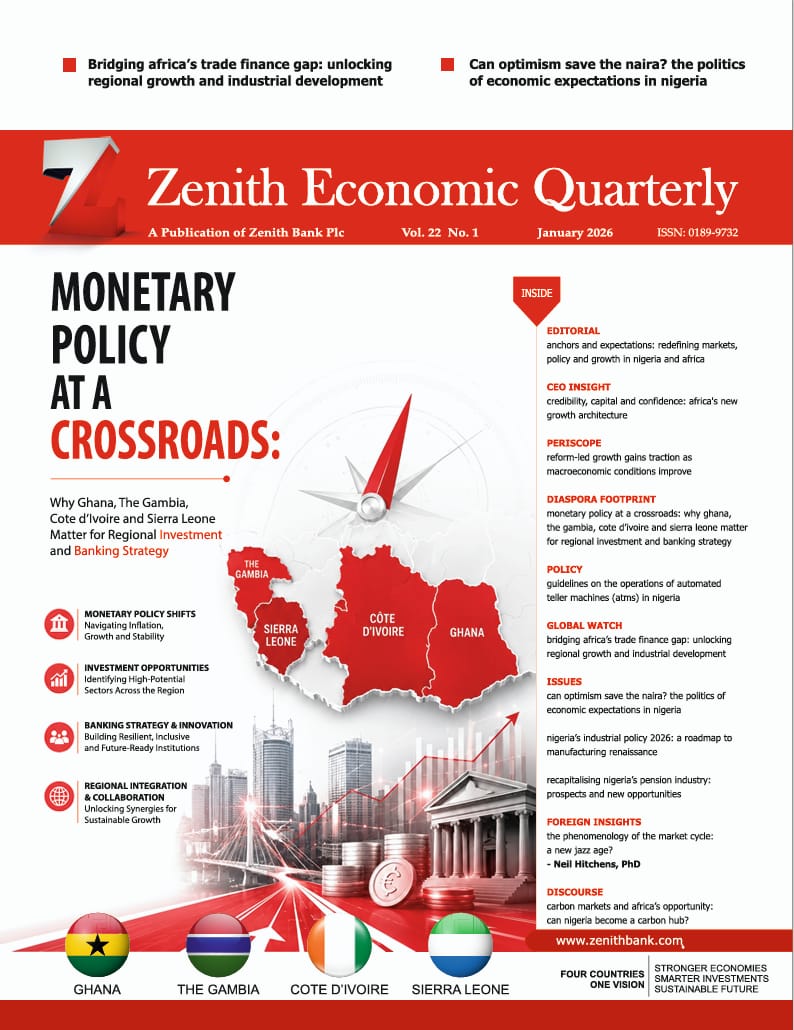 https://www.digital.zenithbank.com/ZEQ/ZEQ-jan-2026/index.html#p=1
A review of Nigeria’s manufacturing performance since the return to democracy in 1999 by the Centre for the Promotion of Private Enterprise (CPPE) shows that the sector’s contribution to Gross Domestic Product (GDP) has remained largely stagnant at between 9 and 10 per cent, highlighting the absence of the broad-based industrial transformation needed to drive sustainable economic growth, job creation and export competitiveness.
According to the CEO, Dr Muda Yusuf, industry observers note that industrialisation remains the foundation of economic development globally, serving as a catalyst for value addition, employment generation, technological advancement and economic resilience. However, despite successive policy initiatives and reform programmes, Nigeria’s manufacturing sector continues to grapple with persistent challenges that have limited its growth potential.
One of the most visible symbols of the country’s industrial decline has been the collapse of its public refineries. Once considered strategic national assets, the refineries suffered decades of poor governance, inadequate maintenance, policy inconsistencies and weak accountability mechanisms, ultimately resulting in their shutdown and the loss of a key component of Nigeria’s industrial ecosystem.
Beyond the refining sector, several manufacturing industries that once contributed significantly to employment and economic activity have either contracted substantially or disappeared altogether. Textile manufacturing, tyre production, battery manufacturing and automobile assembly have all experienced varying degrees of decline, contributing to Nigeria’s growing dependence on imported goods.
Despite these setbacks, some sectors have demonstrated remarkable resilience and growth. The cement industry remains one of Nigeria’s most successful industrialisation success stories, while the food and beverage sector has continued to expand despite challenging operating conditions.
The commissioning of the Dangote Refinery has also been described as one of the most transformative industrial investments in Nigeria’s history. Analysts say the project underscores the scale of ambition and investment required to reposition Nigeria as a major industrial and processing economy.
However, many of these success stories have emerged largely through private-sector initiative rather than through a supportive operating environment. Manufacturers continue to face significant challenges, particularly in energy supply, transportation infrastructure, and access to affordable finance.
Unreliable electricity remains one of the most critical barriers to industrial growth, forcing manufacturers to depend heavily on self-generated power at considerable cost. Similarly, inadequate rail infrastructure and excessive reliance on road transportation have increased logistics costs and weakened supply chain efficiency.
Access to finance also remains a major concern, with lending rates often ranging between 25 and 30 per cent. Industry stakeholders argue that such borrowing costs are incompatible with long-term industrial investment and undermine the competitiveness of local manufacturers.
Policy inconsistency has further complicated the operating environment. Frequent shifts between protectionist measures and market liberalisation have created uncertainty for investors and weakened confidence in long-term industrial planning. Manufacturers also continue to face intense competition from imported products produced in countries with stronger industrial support systems and lower production costs.
The challenge is exacerbated by smuggling, which weakens the effectiveness of tariff protections and exposes gaps in border enforcement and policy implementation.
Stakeholders have also expressed concern over the shrinking footprint of indigenous manufacturing enterprises, noting the increasing dominance of foreign-owned firms in several sectors. While foreign direct investment remains important for economic development, experts stress the need to nurture local industrial champions to ensure sustainable industrial growth and economic sovereignty.
Recent economic reforms have, however, provided some relief to manufacturers. Improvements in foreign exchange market liquidity have eased access to foreign currency, helping businesses procure critical industrial inputs and stabilise production after the severe foreign exchange challenges experienced between 2022 and 2023.
In addition, the Federal Government’s fiscal policy measures providing reduced import duty rates on key manufacturing inputs, raw materials and industrial machinery have been welcomed by industry players as a practical intervention capable of reducing production costs, improving competitiveness and supporting job creation.
As Nigeria looks to the future, manufacturing stakeholders are calling for a comprehensive industrial policy framework anchored on competitiveness, infrastructure development and policy stability.
Among the priorities identified are accelerated power sector reforms, expanded investment in rail transportation, strengthened development finance institutions capable of providing concessionary industrial loans, and the implementation of government procurement policies that prioritise locally manufactured products.
Industry leaders are also urging the government to deepen backward integration, promote resource-based industrialisation and address security challenges affecting production and access to markets across the country.
According to stakeholders, the experience of the past 26 years demonstrates that industrialisation cannot thrive in an environment characterised by infrastructural deficiencies, policy uncertainty and weak implementation.
They maintain that Nigeria must transition from an economy driven largely by imports and consumption to one anchored on production, value addition and industrial competitiveness.
“The future of Nigeria’s prosperity lies in what the country produces, not merely in what it imports,” industry stakeholders emphasised. “Manufacturing remains the bridge between natural resource wealth and broad-based economic development. Strengthening that bridge is essential for achieving economic sovereignty, sustainable prosperity and global competitiveness.”
As Nigeria reflects on more than two decades of democratic governance, the message from the manufacturing sector is clear: industrialisation must move to the centre of national development strategy if the country is to realise its full economic potential.