Category: Literature

  • Nigeria Celebrates Femi Osofisan at 80 with Week-Long Festival of Theatre, Film and Intellectual Discourse

    Nigeria Celebrates Femi Osofisan at 80 with Week-Long Festival of Theatre, Film and Intellectual Discourse

    CELEBRATIONS of the 80th birthday anniversary of one of Africa’s venerable culture personality, playwright, poet, novelist, and essayist, Professor Femi Osofisan, kicked off on Monday, June 8 with a presentation of one of his satires, Love’s Unlike Lading, at the Wole Soyinka Arts Theatre of the University of Ibadan. Featuring students and staff of the Department of Theatre Arts, UI, the presentation ran for three days, concluding with a Command Performance on Wednesday, June 10.

    First published in 2012, Love’s Unlike Lading: A Comedy from Shakespeare, is a striking Nigerian re-reading of Shakespeare’s Merchant of Venice. This is, however, only a taste of the feast of theatrical productions that have been earmarked to feature in the scheduled 8-day celebration of the multi-skilled culture icon, who is also known for his pen name, Okinba Launko.

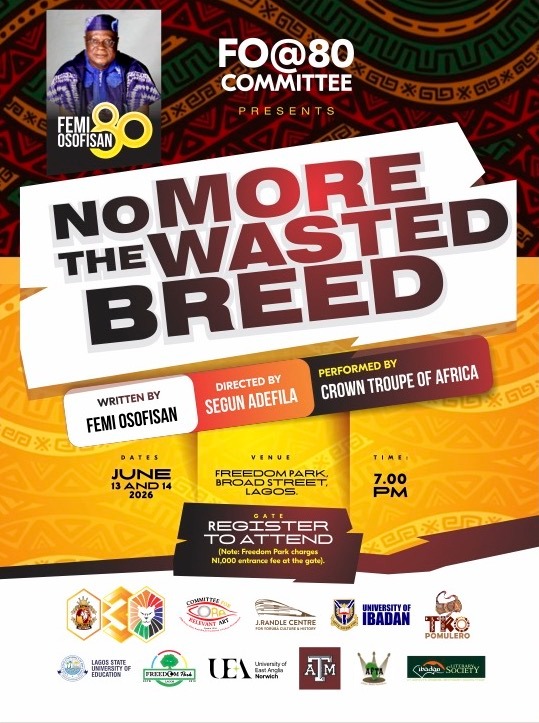
    Other productions are Yungba Yungba and the Dance Contests, directed by Bunmi Adedina and featuring theatre students and faculty of the Lagos State University of Education, LASUED, Ijanikin; No More the Wasted Breed, directed by Segun ‘Oriade’ Adefila for the Crown Troupe of Africa; Medaaye, directed by Tunde Awosanmi, featuring students and staff of University of Ibadan; and The Engagement, directed by Adedapo Treasure for Fadaka.

    Programme Outline

    The landmark birthday anniversary of the distinguished playwright, critic, poet and public intellectual, whose work has shaped generations of artists, scholars and audiences across the world, continues in three venues in Lagos later in the week, with a rich programme of activities including performances, screenings and conversations as outlined below:

    • Lagos (June 11–15, 2026)
    • Ibadan (June 17–18, 2026).

    June 11–15  2026

    The Department of Theatre Arts, Lagos State University of Education, Ijanikin, Lagos, will stage a three‑day stage production of Osofisan’s acclaimed play Yungba Yungba and the Dance Contest (June 11–13). Directed by Bunmi Adedina, the production will run daily at 2:00pm, with a Command Performance at 1.00 pm on June 11. The Command Performance will be hosted by the pioneer Vice Chancellor of the university, Professor Bidemi Bilkis Lafiaji-Okuneye.

    On June 13 and 14, events move to Freedom Park, Broad Street, Lagos, with the performance by Crown Troupe of Africa of Osofisan’s No More the Wasted Breed, directed by Segun Adefila.

    On June 14, dramatist and culture communicator, Ben Omowafola Tomoloju with deliver a Talk titled The Femi Osofisan I Know at JRandle Centre for Yoruba Culture and History, Onikan, Lagos at 3.00 pm. This will be followed by the unveiling of 100 SONGS OF FEMI OSOFISAN, produced by Semoore Badejo for Concrete Studios.

    Roundtable: “Femi Osofisan’s Drama and the Deconstruction of the Nigerian Postcolonial State” – featuring scholars, practitioners and admirers reflecting on Femi Osofisan’s legacy. Time 4.00pm

    Speakers include: Baba Agba Tunde Kelani, filmmaker, culture advocate; Professor Mabel Evwierhoma, theatre and culture scholar, University of Abuja; Professor Akin Adesokan, culture and media scholar, Indiana University, Bloomington, USA; Professor Razinat Mohammed, writer and literary scholar, University of Abuja; Dr. Onyekaba Cornel-Best, theatre and media scholar, University of Lagos; Professor Ifure Ufford-Azorbo, theatre practitioner and scholar, University of Uyo; Israel Eboh, theatre director and former President of National Association of Nigerian Theatre Arts Practitioners, NANTAP. It will be moderated by Jahman Anikulapo, culture curator and communicator.

    Guests will enjoy a screening of Maami, adapted for film by Tunde Kelani from Osofisan’s original work. The screening begins at 6:00pm.

    The Lagos programme concludes on 15 June with a second Roundtable at 4:00 pm, which would feature a treat on the theme: Interpreting Femi Osofisan for the Stage. Speakers are: Professor Grace Adinku, Performance and Visual Arts Studies Scholar, Texas A & M University, USA; Dr Teju Kareem, theatre practitioner, CEO Zmirage Multimedia Company; Dr Toyin Ogundeji, theatre practitioner, teacher, Obafemi Awolowo University; Professor Rasheedat Liman, theatre teacher and culture scholar; Mrs Joke Silva (Jacobs); veteran actress and culture entrepreneur; Segun Adefila, theatre practitioner and President Guild of Nigerian Dancers, GOND; and Makinde Adeniran, theatre director, President of National Association of Nigerian Theatre Practitioners, NANTAP. It will be moderated by Professor Tunji Azeez, theatre teacher, scholar and President of Society of Nigerian Theatre Artists, SONTA.

    The Roundtable will be followed by a screening of Cordelia, an adaptation of Osofisan’s novella of same title at 6:00pm

    The Talk and Roundtables will also be accessible via Zoom. To attend virtually, audiences may register using the link: https://us02web.zoom.us/meeting/register/8q1R0ZdaQrGNBrbDEY4YRA

    On June 17–18 2026, the celebrations continue at the Staff Club, University of Ibadan, beginning on June 17 with a recorded presentation of Yungba Yungba and the Dance Contest as performed at the University of Ghana, Legon, directed by Grace Adinku. The screening starts at 2:00 pm, and is followed by a Q&A.

    The Ibadan programme concludes on 18 June with a recorded performance of Farewell to a Cannibal Rage, staged at Texas A&M University and directed by Grace Adinku. The screening begins at 2:00 pm, followed by a Roundtable session and Tributes

    Prof Femi Osofisan was born at Erunwon on the 16th June 1946, Femi Osofisan (aka Okinba Launko) had his secondary education at the Government College, Ibadan and then proceeded to the University of Ibadan where, after a year abroad in Dakar, Senegal, he obtained an Honours degree in French in 1966. Eight years later, after aborting his postgraduate studies in Paris, he returned to Ibadan to obtain his PhD in 1974, and then joined the faculty as an Assistant Lecturer. He rose to the post of Professor in 1985, and was made Emeritus Professor in 2014 on retirement. Osofisan has published over 40 plays, five novellas, six volumes of poetry, as well as the acclaimed biography of J.P. Clark, entitled, J.P. Clark: A Voyage. A former President of the Association of Nigerian Authors [ANA], of PEN-Nigeria and the Pan African Writers Association [PAWA], Osofisan has been the recipient of several Fellowships and Awards, including the French National Order of Merit Award (1991); the University of Ibadan Faculty of Arts Distinguished Alumnus Award (2001); the Nigerian National Order of Merit Award for the Humanities (2004); and the prestigious Fonlon-Nichols Award (2005). In 2006, he became a Fellow of the Nigerian Academy of Letters. He is married to the first female Professor of Computer Science in Africa, Professor Adenike Osofisan. They are blessed with children and grandchildren.
  • Ayodele Alabi set to unveil three new books on June 12

    Ayodele Alabi set to unveil three new books on June 12

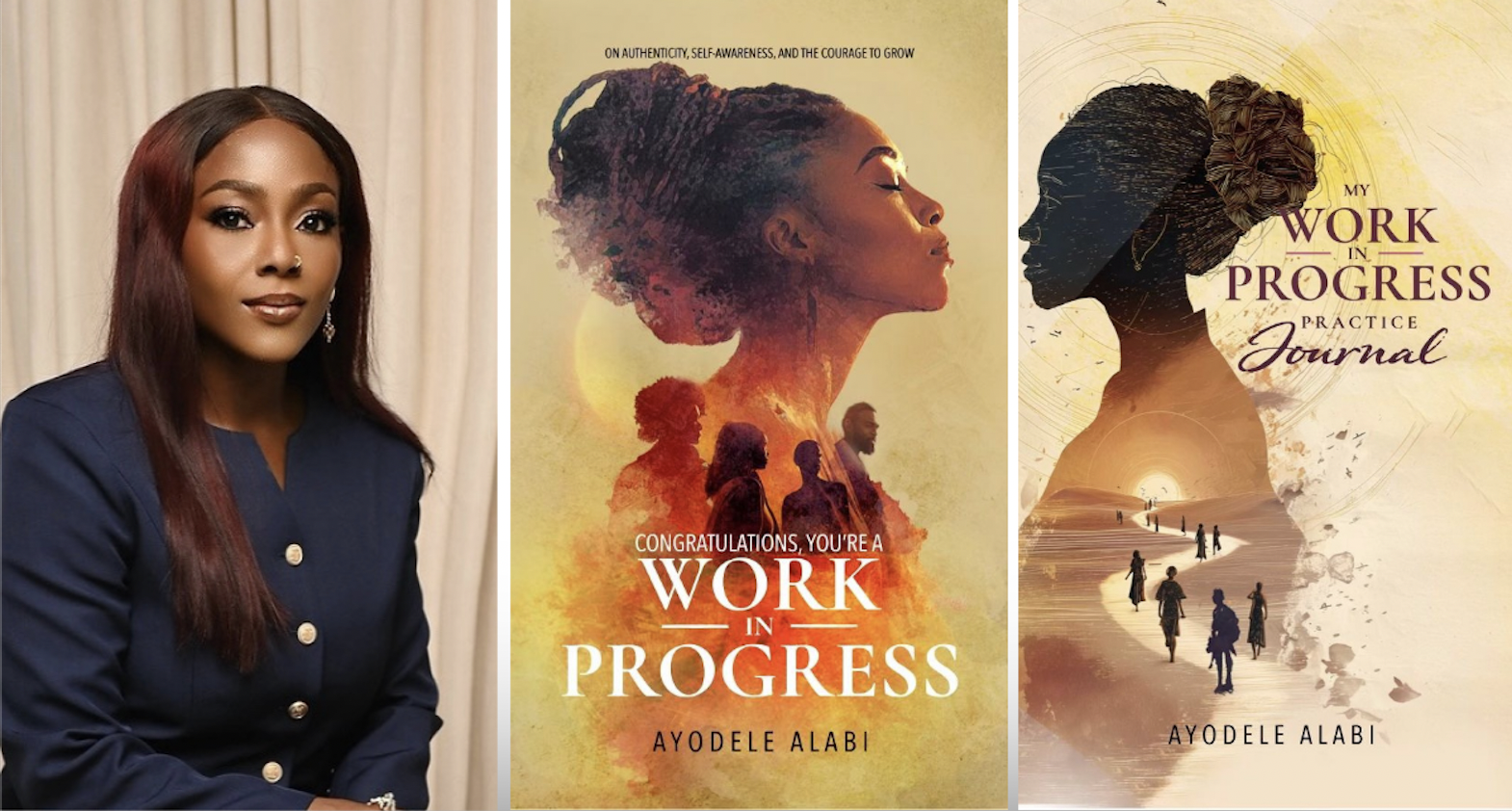
    Award-winning communications leader, author, speaker, and founder of Happiest Girl in the Room, Ayodele Alabi, is set to unveil her three latest books, Congratulations, You’re a Work in Progress; My Work in Progress Practice Journal; and Ashes to Air, on June 12, 2026.

    Speaking on the upcoming unveiling, the author, who is also the Head of Integrated Communications at Nigerian Breweries Plc, Alabi, described the books as compelling, insightful, and relevant. Each work serves as a valuable resource for parents, young people, families, and individuals.

    One of the books, Congratulations, You’re a Work in Progress, offers a perspective of growth as evidence of life. Through a compelling blend of storytelling, reflection, and practical lessons, the book follows the interconnected lives of its characters as they navigate questions of identity, belonging, ambition, grief, self-worth, leadership, and personal growth. Each story invites readers to examine their own lives and consider what it means to remain true to themselves while continuing to evolve.

    “Too often, authenticity is misunderstood as simply being whatever we are in the moment”, said Alabi. “But authenticity is not the absence of growth. It is the willingness to take responsibility for who we are becoming. This book is an invitation to embrace that journey”.

    The title itself challenges a common cultural narrative. Rather than viewing being a “work in progress” as something to hide, Alabi reframes it as something worthy of celebration. The book draws on themes central to Alabi’s work through her Happiest Girl in the Room platform, which encourages people to live with greater authenticity, resilience, joy and purpose.

    In addition to the main book, readers will also have access to other books, such as My Work in Progress Practice Journal and Ashes to Air.
    My Work in Progress Practice Journal is a guided companion designed to help individuals move from reflection to action through thoughtful prompts, exercises and personal exploration. This journal gives your progress a home and holds what you’re learning, what you’re unlearning and who you’re becoming – one honest page at a time.

    Ashes to Air is a deeply reflective new poetry collection that explores the emotional terrain of love, loss, and the gradual process of rebuilding after life-altering experiences. The book is a collection that weaves together themes of absence, reflection, and renewal on the fragments of memory, silence, and resilience that remain after moments of transition and goodbye. It reminds readers about the possibility of growth, meaning and new beginnings in moments of uncertainty and emotional upheaval.

    Congratulations, You’re a Work in Progress is now available through selected bookstores and online platforms.

    Over the years, Ayodele Alabi has demonstrated her expertise as an author, speaker, and wellness advocate whose work sits at the intersection of personal development, storytelling, and joy. She is the founder of Happiest Girl in the Room – a wellness and lifestyle ecosystem born from her personal journey through grief, healing, and rediscovery.

    Her writing is marked by a rare combination of vulnerability and authority; she writes not from the peak of arrival, but from the honest, still-climbing middle.

    By day, she is an award-winning corporate affairs professional. By heart, she is a storyteller committed to helping people live honestly, build resilience, reconnect with purpose, and embrace the beauty of becoming.
    She is still a work in progress, and proud of it.

  • CORA at 35: Expanding the Conversation with Podcast Station Launch, June 6

    CORA at 35: Expanding the Conversation with Podcast Station Launch, June 6

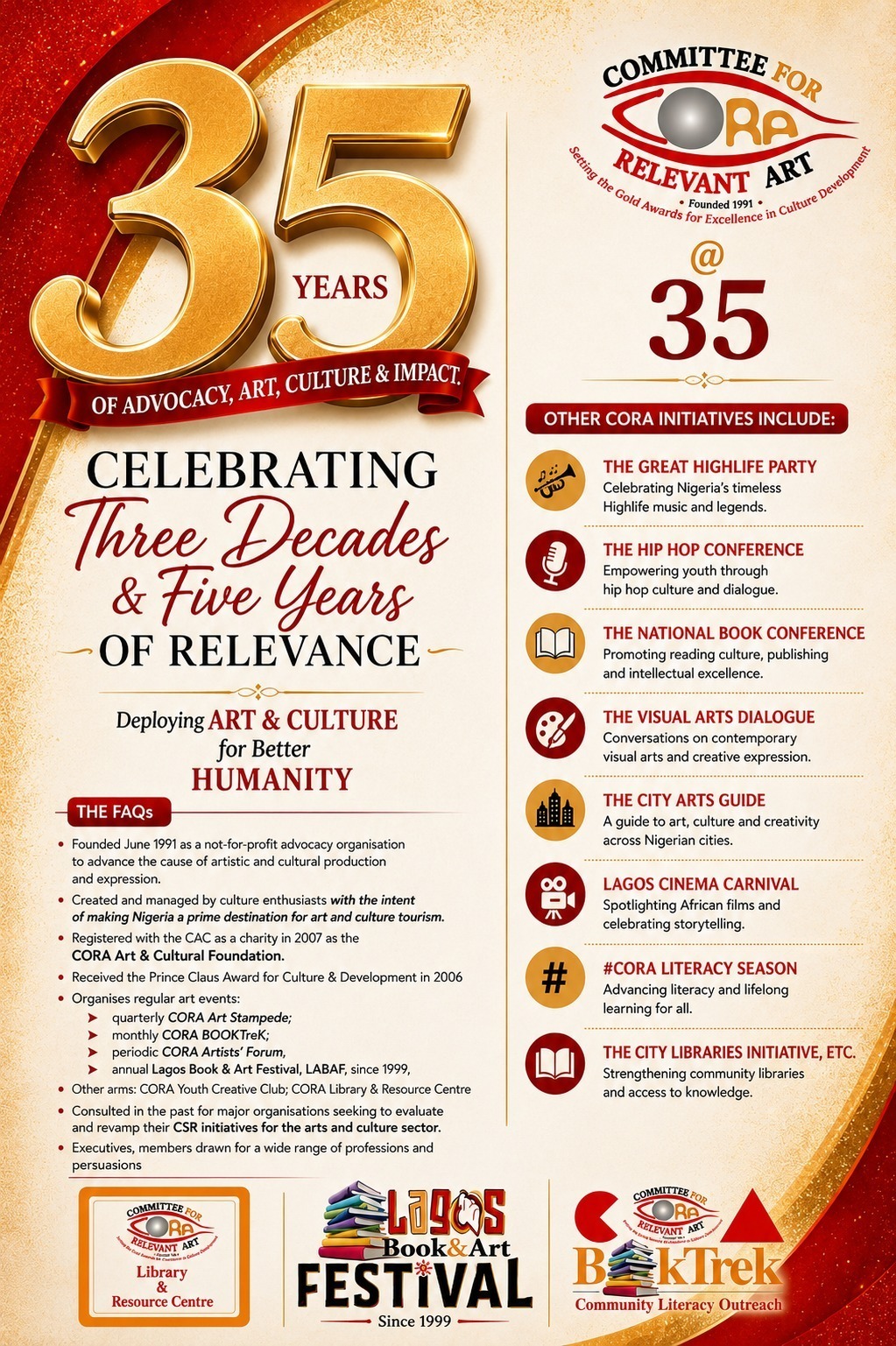
    The Committee for Relevant Arts (CORA), Nigeria’s foremost consortium of writers, journalists, artists and literary enthusiasts, is officially 35 years old on Tuesday June 2, 2026, having been founded and staged its first public outing on June 2, 1991.

    Though not staging any official event on the actual date, the leading advocate for the arts and culture of the nation and the continent, on Saturday June 6, 2026, at 4pm, will commemorate the milestone with the formal launch of its podcast station tentatively named “Voices from the CORAVille.”

    The station is located in its secretariat office space at the CORA Library & Resource Centre, CORAVille, Freedom Park, Lagos Island. It is manned by its Programme Directorate peopled by its cohorts of Associates and Volunteers drawn from the CORA Youth Creative Club. The new podcast initiative, which expands the organisation’s diverse range of activities is designed to deepen conversations around the creative and cultural industries through insightful interviews, critical commentaries and engaging dialogues.

    With a donation by its long-standing patron and support, David Awam Amkpa, professor of Culture Aesthetics with the Tisch School of Art, New York University, NY, and Vice Provost, New York University, Abu Dhabi, the podcast station aims to serve as a platform for thought leadership, knowledge sharing, and advocacy, helping to catalyse transformational change within the creative ecosystem.

    Toyin Akinosho, CORA’s visionary founder and Secretary-General, will be the special guest on the podcast’s maiden edition, which will take listeners back to CORA’s formative years, when the dream was crystallising, and yet take a firm grip. Right from the first Arts Stampede on June 2, 1991, and other baby-step activities that took place in Akinosho’s residential courtyard in FESTAC Town, Lagos, the podcast launch will help relive memories and remember early contributors to the development of CORA.

    Indeed, there is no other individual more suitable than Akinosho, who is expected to pull these strings of nostalgia, telling such epochal stories of an NGO that has grown steadily over the years, becoming home for cultural landscapists who have been instrumental in determining and shaping the country’s cultural horizon in the past 35 years.

    Jahman Anikulapo, CORA’s Program Chair described the double-barrel event as yet another milestone in the organisation’s history.

    “This double-barrel event is yet another history-making moment for CORA. It offers the opportunity to reflect deeply on CORA’s evolution in the last 35 years of active engagements in literacy campaigns, cultural advocacy and the shaping and structuring of Nigeria’s creative ecosystem.

    “We invite everyone who has followed CORA’s journey from its infancy to this remarkable period. Writers, journalists, art enthusiasts, culture advocates, activists and members of the general public are welcome to join us in commemorating CORA’s 35th anniversary and celebrating its enduring contributions to the nation’s cul-tural landscape.”

    The Committee for Relevant Art (CORA) was founded in June 1991 as a not-for-profit advocacy organisation to advance the cause of artistic and cultural production and expression. It was created and, has been over the decades managed by dedicated culture enthusiasts with the intent of making Nigeria a prime destination for art and culture tourism. CORA was registered with the Corporate Affairs Commission in Nigeria as a charity in 2007 as the CORA Art & Cultural Foundation. In 2006, the organisation was a recipient of the Prince Claus Award for Culture & Development.

    CORA has been instrumental to major policy shifts in the creative industries, the most recent of which is the ongoing revamp of the 50-year old National Theatre of Nigeria; the introduction and ongoing review of the Cultural Policy of Nigeria; the sustenance of the various culture parastatals of the Federal Government of Nigeria; and the epochal launch of the Bring Back the Book initiative by former President Goodluck Jonathan.

    CORA organises regular art events, including live performance events and plenaries such as the quarterly CORA Art Stampede; the monthly CORA BookTrek, the periodic CORA Artists’ Forum, and the annual Lagos Book & Art Festival, LABAF, organised since 1999, and widely revered as the biggest of its type in the West Africa sub-region. These events constantly draw attendance from the creme of Nigeria’s art enthusiasts, practitioners and patrons and are regularly reported in the press.

    Ideas shared at CORA-organised forums have influenced major interventions in the literary, film, musical, visual and performative arts of Nigeria in the past three decades. CORA has consulted in the past for major organisations seeking to evaluate and revamp their CSR initiatives for the arts and culture sector.

  • Femi Osofisan at 80: Celebrating an iconic poet, dramatist, scholar with landmark events in Lagos and Ibadan

    Femi Osofisan at 80: Celebrating an iconic poet, dramatist, scholar with landmark events in Lagos and Ibadan

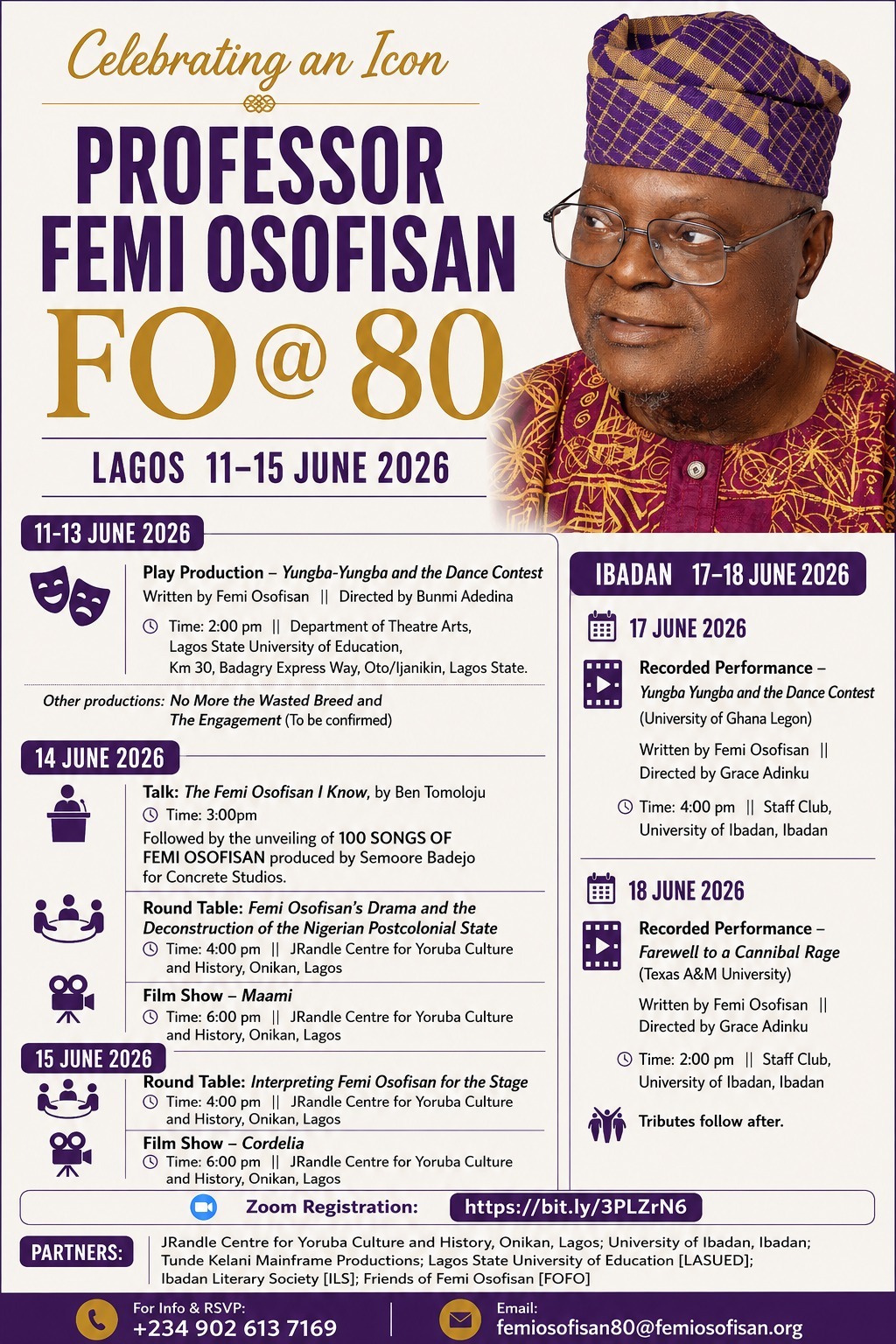
    Nigeria’s literary and theatrical communities are upbeat this June to honour one of Africa’s venerable culture personality, Professor Femi Osofisan, as he celebrates his 80th birthday. 

    The landmark birthday anniversary of the  distinguished playwright, critic, poet and public intellectual, work has shaped generations of artists, scholars and audiences across the world, will be commemorated with a rich programme of activities — performances, screenings and conversations  as outlined below: 
    Lagos (June 11–15, 2026) 
    Ibadan (June 17–18, 2026).

    A National Tribute to a Cultural Luminary
    The FO@80 celebrations bring together theatre practitioners, filmmakers, academics, students and admirers to honour a writer whose work has consistently interrogated power, history, justice and the human condition. The events offer a rare opportunity to revisit Osofisan’s dramatic oeuvre across stage and screen, while engaging in critical dialogue about his enduring impact.

    LAGOS PROGRAMME

    June 11–15  2026
    The Lagos celebrations will begin with a three-day stage production of Osofisan’s acclaimed play Yungba Yungba and the Dance Contest (June 11–13). Directed by Bunmi Adedina, the production will run daily at 2:00pm, with a Command Performance at 1.00pm on June 11 June at the Department of Theatre Arts, Lagos State University of Education, Ijanikin, Lagos.

    Other productions being planned for the days include No More the Wasted Breed (dir. Segun Adefila) and The Engagement (dir. Shola Adenugba)

    On June 14, events move to JK Randle Centre for Yoruba Culture and History, Onikan, Lagos with the activities, starting with a Talk by dramatist Ben Omowafola Tomoloju, title “The Femi Osofisan I Know”. Time: 3.00pm
    Tomoloju’s Talk will be followed by the unveiling of 100 SONGS OF FEMI OSOFISAN, produced by Semoore Badejo for Concrete Studios.

    2. Roundtable: “Femi Osofisan’s Drama and the Deconstruction of the Nigerian Postcolonial State” – featuring scholars, practitioners and admirers reflecting on Femi Osofisan’s legacy. Time 4.00pm
    Speakers include: BabaAgba Tunde Kelani, filmmaker, culture advocate; Professor Mabel Evwierhoma, theatre and culture scholar, University of Abuja; Professor Akin Adesokan, culture and media scholar, Indiana University, Bloomington, USA; Professor Razinat Mohammed, writer and literary scholar, University of Abuja; Dr. Onyekaba Cornel-Best, theatre and media scholar, University of Lagos; Professor Ifure Ufford-Azorbo, theatre practitioner and scholar, University of Uyo; Israel Eboh, theatre director and former President of National Association of Nigerian Theatre Arts Practitioners, NANTAP. It will be moderated by Jahman Anikulapo, culture curator and communicator. 

    3. Guests will enjoy a screening of Maami, adapted for film by Tunde Kelani from Osofisan’s original work. The screening begins at 6:00pm.

    The Lagos programme concludes on June 15 with a second Roundtable at 4:00pm, that would treat the theme: Interpreting Femi Osofisan for the Stage. Speakers are: Professor Grace Adinku, Performance and Visual Arts Studies Scholar, Texas A & M University, College Station, TX, USA; Dr Teju Kareem, theatre practitioner, CEO Zmirage Multimedia Company; Dr Toyin Ogundeji, theatre practitioner, teacher, Obafemi Awolowo University; Professor Rasheedat Liman, theatre teacher and culture scholar; Mrs Joke Silva (Jacobs); veteran actress and culture entrepreneur; Segun Adefila, theatre practitioner, Chairman, Guild of Nigerian Dancers, GOND; and Makinde Adeniran, theatre director, President of National Association of Nigerian Theatre Practitioners, NANTAP. It will be moderated by Professor Tunji Azeez, theatre teacher, scholar and President of Society of Nigerian Theatre Artists, SONTA. 

    The Roundtable will be followed by screening of Cordelia, an adaptation of Osofisan’s novella of same title by BabaAgba Tunde Kelani  at 6:00pm

    Other performances being contemplated in the course of the celebration are: Femi Osofisan’s No More the Wasted Breed as adapted and directed by Segun Adefila for the Crown Troupe of Africa and Osofisan’s The Engagement directed by Shola Adenugba for the Lagos Live Theatre.

    NB: The Talk and Roundtables will also be accessible via Zoom. To attend virtually, audiences may register using the link: https://bit.ly/3PLZrN6 

    IBADAN PROGRAMME

    June 17–18 2026
    The celebrations continue at the Staff Club, University of Ibadan, beginning on June 17 with a recorded presentation of Yungba Yungba and the Dance Contest as performed at the University of Ghana, Legon, directed by Grace Adinku. The screening starts at 2:00pm, and is followed by a Q&A.
    The Ibadan programme concludes on 18 June with a recorded performance of Farewell to a Cannibal Rage, staged at Texas A&M University and directed by Grace Adinku. The screening begins at 2:00pm, followed by a Roundtable session and Tributes.

    The celebrations enjoy the partnerships and technical support of JRandle Centre for Yoruba Culture and History Lagos; University of Ibadan; Lagos State University of Education; Texas A & M University, College Station, TX, USA; University of East Anglia, UK; Mainframe Productions; Ibadan Literary Society; Concrete Studios; and Friends of Femi Osofisan.

    *****
    About Femi Osofisan: Born at Erunwon on the 16th June 1946, Femi Osofisan (aka Okinba Launko) had his secondary education at the Government College, Ibadan and then proceeded to the University of Ibadan where, after a year abroad in Dakar, Senegal, he obtained an Honours degree in French in 1966. Eight years later, after aborting his postgraduate studies in Paris, he returned to Ibadan to obtain his PhD in 1974, and then joined the faculty as Assistant Lecturer. He rose to the post of Professor in 1985, and was made Emeritus Professor in 2014 on retirement. Osofisan has published over 40 plays, five novellas, six volumes of poetry, as well as the acclaimed biography of J.P. Clark, entitled, J.P. Clark: A Voyage. A former President of the Association of Nigerian Authors [ANA], of PEN-Nigeria and the Pan African Writers Association [PAWA], Osofisan has been the recipient of several Fellowships and Awards, including the French National Order of Merit Award (1991); the University of Ibadan Faculty of Arts Distinguished Alumnus Award (2001); the Nigerian National Order of Merit Award for the Humanities (2004); and the prestigious Fonlon-Nichols Award (2005). In 2006, he became a Fellow of the Nigerian Academy of Letters. In 2016, he was the first African to be honoured with the Thalia Prize of the International Association of Theatre Critics to highlight his work in helping critics around the globe to understand new ways of seeing and appreciating the performing arts worldwide.

  • ‘Jide Adeyemi Unveils “Life Guide,” Advocates Purpose, Good Leadership and National Transformation

    ‘Jide Adeyemi Unveils “Life Guide,” Advocates Purpose, Good Leadership and National Transformation

    Brand strategist, ‘Jide Adeyemi, has urged Nigerians to embrace purposeful living, intentional leadership, and value-driven nation-building as a roadmap to personal and national transformation.

    Adeyemi made the call during the Life Guide Colloquium in Lagos, where he officially presented his book titled Life Guide: Stories, Lessons and Insights to Empower Your Journey.

    Speaking during the event, he emphasized the need for clarity, direction, and strong values in a world filled with distractions and uncertainty.

    “We are trying to provide a map through which people can navigate life,” he said, explaining that the colloquium was created to help individuals find clarity of purpose across leadership, business, faith, and personal development.

    Adeyemi noted that quality leadership remains essential for building strong institutions and thriving societies, stressing that effective communication, faith, vision, and responsible citizenship are intertwined pillars of nation-building.

    According to him, the newly released book challenges readers to rethink their approach to life, embrace integrity, and pursue growth with intentionality.

    The event featured renowned comedian and entrepreneur, Atunyota Akpobome, popularly known as Alibaba, as keynote speaker. Speaking on the theme, “Influence Engineering,” Alibaba encouraged Nigerians to consciously develop their talents into assets capable of creating value and opportunities for others.

    “Potential is where to start from, but you have to develop it enough to the point where people begin to seek it for commercial or societal value,” he said.

    The colloquium also featured panel sessions focused on nation building, leadership, branding, wisdom for growth, and faith-driven influence. The Nation Building panel featured Babatunde Ogala, SAN; Nike Oyetunde-Lawal; Gboyega Akosile; and JJ Omojuwa, who examined issues around governance, responsible citizenship, leadership accountability, and the role of young professionals in shaping Nigeria’s future.

    The Brand and Wisdom for Growth panel had Lanre Adisa of Noah’s Ark, Segun Ogunleye of Diageo, Olalekan Fadolapo, and Tolulope Medebem discussing brand positioning, strategic communication, innovation, business growth, and the importance of consistency in building lasting influence and credibility.

    The Leadership and Faith in God panel featured Gbenga Olorunfemi, Hon. Seyi Adisa, Hon. Lanre Oyegbola-Sodipo, Chairman Abeokuta North Local Government, Ogun State, and Paschal Dike. Discussions centered on ethical leadership, faith-based governance, resilience, mentorship, and balancing ambition with values in public and private life.

    The event was chaired by Chief Babajide Olatunde-Agbeja, Chairman of AIICO Insurance Brokers Limited, while the book was reviewed by Dr. Adekunbi Wuraola, CEO of Discover Your Potential, who described Life Guide as a reflective and practical framework for leadership and intentional living.

    The colloquium attracted professionals, entrepreneurs, policy advocates, business leaders, and young Nigerians from different sectors for conversations centered on leadership, influence, innovation, and purposeful living.

  • 223 Entries Set the Stage as The Nigeria Prize for Literature 2026 Enters Adjudication Phase

    223 Entries Set the Stage as The Nigeria Prize for Literature 2026 Enters Adjudication Phase

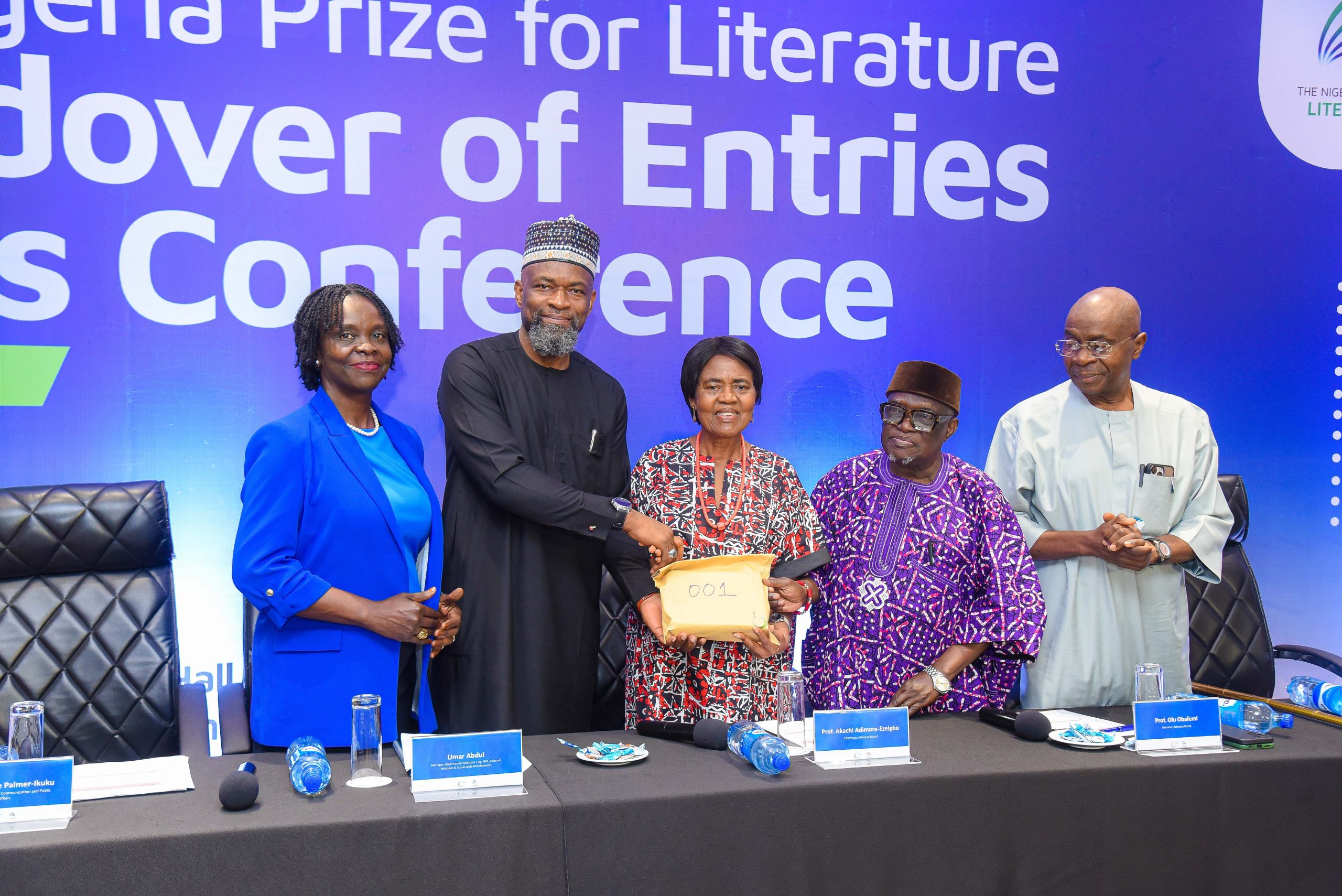
    The 2026 edition of The Nigeria Prize for Literature has entered the adjudication stage following the formal handover of 223 entries by NLNG to the Advisory Board and panel of judges in Lagos on Monday. The submission volume reflects a strong outing for the poetry category, broadly in line with recent cycles and demonstrating sustained participation from writers. While slightly below some peak years, the figure remains competitive, particularly when viewed alongside recent prose entries, underscoring continued interest in the Prize and reaffirming its significance within Nigeria’s literary landscape.

    Speaking at the press conference, the General Manager, External Relations and Sustainable Development, NLNG, Dr. Sophia Horsfall, represented by Abdul Umar, Manager, Government Relations, NLNG, described the handover as the beginning of a rigorous and defining process that will ultimately determine this year’s winning work.

    “This marks the start of a process that demands attention, patience, and sound judgement, and will ultimately determine the work that defines this year’s Prize,” she said.

    This year’s $100,000 Prize, widely regarded as one of Africa’s most prestigious literary honours, focuses on Poetry. Dr. Horsfall noted that the genre demands precision, depth, and clarity, with expectations shaped by the strong benchmark set in previous cycles, particularly the 2022 edition, which produced a winning work that continues to resonate within contemporary Nigerian literature.

    She reaffirmed NLNG’s commitment to sustaining a credible platform that promotes literary excellence and contributes to national development through the arts.

    “At NLNG, we have consistently provided a platform that supports excellence and inspires a sustainable future. Beyond recognising talent, the Prize has contributed to the growth of reading culture, encouraged discipline in writing, and strengthened Nigeria’s literary landscape,” she added.

    Dr. Horsfall emphasised that the credibility of the Prize lies in the integrity of its adjudication process, which will involve months of detailed reading, evaluation, and deliberation, culminating in a longlist of eleven entries, a shortlist of three, and ultimately, the selection of a winner.

    The entries were formally presented to the Advisory Board, chaired by Professor Akachi Adimora-Ezeigbo, who in turn handed them over to the panel of judges for evaluation in line with established standards.

    Speaking while receiving the entries, Prof. Adimora-Ezeigbo commended NLNG for its continued dedication to the Prize, noting that each edition reflects the evolving depth and diversity of Nigerian writing across genres.

    She also acknowledged the writers whose submissions continue to sustain the Prize’s relevance and impact and urged the panel of judges to demonstrate the highest level of professionalism and depth in selecting the winning entry.

    The Nigeria Prize for Literature, sponsored annually by NLNG, remains a flagship initiative in the company’s commitment to education, culture, and sustainable development, and continues to serve as a benchmark for literary excellence in Africa.

  • Gov. Oborevwori, Prof. Osunbor, Sen. Dafinone, others to grace TheNewsGuru Editor’s book launch

    Gov. Oborevwori, Prof. Osunbor, Sen. Dafinone, others to grace TheNewsGuru Editor’s book launch

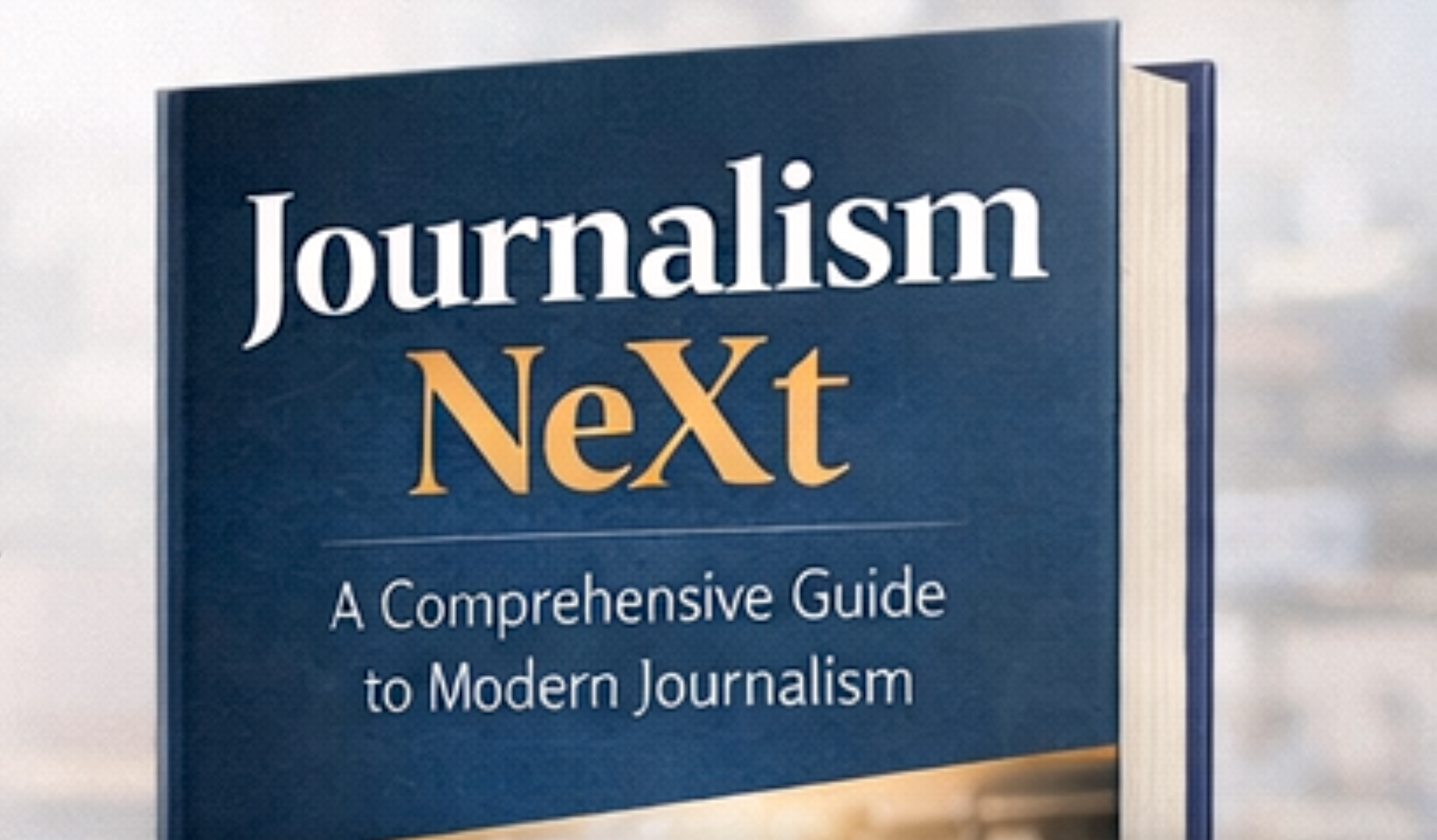
    Organisers of the forthcoming public presentation of “Journalism NeXt: A Comprehensive Guide to Modern Journalism” have announced a distinguished lineup of eminent personalities expected to grace the book launch.

    The book, authored by Editor of TheNewsGuru (TNG), Ediri Oyibo, is scheduled for official unveiling on Thursday, April 30, 2026, at the Secretariat of the Nigeria Union of Journalists (NUJ), FCT Council, Utako, Abuja at 2:00 pm.

    Leading the list of dignitaries is the Governor of Delta State, Rt. Hon. (Elder) Sheriff Oborevwori, who will attend as Special Guest of Honour, while former Governor of Edo State and two-term Senator, Prof. Oserheimen Osunbor, will serve as Chairman of the Occasion.

    The book will be reviewed by Dr. Lemmy Ughegbe, Founder and Executive Director of the Make A Difference Initiative (MADI).

    The event will also feature the presentation of research findings by the author on the state of journalism in Nigeria, with a focus on challenges faced by journalists in the Federal Capital Territory (FCT).

    Other dignitaries expected at the event include Senator Ede Dafinone, Delta Central, Senator Joel-Onowakpo Thomas, Delta South; Senator Ned Nwoko, Delta North; Hon. Benedict Etanabene, Member representing Okpe/Sapele/Uvwie Federal Constituency, and Mr. Mideno Bayagbon, Publisher of TheNewsGuru (TNG).

    Others are Dr. Dili Ezughah, Executive Secretary and CEO, Nigerian Press Council (NPC); Dr. Aminu Maida, Executive Vice Chairman, Nigerian Communications Commission (NCC), and Comr. Alhassan Yahya Abdul, National President of the Nigeria Union of Journalists (NUJ), among others.

    “Journalism NeXt: A Comprehensive Guide to Modern Journalism” explores the transformation of journalism in the digital era, addressing issues such as media ethics, innovation, sustainability, and the evolving role of journalists in a rapidly changing information ecosystem.

    Organisers say the event is expected to attract journalists, media entrepreneurs, academics, policymakers, students, and members of the public, providing a platform for robust engagement and networking.

  • Faith, Character, and the Northern Narrative: Redefining Relationship Dynamics in Between Hearts and Homes

    Faith, Character, and the Northern Narrative: Redefining Relationship Dynamics in Between Hearts and Homes

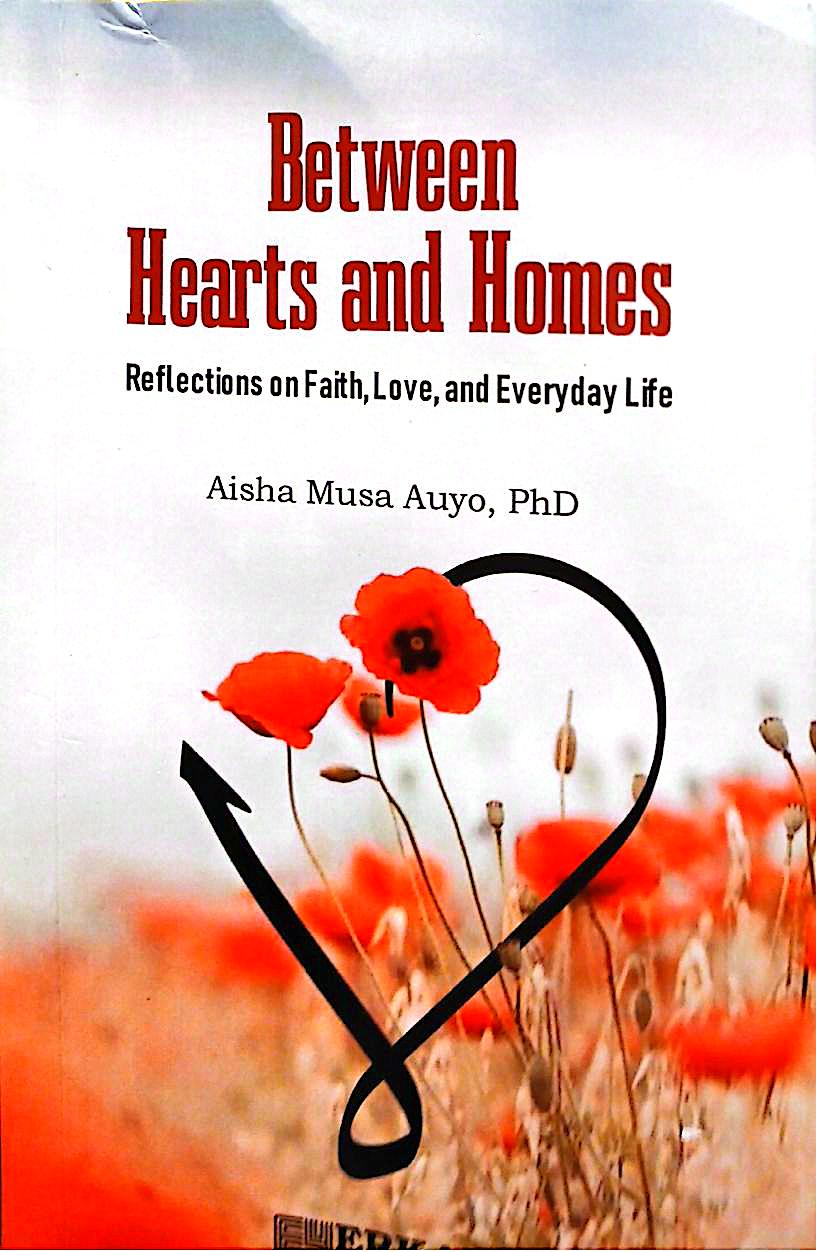
    Title: Between Hearts and Homes: Reflections on Faith, Love and Everyday Life

    Author: Aisha Musa Auyo, PhD

    Year of Publication: 2025

    Pagination: 180 pages

    Reviewer: Olamitayo Ebunola Irantiola

    The book is written out of the author’s deep concern after observing the current trend of marriages and relationships failing. This prompted the author to discuss various themes, including the essentials for sustaining marital relationships, navigating parenthood, and building healthy relationships with those around us. She strongly believes that a happy family is the foundation of a happy society, and a happy society produces a prosperous nation.

    Contrary to the common belief in society that homes are built solely by women, she argues that it takes two to tangle and also to build a home. She encourages men to evolve alongside their wives, noting that neglecting their wives’ growth in experience and exposure can create gaps over time, leading men to perceive their wives as falling short of their standards as they grow.

    The author also emphasises the importance of communication, particularly from men, as a way to build intimacy, encouragement, confidence, and healing within marriage. At the same time, she advises women not to rely solely on men’s approval for validation. She argues that women should pursue purpose and personal growth to remain uplifted even when such approval is not always expressed.

    Dr. Auyo also addresses the challenge of balancing the dual responsibilities of wives—their commitment to their husbands and their duties to their children. She advocates for understanding and support from men, especially during the early years when children require more attention.

    The author acknowledges that challenges are a natural part of marriage and should strengthen the relationship rather than lead to its dissolution. Reflecting on older generations, she notes that many marriages in the past were not necessarily built on love, physical attraction, or material wealth, yet they often lasted longer. According to her, modern couples sometimes prepare more for flamboyant weddings than for the realities of marriage itself.

    She also highlights the importance of character building, stating that marriage tests almost every aspect of a person’s life. Therefore, before one can enjoy a happy marriage, one must grow in wisdom and character.

    The author also advises spouses to let go of situations that no longer serve them, particularly in cases of abuse. She illustrates this with a fascinating childhood story about refusing to let go of a sheep she cared for, which eventually left her with bruises

    Dr. Auyo critiques the idea that partners should complete each other, arguing that they should complement one another. She encourages individuals to seek completeness in their relationship with Allah, which can help reduce frustration when human expectations are not fully met.

    The book also offers practical advice on building relationships with neighbours and members of the community. She recounts her experience in a new neighbourhood where the support of neighbours helped save the life of her child, demonstrating the value of maintaining good relationships with those around us.

    Another important lesson she shares is the need to be less judgmental, illustrated through her personal experience of sometimes failing to recognise people, a condition she described as prosopagnosia.

    One of the most compelling sections of the book addresses the education of girls and women. From an Islamic perspective, she explains that the command to seek knowledge applies to both men and women. This challenges the popular perception about girls’ education in parts of Northern Nigeria, particularly coming from a Fulani descendant.

    She further explains that the world’s first institution of higher education, the University of al-Qarawiyyin in Morocco, was established by a woman named Fatima al-Fihriya in 857–859

    The book is a good read for people of all genders, as it prepares us to build meaningful relationships with our spouses, children, and the wider community. It also helped me gain a deeper understanding of Northern Nigeria, correcting some of the misconceptions I previously held about the region and its people.

    Olamitayo Ebunola Irantiola is a pastor, author and family life practitioner.

  • ‘Winning with Strategic Communications’ Launch, Targets Real-World Impact

    ‘Winning with Strategic Communications’ Launch, Targets Real-World Impact

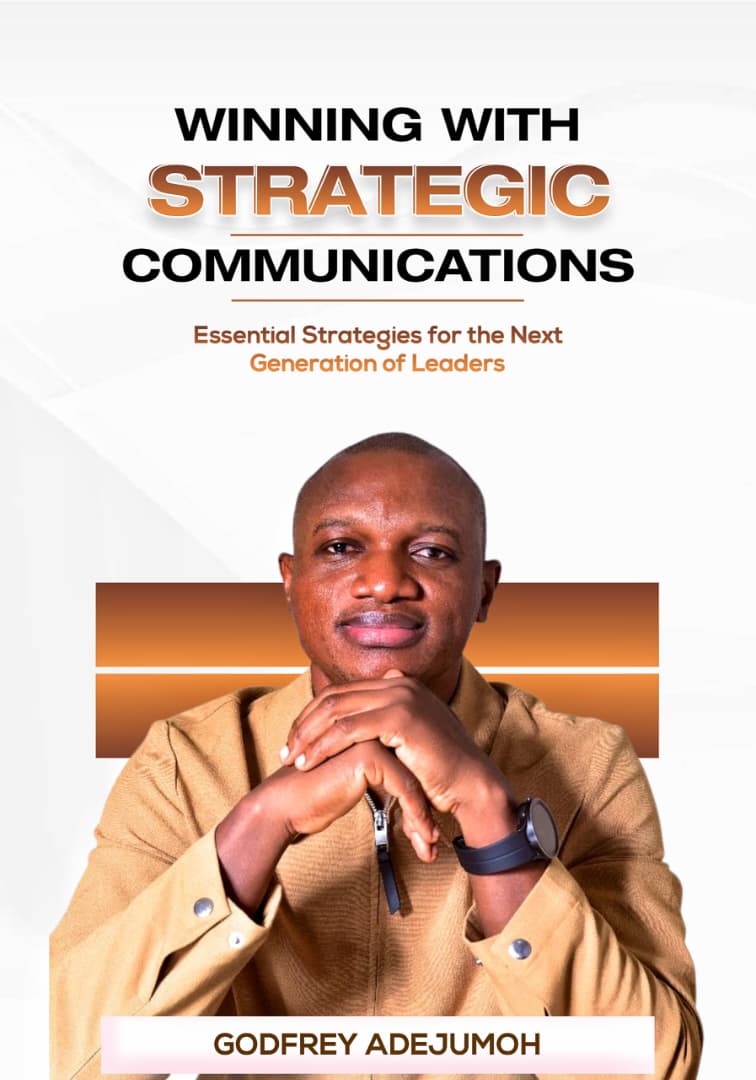
    Godfrey Adejumoh, a seasoned top-performing Global Business Communications Strategist and Thought Leader, is set to launch a book titled, ‘Winning with Strategic Communications: Essential Strategies for the Next Generation of Leaders.’

    Winning with Strategic Communications, is a veritable playbook for navigating today’s complex world of leadership, communication, and influence. It is an important book for communications leaders of all ages. In this book, Godfrey distils years of lived experience, professional insights, and lessons from the frontline of Public Relations into clear, actionable strategies.

    At its heart, this work seeks to bridge the often-wide gap between theory and practice. While academia provides the frameworks, Winning with Strategic Communications reveals how those frameworks come alive in the real world. With practical guidance, compelling examples, and a strong grounding in strategic communications, it offers readers a toolkit to lead with clarity, confidence, and impact. Within these pages, budding leaders, communication professionals, and entrepreneurs will each discover insights to guide their journey.

    This is not just a book to be read; it is a manual to be applied. It challenges assumptions, sharpens leadership instincts, and equips the next generation of leaders to win, not by chance, but with strategy.

    Winning with Strategic Communications is a roadmap to the top!

    Godfrey Adejumoh is a seasoned top-performing Global Business Communications Strategist and Thought Leader. He has extensive experience in Public Relations, strategic corporate communications, policy advocacy, campaign planning/implementation, public affairs/government relations, sustainability/ESG, and corporate social responsibility (CSR).

    With over 15 years experience, he has contributed to the reputation management of different multinationals (Diageo, Unilever, MTN, DHL, Accenture, LG and more) across sectors. He has evolved into a trusted advisor to C-Suite Executives, board members and a rounded business leader, through his career journey that started in Public Relations consultancies.

    He is a public speaker leading the discourse on how strategic business communications play a vital role in crafting winning business strategies, contributing to growing and sustaining high performance for businesses. His public speaking and mentorship cut across various reputable platforms – O2 Academy Lagos, Orange Academy Lagos, Lagos Business School (LBS), Pan Atlantic University, Nile University, University of Lagos (UNILAG), Osun State, University, Nigeria Institute of Public Relations (NIPR), Nigeria Institute of Journalism (NIJ), among others.

    Godfrey has a keen interest in developing the next generation of business leaders through strategic business communications to contribute to high performance for businesses and developing strategies to help reposition companies to maintain growth within a sustainable development framework.

  • Feature: Review of ‘Smash the Glass Ceiling’ by Olamitayo Ebunola Irantiola

    Feature: Review of ‘Smash the Glass Ceiling’ by Olamitayo Ebunola Irantiola

    Aisha Musa Auyo, PhD

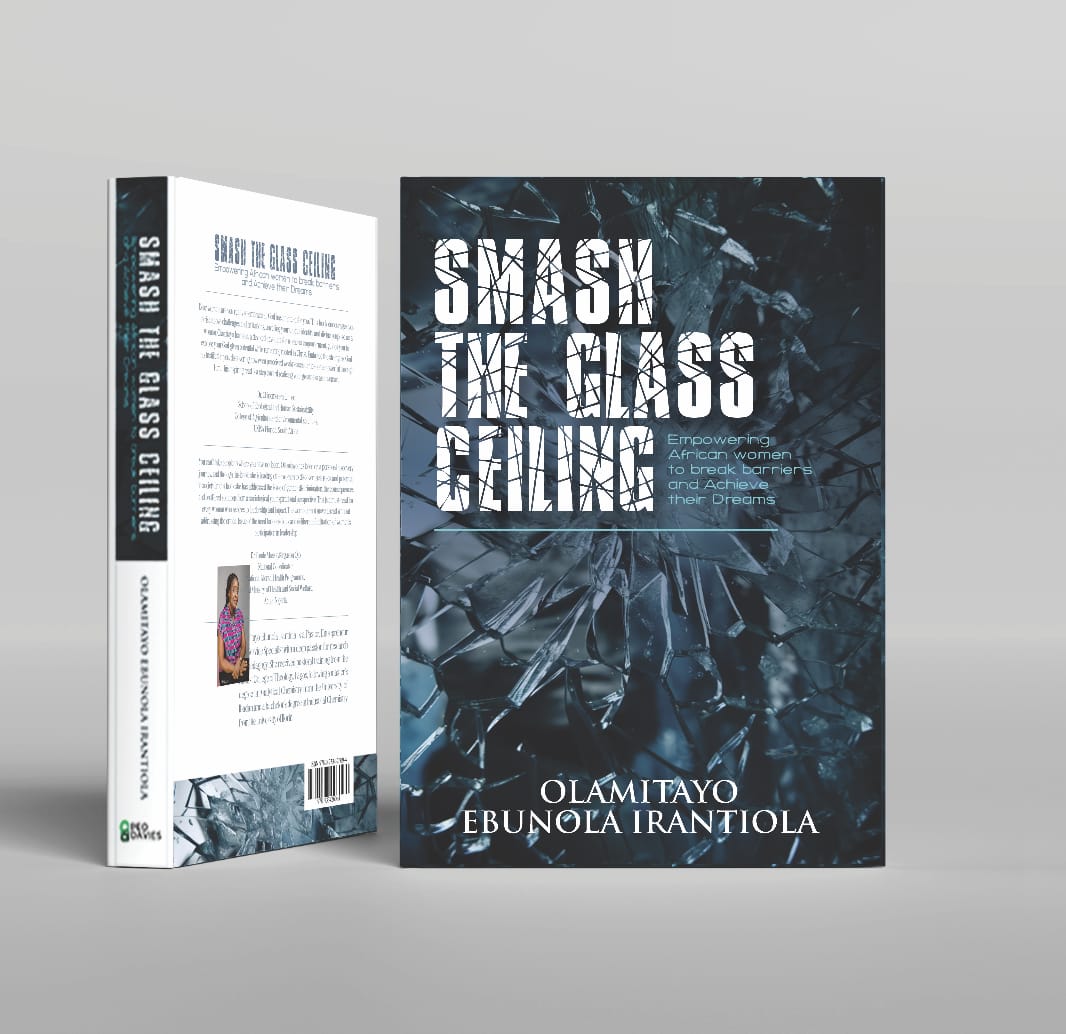
    Smash the Glass Ceiling is a bold and inspiring book that speaks directly to African women navigating personal, professional, and societal barriers. Olamitayo Ebunola Irantiola delivers a timely and powerful message about courage, self-belief, and the determination needed to rise above limitations and pursue one’s dreams.

    What makes this book especially impactful is its practical encouragement and relatable perspective. Rather than only highlighting the challenges women face, the author offers motivation and thoughtful insights that inspire readers to build confidence, strengthen resilience, and take purposeful action. The message is clear: barriers may exist, but they are not unbreakable.

    The book serves both as a source of inspiration and a gentle reminder that growth begins with the right mindset, bold decisions, and the willingness to step beyond one’s comfort zone. It is particularly meaningful for young women, professionals, and anyone in need of encouragement to pursue their ambitions despite obstacles.

    Overall, ‘Smash the Glass Ceiling’ is an empowering and uplifting read that contributes positively to conversations around women’s growth, leadership, and possibilities. I wholeheartedly recommend it to every woman who is ready to dream bigger and move forward with confidence.

    Thank you for sharing a copy with me, I feel truly inspired and invigorated. Every African woman should strive to have this book in her collection.

    Aisha Musa Auyo, PhD
    Mrs Abdullahi Maiwada, National PRO Customs

  • Aba set for Literary Week as All Saints ’92 Set Drives Educational Empowerment

    Aba set for Literary Week as All Saints ’92 Set Drives Educational Empowerment

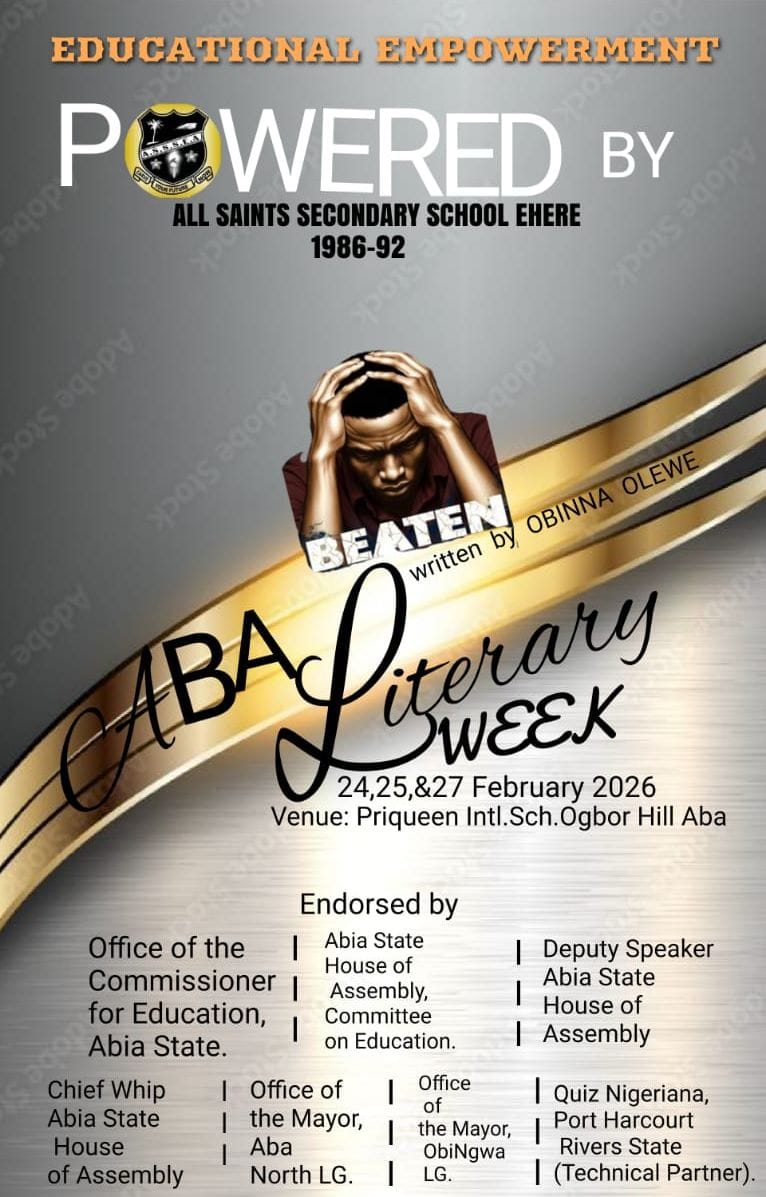
    Eight public and private secondary schools in Aba are set to participate in the maiden edition of Aba Literary Week 1.0, an educational empowerment initiative organised by the All Saints Secondary School, Ehere ’92 Set, aimed at promoting reading culture and healthy academic competition among young students.

    The literary week, scheduled for 24th, 25th and 27th February 2026, will hold at Priqueen International School, Ogbor Hill, Aba, and will feature activities such as quiz competitions, literary reviews and presentations centred on the novel “Beaten” written by Obinna Olewe, a member of the alumni association.

    The programme is powered by the All Saints ’92 Set as part of its community impact drive and alignment with the United Nations Sustainable Development Goal 4 on quality education.

    The initiative is also endorsed by several key stakeholders including the Office of the Commissioner for Education, Abia State; the Abia State House of Assembly Committee on Education; the Deputy Speaker, Abia State House of Assembly; the Mayor of Aba North LGA; the Mayor of Obingwa LGA; and Quiz Nigeriana, Port Harcourt as technical partner.

    Speaking on the project, the President of the All Saints ’92 Set,
    Chief Engr Martin Ikechukwu Uzoegwu described the initiative as a strategic investment in young minds. He noted that the association is committed to “building a sustainable platform that encourages lifelong learning, strengthens reading culture and positively influences the educational ecosystem within Aba and beyond.”

    Also commenting, the Chairman of the Organising Committee, Engr. Samuel Ogbuagu stated that the literary week is designed to create multi-stakeholder collaboration between alumni, schools, government, and the private sector.

     According to him, “this programme is not just an event but the foundation for an annual educational empowerment framework that will continue to grow and benefit students and schools in our community.”

    Participating schools and students are expected to benefit from cash prizes, free copies of the featured novel, and broader exposure to literary engagement while strengthening academic excellence and creativity among secondary school learners in Aba.

  • Feature- Smash The Glass Ceiling: A review by a conscious male reader

    Feature- Smash The Glass Ceiling: A review by a conscious male reader

    Title: Smash The Glass Ceiling: Empowering African Women to Break Barriers and Achieve their Dreams

    Author: Olamitayo Ebunola Irantiola

    Pagination: 244 pages

    Publisher: Peo Davies Communications

    Year of Publication: 2025

    Reviewer: Praise Ojetunde

    It was a privilege to read this fantastic book at this time when I am still a bachelor. I learnt that the writer spent years compiling the book before it reached the press; I strongly believe she held a sledgehammer in her hand during those years. Her intentionality was clear from the beginning to the end.

    Across the book, she mentioned that this limitation or sentiment associated with women is a scandal, harmful ideology, act of wickedness, servitude, unfair treatment, and a damaging mentality.

    Initially, I thought she would simply extend the “limits”, but she ended up removing them and created a strong point for empathetic women’s leadership.

    Despite her strong advocacy for women aspiring to leadership positions, and not limited by misinterpretations of gender roles backed by archaic cultural and out-of-context scriptural references, I found it particularly intriguing and encouraging that she keeps a godly home herself. She even acknowledged her husband and affirmed his support for her pastoral role, even when, in an instance, she was unfairly challenged by a fellow (elderly) woman.

    It is a book filled with high-quality research across every angle: institutions, culture, and spirituality.

    It is a book that encourages everyone, especially women, to dream without limits.

    In conclusion, it is a book written to right the wrong of many years, balance the scales, and spur women to understand the reality of their age and go for gold.

    It has successfully changed my perspective about women.

    I can only hope that more womanists, like Pastor Olamitayo Irantiola, and not feminists, embrace academic writings such as this publication. In addition, I would strongly recommend that this book be read by young men and women.

    Thank you, Pastor Olamitayo Irantiola.

    Praise Tolulope Ojetunde is the author of The Errand President

  • The Nigeria Prizes Open for Entries with focus on AI, Poetry and Documentary Filmmaking

    The Nigeria Prizes Open for Entries with focus on AI, Poetry and Documentary Filmmaking

    The Nigeria Prizes competition officially kicked off on Sunday with a Call for Entries for the 2026 cycle. This year’s edition focuses on Artificial Intelligence and Information and Communication Technology (ICT) for The Nigeria Prize for Science and Innovation; Poetry for The Nigeria Prize for Literature; and Documentary Filmmaking for the newly introduced The Nigeria Prize for Creative Arts.

    The Prizes remain Nigeria’s foremost platform for rewarding excellence in science and innovation, literature, and the creative arts.

    This year, The Nigeria Prize for Science and Innovation retain the theme “Innovations in Information and Communication Technology (ICT), Artificial Intelligence, and Digital Technologies for Development” following a “no winner” verdict of the 2025 cycle.

    Speaking on the commencement of the prizes cycle, NLNG’s General Manager, External Relations and Sustainable Development, Sophia Horsfall, emphasised the relevance of the selected themes in a rapidly evolving global context. For Science, she noted that extensive research has demonstrated the immense potential of ICT, artificial intelligence, and digital technologies in reshaping industries and societies.

    “The themes for the 2026 cycle reflect the realities of a world being reshaped by digital intelligence and creative expression. Through The Nigeria Prizes, NLNG continues to reinforce its commitment to innovative ideas and talents that are rigorous, relevant, and capable of shaping long-term national outcomes. The introduction of the Creative Arts Prize further strengthens this commitment by recognising creativity as a critical component of development”.

    Also speaking on the Call for Entries, the Chairman of the Advisory Board of the Science and Innovation Prize, Prof. Barth Nnaji, called on scientists and innovators from all over the world to submit quality entries that transcend theoretical concepts and demonstrate deployable, scalable, and practical solutions.

    “The Nigeria Prize for Science and Innovation is founded on the principle that science must move beyond abstraction into solutions that work. The Prize recognises innovations grounded in rigorous research, demonstrating technical maturity and clear potential for application within Nigeria’s development landscape. We are looking for works that are inventive, credible, scalable, and capable of delivering measurable outcomes,” Prof Nnaji stated.

    With the prize valued at USD $100,000, the Science and Innovation competition is open to scientists and innovators worldwide and invites pioneering digital and artificial intelligence–based solutions that can enhance systems, improve efficiency, and support informed decision-making in critical sectors of Nigeria’s economy.

    For The Nigeria Prize for Literature, poets will be in the spotlight for the 2026 cycle. Nigerian authors resident in Nigeria and in diaspora are invited to submit poetry collections published from 2023 onwards. The prize, also worth USD $100,000, recognises literature’s enduring capacity to interrogate society, preserve memory, and articulate both personal and collective experience.

    The Chairman of the Advisory Board for The Nigeria Prize for Literature, and The Nigeria Prize for Creative Arts, Prof Akachi Adimora-Ezeigbo, expressed excitement at the establishment of the new Prize for Creative Arts. She described it as a significant addition to NLNG’s over two-decade legacy of celebrating excellence.

    “It reaffirms our belief that excellence transcends form, whether written, spoken, or filmed. The Creative Arts Prize challenges creators to confront truth, explore memory, and translate lived experience into meaningful work. At the same time, the focus on Poetry for The Nigeria Prize for Literature recognises the genre’s enduring role as a tool for reflection, resistance, and social inquiry, with a unique capacity to distil memory and interrogate complex realities,” she said.

    The Nigeria Prize for Creative Arts debuts with Documentary Film under the theme ‘Identity’, with the prize valued at USD $20,000. Targeted at emerging Nigerian filmmakers aged 18 to 35, the Prize challenges young creatives to produce documentary films that explore individual, communal, and cultural identities, and to reshape global perceptions of Nigeria through rigorous storytelling, creativity, and visual excellence.

  • Ajeluorou’s Brides of Infidels Gives Human Face to Nigeria’s Insecurity Crisis

    Ajeluorou’s Brides of Infidels Gives Human Face to Nigeria’s Insecurity Crisis

    Nigerian journalist, poet and novelist, Anote Ajeluorou, has described his novel, Brides of Infidels, as a conscious literary response to Nigeria’s prolonged insecurity crisis, saying the work seeks to humanise the pain of victims and sustain national attention on a tragedy that has persisted for more than a decade.

    Ajeluorou spoke during a book reading and interactive discussion session held at the CRIMMD Museum and Library, Ajao Estate, Lagos, as part of the Book Trek Community Literacy Outreach programme. The event drew students, educators, writers, cultural practitioners and residents of the community.

    According to the author, Nigeria has steadily fallen behind the times in addressing security challenges that have remained unresolved for over 12 to 14 years. He lamented what he described as a culture of denial by government authorities, citing recent incidents in Kaduna State where worshippers were abducted by terrorists, an occurrence initially disputed by the state government before it was later acknowledged.

    He said such denial undermines public confidence and raises concerns about the government’s preparedness to protect citizens across the country. Ajeluorou explained that Brides of Infidels is his fictional attempt to interrogate this failure and to show how insecurity has truncated the lives of thousands of Nigerians.

    Drawing from his experience as a journalist, Ajeluorou said the idea for the novel emerged during the height of the Boko Haram insurgency, particularly following the abduction of the Chibok schoolgirls. He recalled closely following reports in newspapers and on social media at the time, noting that the scale of the violence and the seeming helplessness of victims compelled him to respond creatively.

    “As a writer, I felt the need to lend my own small voice to this raging national tragedy,” he said, adding that literature remains a powerful tool for raising cultural consciousness and ensuring that the suffering of victims does not fade into statistics.

    The novel centres on the story of a young girl from a northern Nigerian community whose education is violently interrupted when insurgents attack her village. Through her experience, Ajeluorou explores themes of displacement, forced marriage, sexual violence, loss and survival, while also reflecting on the broader impact of terrorism on families and communities.

    He stressed that the book is not limited to the experience of the girl child alone, but deliberately broadens its scope to include the neglected trauma of the boy child. Ajeluorou explained that some male characters in the novel are forcibly conscripted into fighting after their communities are attacked, handed weapons and compelled to kill under the threat of death.

    According to him, the story also exposes deeper layers of social injustice, including early marriage, generational poverty and health complications such as vesicovaginal fistula, which further marginalise women and fuel cycles of vulnerability.

    Ajeluorou was careful to separate religion from extremism, stating that Islam is a religion of peace and should not be blamed for the atrocities committed by terrorists. He argued that those who hide behind religion to justify violence cannot claim to share the same spiritual values they profess.

    He criticised government policies that emphasise the rehabilitation of bandits without giving equal attention to victims and traumatised communities. He also condemned the continued existence of the Almajiri system in northern Nigeria, describing it as a social failure that leaves children exposed to exploitation and radicalisation.
    He questioned the commitment of governments in affected regions to education, noting that initiatives such as the Almajiri schools introduced during the Goodluck Jonathan administration were abandoned after his exit from office. According to Ajeluorou, failure to prioritise education has allowed insecurity to thrive.

    Speaking directly to students at the event, the author urged them to value education, remain disciplined and avoid distractions that could derail their academic progress. He also cautioned parents against unmonitored smartphone use by children, warning that excessive phone engagement affects reading habits and academic focus.

    Founder of the CRIMMD Library and Museum, Dr. Raphael James, also addressed participants, shedding light on the vision and impact of the institution. Dr. James, a Nigerian archivist and historian, said the Centre for Research, Information Management and Media Development was established in December 2004 to provide young Nigerians with access to books, knowledge and historical resources.

    He noted that the organisation recently relocated to Ajao Estate, making the Brides of Infidels reading the first major literary event at the new location. While the library had operated for years without charging users, he explained that rising operational costs have made modest fees necessary to sustain its services.

    Dr. James said the library was founded to challenge the notion that Nigerians do not read, arguing instead that many lack access to books due to economic constraints. He revealed that the institution has helped nurture several outstanding individuals, including medical doctors, engineers, a pilot and one of Nigeria’s youngest ICAN qualifiers.

    He further disclosed that CRIMMD has expanded to include the Museum of Nigerian History, Nigeria’s pioneer private history museum, established to document, preserve and reinterpret Nigerian history. According to him, the museum not only houses artefacts but also conducts research aimed at correcting historical inaccuracies and strengthening national consciousness.

    Dr. James emphasised the importance of historical awareness, noting that a society that does not understand its past risks losing its sense of direction. He said CRIMMD’s interactive learning spaces and educational exhibits are designed to make history engaging for young people while fostering a deeper appreciation of Nigeria’s heritage.

    The event concluded with questions and reflections from participants, reinforcing the role of literature, libraries and cultural institutions in sustaining dialogue around insecurity, education and national responsibility.

  • The Nigeria Prizes rebrands with new visual identities

    The Nigeria Prizes rebrands with new visual identities

    NLNG, today, unveiled the new visual brand elements for The Nigeria Prize for Literature, The Nigeria Prize for Science, and the newly introduced The Nigeria Prize for Creative Arts at a press conference in Lagos, marking a new phase in the evolution of these Nigeria’s foremost platforms for intellectual and creative excellence.

    Speaking at the unveiling, General Manager, External Relations and Sustainable Development at NLNG, Sophia Horsfall, described the new visual identities as a strategic repositioning of the prizes to ensure sustained relevance and global resonance. She noted that the refreshed logos reinforce NLNG’s commitment to the promotion of intellectual and creative capital as critical drivers of sustainable development.

    “For over two decades, The Nigeria Prizes have stood as independent symbols of excellence and national aspiration. This redesign is deliberate and forward-looking. It protects the legacy of the prizes while positioning them to be more visible, more iconic, and aligned with global standards of distinction into the future,” Horsfall said.

    She added that novel ideas remain central to national progress, “Ideas shape societies, and societies that invest in ideas secure their future. These new identities reaffirm our belief that literature, science, and innovation are not optional; they are foundational to Nigeria’s development.”

    The logo for The Nigeria Prize for Literature draws inspiration from the turning pages of a book. Rendered in layered green forms, it symbolises imagination in motion, stories unfolding, voices rising, and ideas taking flight. The fluid curves reflect storytelling in all its forms, including çand prose, while the green palette represents renewal, learning, and the fertile landscape of Nigerian literature. The gradient suggests growth, tracing the journey of ideas from seed to story, with a sense of calm dynamism that speaks to reflection, dialogue, and the enduring vitality of the written word.

     L–R: Dr. Sophia Horsfall, GM, External Relations & Sustainable Development, NLNG; Prof. Barth Nnaji, Advisory Board Chairman, The Nigerian Prize for Science & Innovation; Prof. Akachi Adimora-Ezeigbo, Advisory Board Chairman, The Nigeria Prize for Literature, other Prizes’ Advisory Board members and NLNG management staff at The Nigeria Prizes refreshed logos unveiling held in Lagos on Thursday.

    Commenting on the symbolism, Chairperson of the Advisory Board for The Nigeria Prize for Literature, Prof. Akachi Adimora-Ezeigbo said the logo captures the enduring power of Nigerian storytelling.

    “The turning pages remind us that our stories are continuous, rooted in history yet constantly renewed. Nigerian literature has never been static, and this identity affirms its role as a dynamic force shaping thoughts, conscience, and cultural memory,” she said.

    She added that the design sends a strong message to writers and thinkers that their voices matter and that imagination remains central to our collective destiny.

    The Nigeria Prize for Science and Innovation logo is formed from intersecting blue orbits, evoking atomic energy, electron pathways, and celestial motion. Its circular composition conveys continuity and the boundless nature of scientific inquiry, while the blue-lime palette reflects curiosity, intelligence, and the pursuit of truth. The identity celebrates Nigeria’s commitment to evidence-based inquiry and innovation, honouring those who push beyond the known to build a future powered by knowledge and imagination.

    The Chairman of the Advisory Board for The Nigerian Prize for Science and Innovation, Prof. Barth Nnaji, described the Science and Innovation logo as a reflection of the discipline, rigour, and ambition required for national transformation.

    “Science is about movement, questioning, testing, and pushing boundaries. The energy captured in this identity reflects the spirit Nigeria must embrace to industrialise, compete, and solve complex challenges.  The Prize remains a vital platform for recognising continuous and purposeful innovation,” he said.

    Completing the trio, the Nigerian Prize for Creative Arts logo is anchored by a lime-green spiral that represents innovation, continuity, and creative momentum. Its fluid form reflects the breadth of artistic disciplines encompassed by the Prize and the dynamic nature of the creative process. The spiral’s motion conveys rhythm, progress, and interconnectedness, while the lime-green palette signals freshness, optimism, and originality.

    The redesign follows NLNG’s recent corporate brand refresh and the alignment of its visual assets with a modern design approach. Collectively, the redesigned logos articulate a unified vision that celebrates intellectual rigour, creative excellence, and the transformative power of ideas, positioning The Nigeria Prizes for the future, while reinforcing their role as beacons of thought leadership, cultural relevance, and national pride.

    Since the inception of The Nigeria Prize for Literature and The Nigeria Prize for Science in 2004, they have maintained a consistent visual identity that helped establish strong brand equity. Building on this strong legacy, the refreshed identities reflect a deliberate evolution that strengthens the Prizes’ role as leading drivers of intellectual, creative, and national impact.