

























Governor Yemi Cardoso of the Central Bank acknowledges the undervaluation of the naira and pledges efforts for real price discovery in the foreign exchange market in 2024. In his address at the Nigeria Economic Group outlook, he outlines plans for inflation control through collaborative fiscal measures with the Ministry of Finance, vows to instill discipline in the forex market, and emphasizes prompt handling of infractions. Cardoso anticipates increased FX reserves through partnerships, aiming for the accretion of the country’s foreign reserve.
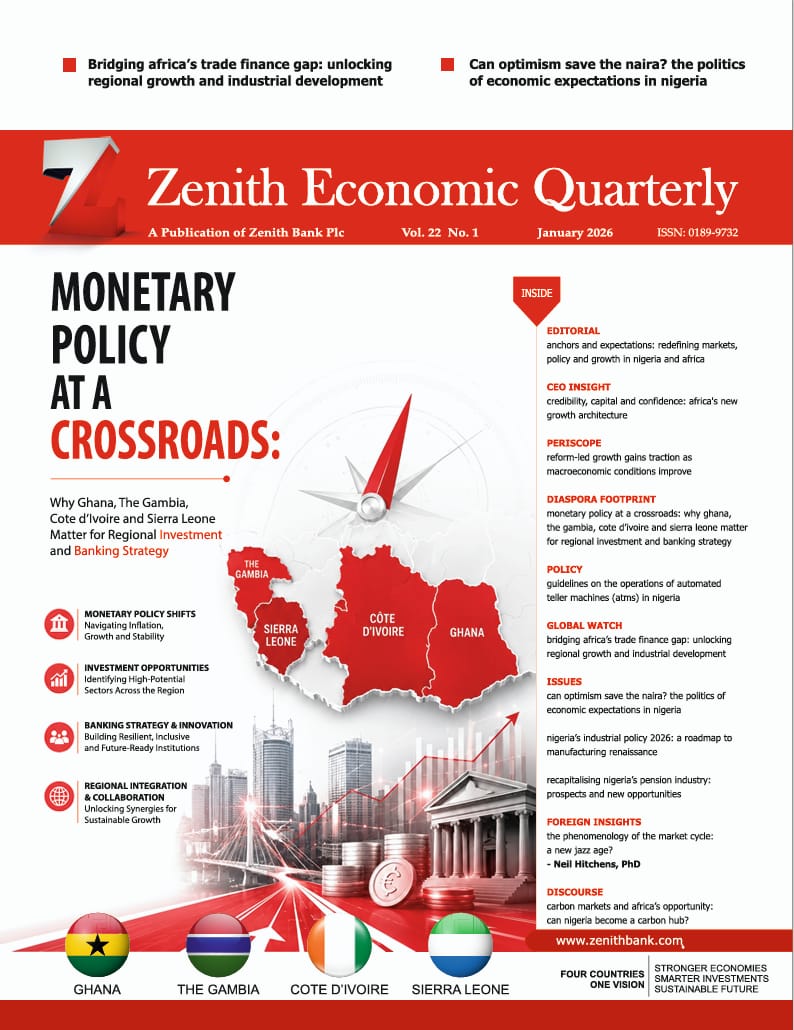 https://www.digital.zenithbank.com/ZEQ/ZEQ-jan-2026/index.html#p=1
Furthermore, he highlights the potential reduction in pump prices of PMS with the expected refinery operations, which is seen as a key factor in lowering the Consumer Price Index (CPI). Governor Cardoso expresses confidence in the Central Bank’s inflation-targeting policy, aiming for a 21.4% inflation rate in 2024. The overall outlook is optimistic, foreseeing decreased inflation’s positive impact on businesses, offering a more predictable cost environment, and potentially leading to lower policy rates, increased investment, economic growth, and job opportunities.
On Tuesday, the World Bank announced the approval of $300 million in funding to support Ghana’s economic recovery. This decision follows Ghana’s successful negotiation to restructure $5.4 billion in loans with official creditors, marking a significant step in the country’s efforts to secure debt relief amid its severe economic challenges. The approved financing represents the initial installment of a three-part series, each totaling $300 million, as part of the World Bank’s comprehensive engagement to address crises and enhance resilience in Ghana. Additionally, Ghana recently received a disbursement of approximately $600 million from the International Monetary Fund (IMF) under its $3 billion bailout program.
Kenya has secured a crucial lifeline from the Trade and Development Bank (TDB) in the form of a $210 million loan, according to Finance Minister, Njuguna Ndung’u. This financial assistance comes at a pivotal moment as Kenya faces the imminent maturity of a $2 billion Eurobond in June. Concerns have arisen due to dwindling hard currency reserves, a significant depreciation of the Kenyan shilling, and challenges in revenue generation, raising questions about the country’s ability to meet its Eurobond obligations. Despite these uncertainties, the International Monetary Fund (IMF) reassured on Thursday that it does not anticipate Kenya defaulting. The TDB’s loan facility, part of its broader mandate to raise $1 billion for Kenya’s liability management, was expected to be disbursed in tranches of $500 million. However, only $210 million has been delivered from the bank’s balance sheet so far. Finance Minister Ndung’u did not specify how the funds would be utilized, leaving room for speculation. Notably, in December, Kenya’s central bank governor hinted at a TDB loan of $300 million earmarked for repurchasing a portion of the Eurobond. This financial development follows the IMF’s approval of $941 million in lending to Kenya, providing some relief amidst the economic challenges. In a letter published on Thursday, both Ndung’u and the central bank governor expressed Kenya’s intention to access international bond markets at the opportune time, signaling the country’s confidence in its financial prospects. Interestingly, the announcement has had a positive impact on the prices of Kenya’s international dollar bonds, with most now yielding below 10%. This shift is notable, as yields above this threshold typically deter new debt issuance, suggesting that the market views Kenya’s current financial moves favorably. As the country navigates through these financial intricacies, securing international support and expressing plans to tap into global bond markets may contribute to bolstering Kenya’s economic outlook.
Money Market
The interbank liquidity at the beginning of the week, starting on Monday, stood at N131.62 billion in repo, contributing to sustained elevated rates throughout the week. However, towards the end of the week, there was an increase in liquidity, attributed to the anticipation of FAAC inflow. By the close of business on Friday, the total repo in liquidity had reduced to N52.97 billion. In a week-on-week analysis, the Open Buy Back rate (OBB) saw a notable decline of 117 basis points, settling at 17.58%, while the Overnight rate (O/N) experienced a more substantial drop of 442 basis points, concluding at 18.83%.
We expect rates to hover around similar levels next week.
Treasury Bills
The treasury bills market exhibited a blend of sentiments this week, characterized by mixed trading activities. Despite a bearish tone, buying actions were observed in the short to mid-end of the curve, while the long end saw dominance by bears. Consequently, the average benchmark yield recorded a 180 basis points increase, concluding the week at 6.08%.
During the mid-week NTB auction, the Debt Management Office (DMO) successfully offered and sold ₦231.81 billion across standard maturities, despite total subscriptions reaching ₦1.086 trillion. Notably, there was a 256 basis points (bps), 293 bps, and 314 bps increase across the standard maturities, leading to yields settling at 5.00%, 7.15%, and 11.54%, respectively.
We expect to see some buying activities next week driven primarily by FAAC inflow.
FGN Bond Market
The FGN market observed a bearish trend influenced by negative system liquidity, although limited demand was noted at the short end of the curve. In contrast to the preceding week, the average benchmark yield saw a modest 27 basis points rise, concluding at a closing rate of 14.21%.
We foresee cautious activity at the next trading session ahead of the bond auction.
Eurobond Market
Throughout the week, the Eurobond market displayed a predominantly bearish sentiment, marked by selling activities observed across various securities. This trend had a noticeable effect on the average benchmark yield, which increased by 7 basis points, ultimately settling at a closing rate of 9.96%.
We expect marginal buying activities in the next session.
Currency Market
The value of the Naira to the dollar appreciated by 117 bps to print at ₦891.90/$ this week at the Investors and Exporters FX Window.
Equities Market
The local stock market experienced a highly positive week, culminating in the NGX All Share Index (NGXASI) surging by 25 basis points day on day and an impressive 832 basis points week on week, reaching a remarkable 102,401.88 points. This outstanding performance marked the fourth consecutive week of positive trading. The bullish trend during the week was primarily fueled by heightened demand for stocks in Dangote Cement (+28.82% WoW), Seplat Energy (+21.00% WoW), BUA Cement (+20.98% WoW), BUA Foods (+13.25% WoW), and Eterna Oil (+19.61% WoW). The year-to-date growth stands at an impressive 36.95%, and the market capitalization concluded the week at ₦56.05 trillion. Market breadth, which gauges advancing stocks against decliners, closed at an encouraging 3.67x, with 44 stocks making gains compared to 12 declining.
Trade metrics exhibited some variation as transaction volumes increased by 3.01% to 519.39 million units, while the total value declined by 14.09% to N8.85 billion. Japaul Gold and Ventures claimed the top spot on the volume chart, trading 59.17 million units, while UBA led the value chart with deals worth N1.48 billion.
Looking ahead, we anticipate similar activities in the upcoming trading session.