























In March 2024, Nigeria experienced a significant increase in inflation, with the rate reaching 33.2%, up from 31.7% in February 2024. The rise was mainly driven by higher costs in food, beverages, energy, and housing. Year-on-year, the headline inflation surged by 11.16% from March 2023, while the month-on-month rate slightly decreased by 0.10% from February 2024. Food inflation hit 40.01% year-on-year, attributed to increased prices in staple foods like garri, millet, and yam tubers. However, the month-on-month food inflation decreased slightly. Over the twelve months ending in March 2024, the average annual food inflation rose to 31.40%. Urban inflation rose to 35.18%, while rural inflation reached 31.45% year-on-year. Core inflation, excluding volatile agricultural products and energy, stood at 25.90% year-on-year. Both urban and rural areas saw marginal decreases in month-over-month inflation rates. Overall, core inflation increased to 22.26% over the twelve months ending in March 2024, reflecting a 5.04% increase from the previous year.
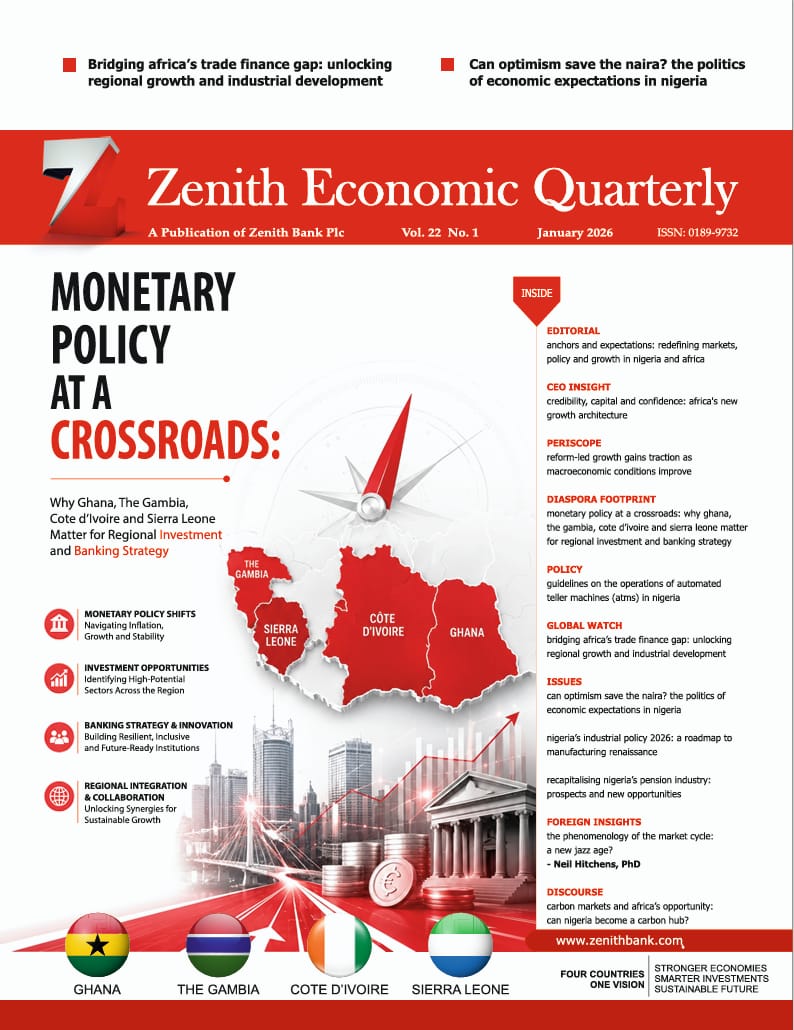 https://www.digital.zenithbank.com/ZEQ/ZEQ-jan-2026/index.html#p=1
Money Market
Liquidity in the interbank market remained in the negative territory for the most part of the week bolstered by the bonds auction settlement which occurred by mid-week. Nevertheless, the Open Buy Back rate (OBB) dipped by 28 bps WoW to close at 29.39% while the Overnight rate (O/N) concluded at 30.25%, marking a decline of 18 bps, respectively.
We anticipate that rates will remain at their current levels.
Treasury Bills Market
The Treasury Bills Market started the week with increased buying interest on the Apr-2025 papers. However, the market sentiment shifted to bearish due to the constrained liquidity condition in the interbank market. As a result, the average benchmark yield increased by 636 bps week-over-week, settling at 25.07%.
We anticipate a calm start at the next trading session.
FGN Bond Market
The FGN Bonds market opened the week on a calm mode as participants awaited the release of the bonds auction result. At the auction, the DMO offered ₦450 billion across three maturities- 2029, 2031, and 2034. Total subscription amounted to ₦920.09 billion while total amount allotted was ₦626.81 billion with stop rates dipping by 30 and 45 bps on the 31 and 34 papers to settle at 19.75% and 20.00% while the 2029 paper, which is a new issuance, closed at 19.30%. Following this, there was improved demand on the short to mid end of the curve while the long end of the curve had a bit of selling pressure. Hence, the average benchmark yield dipped by 26 bps, concluding the week at 19.96%.
We anticipate a continuation of this trend in the upcoming trading session.
FGN Eurobond Market
This week, bearish sentiments dominated the FGN Eurobond market, driven by Powell’s indication of sustained higher rates and escalating tensions in the Middle East. The selloff was compounded by US data releases, notably the initial jobless claims exceeding expectations at 215K versus an anticipated 212K, and the leading index declining to -0.1% from -0.30. As a result, the average benchmark yield surged by 20 bps week over week, reaching 9.76%.
We anticipate this trend to persist.
Currency Market
The value of the Naira to the dollar weakened by 242 bps week-on-week to print at ₦1,169.99/$ this week at the Nigerian Autonomous Foreign Exchange Market Window (NAFEM).
Equities Market
This week, the local stock market primarily demonstrated a bearish trend, with the NGX All-Share Index witnessing a 31-bps decrease day-on-day (DoD) and a 271-bps decline week-on-week (WoW), closing below 100,00 points to settle at 99,539.75 points. Consequently, the year-to-date growth recorded a rise of 33.12%, while the market capitalization fell by ₦1.574 trillion WoW to reach ₦56.296 trillion. Upon closer examination, the weekly market breadth was at 0.21x, indicating 61 stocks on the decline compared to 13 advancing ones.
When analyzing trade data on a WoW basis, the overall trading volume dropped by 64.87% to 257.85 million units, and the total traded value had a 74.99% drop, ending at ₦5.39 billion. Week-to-date (WTD), the most actively traded stocks in terms of volume were Access Corporation, United Bank for Africa (UBA), and Zenith Bank, with total trades amounting to 210.85 million units, 210.05 million units, and 149.11 million units, respectively. In terms of value, the most traded stocks WTD were Zenith Bank, Guaranty Trust Holding Company, and UBA with total value amounting to ₦5.41 billion, ₦5.24billion, and ₦4.98 billion, respectively.