
























President Bola Ahmed Tinubu has approved a N70,000 minimum wage for Nigerian workers, promising to review the national minimum wage law every three years. This decision, announced by Bayo Onanuga, Tinubu’s Special Adviser on Information and Strategy, followed a meeting with leaders of the Nigeria Labour Congress (NLC) and Trade Union Congress (TUC) at the presidential villa in Abuja. Initially, the federal government proposed a N62,000 minimum wage, while labor unions demanded N250,000, leading to a negotiation deadlock. Eventually, both parties agreed on N70,000. Alongside this, Tinubu also promised support for the private sector and sub-national governments to implement the new wage and committed to addressing the four-month salary backlog for university unions. This approval and agreement with organized labor aim to address workers’ financial struggles amidst high living costs.
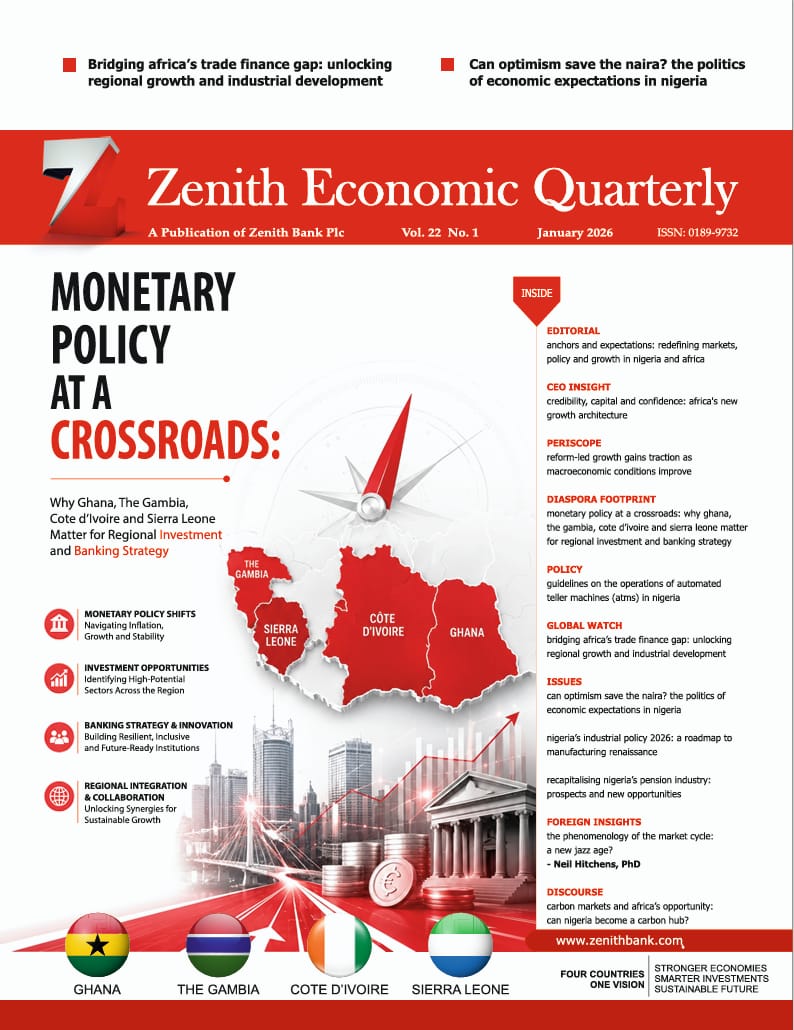 https://www.digital.zenithbank.com/ZEQ/ZEQ-jan-2026/index.html#p=1
In a related effort to address economic challenges, President Bola Tinubu has requested the Senate to increase the 2024 budget by N6.2 trillion, raising it from N28.7 trillion to N34.9 trillion. Senate President Godswill Akpabio read Tinubu’s proposal, which allocates N3.2 trillion for infrastructure projects and N3 trillion for recurrent expenditure. To fund this increase, Tinubu has suggested a new tax on banks’ foreign exchange gains, urging the National Assembly to amend the Finance Act of 2023 to include a one-time windfall tax on these gains. These gains, accrued by banks due to forex rate fluctuations, would help support capital infrastructure development, education, healthcare, and public welfare initiatives under the Renewed Hope Agenda. Top Nigerian banks made significant profits from forex revaluation gains in 2023, amounting to N3.3 trillion. This includes N2.48 trillion by the top 7 banks and N882.9 billion in the first quarter of 2024. In January 2024, the National Assembly had already increased the budget from Tinubu’s initial N27.5 trillion proposal to N28.7 trillion. The adjustments included allocations for statutory transfers, debt servicing, recurrent expenditure, and capital expenditure. The new proposal aims to adjust the budget further to accommodate additional funding requests.
Money Market
Market liquidity opened the day in a deficit of ₦379.55 billion, marking a ₦450.75 billion improvement from ₦830.30 billion at the start of the week. Week-on-week, the Open Buy Back (OBB) rate and the Overnight (OVN) rate slid by 22bps and 43bps to 31.39% and 32.02%, respectively.
We expect rates to remain elevated ahead of the bond auction.
Treasury Bills Market
The Treasury Bills market witnessed a quiet week with a bearish undertone. The 6 March and 22 May bills were largely offered at 23.50% and 21.75% respectively, while bids remained scarce. Nonetheless, we saw trades consummated on the 27 Mar bill at 22.90% and the 10-July-25 bill at 20.65%. There was also minimal demand on the 24-Oct-25 bill bid at 20.00% while the 1-Apr-25 bill was offered at 24.25%. At the OMO auction this week, ₦150bn was offered across the standard maturities, but no sales were made. There were no subscriptions for the short and mid-tenored bills, while the 363-day paper recorded a total subscription of ₦39 billion with bids ranging from 23.22%-24.71%. Week-on-week, the average benchmark yield rose 94bps to close at 24.55%.
We expect a quiet session.
FGN Bond Market
The scene in the FGN local bond Market remained subdued with demand seen on the SK 33s bid at 15.80% and the old 33s while offers remained scarce. In addition, bids were quite elevated on the MAY 33s at 21.95% while improved offers were seen on FEB 34s at 21.30%. Furthermore, the off the run 29-year bond was quoted 17.90/17.80 with the old 28s and 29s bid at 19.90% while offers remained scarce. At the mid end of the curve, we saw offers on the 36s at 19.10%. Week-on-week, the average benchmark yield rose 12bps to 19.09%.
We expect a calm session as focus shifts to the auction.
FGN Eurobond Market
The FGN Eurobond market displayed a bullish bias at the start of the week supported by Powell’s speech in which he highlighted the two-sided risks to interest rate decisions. Although he didn’t specify the timing of the Federal Reserve’s actions on rates, he suggested that a rate hike is unlikely in the near term. However, there was a reversal of this trend as investors indulged in profit taking activities. Furthermore, data this week showed that the United States Retail Sales for June remained flat while the initial jobless claims printed at 243K vs 230K expected and 223K prior. Week-on-week, the average benchmark yields gained 30bps, settling at 9.87%.
We expect a similar trading session.
Currency Market
The value of the Naira to the dollar depreciated by 2.12% to print at ₦1596.92/$ this week at the Nigerian Autonomous Foreign Exchange Market Window (NAFEM).
Equities Market
The local stock market wrapped up the week on a positive trajectory, with the benchmark All-Share Index (ASI) increasing by 4bps day-on-day and 87bps week-on-week, reaching 100,539.40 points. This reflects a year-to-date growth of 34.46%. The day’s performance was chiefly driven by gains in UCAP (+1.63%), FCMB (+3.25%), and MTNN (+1.99%), which eclipsed the losses in GTCO (-0.77%), ZENITHBANK (-0.54%), and UBA (-1.93%). As a result, market capitalization saw an uptick of ₦0.02 trillion, totaling ₦56.94 trillion. Notably, market breadth settled at 1.21x, as 35 stocks advanced while 29 declined.
On a weekly scale, both the volume and value of trades saw an upward trend, growing by 43.48% and 34.36% to 603.88 million units and ₦9.16 billion, respectively. FCMB, JAIZBANK, and UCAP were the top three stocks by volume, with 114.12 million units, 103.35 million units, and 56.76 million units traded. Regarding trade value, UCAP led with ₦2.29 billion in transactions, followed by GTCO with ₦1.70 billion, and ZENITHBANK with ₦1.10 billion.