












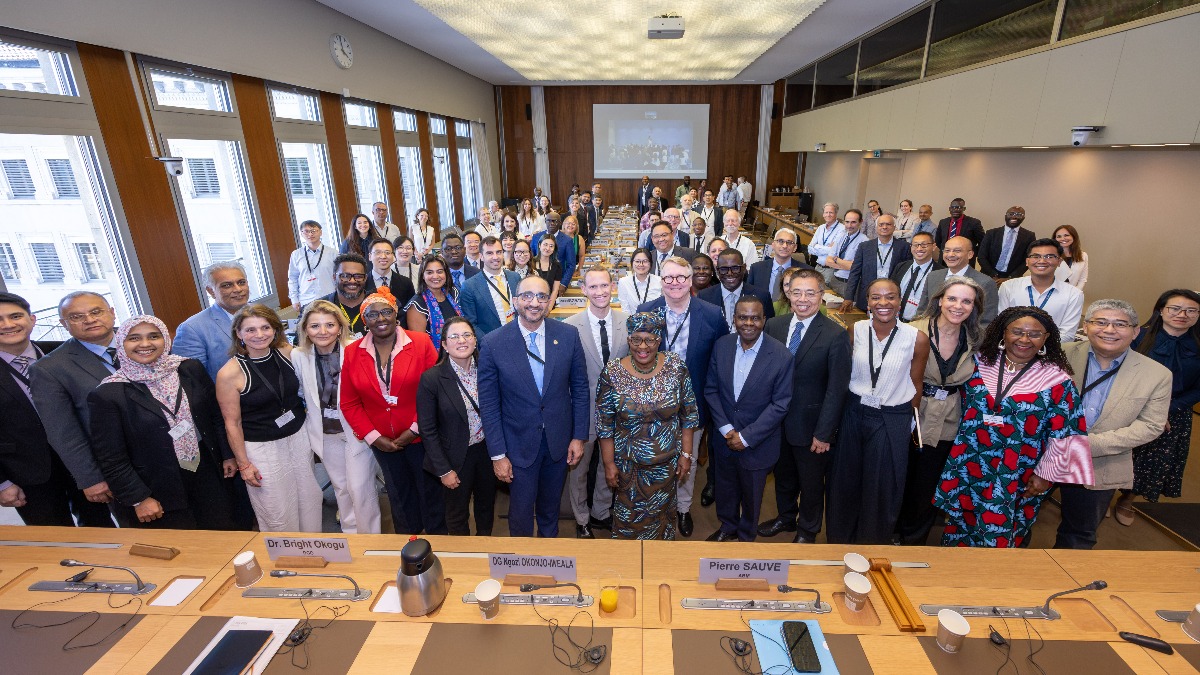
Director-General Ngozi Okonjo-Iweala issued a call on 1 July for deeper engagement between WTO members and academics, research institutes and other stakeholders in order to help advance ongoing discussions on WTO reform. Speaking at the opening of the WTO Chairs Programme (WCP) Annual Conference in Geneva, she highlighted the value of external perspectives in supporting members’ efforts to modernise and strengthen the multilateral trading system.
 https://www.digital.zenithbank.com/ZEQ/ZEQ-jan-2026/index.html#p=1
DG Okonjo-Iweala said the WCP has become one of the WTO’s most valuable platforms for connecting academic expertise with policymaking, and has contributed to a deeper understanding of how trade can support growth, development and inclusion.
“At a time when the global economy is facing profound challenges – from geopolitical tensions and economic fragmentation to technological transformation, climate pressures and growing development concerns – the value of evidence-based analysis and practical policy solutions has never been greater,” the Director-General said.
She referenced the ongoing discussions among members on how to ensure that the multilateral trading system remains responsive and continues to deliver prosperity, inclusion and sustainable development.
“Members need fresh ideas, rigorous analysis and practical solutions,” the Director-General said. “This is where I believe [the WCP] can make a difference.”
Launched in 2010, the WCP supports academic institutions in trade-related research, curriculum development and policy outreach, and now counts 39 academic institutions worldwide within its network. The programme is funded by contributions from France, Austria and the Republic of Korea.
In his opening remarks to the Annual Conference, Deputy Director-General Xiangchen Zhang said the significance of the WCP cannot be measured simply by the number of institutions involved.
“Its real value lies in the contributions that the entire network makes every day to research, teaching, policy dialogue and engagement with stakeholders,” he told participants, noting that the work undertaken by the WTO Chairs cover topics central to the future of international trade such as digital trade and new technologies, sustainability, trade and inclusivity, regional integration, investment facilitation, value chains, reglobalization, food security and development.
“Through your work, universities and research institutions help policymakers better understand trade challenges and opportunities, train the next generation of trade professionals, and bring evidence-based perspectives into public debate,” he added. “In doing so, you strengthen the foundations of the multilateral trading system.
Alix Rancurel, Deputy Permanent Representative of France to the WTO, noted that the global trading system is going through a period of uncertainty and disruption, with issues such as digital trade, climate change, inclusiveness and national security impacting trade.
“In the light of these transformations, policy responses need to be based on facts, rigorous analysis and better understanding of local realities,” she said. “That is what you are here to contribute, and that is why we need you to reform the WTO. Your work will allow us to think innovatively, to evaluate what really works, and to make better informed future choices.”
Austria’s Ambassador to the WTO Alexander Kmentt noted that the Annual Conference is taking place at a time when the multilateral trading system faces major challenges such as rising geopolitical tensions, economic uncertainty and rapid technological transformation.
“Addressing these pressures requires not only constructive engagement among members, but also a strong analytical capacity, evidence-based policymaking and broad, inclusive participation,” he said. “In this regard, the WTO Chairs Programme makes an important contribution by strengthening research, fostering informed dialogue and supporting capacity-building in trade-related issues.
Ambassador Yoon Seongmee of the Republic of Korea told the conference that the WTO “needs cutting-edge research, robust data and fresh insights. The WCP plays a vital role in strengthening the WTO’s analytical capacity, helping the organization adapt and respond to a changing global trade environment.”
Furthermore, “achieving a truly inclusive multilateral trading system depends on the successful integration of developing countries and LDCs into global trade,” Ambassador Yoon said. The WTO Chairs “are uniquely positioned to provide the policy guidance and research needed to support this process.”
Over the course of the three-day conference, participants engaged in lively discussions, collaborative exchanges and forward-looking dialogue aimed at strengthening the impact of the WCP. The agenda featured a fireside chat with the Director-General as well as thematic sessions on the 14th Ministerial Conference (MC14) and its follow-up, the 2026 World Trade Report, WCP partnerships, and opportunities to enhance synergies between WTO Chairs and the WTO Secretariat in curriculum development and teaching.
Participants also took part in discussions with WTO member and regional group coordinators, topic-based research and knowledge-sharing breakout sessions, regional Chair network meetings and discussions on upcoming WCP activities.