























At the conclusion of its 303rd meeting on November 24th and 25th, 2025, the Central Bank of Nigeria’s Monetary Policy Committee (MPC) retained the Monetary Policy Rate (MPR) at 27%. This rate hold marks a change in direction from its last meeting, where it implemented its first 50 basis point rate cut in over two years. This time, the Committee has taken a tactical stance to hold at its last meeting for the year.
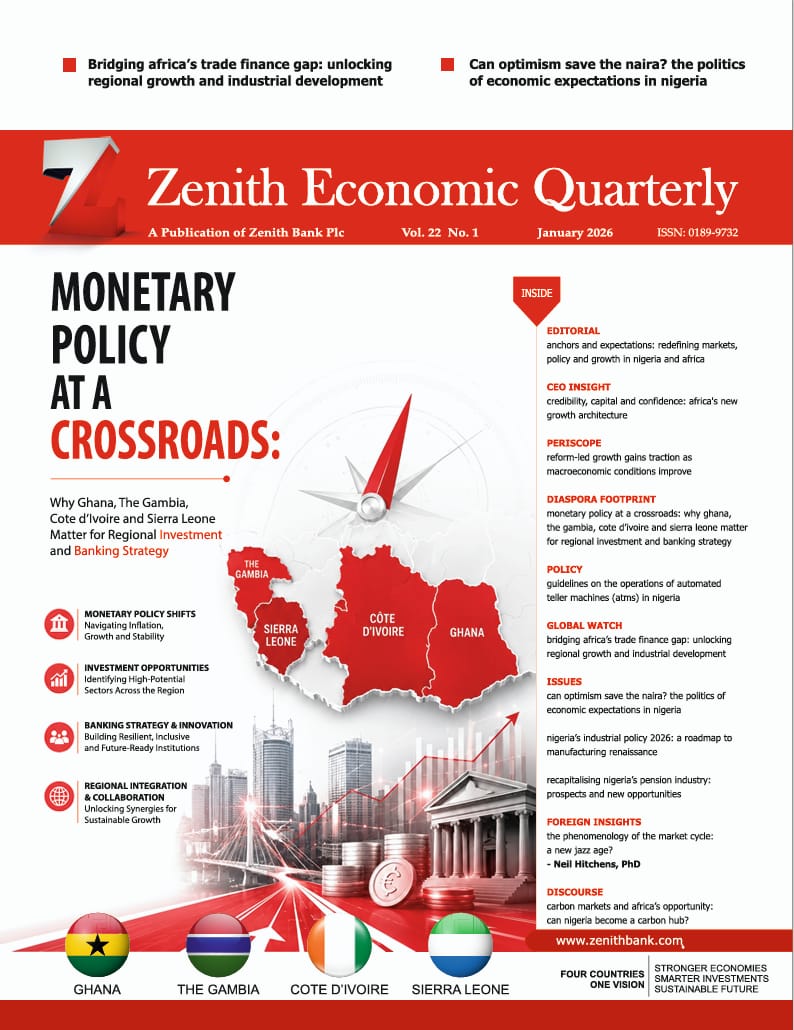 https://www.digital.zenithbank.com/ZEQ/ZEQ-jan-2026/index.html#p=1
Key Decisions
• Retain the MPR at 27.00%
• Adjusted the asymmetric corridor at +50/-450 around the MPR.
• Retain the CRR of Deposit for Money banks at 45%.
• Retain the CRR of Merchant Banks at 16%
• Retain the CRR of Non-TSA Public Sector Deposits at 75%
• Hold the liquidity ratio constant at 30.00%.
The decision reflects a shift back to its stance to control Nigeria’s inflation. While they acknowledge the positive deceleration of inflation year-on-year and a bit of an uptick on a month-on-month basis, the committee has decided to hold the rate constant to
continue to watch coming trend.
Why the CBN opts to hold rate
The CBN decision to hold the policy rate was contrary to our earlier prediction of a 100bps rate cut. In the committee’s view, the steady slowdown in inflation indicates that the impact of earlier tight monetary policy is now being felt and is likely to continue in the near term. With global uncertainties still lingering, they see it as important to keep the current policy stance so that past rate hikes can fully work through the economy and help further reduce price pressures.
The MPC also pointed to the stronger performance of the external sector, shown by a surplus on the current account and steady build-up in external reserves. This has helped to support exchange rate stability and has played a role in the recent slowdown in inflation. In addition, better coordination between fiscal and monetary authorities has supported the recent upgrade of Nigeria’s sovereign credit rating and the delisting of the country from the FATF Grey List.
Taken together, these factors gave the MPC more confidence to pause rather than continue with further rate cuts. In line with these factors, they decided to hold the policy rate in order to continue to reduce inflation towards their target of single-digit inflation.
CBN Policy on Banks: Easing at the Margin, Liquidity Still Tight
The recent hold by the CBN and change from a symmetric to an asymmetric corridor signals a shift towards a more accommodative stance while keeping policy anchored.
While the rate was being held, the latest MPC decision reshapes banks’ operating environment once again. Although the MPR retained rate at 27%, the more significant impact for banks comes from the adjustment of the asymmetric corridor around the policy rate. The corridor has been revised from a symmetric +250/- 250 basis points to a new asymmetric structure of +50/-450 basis points, altering both the cost of accessing liquidity and the incentive to hold idle balances with the CBN.
Under the new corridor, the Standing Lending Facility (SLF) rate now stands at 27.5%, down from 29.5%, effectively making it cheaper for banks to borrow short-term liquidity from the CBN. On the other hand, the Standing Deposit Facility (SDF) rate has dropped to 22.5%, from 24.5%, reducing the return banks earn on placing excess funds with the CBN.
The overall effect is to push banks toward deploying more funds into lending and supporting the real economy rather than locking up liquidity in risk-free deposits with the CBN.
The Cash Reserve Ratio (CRR) for merchant banks remains at 16% and the liquidity ratio at 30%, giving them room to deploy liquidity, which aligns with their wholesale market structure and preserves liquidity for investment operations while commercial
banks continue to operate under a tighter framework.
The 75 percent CRR on non-TSA public sector deposits also remains unchanged. This rule keeps public-sector liquidity out of the commercial banking system and limits abrupt liquidity injections during government disbursement. In essence, the policy stance keeps headline rates unchanged but still aligns with the CBN’s goal of supporting credit growth while maintaining firm liquidity control to manage inflation and reduce pressure on the naira.
Overall, the asymmetric corridor recalibration is likely to support activity and allow credit flows to businesses and households while anchoring policy credibility. Market dynamics in the near term will revolve around shifts in interbank rates and the size of government borrowing, which will ultimately determine the slope and movement of the yield curve. Also, the 2026 budget once released will have an impact on the market activity. Its spending plans and funding requirements could influence investor positioning, creating another driver for a broader market activity.
Rate Hold Throws a Lifeline to a Slipping Naira
In November, the naira has depreciated, opening at ₦1,436 at the start of the month and currently at ₦1,456 as of 24th November 2025, a depreciation of 1.22%, after a period of continuous appreciation over the past few months, driven by stability in the foreign exchange market and improved market transparency.
The MPC’s decision to hold the policy rate could aid in supporting the naira and help reverse its recent depreciation trend. Overall, the policy shift reinforces short-term stability in the FX market
The Nigeria gross external reserves have also improved significantly this year, currently at $44.46 billion as at 25th of November 2025. The MPC noted that this level of reserves provides roughly 10.3 months of import cover for goods and services.
Bottom line
The CBN’s decision to retain the MPR at 27%, alongside the shift from a symmetric to an asymmetric corridor, signals a calibrated policy approach that balances inflation control with support for economic activity. The retained CRR and liquidity ratio continue to constrain excessive liquidity, ensuring systemic stability while preventing sharp spikes in borrowing costs. The unchanged 75% CRR on non-TSA public-sector deposits keeps government cash flows from disrupting the banking system, maintaining control over domestic liquidity conditions.
The fixed income market dynamics will remain influenced by inflation expectations and government borrowing plans, with limited immediate impact from the corridor adjustment.
For the FX market, the hold on rates is expected to stabilize the naira after its recent volatility, supporting exchange rate confidence and countering the weakening that followed market expectations of further rate cuts.
Overall, the MPC’s decision establishes a controlled yet accommodative environment, supporting credit growth, preserving liquidity discipline, stabilizing short-term interest rates, and reinforcing confidence in both domestic fixed-income and FX markets.