


























The Presidency has declared that Nigeria is firmly on track to meet its 2025 non-oil revenue target, citing record collections driven by fiscal reforms, improved tax compliance, and digitised systems. In a statement signed by the President’s Special Adviser on Information and Strategy, Bayo Onanuga, the Presidency revealed that non-oil revenues from January to August 2025 climbed to ₦20.59 trillion, up 40.5% from ₦14.6 trillion during the same period in 2024.
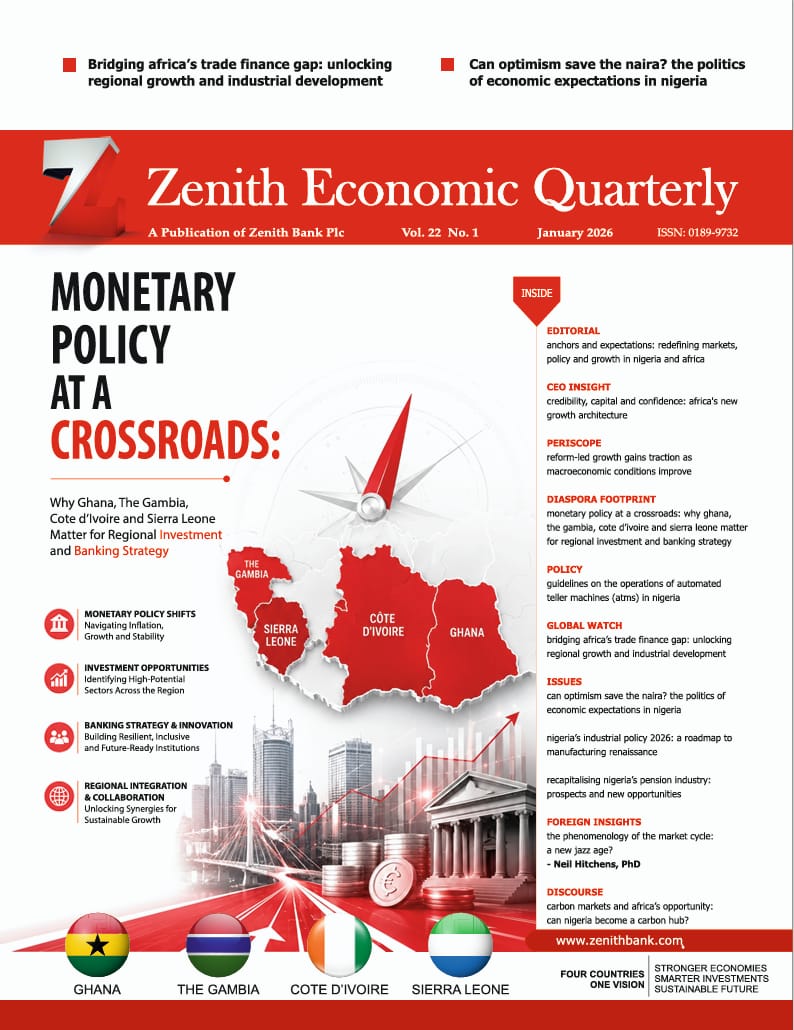 https://www.digital.zenithbank.com/ZEQ/ZEQ-jan-2026/index.html#p=1
The statement, titled “Nigeria’s Non-oil Revenues Power Strongest Fiscal Performance In Recent History,” described the results as a fundamental shift in the nation’s public finance. “For the first time in decades, oil is no longer the dominant driver of government revenue. Nigeria’s fiscal foundations are being reshaped,” Onanuga said, noting that non-oil sources now account for three out of every four naira collected. Customs was a major contributor, generating ₦3.68 trillion in the first half of 2025, ₦390 billion above target.
The Presidency stressed that these gains reflect systemic reforms such as Customs automation and digital tax filing, not temporary windfalls. It added: “The task ahead is to ensure these gains are felt in better schools, hospitals, roads, and jobs.” While inflation and exchange rate adjustments helped lift revenues, the Presidency insisted that the momentum is reform-led. President Tinubu, speaking at the State House, pointed to the revenue growth as proof of stronger public finance, highlighting that the Federal Government had stopped borrowing from local banks, easing pressure on domestic credit markets.
The reform impact has also cascaded to states and local governments. For the first time, monthly allocations to the 36 states and 774 local councils exceeded ₦2 trillion in July, creating fiscal space for spending on infrastructure, agriculture, and social services. “Resources are being directed closer to the people,” the statement noted.
Money Market
System liquidity remained buoyant through the trading week, opening at ₦1.40 trillion on Monday and ₦1.47 trillion on Tuesday, before strengthening to ₦2.00 trillion midweek on the back of net OMO inflows. By Thursday, liquidity moderated slightly to ₦1.64 trillion, reflecting NTB auction settlement. Week-on-week, the Open Buy Back (OBB) remained flat to close at 26.50%, while the Overnight (OVN) rates increased by 5bps to close at 27.00%.
We expect rate to continue to hover around this level, barring any significant outflow.
Treasury Bills Market
The market traded mixed through the week, opening on a calm yet bullish note with buying interest concentrated at the long end of both the OMO and NTB curves. Attention later shifted to the OMO auction, where the CBN offered ₦600bn on the 84-day bill, recording strong demand of ₦1.18trn and selling ₦620.65bn, with the stop rate closing 5bps lower at 26.44%. Midweek, focus turned to the NTB auction as the DMO offered ₦480bn across standard maturities, attracting ₦1.01trn in subscriptions, 93% of which came from the 364-day bill, while total sales stood at ₦585.25bn. Stop rates closed mixed, with the 91-day down by 3bps to 15.32%, the 182-day flat at 15.50%, and the 364-day up by 25bps to 17.69%. The week closed actively, as unmet demand from the auction spilled into the secondary market, with the newly issued 364-day bill trading around the 17.30% level. Week-on-week, the average benchmark yield declined by 43bps to close at 18.70%.
We anticipate an active start to the week on the back of robust system liquidity.
FGN Bond Market
The market traded mixed through the week, opening on a relatively quiet note with yields holding within range, as the 2031s were quoted at 17.80/17.80. Mild buying interest surfaced midweek across the mid-end of the curve, with trades executed on the 2031s at 17.50% while the 2033s were quoted at 17.55/17.35. As the week progressed, activity picked up following the NTB auction, with trades consummated on the 2031s at 17.40% as pockets of demand supported the mid-tenor papers. The week closed on a bullish note, with persistent demand driving yields lower, as the 2033s were quoted at 17.15/17.0. Week-on-week, the average benchmark yield declined by 15bps to close at 16.79%.
We expect this sentiment to persist, albeit at a slower pace.
FGN Eurobond Market
The FGN Eurobond market traded quietly at the start of the week, with limited activity across the curve due to the U.S. Labour Day holiday, before bearish sentiment filtered in as the session progressed, pushing yields higher despite ISM Manufacturing PMI printing at 48.7 (below expectations of 49.0 but above the prior 48.0). The market then turned mildly bullish, supported by rates traders pricing a 91.7% probability of a cut versus 8.3% chance of a hold, while weaker JOLTS Job Openings at 7.18M (below both the 7.38M forecast and the prior 7.44M) added to the positive tone. By midweek, cautious trading dominated ahead of ADP data, and the softer-than-expected print of 54k versus 73k forecast further drove yields lower, closing the week with a bullish bias. Week-on-Week, the average benchmark yield increased by 4bps to 7.84%.
We expect the market to open on a bullish note following the weaker-than-expected NFP print on Friday; however, trading sentiment is likely to remain cautious ahead of the U.S. CPI release.
Currency Market
The value of the Naira to the dollar appreciated by 1.09% to close at ₦1514.87/$ at the Nigerian Foreign Exchange Market Window (NFEM).
Equities Market
The local bourse ended the day with the benchmark NGX All-Share Index (ASI) appreciating by 60bps to close at 138,980.01. Market capitalization also increased, closing at ₦87.95 trillion. Market breadth was positive at 2.93x. Meanwhile, trading activity was mixed on the day, as the volume of shares traded improved by 277% to 1.82 billion units, while the total value of shares traded decreased by 19% to ₦15.98 billion.
Reflecting the week’s performance, the NGX All-Share Index recorded a 0.50% depreciation, as gains in SOVRENINS (+14.23%), SECUREID (+12.94%) and CORNERST (+12.36%) were offset by declines in DAARCOMM (-21.10%), UPDC (-13.85%), and AIICO (-13.61%).
Overall, the NGX has posted a year-to-date gain of 35.03%. Other notable indices are the NGX Top 30 Index (0.62%; -1.46% 1WK; 33.18% YTD), NGX Banking Index (0.8%; -1.52% 1WK; 38.81% YTD), NGX Oil & Gas Index (0.03%; -0.77% 1WK; -12.87% YTD), and NGX Insurance Index (6.73%; -0.36% 1WK; 78.13% YTD).