



























The World Bank has approved a $1.25 billion Development Policy Financing facility for Nigeria, despite growing public concerns over the country’s rising debt burden and continued reliance on external borrowing. The approval was announced alongside the launch of a new Country Partnership Framework (CPF) for Nigeria covering the 2026–2032 period, which aims to create more and better jobs by unlocking private sector-led growth. According to the World Bank, the new framework seeks to build on Nigeria’s recent macroeconomic reforms by supporting measures to deepen capital markets, modernise the regulatory framework for the digital economy and e-governance, and expand access to energy, digital services and agricultural support. The programme targets expanding electricity access to 32 million Nigerians, extending broadband connectivity to 58 million people, improving health and nutrition services for 40 million citizens, and supporting approximately 9.5 million farmers.
The International Monetary Fund (IMF) has disclosed that Nigeria omitted public spending equivalent to about 2% of Gross Domestic Product (GDP) from recent official budgets, creating a gap between the country’s reported fiscal deficit and its actual financing needs. The disclosure was made by the IMF’s Resident Representative in Nigeria, Christian Ebeke, during an engagement with business executives in Lagos. According to the IMF, some public expenditures, particularly capital projects, were executed outside the official budget framework, causing the reported fiscal deficit to understate the government’s true borrowing requirements. The Fund noted that while these expenditures were financed, they were not fully reflected in the budget, raising concerns over fiscal reporting and transparency. The disclosure has renewed investor focus on Nigeria’s fiscal position, as the omission suggests that the government’s financing needs may be larger than officially presented.
Money Market
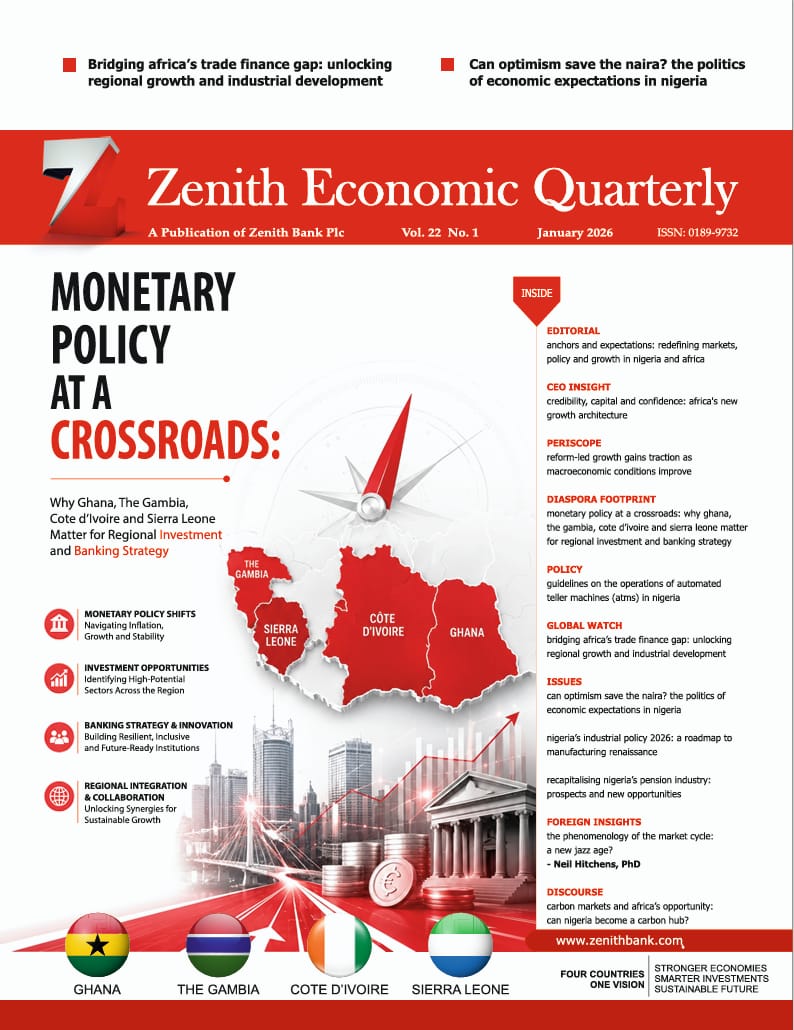 https://www.digital.zenithbank.com/ZEQ/ZEQ-jan-2026/index.html#p=1
System liquidity saw a decreasing trend throughout the trading week, opening at ₦4.08 trillion on Monday, and closing at ₦2.86 trillion. Week-on-week, the Nigerian Overnight Financing Rate (NOFR) held steady to close at 22.00%, while, the Overnight (OVN) rates also held steady to close at 22.18%.
We expect rate to continue to hover around this level.
Treasury Bills Market
The Treasury Bills market traded on a mixed but mildly bullish note this week, with sentiment shaped by the release of the Q3 NTB auction calendar. The week opened on a calm note following the announcement of an OMO auction by the CBN. During the week, the Apex bank conducted two OMO auctions, offering ₦1.2 trillion across various tenors. Demand was strong at both auctions, with total subscriptions of ₦2.64 trillion and total allotments of ₦2.25 trillion, reflecting continued appetite for high-yield short-dated instruments. Following the release of the NTB Q3 auction calendar, activity was largely concentrated on the 17 Jun bill, which was seen trading at 17.55%/17.35%. As the week progressed, demand gradually improved, pushing yields lower to trade at 17.30% levels. By the weekend, there was continued buying interest, as the 17 Jun bill closed at 17.40%/17.20%. Week-on-week, the average benchmark yield increased by 39bps to close at 18.67%.
We expect a relatively active week ahead of the upcoming NTB auction
FGN Bond Market
The FGN Bond market traded on an active note this week. The week opened on a quiet note, following the release of the Q3 bond issuance calendar, as participants remained cautious and assessed the implications of upcoming supply across the curve. Activity remained largely selective, with selling interest seen on the 2035 maturity which was seen trading at 19.00%/18.80%. As the week progressed, sentiment improved following renewed buying interest from foreign portfolio investors (FPIs). Demand was primarily focused on the on-the-run bonds, particularly the 2035 and 2037 maturities, with the 2035 bond trading around the 18.80% level. This bullish sentiment persisted across the mid-to-long end of the curve as we saw trades on the 2035 maturity consummated at 18.55% levels before repricing higher to 18.60%/18.45% to close the week. By the weekend, there was minimal activity seen across the curve, although pockets of demand were observed on the 2053 maturity, where bids were seen around the 15.25% level. Week-on-week, the average benchmark yield increased by 8bps to close at 17.56%.
We expect a cautious session, as market participants look forward to the NTB auction to provide further direction on yields.
FGN Eurobond Market
The Eurobond market traded on a mixed note this week. The week began on a positive note after Iran and the United States agreed to halt recent hostilities in the Gulf and renew talks over the Strait of Hormuz dispute, raising hopes of preserving an interim peace deal. However, sentiment weakened midweek after Iran stated that no meeting with U.S. envoys had been scheduled and reiterated that unresolved ceasefire terms remained a key issue to broader discussions on its nuclear programme. The bearish tone persisted as indirect talks between both sides concluded without any meaningful progress toward a lasting peace agreement. By week-end, sentiment turned mixed as investors shifted their focus to U.S. economic data. A softer-than-expected June jobs report reinforced expectations of a gradual cooling in the labour market and renewed hopes that the Federal Reserve may not need to keep interest rates higher for an extended period. Week-on-Week, the average benchmark yield declined by 4bps to close at 6.99%.
We expect market direction to be driven by evolving geopolitical developments and FOMC minutes.
Currency Market
The value of the Naira to the dollar appreciated by 0.97% week on week to close at ₦1,370.19/$ at the Nigerian Foreign Exchange Market Window (NFEM).
Equities Market
The local bourse ended the day with the benchmark NGX All-Share Index (ASI) appreciating by 2.10% to reach 229,240.30 points while market capitalisation increased marginally to close at N147.10 trillion. Market breadth was negative at 0.38x. Trading activity was active on the day, with the volume of shares traded decreasing by 46.90% to 454.18 million units, while total value of shares traded increased by 2.64% to ₦27.56 billion.
Reflecting the week’s performance, the NGX All-Share Index depreciated by 1.21%, as gains in AIRTELAFRI (+21.00%), REGALINS (+20.25%), and UPDC (+12.31%) were offset by declines in INTENEGINS (-18.83%), MCNICHOLS (-18.60%), and UPL (-17.54%).
Overall, the NGX has posted a year-to-date gain of 47.31%. Other notable indices are the NGX Top 30 Index (2.26%; -1.24% 1WK; +46.67% YTD), NGX Banking Index (2.78%; -4.20% 1WK; +35.31% YTD), NGX Oil & Gas Index (0.36%; -4.34% 1WK; +82.04% YTD), and NGX Insurance Index (1.26%; -4.69% 1WK; -8.43% YTD).