























By Dr Muda Yusuf
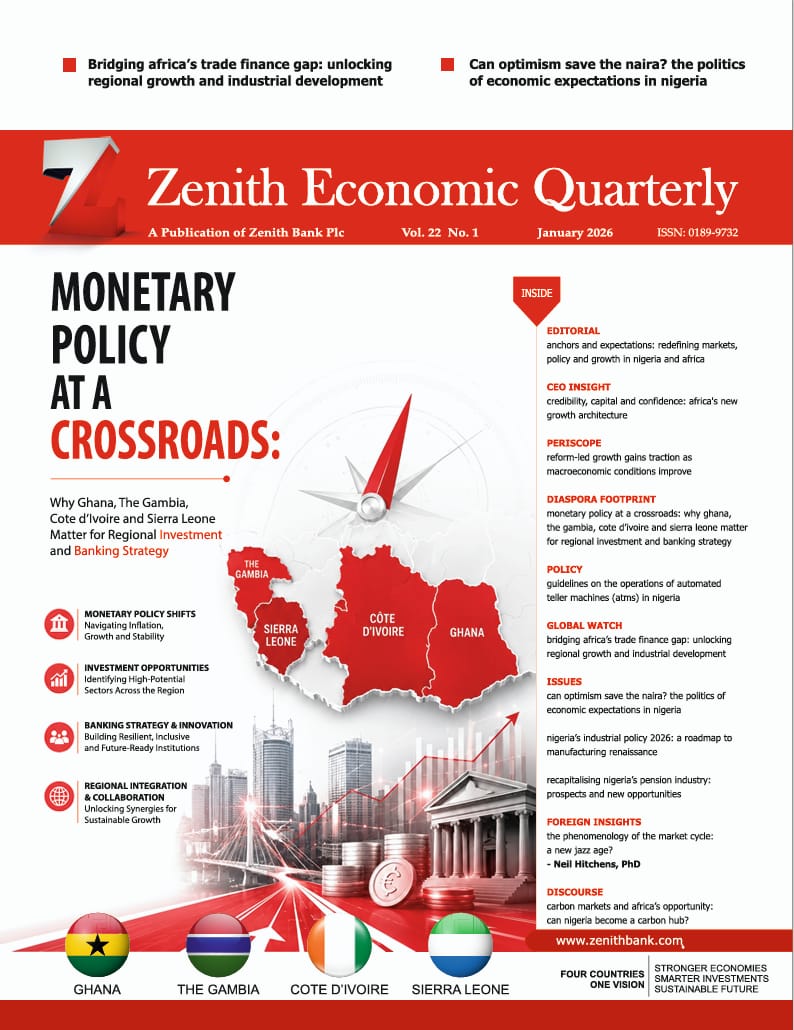 https://www.digital.zenithbank.com/ZEQ/ZEQ-jan-2026/index.html#p=1
As Nigeria marks 66 years of independence, the Centre for the Promotion of Private Enterprise (CPPE) recognises the profound transformation that has taken place in the nation’s economy. Agriculture was once the dominant source of livelihoods and exports, before petroleum reshaped public finance and the structure of the economy. In subsequent decades, telecommunications, banking, trade, construction, entertainment and digital services expanded the range of opportunities available to Nigerian businesses and young people. More recently, significant investments in cement, fertiliser and refining have demonstrated that Nigeria has the capacity to build productive industries at scale.
Yet, Nigeria’s economic transformation remains incomplete. The country has diversified what it produces more than what it exports. Many farms continue to operate with low yields, manufacturers face high energy and logistics costs, and a significant share of employment remains concentrated in activities with relatively low productivity and returns. After six decades of economic growth and structural change, the more consequential question is whether Nigeria can produce more value per worker and translate that productivity into sustained improvements in real incomes and living standards.
Nigeria’s economic history contains important examples of successful reform. The liberalisation of the telecommunications sector transformed access to communication and created a major platform for private investment and entrepreneurship. Banking and payments reforms expanded financial inclusion and strengthened the financial services ecosystem. Across sectors, Nigerian entrepreneurs have repeatedly demonstrated their capacity to build competitive businesses when policies are credible, markets are sufficiently open and the investment environment is predictable.
At the same time, the country has paid a substantial price for its dependence on oil revenues, inconsistent policies and prolonged underinvestment in infrastructure. Volatility in international oil prices has repeatedly disrupted government budgets and foreign exchange availability, while recessions, the COVID-19 pandemic, insecurity and global food and energy shocks have exposed the vulnerabilities of the Nigerian economy. The lesson from these experiences is clear: Nigeria’s large market and abundant natural resources provide enormous opportunities, but resources alone do not guarantee prosperity. Sustainable productivity requires reliable institutions, infrastructure and sound policy formulation and implementation.
The present administration’s removal of the petrol subsidy, exchange-rate reforms and revenue measures have addressed some longstanding fiscal and foreign-exchange distortions. These have been consequential policy decisions, and the early macroeconomic outcomes warrant recognition. Real GDP growth increased from 3.38 per cent in 2024 to 3.87 per cent in 2025 and reached 4.43 per cent year-on-year in the second quarter of 2026. Headline inflation stood at 15.39 per cent in August 2026, while the Central Bank of Nigeria reset its monetary policy rate to 23 per cent in September. Government revenues, foreign reserves and exchange-rate stability have also improved markedly.
These developments provide a stronger foundation for the economy. However, they have yet to translate sufficiently into relief for households and businesses.
Inflation may have moderated, but prices remain significantly higher than their earlier levels. The combined impact of petrol price increases, exchange-rate adjustment and global food and energy shocks has weakened purchasing power. Transport, food, electricity and other essential expenses now account for a greater proportion of household income. Businesses are experiencing similar pressures through higher input, distribution and financing costs.
This is why the next phase of economic management must move decisively from stabilisation to productivity. A farmer needs security, irrigation, storage facilities and access roads to increase output. A manufacturer needs reliable electricity, efficient ports and predictable regulation to compete effectively. A small business needs affordable working capital as well as customers with sufficient purchasing power. Without progress on these structural constraints, economic growth will remain insufficiently strong in terms of job creation and improvements in real incomes, regardless of progress in headline macroeconomic indicators.
The CPPE therefore urges the government to prioritise reliable power supply, security across farming and commercial corridors, efficient ports and logistics, higher agricultural yields, industrial competitiveness and skills development aligned with the needs of enterprise. Public support for industry should increasingly be linked to investment, efficiency and export performance. The objective should be clear: reduce the cost of producing in Nigeria and expand the supply of goods and services that citizens can afford.
The responsibility for delivering these outcomes must extend across all tiers of government. The benefits of national economic reforms will ultimately be realised where Nigerians live, work and conduct their businesses. The Federal Government must sustain macroeconomic stability while delivering on national priorities such as security, power and transportation. State governments have a critical role in improving land administration, roads, investment approvals, education and healthcare, while local governments must focus on maintaining community infrastructure, delivering effective basic services and eliminating arbitrary levies that place unnecessary burdens on small enterprises.
These responsibilities are interconnected. A federal highway cannot fully unlock agricultural production if state and local roads leave farms inaccessible. Increased public revenue will have limited impact if clinics lack adequate staff, schools lack teachers and businesses are still required to provide their own electricity and water. Greater public resources across the federation must therefore be accompanied by clearer spending priorities, stronger accountability and measurable outcomes.
The three tiers of government should be judged increasingly by tangible improvements in the productive capacity and welfare of Nigerians: lower transportation and production costs, higher farm yields, more reliable public services, improved learning and healthcare outcomes, and the creation of more productive jobs. Citizens should be able to see where additional public resources are being deployed and, importantly, what has improved as a result.
At 66, Nigeria has demonstrated that it possesses the enterprise, market and resources to achieve significantly more. The priority now is to convert the gains from economic reform into sustained improvements in productivity and ensure that the benefits of higher productivity are reflected in the living standards of Nigerians.
Dr Muda Yusuf is the Chief Executive Officer of Centre for the Promotion of Private Enterprise (CPPE)