Nigeria’s Engr. Sani Ben Tukur has been elected into the International Civil Aviation Organisation (ICAO) Council as second Vice President. He was endorsed unanimously by the 36 Council member states
The election happened on Thursday at the 6th meeting of the 229th session of the ICAO Council amd saw Engineer Tukur clinch one of the three (3) Vice President positions.
His brief is to assist the President of the ICAO Council with the strategic objectives and goals of the Organisation.
Engr.Mahmoud Sani Ben-Tukur the newly elected 2nd Vice President of the ICAO Council and Mr. Salvatore Sciacchitano the sixth and current President of the ICAO Council.
Engr. Mahmoud Sani Ben-Tukur was appointed as Nigeria’s Permanent Representative to the International Civil Aviation Organisation (ICAO) in 2019.
Engineer Ben-Tukur is an Aircraft Maintenance Engineer/ Aircraft Maintenance Instructor/ Airworthiness Safety Inspector and has over 24 years work experience in the aviation industry, with extensive knowledge of ICAO Standard and Recommended Practices and Nigerian Civil Aviation Regulations (SARPS) and Nigerian Civil Aviation Regulations.
He has worked at Nigerian Civil Aviation Authority as General Manager, Airworthiness Standards, Aerocontractors Airlines as Safety and Quality Auditor, Nigerian College of Aviation Technology as Aircraft Maintenance Instructor, Kabo Airlines as a maintenance engineer.
He has undergone strategic courses with the Federal Aviation Administration (FAA) in the United States, others in the United Kingdom, Singapore and many others.
Emirates Airlines has recommended passengers to take time to plan their travel journey this June and July, as departure numbers increase significantly just before Eid al Adha on 24 June, and again on the 1 July as many families set off on summer holidays. With more than 80,000 passengers expected to depart Dubai on busy days, Emirates advises passengers to arrive at the airport up to three hours before a flight, take note of their boarding time to ensure they reach the departure gate on time, and take advantage of multiple check-in and baggage drop options to reduce time at the airport.
Other top tips offered its passengers to Fly Better with Emirates include checking in and getting their digital boarding pass in advance, dropping luggage off beforehand , thereby avoiding airport queues and generally enjoying the world-class airport experience
Passengers are encouraged to download the Emirates app on their mobile phone and are reminded that when departing from Dubai, boarding passes are now issued in digital format on the app, or by email when passengers check in online via Emirates.com. Both options allow customers to book and change flights, download a digital boarding pass for most destinations, check what meals will be served onboard, book a chauffeur drive service and even pre-select and plan movies to watch via ice inflight entertainment. Online check in and app check in are both open 48 hours ahead of flight departure time.
To save time, Emirates passengers can drop off luggage at the airport the night before travel at no charge. Passengers who are departing from Dubai can check-in early and drop off their bags 24 hours before departure, or 12 hours before departure if flying to the US or Tel Aviv. Then closer to departure time, they can arrive at the airport and proceed directly to immigration.
For a slick start to summer travels, passengers can try the brand-new City Check‑in and Travel Store in ICD Brookfield Place, Dubai International Financial Centre (DIFC). Conveniently check in, drop luggage and enjoy the glamorous surroundings, as early as 24 hours and up to 4 hours before a flight. Customers can visit the space and check in anytime from 8:00am to 10:00pm daily, beginning their travel experience with seamless service via self check in kiosks and at dedicated desks with Emirates agents.
Those starting their journeys from Ajman can also take advantage of a 24‑hour City Check‑in at Ajman Central Bus Terminal. Passengers can check in up to 4 hours before the flight departs, check in baggage, and collect boarding passes, buy a bus ticket for AED 20 and head directly to Emirates Terminal 3, with regular bus departures throughout the day from 4am to 11.30pm. Upon arrival at the airport, travellers can simply continue through to their flight.
Passengers can also opt to check in at homein Dubai and Sharjah. DUBZ agents complete the check-in process in the customer’s home, hotel, or office, and take the bags to the flight while customers are free to breeze through the airport later. Passengers can book at least 24 hours before a flight and proceed to the airport check-in up to six hours before the flight departs. The Home Check In service is complimentary for First Class passengers.
Passengers can choose to use Emirates’ self-check-in kiosks at the airport if they haven’t already checked in online. It’s possible to view the travel itinerary, choose a preferred seat and add Emirates Skywards numbers, and use the baggage drop area to check-in bags.
People of Determination can access dedicated support from trained Emirates and airport staff when travelling over the summer period. This includes a pre-planning guide for Dubai International Airport (DXB) for those with hidden disabilities, 2 hours complimentary parking at the airport and access to a dedicated priority lane for check-in, passport control, security and priority boarding if required. Passengers can check the Accessible Travel page on Emirates.com for information and contact their Emirates local office with queries.
Passengers who wish to save even more time can pre-order Duty-Free Shopping on EmiratesRED.com and get access to exclusive Duty-Free products, which are then delivered to their seat in the air. With over 70 new products this summer, Emirates Red gives passengers the chance to purchase luxury products from Tom Ford, Jo Malone, La Mer and Dolce & Gabbana and many more. The pre-order service is available on most flights, and passengers can shop from 21 days up to 40 hours before their flight. Passengers need to provide their flight details during checkout, and the orders are delivered by cabin crew directly to the passenger’s seat inflight.
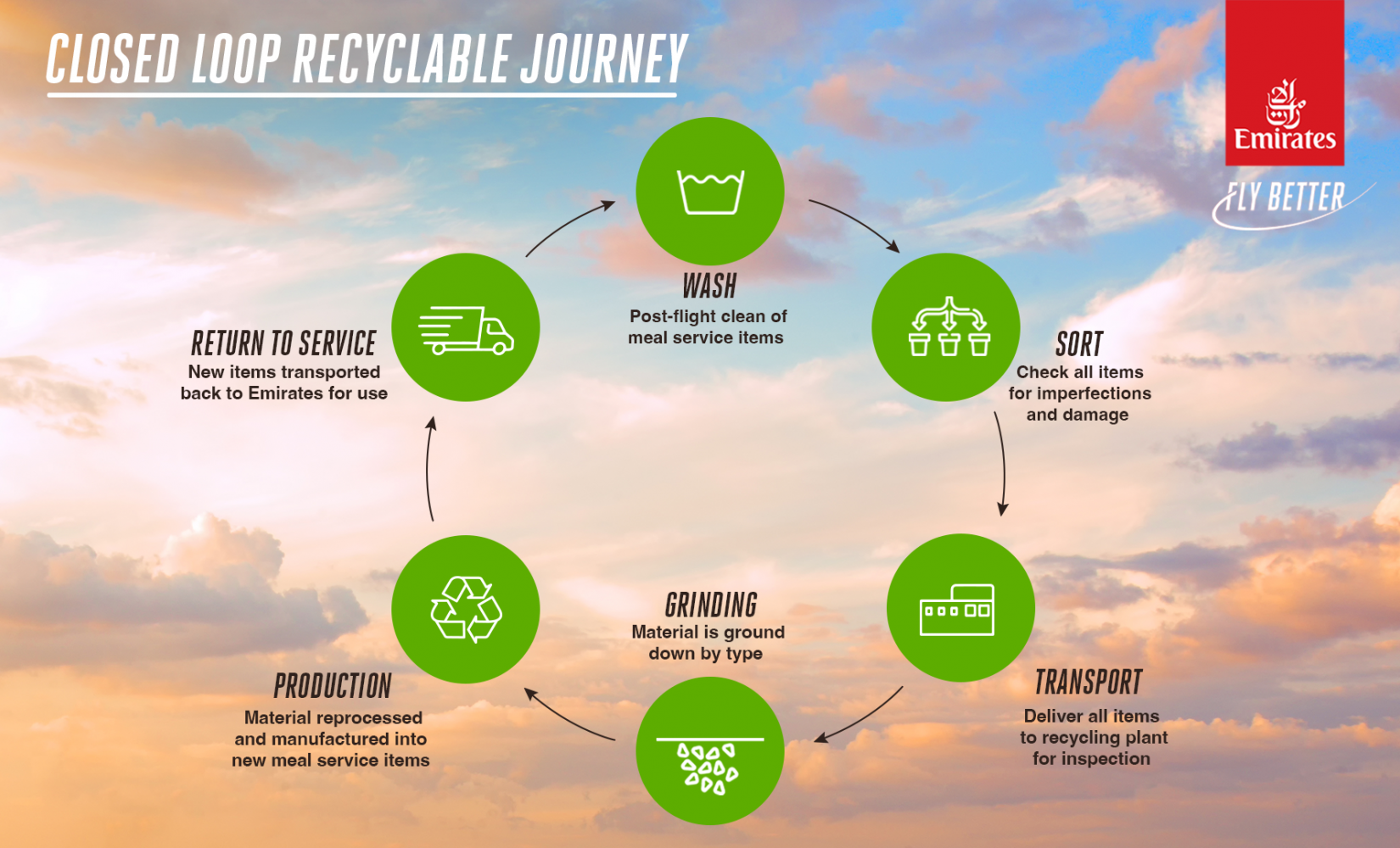
Emirates Airline is unveiling a new closed loop recycling initiative this month, where millions of onboard items such as plastic trays, bowls, snack and casserole dishes, will now be recycled in a local facility and remade into fresh, ready-to-use Emirates meal service products. Marking United Nations World Environment Day on 5 June, and the theme of #BeatPlasticPollution, Emirates will introduce the new recycled utensils onboard from June 2023.
In line with Emirates’ commitment to consuming responsibly, the new initiative is a transition to the principles of a circular economy, whereby items are reduced, reused, and recycled. Millions of old and damaged meal service items from Economy and Premium Economy Class dining will be collected after flights, washed and checked for damage, transported to a facility in Dubai to be ground down, reprocessed, and manufactured into new dishes, bowls and trays – before being sent to Emirates Flight Catering to be used again for thousands of meals in the sky.
In partnership with deSter FZE UAE, a leading provider of service ware concepts to the aviation industry, and expert in closed loop manufacturing, Emirates will be reusing plastic materials that have already reached their end of life and would otherwise need to be written off. The new trays, casseroles, snack dishes and bowls, potentially containing around 25% reused material (recyclate), will be brought back into service on aircraft across the globe, and the proportion will continue to increase over time.
The team at deSter are members of the CE100 network, which includes some of the world’s leading circular economy companies and have also been awarded the ‘Gold’ Sustainability rating from Ecovadis – a globally recognized certification for sustainable practices. Emirates elected to work with deSter once a facility in UAE was ready to facilitate the huge scale of Emirates’ requirement – substantially reducing the carbon footprint of sending the products to another country to be recycled. The deSter factory also incorporates sustainable design principles focusing on solar power, efficient use of water and minimization of waste.
Emirates’ commitment to reducing plastic waste
Emirates Airline is committed to reducing plastic waste and has already implemented several initiatives in addition to the new closed loop recycling project. Emirates has diverted over 150 million single-use plastic items from landfill each year by replacing plastic straws, inflight retail bags, and stirrers with responsibly sourced paper and wooden alternatives.
Economy and Premium Economy Class passengers can get comfortable with soft blankets onboard, where each blanket is manufactured from 28 recycled plastic bottles. Over the course of one year, this initiative saves 88 million plastic bottles from landfill.
Emirates’ current range of inflight toy bags, baby amenity kits and plush toys are made from recycled plastic bottles, and over 8 million plastic bottles were repurposed during 12 months of amenity kit production. The hygiene covers for bowls on Emirates meal trays and plastic tumblers are made from 80% recycled plastic (rPET).
Emirates Economy and Premium Economy amenity kits are made from alternative materials such as kraft paper, rice paper and recycled plastic, reducing the consumption of virgin plastic.
Emirates Cabin Crew segregate glass and plastic bottles for recycling in Dubai, diverting about 500,000 kilograms of plastic and glass from landfill in 2022.
The House of Representatives Committee on Aviation has summoned the Permanent Secretary, Ministry of Aviation, Dr Emmanuel Meribole, to an emergency meeting over Nigeria Air project.
The emergency meeting according to an invitation for the meeting signed by the committee clerk, Bassey Edem dated May 30th 2023 the Permanent Secretary was directed to come with every document and personnel connected with the National Carrier.
This is coming on the heels of the viral reports and videos of the unveiling of the Nigeria Air project on Friday May 26th under controversial circumstances.
Details of the documents demanded in the invitation are the full business case (FBC) as prepared by the Infrastructure Concession Regulatory Commission (ICRC) and full disclosure on the ownership structure of Nigeria Air including equity contributions by individuals, organisations and Consortium outlining each contribution, names, addresses, phone numbers and their businesses’ registration.
Others are; all Private Public Partnership (PPP) agreements reached and signed with Ethiopian Airlines on the project, all Private Public partnership agreements reached and signed with other parties with stakes in Nigeria Air, All Private Public patnetship agreements reached and signed with other parties with stakes in Nigeria Air, all documents, permits and receipts relevant to the subject matter, Shareholders’ agreements, Infrastructure Concession Regulatory Commission (ICRC) agreement and any other documents that will assist the committee in this assignment.
Extract from the invitation reads, “Last Friday, the 26th of May, 2023, the nation was a washed with viral reports and videos of the unveiling of the Nigeria Air project under very controversial circumstances, as a committee of the parliament saddled with responsibility of over sighting the aviation sector of the economy we deem it necessary to be fully briefed about the project”.
“Consequently, l am directed to invite you to an emergency session with the committee on Thursday, first of June 2023. You are to come with all individuals/agencies connected to the project.”
However, the Permanent Secretary was said to have requested for time to be able to Assemble all the necessary documents and individuals connected with the project.
Meanwhile, Tuesday 7th June has been rescheduled for the meeting based on the appeals for time by the ministry.
The International Air Transport Association (IATA) has announced continued strong passenger traffic demand in April as total traffic in April 2023 (measured in revenue passenger kilometers or RPKs) rose 45.8% compared to April 2022.
Globally, traffic is now at 90.5% of pre-Covid levels. At 81.3%, industry load factor was only 1.8 percentage points below pre-pandemic level.
Domestic traffic for April rose 42.6% compared to the year-ago period and has now fully recovered, posting a 2.9% increase over the April 2019 results while International traffic climbed 48.0% versus April 2022 with all markets recording healthy growth, with carriers in the Asia-Pacific region continuing to lead the recovery. International RPKs reached 83.6% of April 2019 levels.
In his remarks, IATA Director General, Willie Walsh said: “April continued the strong traffic trend we saw in the 2023 first quarter. The easing of inflation and rising consumer confidence in most OECD countries combined with declining jet fuel prices, suggests sustained strong air travel demand and moderating cost pressures”.
At the International Passenger Markets, African airlines’ traffic rose 53.5% in April 2023 versus a year ago, the second highest among the regions. April capacity was up 50.0% and load factor climbed 1.6 percentage points to 69.8%, lowest among the regions.
Asia-Pacific airlines saw a 192.7% increase in April 2023 traffic compared to April 2022. Capacity climbed 145.3% and the load factor increased by 13.2 percentage points to 81.6%.
European carriers had a 22.6% traffic rise versus April 2022. Capacity rose 16.0%, and load factor climbed 4.5 percentage points to 83.3%, which was the second highest among the regions.
Middle Eastern airlines during the period posted a 38.0% traffic increase compared to April a year ago. Capacity climbed 27.8% and load factor rose 5.6 percentage points to 76.2%.
North American carriers’ traffic climbed 34.8% in April 2023 versus the 2022 period. Capacity increased 26.5%, and load factor rose 5.2 percentage points to 83.8%, which was the highest among the regions. North American international traffic is now fully recovered, with RPKs 0.4% above April 2019 levels.
Latin American airlines saw a 25.8% traffic increase compared to the same month in 2022. April capacity climbed 26.4% and load factor slipped 0.4 percentage points to 83.1%.
At the Domestic Passenger Markets, while China’s domestic traffic rose 536.2% in April compared to a year ago and surpassing the April 2019 levels by 6.0%, US airlines’ domestic demand climbed 5.5% in April and was 3.3% above the April 2019 levels.
Speaking on the Bottom Line, the IATA DG said: “Heading into the Northern Hemisphere peak travel season, aircraft and airports are full of people eager to make use of their travel freedoms. Airlines are working hard to accommodate them with a smooth travel experience despite continuing supply chain shortages and other operational challenges.
“Sadly, some governments appear more keen on punitive regulation than on doing their part to enable hassle-free travel. The Dutch Government’s high-handed effort to slash capacity at Schiphol airport is a prime example. And then we have a focus on EU-style passenger rights regulation that is spreading like a contagion. Proponents of this approach miss a key fact. EU 261 has not led to a reduction in delays.”
In 1799, Napoleon Bonaparte became France’s first consul and declared: “A newborn government must dazzle and astonish.” Here are ten things Bola Tinubu can announce within the next week to dazzle and astonish
[1] We will establish a special anti-kidnapping squad of the Nigeria Police Force headed by a Deputy Inspector General of Police with a mandate to eliminate what has become a banditry pandemic of late
[2] We will build the world’s largest hydro-electric power plant at Lokoja, Kogi State with a capacity to generate 15,000MW of electricity
[3] A 10th mechanised division of the Nigerian Army will be established in Damaturu, the Yobe State capital. It will be a specialist anti-terrorist division
[4] As from July 1 2023, the federal government will no longer subsidise religious pilgrimages
[5] As from October 1 2023, open grazing of cattle will be illegal across Nigeria. All cattle must be moved to secure ranches by this date or they will be seized
[6] Domestic airlines led by Air Peace have been invited to take a 30% in the new proposed national carrier Air Nigeria. Foreign airlines will have a 20%, Ethiopian Airways will have a 20% stake and the Federal Government will have a 20% stake.
[8] On October 1 2027, Nigeria will abolish its current federal allocation formula. Between now and then, there will be a gradual move towards resource control
[9] The Federal Government will be accepting bids for the NNPC. It remains an albatross around our collective necks as it bleeds Nigeria dry with its petrol subsidies, so we will sell it to those who can make it work and maybe get its refineries functioning again
[10] We shall be sending a bill to the National Assembly linking the salaries of senators, House of Rep members and governors to grades in the civil service
Tinubu needs to make addressing this national carrier matter an urgent priority because apart from the prestige of it, the economics show that our people are being ripped off by foreign airlines.
Among the things that make you proud as a sovereign nation are:
[1] Having an operational national carrier
[2] Owming a national automobile company that can compete on the global stage with the likes of Toyota, Ford, Peugeot, Citroen, or say Daewoo, Lada, Skoda and Proton
[3] Having your own locally manufactured battle tanks that can match the likes of the Abrams, Challenger, Merkava or T-90
[4] Having an urban underground metro network in your capital city
[5] Possessing a healthcare system that can cater for all ailments. People should only have to travel abroad for rare specialist treatment
[6] Owning at least one aircraft carrier. Every country has a vessel known as “The pride of the navy.” These days that is an aircraft carrier. Nigeria desperately needs one to patrol the Niger Delta to combat arms smuggling and crude bunkering
[7] Your public officials should be able to confidently travel about by public transport
[8] You should be able to provide 24 hour non-stop electricity supply 365 days a year
[9] You should have the ability to attract tourists. People should feel safe to travel to your country without knowing anyone there
[10] Every serious nation must possess a manufacturing capability that enables it to produce its own steel, machine tools and finished goods in-house
For me, these are basic criteria that a country should meet before it can be declared a nation state. Were independence being granted today, only those that could meet these criteria should be allowed to become independent.
Some nations are just too small, weak, impoverished and unviable to stand alone. They should be merged with their larger neighbours to enable them realise their potential.
In his desperation to remove shame of failure and convince his principal, President Muhammadu Buhari, that he succeeded, Minister of Aviation, Alhaji Hadi Sirika, made a last minute deal with Ethiopian Airlines, to repaint two of its aeroplanes for a STATIC DISPLAY in Nigeria on Friday May l26.
According to our findings, this was to justify his promise to deliver Nigeria Air before May 29.
To achieve the desperate plot, Sirika had to enter into a quick agreement with his associates in Ethiopia Airlines to rent two of the aircraft on their inventory to be used to convince Nigerians that he delivered.
According to our investigations, the two aircrafts were flown to Turkey were they were repianted and furnished in Nigeria’s colours before they were sneaked into Nigeria for a static display which would hold at 4pm on May 26. They are due back in Addis Ababa after the static display.
Already, Sirika’s office had sent out invitations to government officials, emirs and stakeholders to grace the static display, which would hold in Abuja.
Investigations into Sirika’s desperation to close the deal which had raised many questions, show that the Minister had wanted to armtwist the Nigerian Civil Aviation Authority (NCAA) to wave all registration processes and grant the airline a licence to operate in Nigeria despite not meeting regulatory requirements.
However, the Authority, it was gathered, insisted on strict observation of the mandatory registration processes.
According to NCAA regulations, an applicant for an Airlines Operators Certificate (AOC) must show proof of ownership of at least three aircraft, which must also be registered in Nigeria.
The NCAA insistence on strict observation of the process, we gathered, irked Sirika because his rented aircraft do not meet the requirement.
According to regulatory sources, the two rented aircraft are registered in Ethiopia and not in Nigeria as required by law.
However, Sirika was said to have begged to be allowed to fly them into Nigeria for DEMONSTRATION FLIGHT before President Buhari and his incoming successor in order to clear the shame of failing to deliver.
Though NCAA turned down the request, Sirika deviced a new terminology unknown in the industry to insist that the aircraft would be used for STATIC DISPLAY only.
According to our sources, one other hurdle facing Sirika’s Nigeria Air is that it is just at the second stage of its license acquisition process, which is manual submission.
Our source said Sirika wanted the processes waived in order to remove shame of failure on him and the government.
It was further gathered that insistence by NCAA on due process forced Sirika to attempt the sack of the NCAA Director General. However, his move failed because of new regulations in the NCAA Act, which legally mandated an action by the Senate and board of the agency before the DG could be sacked.
We further learnt that his desperation to force the hands of NCAA on the project got the ire of global aviation regulatory body, the International Civil Aviation Authority (ICAO), which warned Nigeria of dire consequences should the aviation regulation procedures be waived in favour of Nigeria Air.
Specifically. ICAO was said to have told Nigeria that it would be catastrophic for it to breach regulations for Sirika.
However, the leadership of other regulatory agencies, which were not protected by law like the NCAA, were not so lucky as Sirika fired them for insisting that due process must be observed in the creation of Nigeria Air.
Sirika’s desperation has also raised questions about the actual owners of Nigeria Air. While the minister had said that Ethiopian owns 51 percent equity of the airline, industry experts are asking for full disclosure as to the value of the 51% equity.
They also want to know the share capital of the airline and have full disclosure on what other equity stakeholders contributed to it.
According to an industry operator “the minister’s desperation clearly points to something shadowy. He should have put a lot things to rest by telling Nigerians who the equity stakeholders are and the monetsry value of their shareholding in the airline.
“He said that Nigeria owns only 5%. That means we are a minority shareholder. So, why are the majority shareholders not fighting for their investment to see the light of day? Or, did they just throw away the value of 51% equity shareholding? These are questions that Sirika has refused to ask which has made many Nigerians to believe, that the desperation he has shown so far, including disobeying valid court orders, are indications that this project may be his own personal slice of the cake”.
Another aviation expert stated that Sirika may be moving fast to clean the shame that comes with failure in fraudulent schemes.
According to him, “the man is simply running about in a desperate show of shame and to deceitfully hoodwink President Buhari and make him feel that Nigeria Air has been achieved. It would also amount to deceiving the incoming government to believe that Nigeria Air was actually handed over to it. This is nothing else but fraud.
“The minister has been on this project for God-knows-how-long. He has waisted several billions on it without result. Now, he is in desperate chase for validation on a project that is not even on the table. Nothing else could be more fraudulent and I believe the government of Asiwaju Bola Ahmed Tinubu understands the game they bare up to”.
Preparatory to its full deployment in a few days, the Nigerian Airspace Management Agency (NAMA) has successfully conducted the site acceptance test for its newly installed surface movement radar and ground control systems in Abuja and Lagos airports to enable air traffic controllers to monitor aircraft and vehicular movement during low visibility or night time.
Speaking while conducting the site acceptance test of the radar equipment in Abuja, the Acting Managing Director of NAMA, Matthew Lawrence Pwajok stated that in furtherance to its quest to enhance the safety and efficiency of flight operations in Nigeria, the agency had embarked on the procurement of the surface movement radar due to its capability for detection, monitoring, and control of aircraft and vehicles on the ground for the purpose of preventing collision between aircraft, and between aircraft and vehicles as well as between aircraft and obstacles on the ground (runway, taxiway, and apron).
Pwajok said “The surface movement radar, which is a primary radar, would provide surveillance for aircraft and vehicles on the ground for the air traffic controller rather than physically seeing or looking out on the runway, the apron, taxiway or parking gate. Presently, what obtains is that the ground control is manually done. Air traffic controllers at the tower look outside to see where the aircraft is, to separate it, clear it for takeoff, and landing, and direct it to taxi to the parking gate. But with surface movement radar, guidance on the ground is automated as every surface movement is displayed clearly on the console. So, the air traffic controller can clearly see the aircraft and guide it while taxiing on the ground from the departure gate to the runway for takeoff, and once it takes off, he hands it over to the approach control.
“The surface movement radar can be used when aircraft land in poor weather conditions. In most cases the airport is shut down because pilots can’t see and can’t taxi so they would have to wait until there is weather improvement. But with the surface movement radar we can guide aircraft on landing to the parking gate and, on departure, we can guide them from the parking gate to the runway for takeoff as everything is displayed on the console. The same way the radar sees aircraft in the air, this one will see aircraft and vehicles as they are moving on the ground,” he said.
Speaking further, the NAMA MD said the surface movement radar would greatly enhance safety as it would help prevent runway incursions, excursions, and confusion. “Sometimes an aircraft is given an instruction to a particular taxi link and it enters the wrong link. If visibility is very poor or the place is dark, the air traffic controller will not know. Surface movement radar would therefore enable the controller to see clearly that the aircraft is in the right link. It would enhance safety on the ground by preventing collisions between aircraft. The issue of delaying aircraft by waiting for the weather to improve will be a thing of the past,” he said.
Surface movement radar, according to Pwajok, would boost Category III Instrument Landing Systems operations because “with CAT III, aircraft can land at zero visibility while the surface movement radar would then enable the controllers even at zero visibility to separate and control aircraft to the gate as well as those taxiing from the gate to takeoff very efficiently. Surface movement radar can also detect conflicts. If two aircraft are going to converge at a point, it can give an alert to the controller to prevent a collision on the ground.”
He recalled that a similar site acceptance test was conducted successfully in Lagos on the equipment located at Runway 18 Right two weeks ago and that “every aspect of the equipment is working effectively. So, we are now landscaping and fencing the antennas to prevent future encroachment. In Lagos, we had a major challenge of the tower being blocked by the Legend Hotel, Executive Jet, and aviation terminal. And that necessitated the deployment of the surface movement radar. So, with this, that problem has been solved. It has reduced stress on the air traffic controller as he can now see everything from the console. In Abuja, the Chinese terminal also blocked the tower and controllers can neither see the international terminal nor the presidential wing. At the moment we are using the mobile tower to augment the view. But with surface movement radar, we won’t need the mobile tower there anymore as every part of the airport is visible from the console,” he said.
Meanwhile, Pwajok has said the agency was working with the Federal Airports Authority of Nigeria (FAAN) and the airlines to ensure that all vehicles coming to the airside carry a transponder to enable the surface movement radar to identify them and the controller to communicate and control them. On the training of personnel for the equipment, the NAMA boss said engineers had already been trained since last year while arrangements have been concluded for 12 air traffic controllers to proceed for training in a matter of days.
Given Tinubu’s love of his private jet and his penchant for flying all over the world, I am surprised he has not unveiled an aviation policy. I would have expected something like this from him
Ayo Akinfe
[1] If Nigeria was a country that had any shame, we would be eternally embarrassed about the fact that we do not have a single aviation maintenance, repair and overhaul (MRO) facility. This is totally unacceptable for Africa’s largest economy
[2] MRO is an essential requirement to ensure that aircraft are maintained in pre-determined conditions of airworthiness to safely transport passengers and cargo. At an MRO facility, aircraft go through regular rigorous checks just as cars have to have an MOT every year to prove they are roadworthy
[3] What this lack of an MRO facility means in practical terms is that whenever any aircraft lands in Nigeria, it leaves immediately to be maintained elsewhere. In plain language – There is no aircraft mechanic workshop in the whole of Nigeria
[4] Globally, the commercial aircraft MRO market is influenced by external factors in the wider air transport industry including global fleet size, aircraft utilisation and increasing and decreasing air traffic volumes for both passengers and cargo
[5] In 2015, the global MRO market was worth $135.1bn, representing three quarters of the $180.3bn aircraft production market. Just imagine if Nigeria had say 10% of that
[6] Over the 2017–2026 decade, it is expected that the MRO market worldwide should reach over $900bn, with 23% in North America, 22% in Western Europe and 19% in Asia Pacific. As a continent, Africa is once more fast asleep
[7] In 2018, the commercial aviation industry expended $88bn on MRO, while military aircraft spent $79.6bn, including field maintenance
[8] Across Africa, the only MRO providers are South African Airways Technical (Saat), Ethiopian Airlines Maintenance and Engineering, Kenya Airways Technical, Air Algerie Technics and Tunisair Technics. There are also joint ventures such as Air France Industries’ and Royal Air Maroc’s Aerotechnic Industries
[9] Given how centrally located Nigeria is in Africa, the fact that Nigerians are the continents most travelled people and being the largest economy, we should be Africa’s aviation workshop, generating at least $20bn a year from MRO. Tinubu should get a bill passed banning the use of private jets in Nigeria until their owners fund an MRO facility
[10] For me, Lagos, Abuja and Calabar, the gateway to east and central Africa, should all be major MRO and aviation hubs. Our aviation policy should be geared towards making them massive depots where airlines bring their planes for servicing from all across Africa
The Director General of the Nigeria Safety Investigation Bureau (NSIB), Engr. Akin Olateru has commended the Federal Government for boosting aviation safety in the country with the recent procurement of fire tenders for airports.
Giving this commendation yesterday in Abuja while receiving the executive members of the Nigeria Aviation Fire and Safety Association (NAFSA) in his office, the NSIB boss said this was in line with the safety recommendation made in the past by NSIB, which was formerly known as Accident Investigation Bureau (AIB).
According to Olateru, by this gesture, the Federal Government, through the Ministry of Aviation, has demonstrated her commitment to air safety and underlined the critical place of fire fighters in the safety of air travelers.
He recalled the Sosoliso crash of 2005 in which passengers, including school children, died in a most tragic manner and commended the Aviation Minister, Senator Hadi Sirika for taking the bull by the horn to correct the error in the system.
Said Olateru: “Sosoliso crash is an occurrence, which nobody prays to experience again because it was not just that the aircraft crashed, not just that people were burnt to death but that parents watched while their children were burnt to death. They were helpless. That memory will be with any parent for life.”
Olateru commended the aviation minister and Federal Airports Authority of Nigeria (FAAN) for implementing the recommendation, adding that although it is coming more than 15 years after, ‘it is better than never.’
Earlier in his remark, the president of NAFSA, Comrade Sunday Ugbeikwu commended NSIB and its leadership for the wonderful work of promoting aviation safety in Nigeria.
While underscoring the importance of firefighters as first responders during occurrences, the NAFSA president sought collaboration between NAFSA and NSIB to further boost aviation safety in the country.
This partnership, according to him, will ensure an interface between firefighters as first responders during air occurrences and NSIB as investigators, which will assist in delivering thorough investigations.
The NSIB boss lauded the critical role of aviation firefighters in air safety and urged them to assist NSIB in preserving the evidence at the crash sites.
The two organisations agreed to sign a Memorandum of Understanding as soon as possible to strengthen the relationship.
A committee to draft the MoU, which includes the NAFSA president, the NSIB Company Secretary, Alhaji Dalhatu Kakangi, and the General Manager, Safety and Security, Mr Olumide Osineye was constituted.
The aircraft (registered PH-BQM) flew from Nigeria’s commercial hub, Lagos, according to Belgium’s Aviation24.
In what will come across as a really startling development, a dead stowaway has been found in a plane in Belgium.The stowaway was on Monday discovered in the wheel well of a KLM Royal Dutch Airlines Boeing 777.
The aircraft (registered PH-BQM) flew from Nigeria’s commercial hub, Lagos, according to Belgium’s Aviation24.
It is still unknown how the undocumented passenger found his way into the aircraft but an inquiry has commenced.
The man might have died from hypothermia, a medical emergency that occurs when the body loses excess heat.
The Royal Dutch Marechaussee noted that stowaways survive sometimes but do not in most cases.“Most of the time it goes wrong given the sharp drop in temperature,” a spokesperson said.
“On longer flights, temperatures can go down to minus fifty degrees, impossible to survive.”
The Royal Marechaussee is the national force of the Netherlands, performing military and civilian police duties.
The Ministry of Aviation has expressed her displeasure at the ongoing warning strike by the Aviation Unions in spite of efforts at meeting the demands of the workers.The strike is unnecessary as it will increase the hardship on our citizens, affect flight schedules, lead to economic losses and negatively impact on our rating globally
On the grievances prompting the strike by the Unions, these are issues that should not lead to strike.
It should be noted that the planned demolition of certain buildings obstructing the runway is in public interest and an administrative issue that can be sorted in-house. The Unions should have met with management of Agencies for alternative accommodation to all affected offices before going ahead with the strike.
On the Concession of airports, the Unions are aware of global practices and for the Aviation industry in Nigeria to be the hub in Africa, the concession is the way to go to improve infrastructure and make our airports economically viable as this is without loss of jobs.
On Conditions of Service in some of the Agencies, it is work in progress. The National Salaries, Incomes and Wages Commission is already carrying out assessments and will soon conclude.
The Unions should also note, if they are not already aware, that consequential adjustment of the minimum wage has been finalized and about to be paid anytime soon. We have always conveyed this information in the several conversations and meetings held with the Unions.
The Management of the Ministry of Aviation is open to continuous engagement with the Unions to improve their welfare. However, this can only be done in an atmosphere of peace and mutual respect.
Let me reiterate that while we are appealing to the Unions to sheath the sword, the Management will view seriously any behaviour by any Union that is likely to lead to a breakdown of law and order at our airports.
The Ministry wishes to appeal to the Unions to call off the strike and join hands with Management to make the Aviation industry a hub in Africa.
Members of four aviation- National Union of Air Transport Employees (NUATE), Air Transport Services Senior Staff Association of Nigeria (ATSSSAN), Association of Nigeria Aviation Professionals (ANAP), National Association of Aircraft Pilots and Engineers (NAAPE) and the Amalgamated Union of Public Corporation Civil Service Technical and Recreation Services Employees, on Monday embarked on a two-day day warning strike over refusal by the Federal government to release reviewed Condition of Service of the workers in aviation agencies.
As early as 4. am, the workers had gone to the Lagos airport to barricade roads leading into the agencies offices and the airport.
Part of the reason for the warning strike was the planned demolition of the aviation agencies’ headquarters in Lagos.
The Unions had late yesterday warned that there was no going back until the Government meets their demands and while speaking to our correspondent this morning, a unionist said they had mobilised as early as midnight with security agencies lurking around to forestall any deterioration of the industrial action.
The unions also asked their members at other stations to join the strike.
The action is happening despite a meeting called by the Director-General of Nigerian Civil Aviation Authority (NCAA), Capt. Musa Nuhu hich ended in a stalemate on Sunday.
It was learnt that representatives of the unions and permanent Secretary, Ministry of Aviation, Dr Emmanuel Meribole, were in attendance.
Passengers were seen trekking distances with luggage to the airport as vehicular movement was paralysed.
Cars both private and Commercial, could not move freely as the members barricaded the roads.
Airline operators said they were flying as aircraft were on the ground but that passengers were delayed due to gridlock caused by the warning strike.
Following the breakthrough of the expanded air transport agreement between the United Arab Emirates and Canada, Emirates is stepping up its frequency with two additional flights per week between Dubai and Toronto. From 20th April, daily flights will operate on the busy route to serve huge demand for passenger services. The daily flights between Dubai and Toronto will offer over 6,800 seats per week on popular routes with 40% increase in capacity to serve pent up demand.
The move comes as bilateral relations between the United Arab Emirates and Canada have enhanced significantly, with both countries set to reap vast economic benefits across a multitude of sectors and supply chains. Canada air service agreement will pave the way for economic opportunities and value creation for both nations which will spur tourism and trade.
Hailing the development as a crucial one for the airline, Adnan Kazim, Emirates’ Chief Commercial Officer, said: Emirates welcomes the expansion of the air services agreement between the UAE and Canada and we would firstly like to thank all stakeholders and authorities who were involved in this pivotal agreement that will provide a boost to the aviation and tourism sectors in both countries. We have been serving customers between Toronto and Dubai since 2007, and although the double-decker A380 aircraft has been operating the route since 2009, demand arising from leisure and corporate travellers, diaspora and students has consistently outstripped the allocated capacity. This enhanced agreement represents a turning point for us in our strategy to serve our customers better, by offering more choice and flexibility, and meet pent up demand across our growing network.
“Business ties between Canada and the UAE have grown significantly over the years and the expanded air services will help to further nurture business and trade. The expansion of air services is also an affirmation of the growing importance of the UAE to Canada’s global connectivity, which we can support through our global network of more than 130 destinations. Together with the relevant authorities, our codeshare and loyalty programme partner Air Canada, and our valued industry partners, we look forward to playing a role in facilitating more tourism and trade opportunities between the two nations,” continued Kazim.
Emirates operates the flagship A380 aircraft on the Dubai-Toronto route, allowing 491 passengers across Economy Class, Business Class and First Class on each flight. With the two additional flights per week, Emirates will offer close to 2,000 additional seats to serve the busy route, representing a 40% increase in capacity between its hub city of Dubai and the Canadian point. The Dubai-Toronto route is highly popular amongst customers from India, UAE, Bangladesh, Iran, Pakistan, Saudi Arabia and Sri Lanka while the same countries represent top destinations for travellers from Toronto.