






















by Femi Adefemiwa
 https://www.digital.zenithbank.com/ZEQ/ZEQ-jan-2026/index.html#p=1
As Nigeria gradually approaches the 2027 presidential election, the political landscape is beginning to take shape in dramatic fashion. New alliances are emerging, old rivalries are being suspended, and familiar political actors are once again positioning themselves for power. Yet beneath the rhetoric of national rescue and democratic renewal lies a reality that is as old as politics itself: self-interest.
Political ambition is rarely an exercise in altruism. The pursuit of power is, by its very nature, driven by personal conviction, personal aspiration, and often personal calculation. There is nothing inherently wrong with this. The problem arises when private ambition is disguised as public virtue.
Much of the opposition to President Bola Ahmed Tinubu today appears rooted more in the desire to replace him than in any coherent alternative vision for Nigeria. The criticisms being advanced are often wrapped in emotional appeals designed to generate public anxiety, amplify dissatisfaction, and create the impression of national collapse.
This is not to deny the reality of the economic hardship confronting Nigerians. Neither is it to dismiss the persistent challenge of insecurity. These are serious issues affecting millions of citizens. However, they did not begin with the Tinubu administration. They are structural problems that have accumulated over decades of policy failures, weak institutions, and governance deficits. Their complexity defies simplistic solutions and cannot be wished away through campaign slogans or grandiose promises.
The emerging political calculations within the opposition raise even more questions. Consider the frequently discussed combination of Peter Obi and Rabiu Musa Kwankwaso. On paper, it appears attractive to some observers. In reality, it represents a coalition of ambitions that may be difficult to reconcile.
Nigeria’s presidential election is not won merely by securing overwhelming support in regional strongholds. It requires broad national acceptance and a sufficient spread of votes across the federation. While both Obi and Kwankwaso possess significant influence within their respective constituencies, the challenge lies in converting regional popularity into national electoral viability.
The electoral map of 2023 offers important lessons. Peter Obi dominated much of the South-East and made significant inroads into parts of the South-South as well as major urban centres across the country. President Bola Ahmed Tinubu retained his dominance in the South-West and secured important victories in several northern states and South-South. Atiku Abubakar maintained substantial support across parts of the North-East and North-West, while Kwankwaso established overwhelming dominance in Kano State and parts of the North-West.
The implication is straightforward. Each of the principal contenders already commands a recognizable political base. The challenge is not mobilizing existing supporters but expanding beyond them. That task becomes even more difficult when multiple opposition figures compete for overlapping voter blocs.
The possibility of an Atiku Abubakar and Rotimi Amaechi ticket presents a different but equally complicated equation. While both men possess extensive political experience, questions remain about their ability to significantly expand each other’s electoral reach. Amaechi’s influence in Rivers State is no longer what it once was, while Atiku would still have to contend with Kwankwaso’s influence in parts of the North and Tinubu’s growing acceptance across several northern states.
Governor Seyi Makinde’s reported interest in a presidential bid under the SDM further illustrates the fragmentation that continues to plague the opposition. As matters stand, he remains a fringe candidate whose electoral viability on the national stage is yet to be demonstrated.
To many observers, his emergence appears less like a serious pathway to the presidency and more like a spoiler candidacy capable of siphoning votes from established contenders. Whether intentionally or otherwise, such a candidacy could ultimately weaken the electoral prospects of opposition forces rather than strengthen them.
How that translates into any meaningful electoral impact remains highly contentious. Presidential elections in Nigeria are determined by national reach, political infrastructure, and broad geographical spread. A candidate operating from the fringes faces the difficult challenge of transforming regional appeal into a nationwide movement.
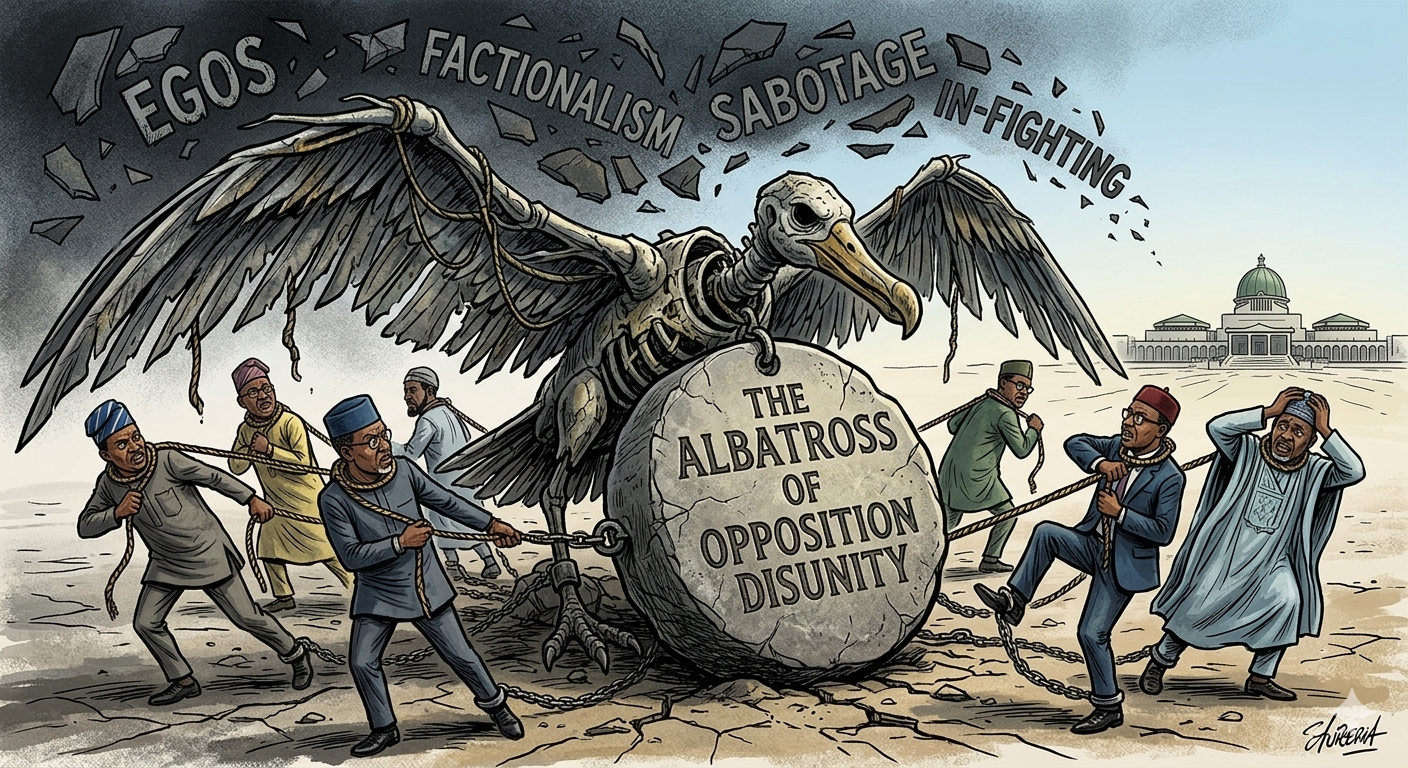
The greatest obstacle confronting the opposition may therefore not be President Tinubu himself but the inability of opposition leaders to subordinate personal ambition to collective strategy. Every major opposition figure appears convinced that he should be the standard-bearer. The result is fragmentation rather than consolidation.
In politics, divided forces rarely defeat a united incumbent. The opposition’s challenge is not merely to criticise President Tinubu’s record but to present a credible and unified alternative. Thus far, it has struggled to do so.
The paradox is striking. Leaders who insist that Nigeria desperately needs change seem unable to agree on who should lead that change. In spreading themselves too thinly across competing platforms, personalities, and ambitions, they risk weakening the very cause they claim to champion.
As things stand today, President Tinubu may well enter the 2027 contest in a stronger political position than he occupied in 2023. The opposition’s inability to unite behind a single formidable candidate could become the decisive factor in the election.
The lesson is simple. Politics may be driven by self-interest, but successful politics often requires enlightened self-interest—the willingness to sacrifice personal ambition in pursuit of a larger objective. Until Nigeria’s opposition learns that lesson, its greatest threat will not be the incumbent President. It will be itself.
Femi Adefemiwa is a global Nigerian, public communicator and advocate for good governance. He is the author of “Remote Working from Africa: A Practical Guide: and writes from the United States of America. He can be reached at jerome.adefemiwa@gmail.com