






















By Femi Adefemiwa
The aftermath of the recent meeting between Catholic Bishops and President Bola Ahmed Tinubu—and the subsequent media tour by John Cardinal Onaiyekan—brings a critical issue back into focus: the line between religious duty and partisan politics.
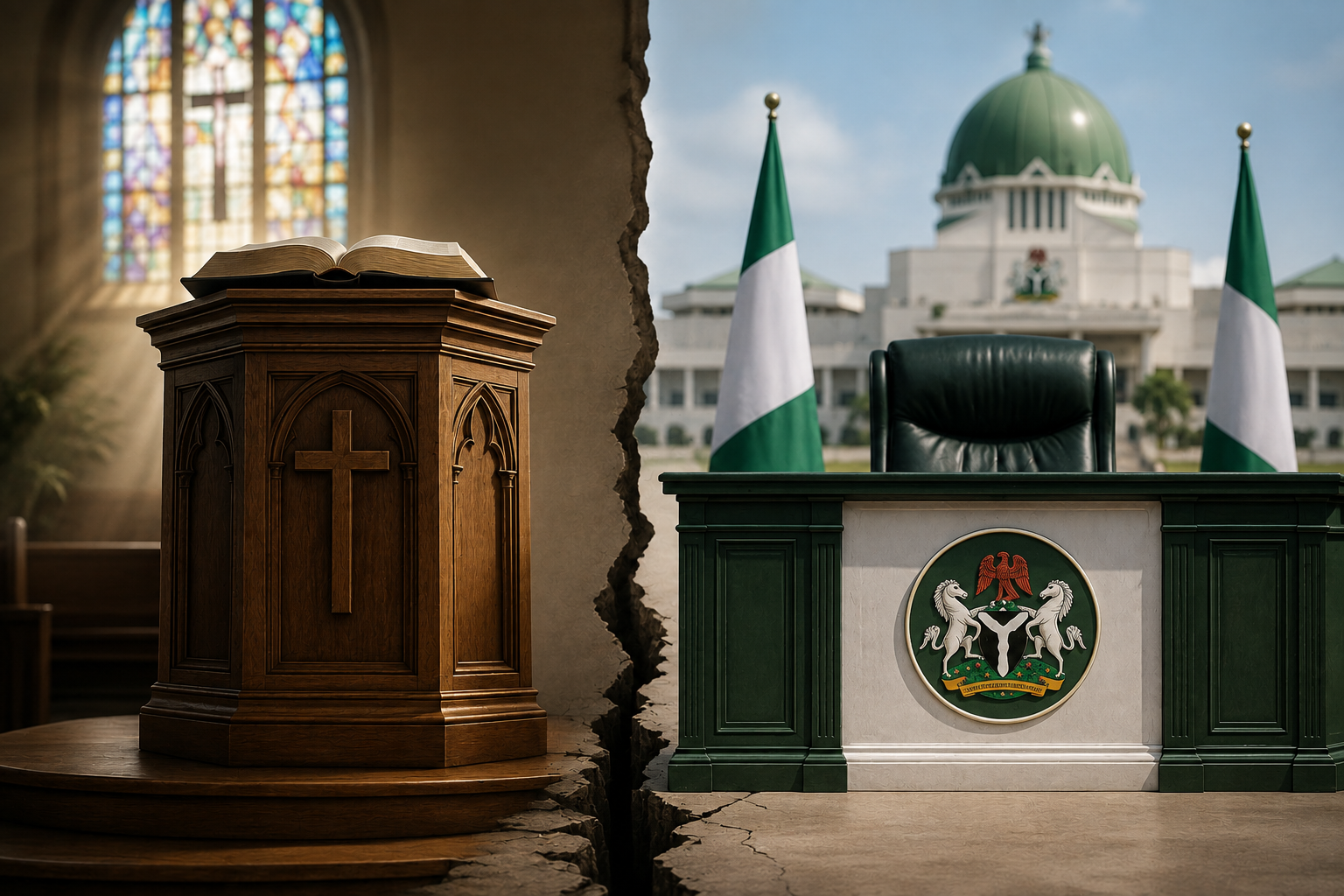
The separation of church and state exists for a simple but important reason: to protect both religious integrity and civil stability. When figures like Martin Luther King Jr. and Desmond Tutu spoke from the pulpit, they confronted systemic injustice and fought causes that transcended political parties. They did not use spiritual authority to fight partisan battles or settle political scores.
In Nigeria, mixing religion with partisan politics is playing with fire.
Ours is a fragile, multi-religious country divided along deeply sensitive fault lines. Words from major religious figures carry enormous weight. When clerics descend into partisan political fights, therefore, the consequences can be immediate and dangerous.
When an influential cleric repeatedly attacks a sitting administration while openly or implicitly favouring opposition figures, ordinary political disagreement can easily become an “us versus them” religious conflict. Policy differences begin to acquire religious colouration, and political opposition is gradually presented as something approaching a moral or even religious crusade.
Nigeria has travelled this dangerous road before. Decades of sectarian violence have left real scars. Turning private diplomatic consultations into public fights feeds inter-faith suspicion and further undermines public trust.
There is also the danger of destroying the neutrality of the altar. The church must remain capable of being a peacemaker and the conscience of society. The moment its leaders take partisan sides, they compromise that position. A church perceived as an opposition mouthpiece cannot, at the same time, convincingly present itself as a neutral arbiter when the nation is in crisis.
It is precisely because Nigeria remains a religious powder keg that Cardinal Onaiyekan’s recent public posture is so troubling.
First is the clear partisan bias. Cardinal Onaiyekan’s alignment with opposition figures, particularly Mr. Peter Obi, is well documented. His persistent public criticism of President Tinubu is increasingly difficult to regard as neutral moral guidance. It looks like partisan advocacy. In a country where virtually every major political disagreement is quickly interpreted through ethnic and religious lenses, this posture does not calm tensions; it escalates them.
Second is a serious breach of protocol. Cardinal Onaiyekan was neither the leader nor the designated spokesperson of the Catholic delegation that met the President. Taking to national television afterwards to air grievances and publicly dissect a private meeting violated the institutional protocol of his own delegation and basic diplomatic decorum.
Third is the damage done to constructive dialogue. Governance requires safe spaces for frank and confidential engagement. Religious leaders must be able to meet political leaders, confront them with uncomfortable truths and receive responses without every exchange becoming material for the next television interview.
Going straight from such an engagement to the media to attack the President’s response transforms a serious intervention into a public spectacle. More importantly, it damages trust. Why should this or any future administration speak candidly with religious delegations if private conversations can immediately become ammunition for public political combat?
Religious leaders have every right—indeed, sometimes a duty—to speak against injustice, bad governance and abuse of power. The church must never be silenced. Neither should the mosque. But there is a fundamental difference between speaking truth to power and joining the partisan struggle for power.
That distinction must not be blurred.
Nigeria is too fragile for religious leaders to behave like opposition politicians in clerical robes. Their enormous spiritual influence places upon them a correspondingly enormous responsibility. Their words can heal or inflame. They can unite or divide.
The pulpit must therefore remain above partisan combat.
When clerics abandon quiet diplomacy for political warfare, they do more than breach protocol. They compromise the neutrality of the institutions they represent, weaken their ability to mediate in moments of national crisis and, most dangerously, risk igniting religious tensions that Nigeria can ill afford.
Femi Adefemiwa is a global Nigerian, public communicator, and advocate for good governance. He is the author of “Remote Working From Africa: A Practical Guide” and writes from the United States of America. He can be reached at jerome.adefemiwa@gmail.com.
The views, thoughts and opinions expressed in this article are solely belong to the author and do not necessarily reflect the official policy, views, opinions, or position of News Wings NG, its management, editorial team, or staff.