


























What is next for the CBN
Nigeria’s inflation showed a divergent trend in June 2025. Headline CPI continued to cool, falling to 22.22% from 22.97% in May 2025. This represents a 0.75% decline. Compared to June 2024, when inflation stood at 34.19%, the figure marks a significant 11.97% drop and a pullback from last year’s inflation spiral majorly due to the rebasing.
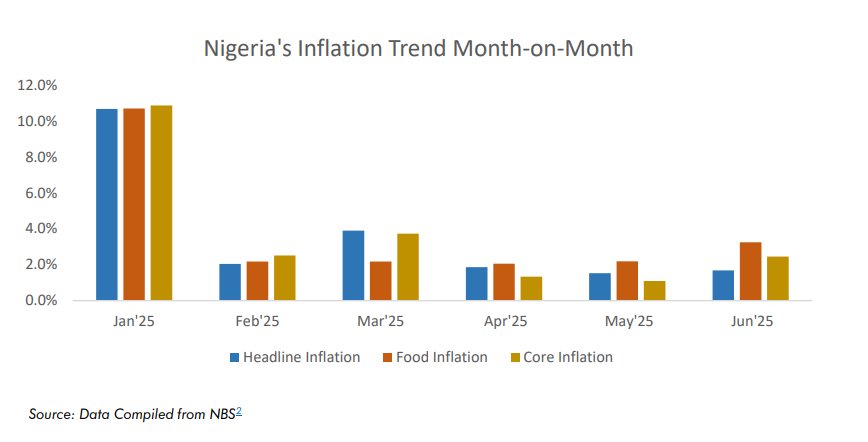
However, while headline inflation eased slightly, core and food inflation rose. Core inflation increased to 22.76% from 22.28% in May. Food inflation also rose to 21.97% from 21.14%. On a month-on-month basis, food inflation edged up to 3.25% from 2.19%, reflecting seasonal pressures. Core inflation also increased to 2.46% from 1.10%.
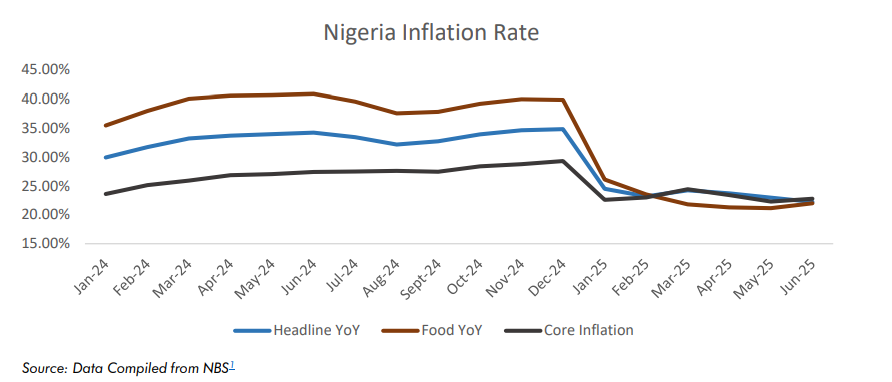
This increase in food and core inflation shows the persistence of underlying price pressures in the economy, despite the easing in headline inflation. It signals rising prices not only in volatile items like food but also in nonvolatile, essential components captured by core inflation, such as housing, healthcare, education, and transportation. This suggests that inflationary pressures are becoming broader-based and entrenched. While base effects and currency appreciation are helping moderate headline inflation, structural issues and supply-side disruptions, particularly insecurity in key agricultural regions, continue to push up prices at both the core and food levels, highlighting the need for targeted interventions to sustain disinflation.
Contrasting Trends: Headline Inflation Falls While Food and Core Inflation Rise
Headline inflation eased year on year, but both food and core inflation increased, indicating a divergence in inflation dynamics. Although food and core prices rose, their impact was offset by declines in other components, resulting in an overall drop in headline inflation. The major factor driving the decline in Headline Inflation is the base effect and cooling energy prices, which offset the increase in Food and Core inflation, and allowed headline inflation to continue a downward trend.
In June 2024, Nigeria recorded one of its highest inflation rates of the year, the third highest in the year. Inflation rose month-on-month by 2.31% in June 2024, compared to 1.68% in June 2025, showing that prices increased more sharply last year than they did this year, thereby diluting the year-on-year growth. This base effect helped create the divergence of a decline in headline inflation in June, as comparison now reflects a smaller rate of increase. Additionally, the rebasing of the Consumer Price Index in January 2025 played a significant role in moderating the inflation trend throughout the year.
Energy costs also continued to ease in early June. as Dangote Refinery, one of the major fuel suppliers, slashed fuel prices across regions by ₦15 toward the end of May. In June, fuel prices remained relatively stable. However, the Israel and Iran conflict caused a short-lived uptick in fuel prices, reflected in price increases by Dangote Refinery and NNPC, as projected in our May 2025 Inflation Report where we earlier stated that fuel could hit ₦1,000 per liter if the conflict escalated. As tensions eased, the impact became minimal, and Dangote Refinery further slashed prices by ₦40 on June 30th. Headline inflation decreased year on year, and rose slightly month on month in June by 1.68%, compared to food inflation which rose by 3.25% and core inflation by 2.46%.
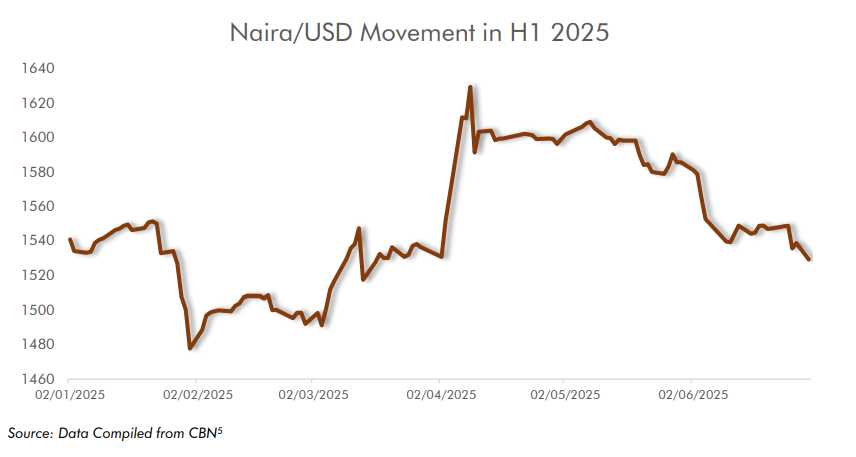
Additionally, the naira appreciated significantly during this period, strengthening from ₦1,580 to ₦1,530 per US dollar, a gain of about 3.25%. This appreciation helped cushion the impact of the spike in imported fuel prices triggered by tensions in the Middle East. While Nigeria is making strides toward fuel self-sufficiency, it still relies on imports, as seen in the reduced import bill for the first quarter. This indicates a decline in fuel imports but not a complete elimination.
Core inflation inched higher year on year at 22.76% from 22.28% and month on month at 2.46% from 1.10%, reflecting a sustained rise in prices beyond just food and energy. This increase signals that inflationary pressures are becoming broad based, with rising costs in essential services such as housing, healthcare, and education. It also points to “stickier” inflation, meaning price increases that are more persistent and less likely to reverse quickly. For consumers, this means a worsening cost of living, as they face higher expenses even outside of volatile categories like food and fuel.
Sticky Pressures: Food Inflation Edge Higher
Food inflation, which had been slowing year-on-year since April 2025, reversed course and increased in June. On a month-on-month basis, it rose sharply by 106 basis points, compared to a modest 13 basis point increase in May. This reflects the continued rise in prices across Nigeria. While the January 2025 rebasing helped bring food inflation down initially, a continued decline now seems unsustainable.
June falls deep within the country’s traditional lean or planting season, a period when supplies from the previous year’s harvest run low and new crops are not yet ready for market. This seasonal scarcity puts upward pressure on prices for staples such as fresh produce, flour, and protein sources. Adding to this, heavy rain during the season disrupts food transportation from rural production centers to urban markets, increasing costs and reducing availability, especially for perishable goods.
Ongoing terrorist attacks and insecurity in key food-producing states have contributed to rising food inflation. As farmers and residents flee these areas for safety, agricultural activities are disrupted, and food losses increase. Benue, one of Nigeria’s top agricultural states, suffered a major attack in June. In July, another attack occurred in Plateau State, another major food-producing region. While the full impact of these incidents is not yet reflected in the June inflation data, insecurity looms as a significant threat to food production in Nigeria. Improving security remains critical to curbing future food inflation. Another contributing factor
is the demand spike associated with the Eid al-Adha (Sallah) festival, which in June 2025 led to notable increases in the price of livestock and other key food items.
The Nigerian Meteorological Agency has issued a flash flood risk alert for July 2025, identifying several food-producing states with a high likelihood of experiencing flash floods. Sokoto, one of Nigeria’s key agricultural states, was listed as the most at-risk state for the month. As the rainy season deepens, flooding is historically common across various parts of the country. This development threatens agricultural activities, particularly in vulnerable regions, and could severely disrupt food production. In the near term, this is likely to increase food inflation due to reduced supply and logistical constraints.
In July, we expect inflation to inch higher. Although the base effect could help moderate the increase, its impact may be limited since July 2024 already recorded relatively low inflation. Persistent insecurity in food producing areas, highlighted by the recent attack in Plateau State, continues to drive food inflation. Additionally, the flash flood risk alert poses further threats to food supply and prices. Energy costs are expected to ease slightly, as Dangote refinery slashed fuel prices again in July by 20 naira, bringing the pump price to 820 naira per litre. However, this decrease may not be enough to offset the upward pressure from rising food
prices and the limited base effect. Core inflation is expected to increase in July, but at a slower pace than the increase recorded in June 2025.
Ahead of the Curve: MPC Gears Up for Next Decision
While headline inflation has been showing signs of disinflation, an encouraging trend, food inflation remains a major concern. The exchange rate of the naira has appreciated significantly, reversing much of the depreciation witnessed earlier in the year and bringing it close to its January 2025 opening level.
The Monetary Policy Committee (MPC) is scheduled to hold its 301st meeting on July 21 and 22, 2025. We expect the MPC to maintain the current interest rate, while possibly adjusting the asymmetric corridor to stimulate economic activity and support domestic demand.
Maintaining the current interest rate is crucial for keeping Nigeria attractive to foreign portfolio investors. A rate cut at this stage could lead to a decline in portfolio inflows, triggering capital flight, exchange rate instability, and a potential reversal of recent gains in the foreign exchange market. However, Nigeria’s recent credit rating upgrades from two major agencies have helped reduce its risk premium, making the country more appealing even to investors with a lower appetite for risk.
With oil prices remaining bearish, Nigeria’s foreign exchange inflows from oil, one of its major export sources, may be limited. Maintaining the current rate should help hedge against any potential resurgence in inflation.
Bottom Line
The June Inflation data, shows increase in Nigeria Inflation, not just from Volatile items but also from non-volatile and essential components such as housing, healthcare, and education. This broad-based inflation underscores deeper structural issues. While headline inflation is easing, thanks to base effects, currency appreciation, and stable energy costs, rising food and core inflation highlight persistent domestic vulnerabilities. This divergence highlights the limits of base effects and currency gains in addressing structural inflation. Sustained disinflation will require targeted reforms, improved security in food-producing regions, and careful monetary policy to strike the right balance between growth and stability.