

























The National Bureau of Statistics (NBS) has reported a further decline in Nigeria’s headline inflation rate, which eased to 22.22% in June 2025, down from 22.97% in May, marking the third consecutive monthly decline since April when inflation stood at 23.71%. This update was contained in the NBS Consumer Price Index (CPI) Report for June 2025. The 0.75 percentage point decrease in headline inflation signals a mild relief for the broader economy. However, the trend contrasts with rising food inflation, which climbed to 21.97% in June from 21.14% in May — a 0.83 percentage point increase on a year-on-year basis. NBS attributed the month-on-month surge in food inflation to rising prices of staple and perishable items. The monthly food inflation rate rose by 3.25% in June, up from 2.19% in May. Despite the increase, the year-on-year food inflation figure in June 2025 was 18.93 percentage points lower than the 40.87% recorded in June 2024. This significant drop is largely attributed to a change in the base year used for inflation calculations. While the continued easing in headline inflation suggests some stability in the general price level, the rising food prices especially in key consumer staples highlight ongoing vulnerabilities in household consumption and food supply chains.
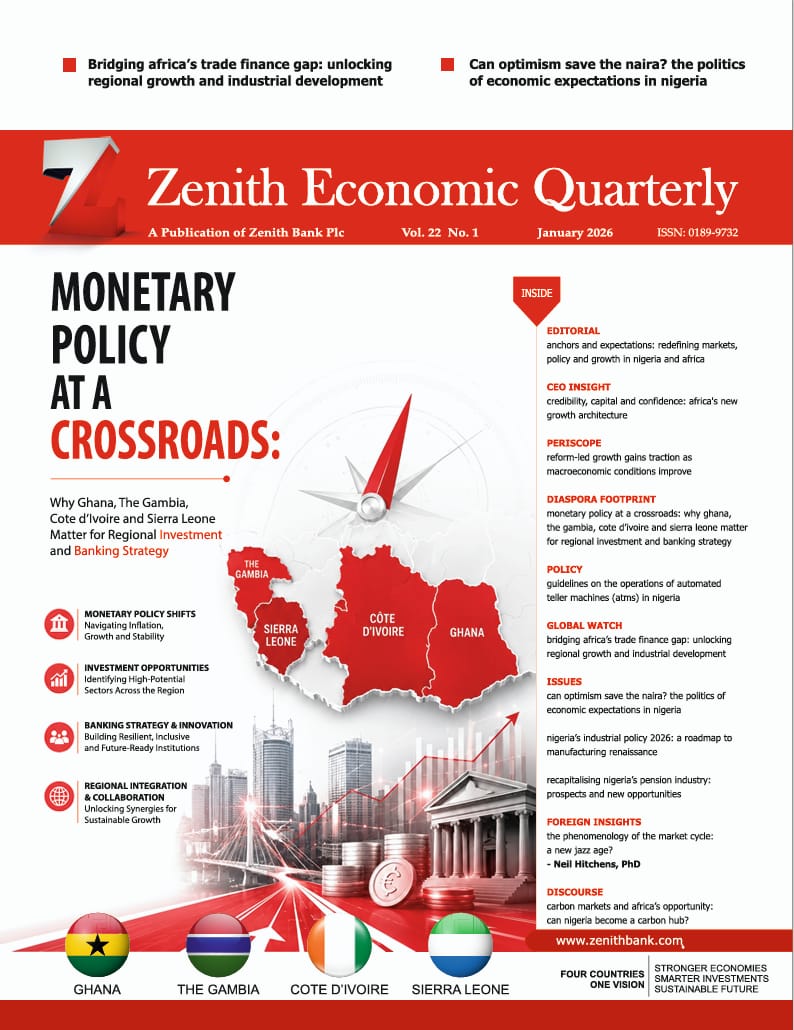 https://www.digital.zenithbank.com/ZEQ/ZEQ-jan-2026/index.html#p=1
Money Market
System liquidity opened the session with a deficit of ₦659.92 billion deficit. The Open Buy Back (OBB) rate increased by 83bps to close at 32.33%, while the Overnight (OVN) rates increased by 50bps to close at 32.67%.
FGN Treasury Bills Market
The FGN Treasury Bills market opened the week on a quiet note, with tight system liquidity dampening demand and limiting activity across the curve. Quotes on the July bill reflected this subdued sentiment, initially seen at 15.95%/15.50% before easing to 15.50%/15.25% as the week progressed. Trading remained muted as liquidity constraints continued to weigh on market participation. Week-on-week, the average benchmark yield decreased by 29bps to close at 17.73%.
We anticipate a quiet start, as market participants adopt a cautious stance ahead of the Primary Market Auction (PMA), where the DMO is set to offer ₦290 billion across the standard maturities.
FGN Bond Market
The FGN Bonds Market traded with mixed sentiments over the week. The market initially opened on a bearish note, with profit-taking activities driving yields higher across the curve. The 2033 maturity was quoted at 16.80%/16.60% before some buying interest emerged, adjusting quotes to 16.75%/16.55%. Midweek, sentiment shifted as demand resurfaced for mid-curve maturities. The 2031s, which had opened at 16.90%/16.55%, firmed to 16.68%/16.50% by close, with trades also executed on the 2033s at 16.55%. The momentum continued into the latter part of the week, with sustained interest on the mid-tenor segment. On the macroeconomic front, headline inflation provided some relief. Year-on-year inflation slowed to 22.22% in June from 22.97% in May, while month-on-month inflation edged higher to 1.68% from 1.53%, reflecting some persistent price pressures. Week-on-week, the average benchmark yield declined by 35bps to close at 16.32%.
We expect a calm start as we look forward to MPC’s decision.
FGN Eurobond Market
The FGN Eurobonds market started the week on a bearish note, as global risk sentiment weakened following President Trump’s announcement of new tariffs. These included increased duties on Canadian imports effective August 1, proposed blanket tariffs of 15%-20% on other countries, and an expanded 50% tariff on copper. The downturn was further driven by declining oil prices, which opened at $71.74 and closed at $69.20, reinforcing negative sentiment. Midweek, the bearish tone persisted amid mixed U.S. inflation data. The monthly Producer Price Index (PPI) printed at 0.0%, falling short of the 0.2% forecast and prior reading of 0.3%, which dampened expectations of a near-term rate cut. Additionally, speculation resurfaced that Trump might fire Fed Chair Powell, unsettling markets and pushing yields higher across the curve. However, by week’s end, the market saw improved activity as Trump dismissed the Powell rumors, restoring some confidence. Positive economic data also supported sentiment as U.S. retail sales rose by 0.6%, far exceeding the 0.1% consensus, while initial jobless claims came in at 221,000, below the expected 233,000. Week-on-Week, the average benchmark yield increased by 15bps to 8.39%.
We look forward to unemployment claims, flash services PMI and flash manufacturing PMI data.
Currency Market
The value of the Naira to the dollar declined by 0.14% to close at ₦1532.34/$ at the Nigerian Foreign Exchange Market Window (NFEM).
Equities Market
The local bourse ended the day with the benchmark NGX All-Share Index (ASI) gained by 100bps to close at 131,585.66. Market capitalization also gained, closing at ₦83.25 trillion. Market breadth was positive at 1.84x. Meanwhile, trading activity was robust on the day, as the volume of shares traded increased by 85% to 2.21 billion units, while the total value of shares traded decreased by 7% to ₦39.57 billion.
Reflecting the week’s performance, the NGX All-Share Index recorded a 4.31% appreciation, as notable gains in EUNISELL (+32.59%), BUACEMENT (+31.28%) and ABCTRANS (+28.41%) were partially offset by declines in ACADEMY (-24.32%), RTBRISCOE (-22.73%), and CUTIX (-19.57%).
Overall, the NGX has posted a year-to-date gain of 27.84%. Other notable indices are the NGX Top 30 Index (0.98%; 4.63% 1WK; 26.82% YTD), NGX Banking Index (-1.08%; 5.36% 1WK; 41.64% YTD), NGX Oil & Gas Index (0.00%; -0.76% 1WK; -10.50% YTD), and NGX Insurance Index (0.59%; -3.65% 1WK; 21.01% YTD).