





























Capital inflows into Nigeria maintained strong upward momentum in Q1 2025, with total foreign investment climbing 67.12% YoY to $5.64bn (Q1’24: $3.38bn), according to the latest Nigeria Capital Importation report from the National Bureau of Statistics (NBS). On a quarterly basis, inflows increased 10.86% from $5.09bn recorded in Q4 2024, underscoring resilient foreign appetite despite global macro headwinds. Portfolio Investment remained the dominant driver, accounting for 92.25% of total inflows at $5.20bn, reflecting heightened foreign participation in Nigeria’s debt and equity markets.
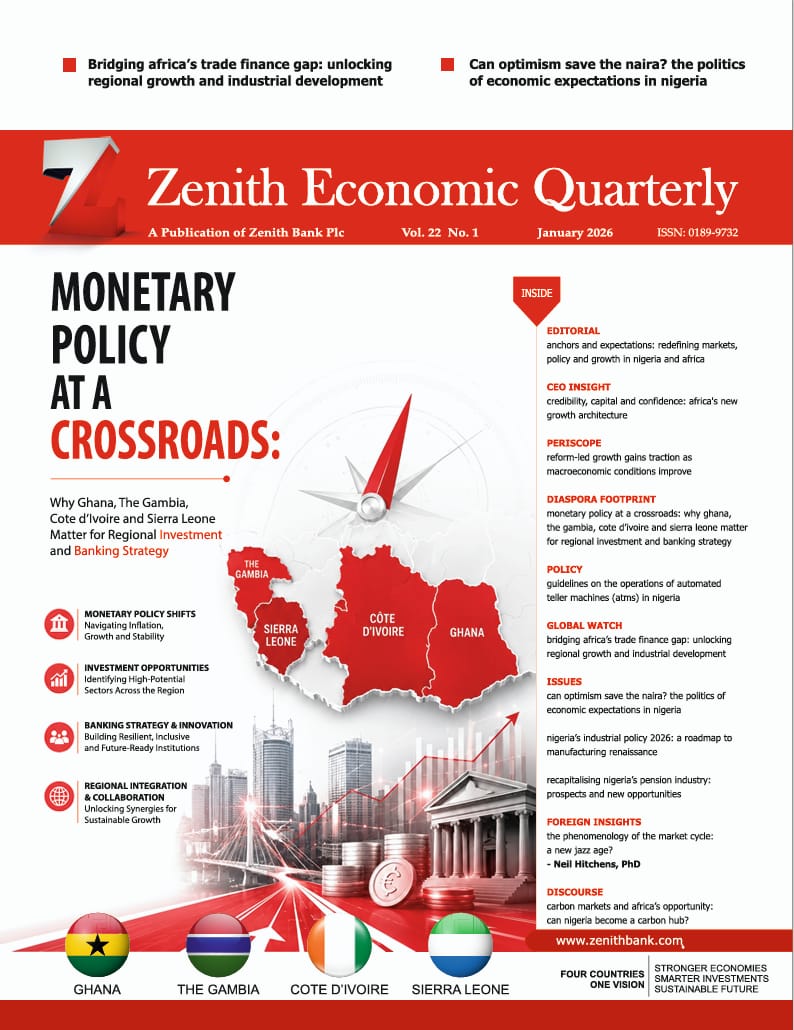 https://www.digital.zenithbank.com/ZEQ/ZEQ-jan-2026/index.html#p=1
Other Investment followed with $311.17m (5.52%), while Foreign Direct Investment (FDI) was subdued at $126.29m (2.24%), highlighting continued structural challenges for long-term capital commitments. Sectoral breakdown showed the Banking sector capturing the largest share at $3.13bn (55.44%), supported by robust fixed income activity and portfolio inflows. The Financing sector attracted $2.10bn (37.18%), while Production/Manufacturing received a modest $129.92m (2.30%). Source countries were concentrated, with the United Kingdom accounting for $3.68bn (65.26%), reflecting strong UK-based portfolio positioning. South Africa and Mauritius followed with $501.29m (8.88%) and $394.51m (6.99%), respectively.
President Bola Tinubu has signed into law the Nigerian Insurance Industry Reform Act (NIIRA) 2025, introducing a sweeping overhaul of the country’s insurance regulatory framework. The legislation, passed by the Senate in December 2024 and the House of Representatives in March 2025, replaces multiple legacy laws with a unified framework aimed at enhancing transparency, capital adequacy, and market efficiency. The Act mandates higher minimum capital requirements for insurers and re-insurers, adopts a Risk-Based Capital (RBC) regime covering insurance, market, credit, and operational risks, and enforces compulsory insurance policies to boost consumer protection. Other key provisions include the digitisation of insurance operations to improve market access and operational efficiency, strict timelines for claims settlement to curb delays and strengthen trust, creation of policyholder protection funds to safeguard consumers in cases of insolvency, and expanded participation in regional schemes such as the ECOWAS Brown Card System.
Money Market
System liquidity opened the session with a surplus of ₦750.31 billion. The Open Buy Back (OBB) rate closed flat at 26.50%, while the Overnight (OVN) rates increased by 10bps to close at 27.00%.
FGN Treasury Bills Market
The FGN Treasury Bills market began the week on a bearish note, with the market largely offered and minimal bids across the curve. Some activity was observed on the Nov 6 bill, which was quoted at 16.80%/17.00%. Activity slowed in the following session as market participants turned their attention to the Central Bank’s ₦600 billion OMO auction, offered across the 105-day and 245-day bills. The auction recorded total subscriptions of ₦2.12 trillion, all allotted to the 245-day paper, with the stop rate declining by 17bps to 23.70%. Midweek, focus shifted to the Primary Market Auction (PMA), where the DMO offered ₦220 billion across standard tenors. Total subscriptions reached ₦366.55 billion, but sales were limited to ₦173.24 billion, below the initial offer size. Stop rates on the 91-day and 182-day bills held steady at 15.00% and 15.50%, respectively, while the 364-day bill’s stop rate rose by 62bps to 16.50%. Subsequent sessions saw muted interest in the newly issued 364-day bill, before the market closed the week on a slightly bullish note. Bid and offer activity was concentrated at the long end of the curve, with the July 23 NTB quoted at 16.50%/16.40%. Week-on-week, the average benchmark yield increased by 13bps to close at 17.93%.
We anticipate a similar sentiment this week.
FGN Bond Market
The FGN Bonds market started the week on a bearish note, with offers dominating across the curve. The 2033 maturity opened at 17.25%/17.20% as market participants sought to offload positions. In subsequent sessions, the market opened on a calmer tone, with most activity concentrated on the mid-tenor segment. Pockets of demand drove yields slightly lower, with the 2033 maturity easing from 17.30%/17.00% to 16.95%/16.75%, while the 2053s were quoted at 15.90%/15.70%. Midweek, attention shifted toward the NTB auction, leading to muted bond activity and yields holding around prior levels. The 2033 maturity was quoted at 17.00%/16.80%. Toward the end of the week, the market remained quiet, though modest demand resurfaced on the mid-tenors, particularly the 2033s, where trades were executed around the 16.80% yield level. Week-on-week, the average benchmark yield increased by 6bps to close at 16.28%.
We expect a slow start to the coming week as investors trade cautiously, with attention turning to the upcoming inflation data release.
FGN Eurobond Market
The FGN Eurobonds market kicked off the week on a mixed note, as last week’s U.S. job numbers fueled bearish sentiment. Momentum shifted to a bullish tone as markets reinforced expectations of a Fed rate cut, with the ISM Services PMI printing at 50.1, below both the forecast of 51.5 and the previous reading of 50.8. Midweek, the market again opened mixed, shrugging off the weaker PMI data, while Brent crude rebounded from a five-week low on renewed supply concerns. The bullish bias strengthened later in the week as participants continued to price in a September rate cut, despite U.S. unemployment claims rising to 226k, above the forecast of 221k and the prior 219k. Toward the week’s close, sentiment turned slightly bearish following geopolitical developments, as Israel’s approval of a plan to take control of Gaza City weighed on risk appetite. Week-on-Week, the average benchmark yield declined by 15bps to 7.98%.
We look forward to CPI, PPI, retail sales, and consumer sentiment data in the coming week, which are expected to guide market direction.
Currency Market
The value of the Naira to the dollar appreciated by 0.01% to close at ₦1533.57/$ at the Nigerian Foreign Exchange Market Window (NFEM).
Equities Market
The local bourse ended the day with the benchmark NGX All-Share Index (ASI) declining by 56bps to close at 145,754.91. Market capitalization also gained, closing at ₦92.23 trillion. Market breadth was negative at 1.45x. Meanwhile, trading activity was robust on the day, as the volume of shares traded increased by 12% to 2.22 billion units, while the total value of shares traded increased by 20% to ₦32.42 billion.
Reflecting the week’s performance, the NGX All-Share Index recorded a 3.18% appreciation, as notable gains in MBENEFIT (+60.44%), AIICO (+59.82%) and ROYALEX (+59.33%) were partially offset by declines in LIVINGTRUST (-24.13%), ACADEMY (-18.18%), and ACADEMY (-12.73%).
Overall, the NGX has posted a year-to-date gain of 41.61%. Other notable indices are the NGX Top 30 Index (-0.70%; 2.74% 1WK; 39.76% YTD), NGX Banking Index (0.19%; -0.75% 1WK; 48.15% YTD), NGX Oil & Gas Index (0.38%; 0.17% 1WK; -10.00% YTD), and NGX Insurance Index (6.11%; 41.00% 1WK; 74.18% YTD).