


























Nigeria’s headline inflation decelerated in July 2026 to 15.43% year-on-year from 15.91% in June, marking a second consecutive decline and the sharpest monthly slowdown so far this year.
On a month-on-month basis, inflation eased to 1.57% from 1.66% in June. However, this masks a divergence: food inflation rose to 5.56% from 3.75%, while core inflation dropped sharply to 0.15% from 1.66%, alongside a 2.39% decline in energy prices. Overall, disinflation was driven by easing core and energy pressures, even as food inflation accelerated.
Highlights
Headline CPI (YoY): In July 2026, headline inflation stood at 15.43%, down from 15.91% in June 2026.
Headline CPI (MoM): On a month-on-month basis, the inflation rate in July 2026 was 1.57% compared to 1.66% recorded in June 2026.
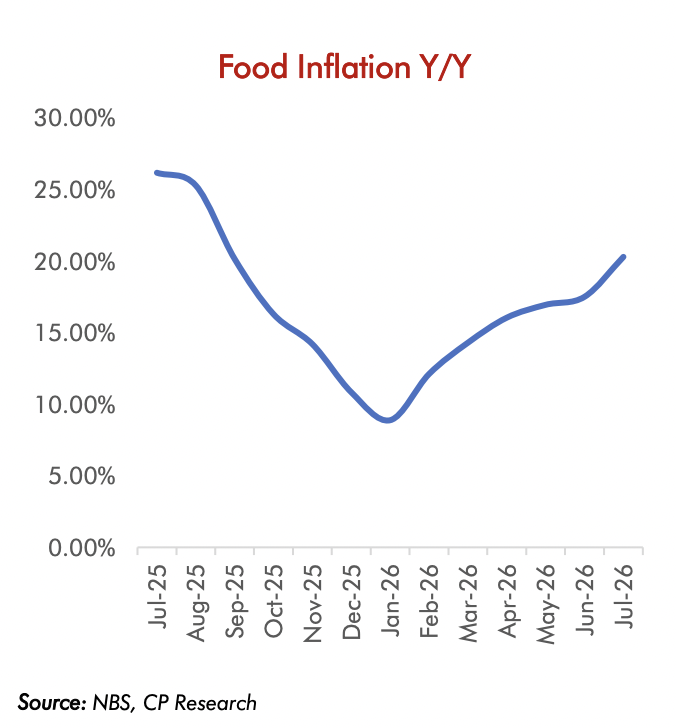
Food Inflation (YoY): Food inflation rose to 20.31% in July 2026 from 17.52% in June 2026.
Food Inflation (MoM): On a month-on-month basis, food inflation increased to 5.56% in July 2026 from 3.75% in June 2026.
Core CPI (YoY): Core inflation declined to 14.97% in July 2026 from 15.92% in June 2026.
Core CPI (MoM): On a month-on-month basis, the Core Inflation rate fell sharply to 0.15% in July 2026, from 1.66% in June 2026.
Headline Disinflation continues amid lower y/y contribution from key divisional items.
The slowdown in the headline inflation rate was driven by lower y/y contributions from key divisional items in the period. Food & non-alcoholic beverages, Restaurant & accommodation, and Transport contributed roughly 64% of the headline rate.
Compared with June, the contribution from Food and Non-Alcoholic Beverages declined from 6.37pp to 6.18pp; Restaurants and Accommodation fell from 2.06pp to 1.99pp; Transport moderated from 1.70pp to 1.64pp; while Housing and Utilities declined from
1.34pp to 1.30pp. Taken together, these four divisions recorded a 0.36pp decline in their combined contribution, equivalent to roughly 75% of the 0.48pp decline in headline inflation, based on the rounded NBS contribution figures, suggesting that July’s moderation was relatively broad across major consumer expenditure divisions.
The CPI nevertheless increased to 145.3 (vs 143 in June 2026), underscoring continued price pressures in the economy.
Food Inflation remains a structural weakness.
Food inflation stood at 20.31% y/y, substantially above the 15.43% headline rate. More importantly, it rose from 17.52%
in June, indicating a renewed acceleration in annual food inflation. On a m/m basis, food inflation was 5.56% in July (vs 3.75%
in June). This reflects changes in the average prices of products such as crayfish, Fresh pepper, Fresh carrots, tomatoes,
among others.
Food constitutes a relatively large portion of household expenditure, particularly among low- and middle-income earners.
Consequently, it highlights the divergence between easing headline rates and sticky food prices, even as food inflation
continues its upward trajectory. We believe that this reflects a combination of agricultural supply constraints, logistics and
distribution costs, seasonal effects & broader structural bottlenecks that monetary policy alone cannot resolve.
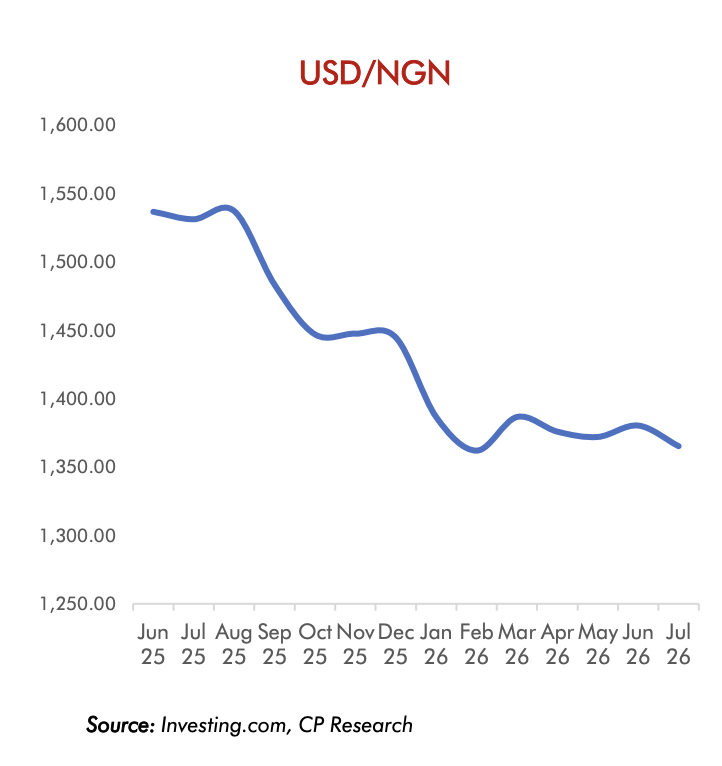
Core Inflation moderation suggests that inflation is concentrated in volatile food/energy categories
The NBS core measure stood at 14.97% in July (vs 15.92% in June 2026). The month-onmonth reading also declined to 0.15% (vs
1.66% in June). The implication is that inflation appears increasingly concentrated in volatile food-related categories rather than
broadening across the entire economy.
Consequently, we expect headline disinflation to continue gradually, supported by sustained moderation in core inflation and reduced
exchange rate volatility. However, our outlook remains subject to risks from persistent food price pressures and a potential increase in
election-related spending. As political activity intensifies, stronger demand across food, transport, accommodation, and FX could
accelerate price increases across the economy