



























The Centre for the Promotion of Private Enterprise (CPPE) has noted a significant moderation in Nigeria’s inflation dynamics as reflected in the January 2026 Consumer Price Index (CPI), describing the development as an important macroeconomic shift with wide-ranging implications for household welfare, agricultural sustainability, monetary policy direction, and private-sector investment strategy.
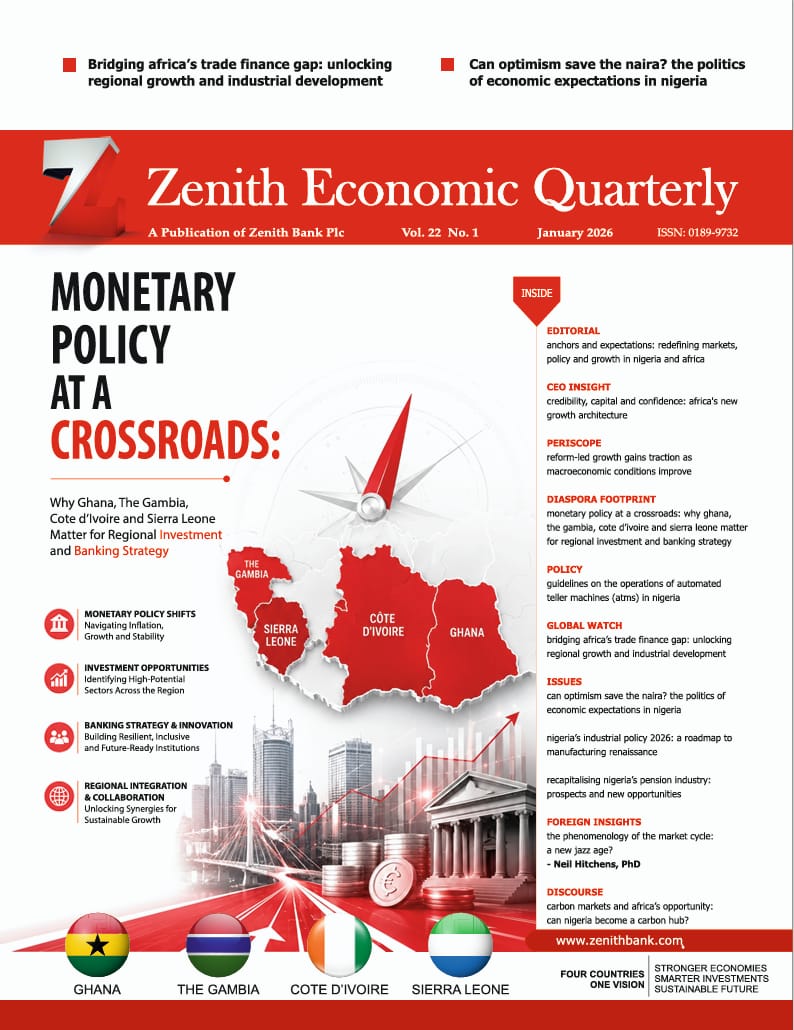 https://www.digital.zenithbank.com/ZEQ/ZEQ-jan-2026/index.html#p=1
According to the CPPE, headline inflation declined sharply to 15.10 percent year-on-year in January 2026, compared with 27.61 percent in January 2025 and 15.15 percent in December 2025. Month-on-month inflation turned negative at −2.88 percent, indicating an actual easing in the general price level relative to December 2025. The Centre noted that this movement reflects real disinflation rather than temporary price volatility.
The easing of inflationary pressures was broad-based across major components of the price index. Food inflation fell markedly to 8.89 percent year-on-year, down from 29.63 percent in January 2025 and 10.84 percent in December 2025. On a month-on-month basis, food prices declined by −6.02 percent, driven largely by falling prices of staple food items. Core inflation also moderated to 17.72 percent year-on-year from 18.63 percent in December 2025, suggesting that price easing is extending beyond food into other segments of the consumption basket, even though structural cost pressures remain elevated. Urban and rural inflation rates declined to 15.36 percent and 14.44 percent respectively, indicating that the disinflation trend is geographically widespread.
CPPE emphasized that the sharp moderation in food inflation carries substantial welfare benefits, as food accounts for the largest share of household expenditure in Nigeria. Lower food prices are expected to improve real purchasing power, particularly for low-income households, reduce poverty and food-security pressures, and support a gradual recovery in consumer demand for non-food goods and services. If sustained, the Centre believes the trend could stimulate retail trade, boost manufacturing capacity utilisation, and strengthen service-sector activity, thereby reinforcing broader economic recovery.
However, the Centre cautioned that while declining food prices benefit consumers, they also pose risks to farm incomes and rural economic stability. Sustained weakness in farm-gate prices could reduce farmers’ revenues and investment capacity, weaken rural purchasing power, and discourage agricultural production, potentially creating future supply shortages and renewed inflationary pressures. CPPE stressed the need to balance consumer affordability with producer sustainability to safeguard national food security.
On monetary policy, CPPE stated that the disinflation trend creates room for cautious and gradual easing, though such action must remain data-driven given that core inflation and the twelve-month average inflation rate remain elevated. In the area of agricultural and food-price policy, the Centre recommended targeted measures to protect farm incomes while sustaining food affordability. These measures include productivity support initiatives, minimum guaranteed prices for selected crops, strategic reserves, and expanded agro-processing capacity to absorb surplus output.
The Centre also highlighted state-level disparities in inflation, noting that headline inflation remains highest in Benue, Kogi, and the Federal Capital Territory, and lowest in Ebonyi, Katsina, and Imo. These variations underscore the role of transport costs, security conditions, and supply-chain efficiency in price formation. Addressing these structural constraints, CPPE argued, is essential to achieving durable nationwide price stability. With lower food inflation, the Centre further suggested an opportunity to shift social policy emphasis from emergency relief toward productivity enhancement, improved nutrition, and long-term human-capital investment.
For investors and businesses, CPPE observed that easing inflation—particularly food inflation—signals a gradual recovery in real household demand, creating opportunities in consumer goods, retail, logistics, and services. At the same time, disinflation reduces the ability of firms to rely on price increases for revenue growth, thereby increasing the importance of cost efficiency, productivity improvements, and scale expansion. In agriculture, lower primary food prices may compress margins in crop production but strengthen the case for investment in storage, processing, cold-chain infrastructure, and export-oriented agribusiness. From a financial-market perspective, sustained disinflation could support gradual moderation in interest rates and improved equity valuations, favouring long-term productive investment over short-term inflation hedging.
In conclusion, CPPE stated that Nigeria’s January 2026 inflation outcomes signal a meaningful transition toward macroeconomic stabilisation, driven primarily by declining food prices and supported by easing core inflation. While the development is positive for household welfare, consumption recovery, and investment confidence, it presents downside risks for farm incomes and rural economic sustainability. The Centre emphasized that consolidating disinflation while protecting agricultural productivity and rural livelihoods must remain the central policy priority. Achieving this balance, it noted, will be critical to transforming current price moderation into durable stability, inclusive growth, and strengthened investor confidence in Nigeria’s economy.