








Advertisement
Home Blog Page 14

From Showmax to GOtv: Your Favourite Shows Aren’t Over 

0

For millions of viewers across Africa, the news that Showmax is shutting down its streaming service in April 2026 was like a punch to the gut. Long after Netflix and other global streamers arrived on the scene, Showmax carved out a special place in many hearts; home to local originals, international series, movies and memorable reality TV shows.

You’d be surprised how many are already convinced their favourite shows are lost forever. But here’s the thing: it doesn’t have to be the end of your entertainment journey. In fact, you can keep watching most of what you love and discover more on GOtv and the MyGOtv mobile app.

Why You Don’t Have to Lose Your Shows

The Showmax shutdown comes as MultiChoice and its new owner Canal+ discontinue the streaming service after more than a decade in operation. But what many viewers don’t realise is that a lot of the best content you watched on Showmax is already part of the GOtv ecosystem, either airing on channels like Africa Magic or available through the MyGOtv app.

Here’s how:

  • Simulcast & Channel Broadcasts: Many African originals and popular series that debuted on Showmax or that you streamed there first are part of the TV lineup on GOtv channels like Africa Magic Family, Africa Magic Showcase and more. These channels carry ongoing episodes of dramas, sitcoms and reality shows live across the week.
  • MyGOtv App: If you prefer watching on your phone, tablet, or on the go, just like you did on Showmax, you can download the MyGOtv app and stream many of these GOtv channels anytime, anywhere, not just in front of your TV.

So watching your favourite storylines doesn’t end because the streaming service does; it changes platforms.

Shows You Can Still Follow on GOtv

Here are a few big titles people loved on Showmax that you can still keep up with on GOtv or the MyGOtv App:

Masoyinbo:  There’s always that one scene or one moment that stays with you long after the episode ends. If you’ve been keeping up, especially with the weekend episodes, then you already know how easy it is to get pulled in. It’s the kind of show you don’t just drop halfway because you know there’s more coming. It is shown every Saturday and Sunday on Africa Magic Yoruba (GOtv Ch 2).

Off Air with Gbemi and Toolz: It’s all about the conversations with Gbemi and Toolz. You start watching casually and before you know it, you’re fully locked in because it feels real and unfiltered. If you’ve been following it, then you already know you can’t just stop now when the discussions keep getting better. You don’t want to miss new episodes of your favourite show on Africa Magic Showcase every Thursday (GOtv Ch 8).

Heartbeats: This is one of those shows that grows on you. The emotions, the relationships, the little moments that start to matter more as you keep watching. If you’ve stayed with it this long, then you know it’s not something you walk away from when it’s still unfolding. Catch Heartbeat every Sunday on Africa Magic Showcase (GOtv Ch 8).

For Fans Who Prefer Watching On Their Phones

One of the biggest concerns for many Showmax viewers was that they loved watching shows anywhere, especially on their phones or tablets. Good news: the MyGOtv app gives you that flexibility too.

With MyGOtv app, you can:
Watch GOtv channels live wherever you are
Stream your favourite series and shows on mobile
Catch up on episodes you miss at home

That means no more missing out just because you’re away from the TV,  just open the app and tune into your favourite programmes on the move.

The end of Showmax is not a blackout. It’s just a new chapter in how you enjoy content. Shows you’ve loved, from reality TV and comedies to dramas and big live events, are still accessible through traditional broadcast on GOtv and via mobile streaming on MyGOtv app.

So when your favourite platform leaves, watching doesn’t have to stop,  it just evolves to where the stories live next.

To upgrade, subscribe, or reconnect, download the MyGOtv App or dial *288#. For catch-up and on-the-go viewing, download the GOtv Stream App and enjoy your favourite shows anytime, anywhere.

ADVERTISEMENT

Showmax Originals have a new home on DStv Stream

0

Customers to get the best of both worlds as Showmax Originals and fan favourites join live sports, and award-winning local and international content on DStv Stream.

MultiChoice, a CANAL+ company, has announced that the titles which defined Showmax will continue to be available to audiences on DStv Stream from 1 April 2026. A dedicated Showmax section within the platform will bring together a curated selection of the service’s most acclaimed originals and fan-favourite titles.

This content will sit alongside DStv Stream’s live channel offering, available to subscribers across DStv Compact, Compact Plus and Premium packages. Showmax customers with existing subscriptions will be migrated to DStv Stream on Compact and continue to stream until 31 May 2026 at no extra cost.

The move ensures that the award-winning African series that helped establish Showmax as one of the continent’s most influential streaming platforms remain widely available within the broader DStv Stream experience, after the current Showmax service closes on 30 April 2026.

“This move reflects DStv’s long-term commitment to streaming, bringing together on-demand entertainment and live television in a single platform designed around how audiences want to watch today,” said Kemi Omotosho, Chief Executive Officer of MultiChoice Nigeria.

“Showmax helped unlock a wave of world-class African storytelling. Series like WURA, Flawsome, Cheta M and The Real Housewives of Lagos, along with productions from across the continent, were created through collaboration between MultiChoice’s content teams and local producers. That commitment to African storytelling does not change,” she added.

The success of Showmax Originals has been built through partnerships with producers, writers and creative talent across Africa. Series such as Spinners, a co-production between MultiChoice and CANAL+, which aired across Africa and in France, demonstrate how locally developed African stories are increasingly reaching global audiences. DStv Stream remains the platform where this content is available locally, alongside a much broader library of African and international content, live channels and sport.

What will be available to watch?

The dedicated Showmax section on DStv Stream will feature standout titles including WURA, Flawsome, Cheta MPrincess on a Hill and Under the Influence alongside popular series from across the continent such as The Wife (South Africa) and Single Kiasi (Kenya).

This sits alongside everything else available on DStv Compact, Compact Plus or Premium Stream, including tens of thousands of hours of on-demand movies and series and more than 100 live channels available to stream 24/7.

For customers it delivers the best of both worlds: popular local originals and premium international channels, plus kids’ programming and world-class sport, reinforcing DStv as Africa’s most comprehensive entertainment platform.

Sports remains a key part of the experience. Through SuperSport, subscribers can watch competitions such as the Premier League, UEFA Champions League, LaLiga and Serie A, as well as additional sports channels like ESPN. Unlike Showmax Premier League, which was only available on mobile devices, DStv Stream can be viewed on smart TVs as well as mobile devices.

How to get Showmax on DStv

Customers can download the DStv Stream app or visit the DStv website, log in or sign up, and navigate to the Showmax section. Showmax Originals on DStv Stream are available on DStv Compact, Compact Plus and DStv Premium packages. 

Beyond its content library, DStv Stream offers familiar streaming features such as live and on‑demand viewing in one place, pause and rewind on live TV, Watch from Start, offline downloads and personalised recommendations. 

ENDS

Notes for editors:

CategoryDStv Stream
*Content and channels available varies per package.
Showmax (across plans)
Live TV channels✅ Yes❌ No
Live sport (incl. Premier League)✅ Yes – via SuperSport, Compact and above on all devices✅ Premier League only, on mobile plans only
Other live sport✅ Yes❌ No
MultiChoice Originals✅ Included✅ Included
Showmax Originals✅ Included✅ Included
International series & movies✅ Included✅ Included
All content in one place✅ Yes❌ Entertainment and sport split
Single, simple platform✅ Yes❌ Multiple plans required
Devices supportedMobile, Smart TV, laptop, Android TV, Apple TV, Hisense (full devices supported here (link))Showmax Entertainment: Mobile, Smart TV, laptop, Android TV, Apple TV, (full devices supported here (link))
Showmax PL: Mobile only
Maximum resolutionHD (1080p)HD (1080p)
Mobile‑only plans❌ No✅ Yes
Concurrent streams✅ Multiple (plan dependent)Varies by plan (1–2 streams)
Downloads for offline viewing✅ Yes✅ Yes
Watch from start (live TV)✅ Yes❌ No
Catch‑up / replay✅ Available (not all content)❌ Not available
Reverse EPG✅ Yes (selected channels)❌ No
Kids profiles & parental controls✅ Profiles, PINs & age limits✅ Profiles & age limits
Personalised recommendations✅ Yes✅ Yes
Split / shared bill payments✅ Yes (Share My Bill via MyDStv App)❌ No
Rewards & loyalty benefits✅ DStv Rewards (earn & redeem Coins, incl. bill payments)❌ No
Advertising modelAd‑supported streamingAd‑free
Overall propositionAll‑in‑one live TV, sport, entertainment and value platformEntertainment and sport accessed via separate plans
ADVERTISEMENT

Zenith Bank elevates Kennedy Okwudili to an Executive Director

0

Zenith Bank Plc has elevated Mr Kennedy Onuwa Okwudili as an Executive Director of the bank, effective May 1, 2026. The appointment, which is consistent with the bank’s tradition and succession strategy of grooming leaders from within, will further strengthen the bank’s Executive Management.

Mr Okwudili graduated with a Bachelor of Science (Honours) in Accounting in 1998 from the University of Maiduguri, Nigeria, with a Second Class Upper Division. He obtained a Master’s of Business Administration (MBA) from Ahmadu Bello University, Zaria, Nigeria, in 2008 and a Master’s of Science in Accounting from Veritas University, Abuja, Nigeria, in 2021.

Mr Okwudili has over twenty-five years of cognate banking experience spanning credit and marketing, treasury, compliance, as well as operations and has at different times worked in various zones and departments of the bank.

He is a Fellow of the Institute of Chartered Accountants of Nigeria (ICAN), 2013, a Fellow of the Chartered Institute of Bankers of Nigeria (CIBN), 2024 and an Associate of the Chartered Institute of Taxation of Nigeria (CITN), 2016.

He has attended several Executive Education Programmes both within and outside the country, including: Senior Leadership Development Programme at the Lagos Business School, Corporate Directorship Programme at the Harvard Business School and Oxford Advanced Management and Leadership Programme at the University of Oxford, SAID Business School.

He is currently the President of Catholic Bankers Association of Nigeria (CBAN) and a member of the Noble Order of the Knights of St. John International (KSJI).

ADVERTISEMENT

CPPE Strongly Rejects Proposed Additional Tax on Sugar-Sweetened Beverages, Citing Severe Energy Costs and Economic Fragility

0

The Centre for the Promotion of Private Enterprise (CPPE) has strongly rejected calls for the introduction of additional taxation on sugar-sweetened beverages (SSBs), describing the proposal as ill-conceived, poorly timed, and inconsistent with Nigeria’s current economic realities and tax reform priorities.

The proposal, put forward by Corporate Accountability and Public Participation Africa (CAPPA), seeks to impose further fiscal measures on the beverage sector. However, CPPE maintains that such a move runs counter to the Federal Government’s ongoing tax reform agenda, which is focused on reducing the burden on businesses, improving tax efficiency, and stimulating investment across key sectors of the economy.

CPPE noted that Nigeria’s economy remains in a fragile recovery phase, with businesses operating under severe macroeconomic pressures. Inflation remains elevated, significantly eroding consumer purchasing power, while interest rates have climbed to historic highs, with the Monetary Policy Rate exceeding 26.5 percent and lending rates rising above 30 percent for many firms. In addition, energy costs have surged dramatically, with diesel prices increasing by over 70 percent and petrol prices rising by more than 200 percent in the past two years, forcing many manufacturers to rely on expensive self-generation due to unreliable grid electricity. Exchange rate depreciation has further compounded these challenges by driving up the cost of imported inputs and raw materials.

Within this context, CPPE emphasized that the manufacturing sector—particularly the food and beverage segment—is under intense strain. The sugar-sweetened beverage industry, in particular, is highly energy-intensive, relying on power at multiple stages of production including water extraction and treatment, heating and pasteurisation, bottling and packaging, as well as refrigeration and cold-chain logistics. These cumulative cost pressures have significantly weakened the operating environment for manufacturers.

The think tank highlighted that prices of beverages and other consumer goods have risen by over 50 percent in the past two years, while sales volumes have declined due to weakened consumer demand. Many operators, especially small and medium-scale producers, are facing existential threats. Against this backdrop, CPPE warned that imposing additional taxes on the sector would amount to a punitive layering of fiscal pressure, further destabilising already fragile business operations.

CPPE also raised concerns about the broader implications for employment, investment, and value chains. The food and beverage sector is one of the largest employers in Nigeria’s manufacturing space, supporting a vast ecosystem that spans agriculture, processing, logistics, retail, and hospitality. The sugar-sweetened beverage segment plays a particularly strategic role due to its scale and integration across these value chains.

According to CPPE, additional taxation could trigger production cutbacks, force the closure of vulnerable firms, and lead to widespread job losses across production, distribution, and retail channels. It could also disrupt agricultural supply chains linked to beverage production and accelerate the informalisation of the sector as businesses struggle to survive. At a time when unemployment and underemployment remain high, such outcomes would further exacerbate socio-economic challenges.

While acknowledging concerns about rising cases of non-communicable diseases such as diabetes, CPPE argued that taxing sugar-sweetened beverages is not an effective standalone solution to public health challenges. The organisation stressed that health outcomes are influenced by broader lifestyle factors, including overall dietary habits, physical inactivity, and consumption patterns across multiple food categories.

CPPE noted that global evidence on sugar taxes has produced mixed results, with limited long-term impact on health outcomes in many countries, particularly where complementary interventions are lacking. It recommended a more holistic approach focused on public health education, promotion of active lifestyles, improved access to preventive healthcare, and constructive engagement with industry stakeholders.

The organisation further warned that introducing new sector-specific taxes would undermine policy consistency and send negative signals to investors. It pointed out that the current administration has received commendation for its efforts to streamline the tax system, reduce multiplicity of taxes, and create a more investment-friendly environment. Reversing course by imposing additional taxes on a struggling sector, CPPE argued, would create uncertainty and weaken investor confidence in Nigeria’s manufacturing landscape.

In conclusion, CPPE reiterated that the proposed tax on sugar-sweetened beverages is misaligned with Nigeria’s economic priorities and unjustifiable given the extraordinary cost pressures facing the industry. It cautioned that such a policy would undermine business sustainability, threaten jobs, discourage investment, and further strain consumers.

The organisation therefore called on the Federal Government to reject the proposal, urged the National Assembly to discontinue any legislative consideration of the tax, and advised public health authorities to prioritise education, prevention, and lifestyle-based interventions.

“At this critical stage of Nigeria’s economic recovery, the priority should be to support businesses, protect jobs, and strengthen growth—not to impose additional tax burdens on an already strained sector,” CPPE stated.

ADVERTISEMENT

AMVCA: ‘I Was Joking’, Kunle Remi Clarifies Viral Comment Amid Debate on Award Process

0

Nollywood actor Kunle Remi has clarified that his recent social media comment comparing the Africa Magic Viewers’ Choice Awards to the Academy Awards (Oscars) was made in jest, following widespread reactions online.

The conversation began after the actor shared a video from the 2026 Academy Awards (Oscars), where Michael B. Jordan was seen having his award engraved shortly after his win. In his initial reaction, Remi suggested that winners at the AMVCA do not receive their plaques immediately, a claim that quickly gained traction across multiple media platforms.

However, in a follow-up video posted shortly after, the actor dismissed the comparison as a joke, noting that he is aware of how the AMVCA award process works.

“I was just messing around, and it was all a joke,” he said, adding that people had taken the remark more seriously than intended.

He reaffirmed his respect for the platform, describing the AMVCA as the only African awards show comparable to the Oscars.

“AMVCA is the only African show you can even compare to the Oscars,” he added.

The actor also confirmed his involvement with the awards, noting that he will be present at this year’s edition and is actively working on it.

“I’ll be at this year’s AMVCA, in fact, I’m working with them on this one.”

The exchange has since drawn attention to how awards are handled at the AMVCA. Winners receive their plaques on stage immediately after being announced and are subsequently directed to a designated media room, where engraving stations are set up to personalise each award in real time.

The engraving process is completed on the night of the event, with winners finalising their plaques while also engaging with the press through interviews, photography, and official media documentation.

Industry sources familiar with the production confirm that this system has been consistently implemented across previous editions, with visual documentation from past ceremonies showing the engraving process and post-win media interactions.

The clarification comes amid ongoing conversations about production standards across global award platforms, as African film and television continue to gain wider international visibility.

ADVERTISEMENT

REDWOLF Company Bags Workplace Global Accreditation

0

The REDWOLF Company, a leading digital agency in Nigeria, has been named the Best Agency Workplace in Nigeria by Agency Workplaces, a global organisation dedicated to culture recognition for agencies. The recognition was contained in a mail dated March 22, 2026.

Agency Workplaces is a global organisation that serves as the definitive authority recognising exceptional workplace culture exclusively within the marketing communication industry.

According to the award convener, REDWOLF was recognised for its commitment to prioritising teamwork and collaboration, attracting the best talent, and fostering the right culture. With the recognition, REDWOLF becomes the first Nigerian agency to be so honoured, which according to Agency Workplaces follows a rigorous interrogation of the agency’s work culture through a research-backed survey and interview. It also described the honour as a reflection of the agency’s commitment to building a strong workplace culture while delivering impactful work for clients.

‌Speaking on the milestone achievement, the Managing Director, REDWOLF Company, Ekeno Eyo, acknowledged the great foresight of the agency’s visionary, Lanre Adisa, in birthing a truly digital-first agency at a time when the industry was in dire need of a real digital-first approach to marketing.

Eyo explained that “We didn’t just build a digital-first agency, we have been building a digital-first culture, and we are honoured to be the first in Nigeria to be named the Best Agency Workplace in Nigeria”.

The agency continues to strengthen its strategic capabilities and talent upskilling through industry collaborations such as the 2025 Google Ads Lab with Google Nigeria. These latest achievements are rooted in REDWOLF’s “Pack of Wolves” philosophy, a culture that prioritises teamwork, adaptability, and collective problem-solving in a fast-moving digital-first environment. The recognition comes at a fitting moment as the company prepares to celebrate its eighth anniversary.

‌Since its founding in 2018, The REDWOLF Company has grown steadily over the years, providing full digital marketing and through-the-line marketing services to an enviable portfolio of global brands, multinational brands, and national brands in different categories, including FMCG, Fintech, NGOs, Financial Institutions, Consumer Electronics, Telecomunications in Nigeria, and within the West African sub-region. It is worth noting that the Agency has consistently featured on the LAIF awards table, coming in a joint 7th position at the last edition.

ADVERTISEMENT

Momentum Builds Around Abdulrahman Haske at Adamawa Governor’s APC Reception

0

The grand reception of Governor Ahmadu Umaru Fintiri of Adamawa State into the All Progressives Congress (APC) fold on Monday (today) turned out to be a major event, further building momentum around one of the governorship aspirants in the forthcoming 2027 Governorship Election in the State, Abdulrahman Bashir Haske.

The event, held at Ribadu Square in Yola, witnessed an extraordinary political gathering as thousands of supporters, party leaders, and stakeholders converged to welcome Governor Fintiri into the APC, a move widely seen as a significant shift in the political direction of Adamawa State.

The grand reception attracted a massive crowd from across the state, turning the historic square into a vibrant sea of APC colours, as many political observers described the moment as a strategic alignment aimed at strengthening Adamawa’s connection with the national leadership of President Bola Ahmed Tinubu and positioning the state to benefit more directly from the Renewed Hope Agenda.

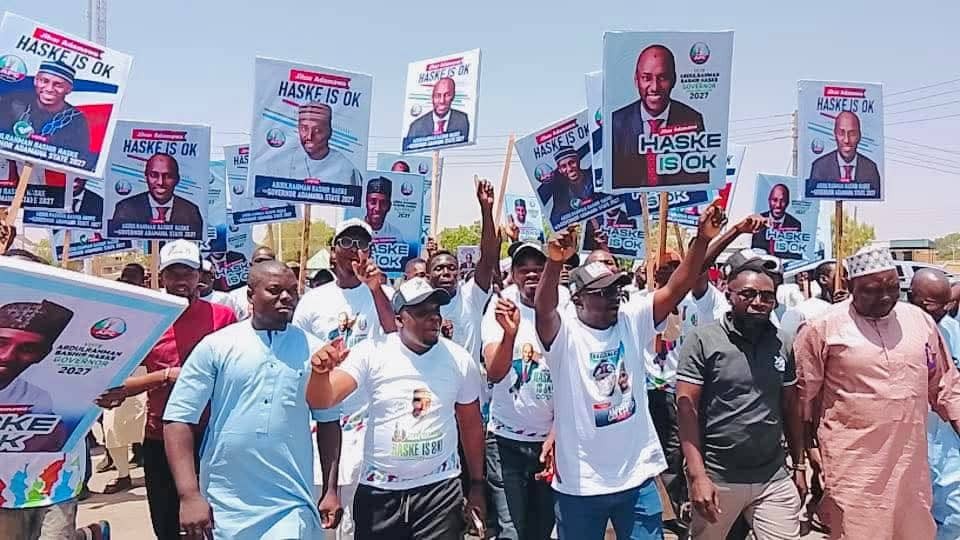
Amid the celebration and political symbolism of the day, one figure whose presence resonated strongly with the crowd was Haske, as his arrival sparked waves of excitement across different sections of the venue with supporters and youth groups erupting into chants that echoed across Ribadu Square.

Placards bearing messages of confidence in his leadership and vision were lifted high as the crowd started chanting household slogans, “Haske is Ok,” which reverberated through the crowd, reflecting a growing grassroots sentiment about his role in the future of Adamawa politics.

Observers say the spontaneous show of support signalled the rising political momentum surrounding Haske among party faithful and the youth demographics.

Widely recognised for his community engagement and youth-driven initiatives through the AB Haske Foundation, Haske has steadily built a reputation for connecting with grassroots communities and championing empowerment programmes that resonate strongly with young population across the state.

For many observers at the event, the energy around Haske underscored the emergence of a new wave of political enthusiasm centered on development-focused leadership, inclusive governance, and stronger grassroots representation.

While the reception primarily celebrated Governor Fintiri’s political realignment, the electrifying reception accorded to Haske added another dimension to the gathering signaling the rising expectations of supporters, who believe Adamawa’s next chapter should be driven by bold ideas, youthful energy, and a clear commitment to sustainable development.

As conversations gradually begin to shape the road toward 2027, the atmosphere at Ribadu Square suggests that the call for a new generation of leadership in Adamawa is growing louder—and the name Abdulrahman Bashir Haske is increasingly becoming part of that conversation.

Meanwhile, speaking at the event on behalf of President Bola Tinubu at the grand reception for Fintiri, Vice President Kashim Shettima said the APC and the Federal Government are proud of Fintiri and pleased to welcome him and his supporters into the party.

The APC National Chairman, Prof. Nentawe Yilwatda, while presenting Fintiri with the party’s flag, said the APC is glad to have him, describing him as a hardworking governor, and urged him to make the party’s flag fly even more vigorously.

The National Chairman, while handing over the APC’s symbolic broom to Fintiri, charged him to bring the remnants of other parties in the state into the APC.

Haske, who applauded the party leadership for strengthening unity and understanding within the part, also expressed his commitment to work with the party leadership towards bringing the dividends of democracy to the good people of Adamawa, as stakeholders consultations and engagements intensify ahead of the 2027 governorship election in the State.

ADVERTISEMENT

Air Peace Refutes Allegations of Tax Suit by Lagos State Government

0
Allen Onyeama of Air Peace

Air Peace Limited has officially addressed recent media publications alleging that its Chairman and Chief Executive Officer, Dr. Allen Ifechukwu Onyema, alongside the Vice Chairman, Mrs. Alice Ojochide Onyema, are the subjects of a tax-related lawsuit initiated by the Lagos State Government.

​In an unequivocal statement, the management of Air Peace clarified that neither the Onyemas nor the airline has received any court summons or official notification regarding the purported legal action. The company expressed deep concern and surprise over claims that such proceedings have been ongoing since February without any formal service or communication being extended to the involved parties.

​The airline maintained that it has consistently fulfilled its civic responsibilities, stating that all personal and corporate tax obligations are fully up to date and in strict compliance with existing laws and regulatory frameworks. Despite this, the management emphasized its willingness to cooperate with authorities should any discrepancies in tax computation arise. The Onyemas and Air Peace remain open to constructive engagement with the Lagos State Government to review and reconcile any potential shortfalls in the interest of transparency, clarity, and the rule of law.

​For years, Dr. and Mrs. Onyema have been recognized for their significant contributions to the advancement of Nigeria’s aviation sector. The airline reiterated that its leadership continues to operate with the same integrity, resilience, and patriotism that have defined its history.

​Air Peace concluded the statement by assuring the public that it remains dedicated to the highest standards of professionalism. The company stated firmly that it will not be distracted by these allegations as it continues its mission to serve the flying public and contribute to the nation’s economic growth.

ADVERTISEMENT

Indigo’s Winning Streak Continues with another SABRE Africa Award

0

Integrated Indigo Limited, one of Nigeria’s leading full-service marketing communications consultancy firms, has once again proved its mettle as an agency to reckon with, not only in Nigeria but also across the continent by winning another award at the 2026 Superior Achievement in Branding, Reputation & Engagement (SABRE) Awards recently held in South Africa.

Indigo won in the Industrial/Manufacturing category for its impactful ‘Women on Wheels’ campaign executed for Lafarge Africa Plc. The award-winning ‘Women on Wheels’ campaign was designed to challenge gender stereotypes and promote inclusivity within the industrial and manufacturing sector, while amplifying Lafarge Africa’s commitment to empowering women through innovative and purpose-driven initiatives.

Last year, the agency emerged as the winner for its effective communication strategy and execution on the Nigerian Breweries Plc Rights Issue.

Commenting on the win, the Managing Director/CEO, Integrated Indigo Limited, Bolaji Abimbola, explained that the success of the campaign was driven by a shared vision between the agency and Lafarge Africa Plc, noting that the win reflects the agency’s long-standing commitment to delivering impactful and purpose-driven campaigns that go beyond traditional communications.

Abimbola added that such recognitions serve as both validation and motivation for the agency to continue pushing boundaries, challenging norms, and delivering innovative solutions that create real value for clients and society at large.

“We are thrilled to receive this recognition for our ‘Women on Wheels’ campaign. This win is a testament to our consistency and dedication to breaking new ground by relentlessly pushing bold ideas, building impactful collaborations, and fostering strong partnerships. We are proud of the impact this campaign has created and grateful to our clients for trusting us to bring this vision to life,” he said.

Abimbola also commended the Integrated Indigo team for their creativity, passion, and resilience, noting that the award reflects the collective effort of a team committed to excellence and innovation.

“I would like to celebrate our incredible team for their commitment and drive. This achievement belongs to every individual who contributed to making this campaign a success. We remain focused on pushing boundaries, delivering value, and continuing to create meaningful impact


As it celebrates this milestone, Integrated Indigo reaffirms its commitment to delivering innovative communication solutions, pushing


The 2026 Africa SABRE Awards shortlist includes more than 120 campaigns, selected from over 500 entries in this year’s competition, which recognises Superior Achievement in Branding, Reputation and Engagement. The campaigns were evaluated by a jury of industry leaders.

ADVERTISEMENT

Access Bank and King’s Trust International Formalise Strategic Partnership to Advance Youth Opportunity across Africa

0
L-R: (Sitting) Roosevelt Ogbonna, Managing Director/CEO, Access Bank Plc, and Will Straw, CBE, CEO, King’s Trust International. (Standing) Aigboje Aig-Imoukhuede, Co-Chair, King’s Trust International Africa Advisory Board and Chairman, Access Holdings Plc; Ofovwe Aig-Imoukhuede, Co-Chair, King’s Trust International Africa Advisory Board; Lagos State Governor, Babajide Sanwo-Olu, and Tom Hartley, Assistant Private Secretary to HM The King, during the signing of partnership agreement between Access Bank and King’s Trust International in London, UK

Access Bank Plc and King’s Trust International (KTI) have formally signed a strategic partnership agreement to expand opportunity, entrepreneurship and sustainable livelihoods for young people across Africa.

The partnership agreement was signed by Roosevelt Ogbonna, Managing Director/Chief Executive Officer, Access Bank Plc, for Access Bank, and Will Straw, CBE, Chief Executive Officer of King’s Trust International, on behalf of KTI.

The signing ceremony was witnessed by senior leaders and representatives from both organisations, alongside distinguished guests including Aigboje Aig‑Imoukhuede, CFR, Co-Chair, King’s Trust International Africa Advisory Board and Chairman, Access Holdings Plc; Ofovwe Aig‑Imoukhuede; Co‑Chair, King’s Trust International Africa Advisory Board, and Lagos State Governor, Babajide Sanwo-Olu.

The partnership brings together King’s Trust International’s expertise in youth development with Access Bank’s pan‑African reach and long‑standing commitment to inclusive and sustainable growth. Through this collaboration, the two organisations will work to equip young people with the skills, confidence and support needed to build successful futures through employment and entrepreneurship.

Under the agreement, Access Bank will support the delivery of King’s Trust International programmes that empower young people across several African countries, helping them gain skills and find pathways into meaningful employment and self-employment.

Speaking at the signing, Will Straw CBE, Chief Executive Officer of King’s Trust International, said: “This partnership with Access Bank reflects a shared commitment to unlocking the potential of young people across Africa. By combining our experience in youth development with Access Bank’s scale and leadership across the continent, we can create meaningful pathways to opportunity and long‑term impact.”

Roosevelt Ogbonna, Managing Director/Chief Executive Officer of Access Bank, added: “At Access Bank, we believe that empowering young people is fundamental to Africa’s sustainable growth. Our partnership with King’s Trust International reinforces our commitment to entrepreneurship, job creation and inclusive development, while enabling us to play a purposeful role in shaping the continent’s future.”

The partnership marks a significant milestone in advancing cross‑sector collaboration to address youth unemployment, foster entrepreneurship and drive inclusive growth across Africa.

ADVERTISEMENT

FY2025: Unilever Nigeria Posts Strong Revenue Growth, Doubles Profit After Tax to N32 Billion.

0

Unilever Nigeria Plc released its audited financial results for the year ended 31st December, 2025, reporting a turnover of N214 billion, which represents 43% increase from the N150 billion turnover recorded in the corresponding period of 2024. Gross profit rose 62% to N90 billion, while Net Profit doubled to N32 billion, up from N15 billion in the same period in 2024.

Speaking on the results, the Managing Director, Tobi Adeniyi, stated, “Our strong full-year performance reflects a business that is sharper, faster, and built to win. This momentum stems from focusing our resources on our power brands such as Knorr, Vaseline, Close Up, Pepsodent, and Rexona. These iconic brands continue to anchor our growth and benefit from structural tailwinds across the categories we operate in. Our disciplined approach reinforces Unilever’s collective intent to build a simpler, sharper organisation with a future ready portfolio and brands that drive desirability at scale.”

He further highlighted how the current business model delivers better value to consumers. He noted, “We have revamped our operations by embedding clarity, accountability and speed into the heart of our operations. We are now better positioned to innovate and serve the millions of Nigerian households who use our products daily. We have strengthened our ‘play to win’ culture, where excellence in innovation and execution is non-negotiable. We are committed to a culture of discipline that relentlessly improves our cost structures and elevates the overall consumer experience.”

With over 100 years of manufacturing heritage in Nigeria, every Unilever product carries a legacy of innovation and trust. Through its portfolio of beloved brands, Unilever restates its commitment to Brighten Everyday Life for All.

ADVERTISEMENT

Nigeria’s Inflation Eases Further in February, but Underlying Price Pressures Persist

0

Nigeria’s inflation rate continued its gradual moderation in February 2026, offering cautious optimism for households and businesses. However, emerging monthly trends indicate that underlying price pressures remain active, raising concerns about the sustainability of the disinflation trajectory.

According to the latest data, headline inflation eased slightly to 15.06% year-on-year, down from 15.10% in January, extending the downward trend observed in recent months. This represents a significant decline from 26.27% recorded in February 2025, largely driven by base effects, tighter monetary conditions, and relative macroeconomic stabilisation.

Despite this annual moderation, month-on-month inflation rose sharply to 2.01%, reversing the contraction of -2.88% recorded in January. This rebound highlights renewed short-term price pressures across the economy.

Food inflation—arguably the most critical component affecting Nigerian households—mirrored this mixed trend. While food inflation slowed significantly to 12.12% year-on-year, down from 26.98% a year earlier, it surged by 4.69% month-on-month, pointing to rising food costs and continued pressure on household budgets.

Core inflation followed a similar pattern, easing to 15.88% year-on-year from 25.66% in February 2025, but increasing to 0.89% month-on-month, compared to -1.69% in the previous month.

Overall, the February inflation data reinforces a narrative of fragile disinflation, driven primarily by statistical base effects rather than a broad-based decline in price levels.

Financial Markets Overview

Money Market
System liquidity remained robust during the week, closing at ₦8.24 trillion, up from ₦6.78 trillion at the start of the week. Key rates, including Open Buy Back (OBB) and Overnight (OVN), remained stable at 22.00% and 22.33%, respectively, reflecting a relatively balanced liquidity environment. Rates are expected to remain at similar levels in the near term.

Treasury Bills Market
The Treasury Bills market recorded mixed activity, influenced by the Primary Market Auction (PMA) and investor sentiment. The Debt Management Office offered ₦1.05 trillion, attracting strong demand with subscriptions reaching ₦3.06 trillion. Stop rates held steady for 91-day bills at 15.95%, while longer tenors declined slightly. Average yields rose marginally to 17.65%, indicating cautious investor positioning.

FGN Bond Market
The Federal Government bond market traded cautiously, with investor activity shaped by inflation data and developments in the fixed income space. Yields remained broadly stable, with average benchmark yield closing at 15.60%. Market sentiment remains subdued amid macroeconomic uncertainties.

Eurobond Market
Nigeria’s Eurobond market experienced volatility driven by geopolitical tensions in the Middle East and global economic indicators. While yields fluctuated during the week, the average benchmark yield declined slightly to 7.12%, reflecting mixed investor sentiment.

Currency Market
The Naira appreciated by 0.90% week-on-week, closing at ₦1,353.90/$ at the Nigerian Foreign Exchange Market window, supported by improved market liquidity and stable inflows.

Equities Market
The Nigerian equities market posted a positive performance, with the NGX All-Share Index rising by 0.69% to close at 201,156.85, while market capitalisation stood at ₦129.1 trillion.

On a weekly basis, the market recorded a 1.39% gain, driven by strong performances in stocks such as JOHNHOLT, BUACEMENT, and PREMPAINTS. However, losses in PRESCO, DAARCOMM, and ETERNA moderated overall gains.

Year-to-date, the market has delivered an impressive 29.27% return, underscoring sustained investor interest despite macroeconomic headwinds.

Outlook

While Nigeria’s inflation outlook shows signs of improvement, the rebound in monthly price indicators suggests that inflationary pressures remain entrenched. This presents a delicate balancing act for monetary authorities, who must weigh the need to support economic growth against the risk of renewed inflation acceleration.

ADVERTISEMENT

Pepsodent deepens awareness on Oral care, takes campaign pan-Nigeria

0
L-R: Marketing Manager, Oral Care, Unilever Nigeria Plc, Elvis Twumasi; Headmistress, Temidire Primary School, Oke-Odo, Alimosho, Moninuola Lawal; Pupil, Temidire Primary School, Oke-Odo, Alimosho, Onoja Glory; Education Secretary, Local Government Education Authority, Alimosho, Dr. Amina Ige; another pupil, Rueben Perfect, and Brand Manager, Pepsodent, Lauretta Amie during the school activation for Pepsodent “Do the Two” campaign

As part of activities to commemorate World Oral Health Day 2026, Pepsodent, a leading voice in oral hygiene advocacy, launched a school activation campaign in select schools across 17 states to promote healthy oral habits among Nigerian children.

The activation campaign was held simultaneously across key cities, including Port Harcourt, Abeokuta, Sagamu, Ibadan, Ondo Town, Awka, Enugu, Abuja, Lagos, Yenagoa, Keffi, Calabar, Uyo, Benin City, among others. The school activation offered an opportunity for the brand to demonstrate the essence of good oral hygiene to the pupils.

World Oral Health Day is celebrated annually every March 20 to empower people with the knowledge, tools, and confidence to secure good oral health, a key indicator of overall health, well-being, and quality of life.

The World Oral Health Day school awareness campaign provided an opportunity to educate and enlighten thousands of schoolchildren about the importance of proper oral hygiene through interactive learning sessions and other engagement activities.

In total, the campaign reached 51 schools nationwide, reinforcing the brand’s commitment to expanding access to oral health education and promoting preventive care practices among children at an early age.

Speaking at the Lagos school awareness campaign held at Temidire Primary School, Oke-Odo, Alimosho, the Brand Manager, Pepsodent, Lauretta Amie, said that the campaign reflects the brand’s long-standing commitment to preventive oral care, particularly among children who are most vulnerable to poor dental habits.

Amie noted that by combining education with interactive learning experiences, the initiative helps children better understand the importance of brushing correctly, reducing sugar intake, and maintaining regular dental check-ups.

She added that Pepsodent remains focused on working with schools, parents, and communities to reinforce these habits, ensuring that the knowledge gained during such campaigns translates into consistent practices both in the classroom and at home.

“At Pepsodent, we understand that maintaining healthy teeth is about more than just brushing once in a while; it is about building consistent, daily habits that protect your smile and overall health. That is why this year’s ‘Do The 2’ campaign is so important. We want families across Nigeria to see brushing twice a day, morning and night, not as a chore, but as a simple, achievable habit that makes a real difference. Beyond the message itself, we are also committed to providing people with the right tools, education, and support so they can take charge of their oral health. Through partnerships, community outreach, and interactive programs, we hope to empower Nigerians to protect their smiles and gain the confidence that comes with good oral hygiene,” she said.

Also speaking, the Education Secretary, Local Government Education Authority, Alimosho Local Government, Dr. Aminat Ige, commended the brand for bringing the initiative to the doorsteps of schools located within the area, maintaining that this alone will raise students’ and parents’ awareness of the significance of oral hygiene habits.

On his own part, the Dental Surgeon, Dr. Abraham Akinbami, extolled the initiative for encouraging behavioural change stating that “It was heartwarming to see that Unilever, through Pepsodent, was taking the initiative to drive oral hygiene habits among young people, rather than older people, who may be more difficult to change at this time”.

In her remarks, the Headteacher, Temidire Primary School, Alimosho Local Government, Moninuola Lawal, expressed gratitude to the management of Unilever Nigeria Plc for the initiative, noting that it will create a ripple effect, empowering children to influence household habits by raising awareness within families and enabling them to live healthy lives.

“Bringing this campaign into our school has been a remarkable experience for both our pupils and staff. Oral health is often overlooked, yet it is crucial to children’s well-being, affecting everything from their confidence to their ability to focus and learn. The interactive sessions, demonstrations, and screenings create lasting impressions that our students can carry home, helping families adopt better oral care habits together. Initiatives like this are exactly what we need to ensure our children grow up with strong, healthy teeth and the knowledge to maintain them for life,” she added.

This school awareness campaign is part of Pepsodent’s ongoing commitment to promoting oral health in Nigeria. Through this initiative, the brand continues to expand its reach, empowering children with the knowledge and habits needed to maintain good oral hygiene and overall well-being.

ADVERTISEMENT

Feature: How the war in Iran is reshaping the world

0
David Ansara

by David Ansara

The war in Iran is a “hinge of history” moment for the world. This is perhaps the most significant geopolitical event since the end of the Cold War in 1989 or the 9/11 terror attacks in 2001 – and its consequences will be just as far-reaching. How will the conflict change regional dynamics in the Middle East and affect the global balance of power?
 

A weakened regime in Tehran

For decades, the world cowered in fear of Iran’s perceived military strength. Even the mighty United States (US) treated Iran with caution, with successive US administrations failing to contain the regime over nearly five decades.
 

The destruction of Iran’s nuclear weapons capabilities, the severe degradation of its military power, and the death of its Supreme Leader, Ayatollah Ali Khamenei, will dramatically alter this dynamic. Without a clear successor, and with many of the top leadership of the Iranian Revolutionary Guard Corps eliminated, Iran remains in a state of interregnum.
 

While many speculate that the Trump administration is aiming for regime change, it is more likely that the US is interested in neutralising the security threat posed by Iran rather than ushering in a new government.
 

That would be nice, but it doesn’t appear to be Donald Trump’s primary goal. He will be reluctant for the US to engage in a long-term occupation of Iran (as it did in Iraq or Afghanistan) which would require the deployment of troops on the ground.
 

Realignment in the Middle East

The Iranians made a strategic blunder by retaliating not only against US and Israeli military positions in the Middle East, but also against civilian targets in neighbouring Gulf States.
 

By launching drone and missile attacks on infrastructure and residential buildings in the United Arab Emirates, Kuwait, Qatar, and Oman – which until now had tried to play a mediating or bystander role – Iran has forced these countries to align with the Americans and the Israelis. Saudi Arabia, a long-time foe, is also mobilising its considerable military resources against Iran.
 

On Thursday, Iranian drones hit an airport in Azerbaijan, injuring civilians mere days after President Ilham Aliyev paid heartfelt tribute to Ali Khamenei after the latter’s demise. The Azerbaijanis are not impressed.
 

Regional hegemon

Iran was the primary sponsor of regional terror proxies – including Hezbollah in Lebanon, the Houthis in Yemen, and Hamas in Gaza – whose stated goal was the destruction of Israel and “Death to America”.
 

However, Israel’s ability to seize control of Iran’s airspace during the Twelve-Day War last June revealed the fragility of Iran’s defensive capabilities. Now, by striking at the head of the octopus, Israel has significantly reduced this threat.
 

This is a remarkable turnaround from 7 October 2023, when Israel suffered its worst attack since the founding of the country in 1948 and found itself surrounded by hostile actors. The so-called “Ring of Fire” encircling the Jewish state has been extinguished and Israel now stands as the dominant power in the Middle East.
 

Not only is Israel regionally dominant, but it has also positioned itself as the most important partner of the US, eclipsing long-time American allies, the United Kingdom and Europe, who have chosen to remain at arm’s length from this conflict.
 

US regains its global supremacy

History teaches us that war is unpredictable, so the US should be careful of premature triumphalism at this moment. However, as things stand, the US actions against Iran have greatly enhanced its position as a global superpower.
 

Iran’s allies, China – which buys 80% of Iran’s oil – and Russia – which supplies most of its weapons – have been reluctant to offer more than rhetorical support for the regime at its moment of great vulnerability.
 

China will be particularly affected, with 12% of its crude oil imports coming from Iran. China is reported to have stored up to 1.39 billion barrels of oil reserves, so it might be able to weather any short-term supply disruptions.
 

However, the attack on Iran – as well as the weakening of the Chavista regime in Venezuela – will surely impact China’s long-term energy security and undermine its technological and military ambitions.
 

Chinese President Xi Jinping’s goal of a forced reunification of Taiwan with the People’s Republic of China by 2027 might have to be put on ice. Xi will be hoping that the US becomes mired in a protracted conflict in the Middle East. Meanwhile, Russia remains bogged down in its own war in Ukraine.
 

BRICS is crumbling

The conflict has also shown up the irrelevance of BRICS as an alternative to the US-led international order. Iran is one of the newer members of BRICS, but its membership has yielded little. At most, BRICS serves as a kind of diplomatic discussion club (akin to the G20) rather than a formal military or strategic alliance.
 

India, one of the founding members of BRICS, has been careful to manage its relationship with the US, despite some recent tensions over tariffs and its buying of Russian oil. India’s Prime Minister Narendra Modi visited Israel last month and has pledged to work towards greater trade and technological co-operation between the two countries.
 

South Africa exposed

Just a couple of months ago, South Africa engaged in joint naval exercises with Iran. Many of those Iranian vessels now lie at the bottom of the sea, destroyed by Israeli and American bombs.
 

It is possible to be non-aligned (as India has shown), but South Africa’s continued support for Iran exposes the fallacy of Pretoria’s impartiality. At the outbreak of the war, South Africa bemoaned the violation of Iran’s sovereignty and co-chaired a meeting of the Hague Group, a motley crew of countries united by their antipathy towards Israel. This did not go unnoticed in Washington (and Jerusalem).
 

Relations between South Africa and the US were already at an all-time low, but the latest conflict will exacerbate these tensions and undermine the potential for a mutually beneficial trade and investment deal between the two countries.
 

It is clear that South Africa’s foreign policy establishment represents the narrow ideological interest of the African National Congress rather than South Africa’s broader national interest.
 

A new world order

John Endres, CEO of the Institute of Race Relations, often refers to the concept of ‘punctuated equilibrium’. Political systems, he says, can remain relatively stable for a prolonged period of time, only to be suddenly – and often violently – disrupted. Thereafter, a new equilibrium is established and the cycle continues.
 

The war in Iran is such an equilibrium-puncturing moment.
 

The world has changed – and is still changing. What follows next will define the global order for many years to come.

ADVERTISEMENT

Oil Gains, Rising Costs: Businesses and Households experience growing Pressures- NECA

0

The Nigeria Employers’ Consultative Association (NECA) has warned that rising global oil prices are translating into increased energy costs in Nigeria, with significant consequences for businesses and households.

The Director-General of NECA, Mr. Adewale-Smatt Oyerinde, in reaction to ongoing tensions in the Middle East and their impact on global oil markets, noted that the current trend is driving up domestic fuel prices and worsening inflationary pressures across the economy.

He stated that the situation reflects a growing paradox, where increases in crude oil prices are pushing up domestic energy costs, placing pressure on businesses and eroding the purchasing power of citizens.

According to him, “What we are witnessing is Nigeria’s oil paradox. Rising crude oil prices are pushing up domestic energy costs, squeezing businesses and worsening the cost of living for citizens.”

He noted that fuel prices have risen sharply in recent days, with petrol exceeding ₦1,300 per litre in some locations and diesel approaching ₦1,800 per litre, reflecting the impact of global oil price movements.

He stressed that energy costs sit at the heart of Nigeria’s economy, and energy is the engine of production and distribution.

“Once fuel prices rise, the effects are immediate and widespread: transport costs increase, food prices rise, and the overall cost of doing business escalates.”

Oyerinde stressed that businesses, particularly in manufacturing, agriculture, and logistics, are already under significant pressure.

“For many firms that rely on diesel for operations, current price levels are becoming increasingly difficult to sustain. Profit margins are shrinking, and businesses are being forced to either pass on costs or scale down operations.”

He further noted that global oil prices have surged amid geopolitical tensions, with Brent crude rising above $110 per barrel, intensifying cost pressures across energy markets.

He clarified that while the Middle East conflict has contributed to the rise in oil prices, the impact is exposing deeper structural weaknesses, underinvestment, weak infrastructure, and inefficiencies in Nigeria’s energy value chain.

“This situation is not only driven by external factors, it is also reflecting ongoing constraints within the energy value chain, including supply inefficiencies and infrastructure limitations.”

He warned that without urgent intervention, the situation could escalate. If this trend continues unchecked, we risk business closures, job losses, and a deeper cost-of-living crisis. Calling for immediate action, he urged the government to stabilise the downstream sector and support vulnerable industries.

“The government must act swiftly to ease supply constraints, stabilise prices, and provide targeted relief to critical sectors, he added.

On the long-term outlook, Oyerinde emphasised the need for structural reforms. Nigeria’s resilience will not be determined by oil prices, but by how effectively we manage them. This is a moment to strengthen institutions, improve transparency, and invest in sustainable energy solutions.

He concluded with a caution that if properly managed, this could strengthen our economy. If not, the gains from rising oil prices will be completely eroded by inflation and economic hardship.

ADVERTISEMENT