























The macroeconomic environment for February 2026 reinforced the view that Nigeria’s macro cycle has turned. Reform transmission is
now visible across prices, policy and activity indicators, with growth stabilising under a tighter but gradually normalising monetary regime.
Inflation extended its disinflation path. Headline CPI eased to 15.10% year-on-year in January 2026 from 15.15% in December 2025,
marking a tenth consecutive monthly decline and the lowest level since November 2020. The move was marginal on the surface, but
directionally important. The drivers were clearer: improved domestic food supply, lower logistics pressure, and exchange rate stability,
compressing imported inflation.
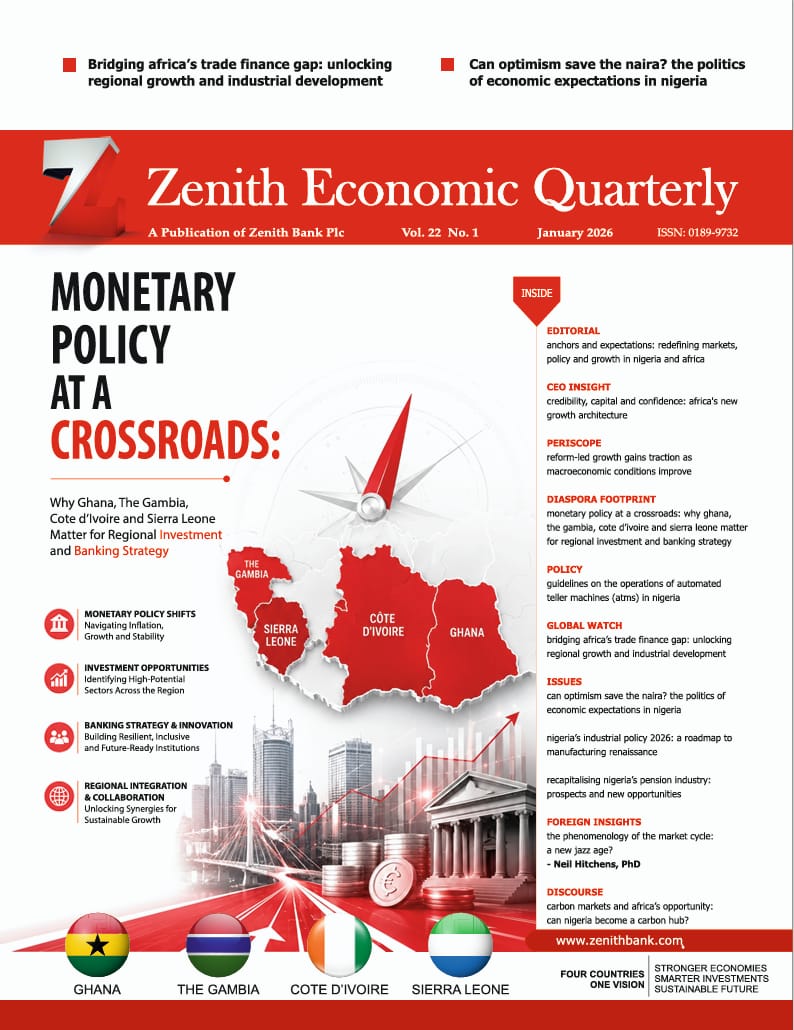 https://www.digital.zenithbank.com/ZEQ/ZEQ-jan-2026/index.html#p=1
Food inflation provided the largest contribution to the slowdown. It fell to 8.89% year-on-year from 10.84% in December and 29.63% a year earlier. On a month-on-month basis, food prices contracted by 6.02%, a deeper deflation than the 0.36% decline recorded in
December. This points to supply-side improvement rather than purely base effects. Given the weight of food in the CPI basket, this shift
materially altered the inflation trajectory and household cost dynamics.
Core inflation, which strips out food and energy, printed at 17.72% year-on-year, down from 18.63% in December and 25.27% in
January 2025. This marked a seventh straight month of easing and the lowest level since October 2022. However, core remains above
headline, indicating that underlying price pressures in services and other non-food components are moderating but not yet neutral.
Disinflation is broadening, but stickiness persists.
On the activity front, business conditions remain expansionary. The CBN’s composite PMI stood at 55.7 in January 2026, marking a 14th
consecutive month above the 50-point threshold. Although down from 57.6 in December, the reading indicates continued growth across
manufacturing, services and agriculture. The moderation suggests a cooling in momentum rather than a reversal, consistent with a
transition from rebound growth to consolidation.
Headline inflation is likely to remain on a downward path in February; however, going forward, the pace may slow if imported inflation
pressures re-emerge amid global commodity price shocks linked to the conflict. Core inflation could flatten or edge higher if cost-push
pressures build in tradable sectors.
Policy in February 2026 followed a cautious, calibrated path. The Monetary Policy Committee (MPC) of the Central Bank of Nigeria
cut the benchmark rate by 50 basis points to 26.5%. The decision reflects confidence that inflation is trending lower while preserving
a restrictive stance to anchor expectations and support currency stability. Real rates remain positive, maintaining monetary
credibility.
Other policy levers remained steady. The MPC maintained the asymmetric corridor at +50/-450 basis points around the MPR
and kept the Cash Reserve Ratio and liquidity ratio unchanged. This signals targeted easing rather than a shift to full
accommodation, balancing the need to contain excess liquidity, especially in the context of potential fiscal expansion or electionrelated spending, while protecting the gains in price stability and banking sector resilience.
Structural reforms continue to reinforce market functioning. The unification of the exchange rate framework, improved transparency in FX allocations, tighter surveillance of speculative activity, and deliberate liquidity management have reduced distortions, enhanced price discovery, and restored credibility to the NAFEX market. These measures, combined with monetary discipline, supported a 4.37% appreciation of the naira in the official market, closing at ₦1,369/$ by month-end.
March introduced external volatility from a new war in the global system. Rising geopolitical tensions triggered heightened demand
for the dollar and elevated risk premia, which created intermittent depreciation pressure on the naira. While domestic FX reforms,
disciplined liquidity management, and targeted CBN interventions provided support, the currency may faced episodic volatility as
global commodity prices, especially oil and key food items, responded to the conflict.
The naira is likely to experience periods of volatility with intermittent pressures from elevated global risk premiums and increased
demand for dollars. The CBN is expected to maintain disciplined FX interventions and liquidity management to contain volatility while
supporting price and exchange rate stability.
The MPC’s stance and FX interventions were designed to contain these pressures while safeguarding the disinflation trajectory.
Overall, March 2026 was expected to be a test of Nigeria’s macro resilience: inflation would likely continue moderating, but at a
slower pace, the naira could experience periods of stress linked to global risk sentiment, and monetary policy would remain cautious,
prioritising stability over aggressive easing.
Nigeria’s Gross Domestic Product (GDP) grew by 4.07% year-onyear in real terms in Q4’25, compared to 3.98% in Q3’25. For the
year ended, Real GDP grew by 3.87%, up from 3.38% in 2024. Nigeria’s economic growth in early 2026 continues on a
stabilising trajectory, reflecting the cumulative effects of policy reforms, structural adjustments, and post-harvest recovery. The Q4
2025 GDP data showed moderate expansion, with non-oil sectors sustaining activity amid volatility in the oil market.
The services sector continues to anchor growth, driven by financial services, telecommunications, and trade, reflecting both robust
domestic demand and recovering consumer confidence. Agriculture shows steady output following the harvest season,
supporting both rural incomes and food supply, which in turn reinforces disinflationary pressures. Industrial activity, including manufacturing, continues to expand, but at a moderated pace, constrained by higher imported input costs and lingering energy
supply challenges.
Oil production remains a volatile factor for GDP, with global price shocks from the March conflict introducing uncertainty. While the
direct fiscal contribution from oil remains significant, revenue volatility could dampen investment and government spending, creating asymmetric growth pressures across the economy.
Non-oil GDP remains the stabilising anchor, supported by structural reforms in the FX market, improved liquidity management, and targeted fiscal measures.
Leading PMI data for January 2026 indicated continued expansion in business activity, with a composite index of 55.7 points. Although slightly lower than December 2025, the reading confirms that the economy is consolidating post-reform, with services and agriculture offsetting the moderation in industrial momentum.
Looking ahead to March 2026, GDP growth is projected to remain positive but slightly tempered by external shocks. The new conflict
has the potential to affect commodity prices, supply chains, and investor sentiment, introducing volatility in both the oil and non-oil
sectors.
Nigeria’s external reserves have strengthened significantly in early 2026, Gross external reserves reached $50.45 billion according
to the governor of the CBN, the highest level in 13 years, up from the $45–46 billion range recorded at the start of the year. This
provides 9.68 months of import cover for goods and services, well above the generally recommended threshold for emerging
markets, reflecting stronger FX inflows and disciplined reserve management.
The reserve accumulation has been supported by sustained oil export receipts, higher diaspora remittances, and effective
interventions in the NAFEX market. Structural reforms, including the unification of exchange rates, enhanced transparency in FX
allocations, and tighter monitoring of speculative activity, have reduced distortions and improved price discovery, allowing the
CBN to deploy reserves efficiently while maintaining naira stability.
The recent outbreak of war in March introduced an external risk factor. Heightened global commodity price volatility and increased
demand for hard currency could generate short-term pressures on the naira, potentially prompting additional FX interventions and
moderating reserve accumulation. Despite these risks, the current reserve position provides Nigeria with substantial flexibility to
absorb external shocks, defend the currency, and support ongoing macroeconomic stability.
For the month of March, foreign reserves, currently around $50 billion, provide a strong buffer, but continued volatility in
commodity markets and capital flows may require active management to prevent drawdowns. If external pressures intensify,
reserves may experience temporary contraction, though the overall buffer remains adequate to support imports and stabilise the
currency.
NGX Market February’s Performance: Powered by Corporate Results, Reinforced by Corporate Actions, Tempered by Profit-Taking
Introduction
NIGERIA MACROECONOMIC & MARKETS REPORT
February extended Nigeria’s 2026 equity bull run with an earnings and dividend-driven surge that lasted through mid-tolate month, followed by profit-taking as the month came to a close.
The Nigerian Exchange’s All Share Index rose by 16.6% in February, significantly surpassing January’s gain of 6.27%. The index concluded the month at 192,826.75 points, up from 165,384.61 points in January.
The main driver was a series of strong full-year 2025 results and positive corporate actions. Major corporates, especially in banking, oil and gas, telecoms, and industrial goods, led the way. These strong earnings boosted investor confidence and sparked a fear of missing out, especially among retail investors who shifted into mid-cap and growth stocks, pushing prices even higher.
On the 9th of February 2026, the National Pension Commission issued an addendum to the Revised Regulation on Investment of Pension Fund Assets, raising the allowable exposure to ordinary shares across key Retirement Savings Account fund categories.
Even before flows fully materialise, markets reprice the existence of a long-duration buyer in value stocks with a good history of
dividend payment. As evidenced by the pension index rising 22.1% for the month.
However, in the final week of February, sentiment shifted as investors began to take profits. This wave of selling, which hit
large-cap stocks like BUA Foods, MTN Nigeria, and Dangote Cement, led to a mild correction. Over N1 trillion was wiped off
the market in a single week, resulting in negative market breadth. This consolidation provided attractive entry prices in
fundamentally healthy stocks.
The Banking Sector
The NGX Banking Index rose by 16.67% to close at 1,892.07 points, driven by a combination of strong 2025 earnings and
high dividend expectations.
Tier-one banks led the charge, with Zenith Bank appreciating by 27.36%, First HoldCo by 19.89%, GTCO and Access Holdings
by 18.18% and 17.26%, respectively. Tier-two lenders like FCMB also benefited from the positive sentiment, going up 25.23%.
The primary undertone for the sector remains the Central Bank of Nigeria’s (CBN) recapitalisation exercise. While banks have
reported strong profitability, investors are cautiously eyeing dividend yields, as the lenders that still have forbearance loans
on their books are expected to curtail their profits to write off these loans.
The Agricultural sector
The Agricultural sector emerged as a standout performer, led by spectacular gains from newly-listed and mid-cap entities. While
new listings captured headlines, the sector’s rally was powerfully underpinned by the stellar performances of palm oil producers
Presco Plc and Okomu Oil Palm Company Plc.
Presco Plc was a major highlight, with its shares crossing the ₦2,000 mark for the first time in history, closing at ₦2,015.00
on 16 February 2026. This rally was fueled by its impressive fullYear 2025 results, which showed a 57.28% jump in pre-tax
profit to ₦178.55 billion, driven by a 59.61% surge in revenue to ₦331.18 billion. The Okomu Oil Palm Company Plc also
delivered robust returns, with its share price surging by approximately 10% on two separate days in mid-February
alone. Investor enthusiasm was driven by its 2025 unaudited results, which revealed a 63.64% year-on-year increase in pretax profit to ₦87.3 billion, supported by a 52.35% rise in revenue to ₦198.1 billion.
Complementing the gains of the sector heavyweights, the star of the show was newly-listed Zichis Agro-Allied Industries Plc. Listed
on the NGX Growth Board in January 2026 at ₦1.81, its shares skyrocketed by over 157% month-to-date in February, breaking into the N10 price. Ellah Lakes Plc experienced a turbulent February. The company’s month was defined by the highly publicised failure of its ambitious ₦235 billion Public Offer announced on the 20th of February; the stock plunged 24.2% in the 3 days that followed. Other agro-allied companies, such as FTN Cocoa Processors, also frequently appeared on the gainers’ list.
The Industrial Goods Sector
The Industrial Goods sector mirrored the broader market’s strength, with the NGX Industrial Index climbing 22.20% to break the 7,000-point barrier for the first time, closing at 7,314.57 points.
The rally was predominantly driven by the heavyweight cement manufacturers. Lafarge Africa (+27.39%), Dangote Cement (+22.68%), and BUA Cement (+19.67%) saw substantial buying interest as investors bet on sustained demand for infrastructure and construction materials. Notably, Lafarge announced plans to add 5.5 metric tonne per annum to its cement processing capacity, which provided a catalyst for further upside with the stock.
The Consumer Goods Sector
The Consumer Goods sector staged a notable recovery in 2025, which supported price gains in February. The NGX Consumer Goods Index increased by 6.51% to 4,370.2 points in the month.
The sector’s advance was led by mid-cap stocks. Nascon Allied Industries (+44.69%), Nestle Nigeria (+43.93%), and PZ Cussons (+28.57%) posted impressive recoveries from prioryear foreign exchange losses, as a stable naira and cooling inflation have helped these companies restore profitability.
The Oil and Gas Sector
The Oil & Gas sector was the star performer in February, leading all other indices with a staggering gain of 33.63%, closing at 4,060.73 points.
The rally was fueled by a combination of strong earnings and positive corporate actions. The upstream companies in the sector were the outperformers. Aradel Holdings surged 38.94%, and Seplat Energy gained 35.82%, while mid-cap Japaul Gold soared 58.20%.
Aradel Holdings released strong full-year 2025 results, posting a 55% jump in profit-after-tax to ₦401.2 billion, driven by successful acquisitions that increased its stakes in ND Western Limited and Renaissance Africa Energy Company. Seplat Energy’s announcement of a bold $ 3 billion, five-year investment plan targeting production growth to over 200,000 boepd by 2030, alongside the fact that its 300 MMcfd ANOH gas project achieved first gas in January, continued to drive its share price in February. Japaul Gold also rallied on the successful delivery and commencement of the test run for its pilot gold processing plant.
The Telecommunication Sector
The Telecoms sector delivered a historic market performance in February, driven almost entirely by the spectacular comeback of
heavyweight, MTN Nigeria Communications Plc. The company staged an impressive turnaround, returning to profitability with
a staggering profit after tax of ₦1.1 trillion for the full year 2025, from the previous year’s loss of ₦400.4 billion. This impressive rebound was fueled by a 55.1% surge in service revenue to ₦5.2 trillion, driven by a 34% increase in data traffic and a growing subscriber base that hit 87.3 million. MTN Group’s acquisition of approximately 76% of IHS Towers also attracted investors’ interest in the Nigerian telecom provider.
Airtel characteristically traded flat for the month largely due to a free float of 2%, as its Nigerian operations showed an impressive 52.1% growth in revenue driven by strong demand for data service, which was supported by tariffs adjustment and a 61.6% growth in operating profit reported on the last trading day of January.
The Insurance Sector
The Insurance sector was the notable laggard in February’s market rally, with the NGX Insurance Index gaining only 2.31%
to close at 1,359.91 points, significantly underperforming other major indices.
The sector was marked by unimpressive full-year 2025 earnings releases in February, which weighed on market performance.
The recapitalisation exercise under the Nigerian Insurance Industry Reform Act 2025 loomed large over February’s activity,
with companies racing to meet the August 2026 deadline with operators such as Universal Insurance Plc and Sunu Assurance
announcing capital raises in February 2026.
Outlook
March is likely to be a consolidation month after February’s fast run-up, marked by rotation to fundamentally sound stocks. The market will continue to digest full-year 2025 financial results and accompanying dividend declarations. with investors rewarding companies that demonstrate strong earnings.
Building directly upon the earnings-driven sentiment is the bank recapitalisation deadline of March 31st, the single most important event for the financial services sector in 2026 and, by extension, the broader market, as compliant banks with a compelling outlook for growth attract investors.
In addition to these domestic factors, escalating geopolitical tensions in the Middle East have had the immediate impact of a surge in crude oil prices, which directly benefits Oil & Gas stocks and boosts government revenues.
However, a prolonged conflict poses significant risks, including imported inflation from higher fuel prices and imported goods, and global economic uncertainty, which could trigger foreign portfolio outflows from emerging markets like Nigeria just as investors seek to lock in February’s gains.
Banking/Financial Services: Strongest domestic theme. Recapitalisation progress (near-full compliance in many cases) strengthens balance sheets, supports lending/growth, and draws investor focus on compliant leaders with compelling post-recap outlooks. Earnings momentum and dividend potential add appeal despite some dilution concerns. Positive near-term, especially as the deadline approaches.
Oil & Gas: Clear beneficiary of the oil repricing. Upstream names (e.g., Aradel, Oando) have shown resilience or gains amid global surges, with upside to revenue/earnings from higher prices. Acts as an inflation/geopolitical hedge, though prolonged conflict could raise domestic costs. Bullish near-term if tensions sustain.
Consumer Goods/Staples: Mixed but selectively resilient. Strong earnings and pricing power help as inflation hedges, though higher fuel/import costs pressure margins. Focus on fundamentally sound names with export potential or resilient demand.
Industrials & Others: Rotation toward value/fundamentals favours industrials tied to infrastructure/domestic activity. Insurance/pension sectors (post-reforms) offer long-term appeal but less immediate March drivers.
The Nigerian equities market in March will be supported by strong 2025 earnings and the conclusion of the bank recapitalisation. However, this support will be continually tested by persistent profit-taking following February’s record rally and the overhang of heightened geopolitical tensions in the Middle East.
Overall, March 2026 looks like a selective, earnings- and event-driven consolidation month rather than broad euphoria. The market stays supported by domestic fundamentals (earnings, recap) and oil tailwinds, but geopolitics add volatility, favouring banking (recap completion) and Oil & Gas (price surge) for relative strength, while rewarding quality over momentum.