







Tag: Uganda

  • ‘You escape, or you die’: African men say Russia duped them into fighting in Ukraine

    ‘You escape, or you die’: African men say Russia duped them into fighting in Ukraine

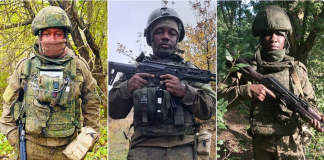
    CNN’s Larry Madowo has uncovered the recruitment tactics involved with enticing African men to fight in Ukraine for the Russian army. CNN reviewed hundreds of chats on messaging apps, military contracts, visas, flights and hotel bookings, as well as gathering first-hand accounts from African fighters in Ukraine and to those who managed to escape back home, to understand just how Russia entices African men to bolster its ranks.  

    Several African governments, including Botswana, Uganda, South Africa and Kenya, have acknowledged the scale of the problem. Local media have detailed how citizens were duped into becoming mercenaries for Russia in Ukraine and officials have warned others against following suit.

    CNN spoke with 12 African fighters still in Ukraine – from Ghana, Nigeria, Kenya and Uganda – who said they were offered civilian jobs such as drivers or security guards. Most said they were promised a signing bonus of $13,000, monthly salaries as high as $3,500, and Russian citizenship at the end of their service.

    But when they landed in Russia, they say they were forced into the military and given little training before being deployed to the front line. They were made to sign military service contracts in Russian without lawyers or translation provided, they said. Some had their passports confiscated, effectively making it impossible to flee.

    In December, someone sent Anne Ndarua a video of her son, Francis Ndung’u Ndarua, warning other Africans not to travel to Russia for any job offers. “You’ll end up being taken to the military even if you’ve never served in the military, and you’re taken to the frontline battle. And there are true killings,” he says in the video, sent from an unknown Kenyan number. “Many friends have died in the name of money.”

    About a week later, a disturbing video of Francis went viral on social media. In uniform, with a land mine strapped to his chest, he appears scared as a Russian speaker, using racist slurs, says he will be used as a “can-opener” to breach Ukrainian army positions.

    Russia’s Defense Ministry and Foreign Ministry did not respond to CNN’s request for comment on allegations that some African recruits were misled or coerced into fighting.  

  • Savannah Energy Provides Unaudited FY 2025 Operational and Financial Update with 12% Increase in Cash Collections in Nigeria

    Savannah Energy Provides Unaudited FY 2025 Operational and Financial Update with 12% Increase in Cash Collections in Nigeria

    Savannah Energy PLC, the British independent energy company focused around the delivery of Projects that Matter, has released its financial and operational update on its Nigerian operations and other markets in Africa, including up-to-date cash collections in its Nigerian business.

    The update shows that its gross production in Nigeria averaged 18.8 Kboepd for FY 2025, of which 83% was gas (FY 2024: 88%). Following the completion of the SIPEC Acquisition in March 2025, it had commenced an 18-month expansion programme that saw it Stubb Creek average gross daily production increase to 3.0 Kbopd in 2025, approximately 13% above the 2024 average.

    The report also shows that its cash collections in Nigeria increased by over 12% to US$278.0 million, compared to the previous year’s US$248.5 million, with the trend continuing into 2026 with cash collections during January 2026 at over US$64.4 million, compared to US$20.4 million in January 2024.

    According to the report, Savannah’s Total Revenues for FY 2025 stood at US$235.0 million, compared to US$258.9 million in FY 2024. As at 31 December 2025, its cash balances stood at US$39.5 million, compared to US$32.6 million in FY 2024, with a net debt US$655.9 million, compared to US$636.9 million as at 31 December 2024. It also reported a Gross debt US$698.4 million as at 31 December 2025, of which only US$39.0 million (6%) was recourse to the Company, with the balance sitting within subsidiary companies on a non-recourse basis. Its Trade Receivables balance as at 31 December 2025 stood at US$507.2 million, a 6% improvement on year-end 2024’s US$538.9 million.

    Savannah also reported that it has made significant progress in refinancing its debt facilities. It reports that  following the previously announced increase in the Accugas debt facility from NGN340 billion to up to approximately NGN772 billion as at 31 December 2025, there was a remaining principal balance under the US$ Facility of approximately US$2 million, which has been repaid in early 2026.

    Savannah also provided new updates on its Uquo NE development well, the Uquo South exploration well, and the new compression system at the Uquo Central Processing Facility (“CPF”). It reports that site construction on the Uquo NE development well is expected to be completed this month, with the rig ready for deployment, and mobilisation scheduled over the next few weeks, with first gas from the facility targeted by the end of Q2 2026. Well site preparation has also commenced on the Uquo South exploration well.

    According to the company, the newly completed and fully commissioned compression system at the Uquo Central Processing Facility which was delivered safely and approximately 10% under the original US$45 million budget, will enable it to maximise production from its existing and future gas wells. It also announced signed a gas contract extension agreement with the Central Horizon Gas Company Limited to end December 2026 for up to 10 MMscfpd.

    On the renewable energy front, Savannah, which had in 2025 repositioned its power sector business model to pursue operating asset opportunities in both the thermal and renewable energy spaces alongside interests in large scale renewable energy development projects, said it has set itself the target of completing its proposed acquisition of indirect interests in three East African hydropower projects by H1 2026. The assets include the 255 MW Bujagali power plant, with a 13-year operating and payment track record, and two advanced-stage development projects, marking Savannah’s potential for entry into five new countries – Uganda, Burundi, the Democratic Republic of the Congo, Malawi and Rwanda.

    It is also continuing to progress its existing priority Power Division projects, including the up to 250 MW Parc Eolien de la Tarka wind farm project in Niger and the up to 95 MW Bini a Warak hybrid hydroelectric and solar project in Cameroon.

    In Niger, its subsidiary is considering commencing a four-well testing programme and/or a return to exploration activity in the R1234 PSC contract area in 2026/27, subject to a satisfactory agreement being reached with the country’s government.

    Andrew Knott, CEO of Savannah Energy, said, “2025 was a year of execution for Savannah with good progress delivered across the nine focus areas we set out at the start of the year. In Nigeria, we increased our rate of cash collections year-on-year by 12%, a trend which we hope to continue into 2026, and have made significant progress in refinancing our debt facilities.

    In our Hydrocarbons Division, the completion of the SIPEC acquisition in March enabled us to commence an expansion programme at Stubb Creek, increasing 2025 production materially above 2024 levels. At Uquo we delivered the new compression system under budget and advanced site construction ahead of the planned commencement of drilling of the new Uquo NE well. During the year, we also announced a 21% 2P Reserves upgrade at the Uquo gas field and a 29% upgrade to Stubb Creek oil field 2P Reserves. In Niger, we remain actively engaged with the Government on future activity, with the R3 East development plan significantly enhanced during the year.

    In the power sector, we repositioned our business model and advanced both operating and development opportunities, including the proposed acquisition of interests in three East African hydropower projects, which is targeted for completion in H1 this year. We have also continued to progress on our wind, solar and hydro portfolio. Alongside this, we continue to pursue further value-accretive acquisitions across both hydrocarbons and power, with several other opportunities under active discussion.

    We also continued to progress our arbitration claims, with the Savannah Chad Inc (“SCI”) and Savannah Midstream Investment Limited (“SMIL”) proceedings currently expected to be concluded in the first half of 2026.

    Overall, this progress provides a strong platform for continued delivery in 2026.”

    Highlights

    Operational

    • FY 2025 average gross daily production of 18.8 Kboepd (FY 2024: 23.1 Kboepd), of which 83% was gas (FY 2024: 88%). Following completion of the SIPEC Acquisition in March 2025, commenced an 18-month expansion programme that saw Stubb Creek average gross daily production increase to 3.0 Kbopd in 2025, approximately 13% above the 2024 average;
    • Well site construction for the Uquo NE development well is expected to be completed this month. The rig is ready for deployment, with mobilisation scheduled over the next few weeks and first gas targeted by the end of Q2 2026;
    • Well site preparation has commenced on the Uquo South exploration well;
    • New compression system at the Uquo Central Processing Facility (“CPF”) completed and fully commissioned. This project, which was delivered safely and approximately 10% under the original US$45 million budget, is expected to allow us to maximise the production from our existing and future gas wells;
    • Gas contract extension agreed with the Central Horizon Gas Company Limited (“CHGC”) to end December 2026 for up to 10 MMscfpd;
    • The proposed acquisition of indirect interests in three East African hydropower projects is targeted to complete in H1 2026. The assets include the 255 MW Bujagali power plant, with a 13-year operating and payment track record, and two advanced-stage development projects, marking Savannah’s potential for entry into five new countries – Uganda, Burundi, the Democratic Republic of the Congo (the “DRC”), Malawi and Rwanda;
    • Continuing to progress our existing priority Power Division projects, including the up to 250 MW Parc Eolien de la Tarka wind farm project in Niger and the up to 95 MW Bini a Warak hybrid hydroelectric and solar project in Cameroon;
    • Subject to a satisfactory agreement being reached with the Government of Niger, our subsidiary is considering commencing a four-well testing programme and/or a return to exploration activity in the R1234 PSC contract area in 2026/27; and
    • Actively reviewing opportunities in both the thermal and renewable power sector, with the expectation of announcing transaction(s) currently under consideration over the course of the next 24 months in the African power space.

    Financial (unaudited)

    • FY 2025 cash collections increased by over 12% on the prior year to US$278.0 million (FY 2024: US$248.5 million) and this trend has continued into 2026 with cash collections during January 2026 of over US$64.4 million (January 2024: US$20.4 million);
    • FY 2025 Total Revenues of US$235.0 million (FY 2024: US$258.9 million);
    • As at 31 December 2025, cash balances were US$39.5 million (31 December 2024: US$32.6 million) and net debt stood at US$655.9 million (31 December 2024: US$636.9 million). Gross debt as at 31 December 2025 was US$698.4 million, of which only US$39.0 million (6%) was recourse to the Company, with the balance sitting within subsidiary companies on a non-recourse basis;
    • The Trade Receivables balance as at 31 December 2025 was US$507.2 million, a 6% improvement on year-end 2024 (31 December 2024: US$538.9 million); and
    • Following the previously announced increase in the Accugas debt facility from NGN340 billion to up to approximately NGN772 billion (the “Transitional Facility”), as at 31 December 2025, there was a remaining principal balance under the US$ Facility of approximately US$2 million, which has been repaid in early 2026.

  • AfDB Approves New Program to Help African Countries Turn Energy Promises into Power for Millions

    AfDB Approves New Program to Help African Countries Turn Energy Promises into Power for Millions

    The new project, known as AESTAP Mission 300 Phase II, will provide direct technical support to 13 Mission 300 countries over the next 24 months

    The Board of Directors of the African Development Bank (AfDB) has approved a new USD 3.9 million, two-year technical assistance project to support African countries in the implementation of their National Energy Compacts into action under Mission 300, the AfDB–World Bank initiative to connect 300 million Africans to electricity by 2030.

    Energy Compacts are national plans in which governments set out how they will expand electricity access, strengthen their power sectors, and attract investment. Over the past year, dozens of African countries have launched these compacts, backed by strong political commitments and pledges from development partners.

    The new project, known as AESTAP Mission 300 Phase II, will provide direct technical support to 13 Mission 300 countries over the next 24 months, enabling them to move from documented energy plans to actual electricity connections for homes, schools, hospitals, and businesses. The benefiting countries are Chad, Gabon, Tanzania, Mauritania, DRC, Kenya, Nigeria, Madagascar, Ethiopia, Malawi, Lesotho, Namibia, and Uganda.

    In practical terms, AESTAP Mission 300 Phase II will:

    • Help governments improve electricity regulations, planning, and tariffs so investments can move forward.
    • Strengthen utilities so they can deliver more reliable power and reduce losses.
    • Support better data, research, and learning across countries through tools like the Electricity Regulatory Index and regional energy forums.
    • Place expert advisers inside national Compact Delivery and Monitoring Units to help governments coordinate reforms and track progress.

    Wale Shonibare, Director of Energy Financial Solutions, Policy and Regulation at the AfDB, said, “Countries have made bold commitments through their energy compacts. Now, through AESTAP Mission 300 Phase II, we are helping them implement those commitments so that more households, entrepreneurs, and communities actually get electricity.

    The new project follows the approval of AESTAP Mission 300 Phase I in December 2025, which provided about USD 1 million to help countries set up and run their Compact Delivery and Monitoring Units (CDMUs). These units sit inside governments and are responsible for coordinating energy reforms across ministries and tracking progress.

    Phase I focused on creating and strengthening these delivery teams – training staff, setting up monitoring tools, and helping countries plan their next steps. Phase II will build on this by providing the technical support needed to implement planned reforms. The project will be implemented in coordination with other Mission 300 partners, including the World Bank, governments, and development organizations, to ensure a coordinated effort.

  • Trump Administration Announces Historic Progress on America First Global Health Strategy

    Trump Administration Announces Historic Progress on America First Global Health Strategy

    Today, the Trump Administration announced a series of landmark bilateral Memorandums of Understanding (MOUs) with nine partner nations, marking a historic milestone in the implementation of the America First Global Health Strategy.

    In just three months, the Administration has moved with unprecedented speed to secure agreements that protect American interests, save millions of lives, and transition recipient nations toward permanent self-reliance. To date, these MOUs represent more than $8 billion in direct U.S. investment, matched by over $5 billion in co-investment from partner countries.

    “These MOUs are proof positive that President Trump’s leadership is making America safer, stronger, and more prosperous,” the Administration stated. “By fixing inefficiencies and reducing dependency, we are ensuring that every American tax dollar delivers real results while helping our partners stand on their own two feet.”

    A New Era of Strategic Partnership

    The America First Global Health Strategy, launched on September 18, 2025, prioritises bilateral agreements that shift health responsibilities from non-governmental organisations (NGOs) to national systems. The strategy emphasizes private sector mobilization, the inclusion of faith-based organizations, and mandatory co-investment from recipient countries.

    Key Bilateral Highlights:

    • Nigeria ($5.1 Billion total): A massive joint investment ($2.1B U.S. / $3B Nigeria) to reinforce national leadership of health systems and provide critical support to over 900 faith-based clinics and hospitals.
    • Kenya ($2.5 Billion total): A strategic shift to national systems, reducing NGO reliance and modernizing commodity procurement for long-term self-sufficiency.
    • Uganda ($2.3 Billion total): A focused investment in HIV/AIDS, TB, and malaria combat, featuring a $500 million pledge from Uganda and specialized support for the Ugandan military and faith-based providers.
    • Mozambique: Features a 30% increase in domestic health expenditures by Mozambique and the deployment of American-made cutting-edge solutions like lenacapavir.
    • Rwanda ($228 Million total): A high-tech partnership leveraging American robotics (Zipline) and AI to modernize infrastructure, with Rwanda set to take full control of its HIV/AIDS response by year four.
    • Cameroon, Lesotho, Eswatini, and Liberia: These agreements collectively drive hundreds of millions into frontline commodities, American-made medical technology, and the transition of health workers to local government payrolls.

    Core Pillars of the MOUs

    Unlike previous open-ended assistance programs, these MOUs have a maximum duration of five years with no future commitment of U.S. assistance beyond the agreement period. Every MOU is built on five innovative pillars:

    1. Commodity Transition: Gradual transfer of procurement responsibilities to partner governments.
    2. Frontline Worker Sustainability: Mapping U.S.-funded workers to national cadres and transitioning them to partner payrolls.
    3. Data Integrity: Scaling interoperable digital tools to track disease outbreaks and programmatic data.
    4. Domestic Co-Investment: Required increases in domestic health expenditures by partner nations.
    5. Performance Incentives: U.S. financial support is strictly linked to meeting or exceeding key health metrics.

    The United States expects to sign additional MOUs in the coming weeks as more nations align with the America First framework.

  • How faith is powering African music’s next big wave

    How faith is powering African music’s next big wave

    While genres like Afrobeats and Amapiano have long held the cultural spotlight in Africa, a spiritual and commercial revolution is fiercely challenging their territory. Gospel is now achieving equal attention, filling venues, and climbing streaming charts across Sub-Saharan Africa (SSA), signalling its arrival as a major continental force.

    The numbers behind the takeover

    Confirming this spiritual surge, Spotify 2025 Wrapped data reveals Sub-Saharan Africa’s Gospel streams jumped by 50% year-on-year (2024 – 2025), marking a huge 3480% growth since 2020. This rise was most pronounced in key markets: Nigeria registered an 88% growth in Gospel listening; South Africa saw growth at 42%; Ghana achieved an increase of 36%; and Kenya registered a 30% rise. The countries driving the most plays overall are South Africa, Nigeria, Kenya, Ghana, and Angola.

    The genre’s rising influence is clearly reflected in overall genre rankings, proving it now plays alongside the biggest commercial genres. Gospel music was ranked as the 4th most-streamed genre in South Africa, 7th in Ghana, 9th in Kenya, and 10th in Nigeria. Additionally, its role as a key soundtrack to the daily routine is clear, with Gospel performing strongly in commuting hour music data, holding the 2nd rank in Nigeria, where heavy traffic is common, and the 4th rank in Ghana.

    This role is further underscored by its prominence on the Words on Playlists Chart, where Gospel ranks highly across key markets, holding the 3rd position in Nigeria, the 2nd position in Ghana, and the 3rd position in Kenya and South Africa respectively

    Chart architects and tracks

    Driving this streaming success is a mix of African and international Gospel artists. The top 10 most streamed Gospel artists in SSA feature African stars like Nathaniel BasseyLawrence OyorDunsin OyekanMoses Bliss, and Sunmisola Agbebi (Nigeria); Spirit of Praise and Joyous Celebration (South Africa), who share the spotlight with international groups such as Hillsong Worship (Australia), Maverick City Music (United States), and Elevation Worship (United States). These artists and groups are fronting a list of deeply resonant and popular tracks. 

    The top five most streamed Gospel songs in SSA showcase a blend of solo and collaborative power: the list is headed by Lawrence Oyor’s Favour and includes We will be many by Sound of Salem, Lawrence Oyor, and Moses Akoh, Gaise Baba and Lawrence Oyor’s No Turning Back II, Nontokozo Mkhize’s Esandleni, and Promise Keeper by Pst. Oche Ogebe and Sound Of Salem.

    Arena worship: The live show effect

    This transformation is driven by several factors that are taking Gospel music from traditional settings into the mainstream spotlight. The sheer scale of live events has turned the Gospel genre into an arena-sized spectacle across Africa. 

    In Nigeria, gatherings like The Experience concert remain a monumental fixture, consistently drawing vast numbers and generating global buzz that makes it one of the largest faith-based concerts in the world. This trend is mirrored in South Africa, where groups like Joyous Celebration operate as cultural tastemakers, continually setting the industry standard with massive live tours and annual recordings. 

    Similarly, collectives like the Spirit of Praise, with their Spirit of Praise 11 Tour create major event moments essential for platforming established stars alongside emerging talent. High-profile events like Nigerian artist Moses Bliss’s Grace Encounter: A Night of Worship and Miracles in Kenya generate significant social media buzz, showcasing the seamless movement of influence and artistry across African borders, effectively turning concerts into vital continental moments.

    Virality & global reach

    The power of social media has proven vital, instantly turning Gospel songs into viral phenomena. The music is shareable; two gospel-driven tracks, Lawrence Oyor’s Favour and Gaise Baba & Lawrence Oyor’s No Turning Back II ranked among the top five most shared songs in Nigeria.

    The Hallelujah Challenge by Nathaniel Bassey is another viral moment that demonstrated the immense power of digital communal worship, establishing a precedent for massive, spontaneous online gatherings.

    Global validation: The new influence

    The African Gospel scene is receiving validation from international collaborations and visits. In August 2025, Grammy-winning icon CeCe Winans visited Africa as part of her #MoreThanThisWorldTour, with stops in South Africa, Zimbabwe, Uganda, and Kenya, signalling the region’s importance to global gospel artists.

    African Gospel music has proven that profound faith offers a spiritual anchor that keeps millions grounded, whilst achieving undeniable commercial and cultural success.

  • Malaria and rising child mortality put African health at a crossroads

    Malaria and rising child mortality put African health at a crossroads

    A 20% decrease in health funding could lead to 12 million more children dying by 2045

    The latest WHO World Malaria Report 2025 highlights a critical reality: malaria remains one of Africa’s most pressing health challenges. With an estimated 282 million cases and approximately 610,000 deaths globally in 2024, the African Region continues to account for most of the burden, particularly among children under five. 
    
    Five countries; namely Nigeria, Democratic Republic of Congo, Ethiopia, Mozambique, and Uganda contribute more than half of all global cases.

    
    According to the 2025 Goalkeepers report, in 2024, 4.6 million children died before their fifth birthday. In 2025, that number is projected to rise for the first time this century, by over 200,000, to an estimated 4.8 million children. That means more than 5,000 classrooms of children, gone before they ever learn to write their name or tie their shoes.

    
    “Across Africa, we lose children every day to a disease we understand and know how to prevent. Each of those losses is a profound tragedy, not just for a family, but for communities and economies too. What makes it even more heartbreaking is that malaria is a problem we can solve. Our responsibility now is to scale up those solutions, innovate responsibly, and make sure no child’s life is cut short by any preventable disease,” said Krystal Birungi, Ugandan scientist and malaria advocate.
    

    WHO’s World Malaria Report 2025 highlights growing antimalarial drug resistance in Africa and the urgent need for complementary strategies. Progress in diagnostics, surveillance, vaccination, vector control, treatment delivery, and community-driven engagement will be key to achieving lasting gains.
    

    In Uganda, malaria continues to exact a heavy toll, there was an estimated 13.6 million cases and over 16,204 estimated deaths. Despite strides in prevention and treatment, progress against malaria mortality remains uneven, with incidence and deaths concentrated in high-transmission districts. Neighbouring countries across East and West Africa face similar challenges, driven by drug resistance, climate pressures, humanitarian crises and gaps in access to interventions.


    A roadmap to change
    

    The Goalkeepers Report outlines a clear path forward at a time when global health systems are strained and progress is slipping. For the first time this century, child deaths are set to rise; a 20% decrease in health funding could result in 12 million more children dying by 2045.
    

    The most impactful actions over the next decade include:
    

    • Strengthening primary health systems so frontline workers can diagnose and treat malaria quickly and consistently.
    • Scaling up proven tools, including malaria vaccines, insecticide-treated nets, rapid diagnostics, and timely treatment.
    • Investing in next-generation solutions, from improved vector control tools to responsibly developed genetic innovations that can complement existing measures.
    • Supporting local scientific leadership, ensuring African researchers and institutions drive the development and implementation of future tools.
    • Integrating community voices, recognising that trust and understanding are critical for the success of any intervention.
      

    The research and development of emerging tools like gene drive for vector control require not only scientific rigour but also clear, accessible and timely engagement and communication,” said Naima Sykes, Director of Global Stakeholder Engagement for Target Malaria at Imperial College London. 

    
    “Communities and stakeholders want to understand how these technologies work, how they are developed, and how they, as people who are potentially impacted by this research, are involved in their development. Researchers, in turn, need to be open to understanding and considering the perspectives of these groups. When information flows both ways, is transparent and locally grounded, trust grows. Trust is essential for progress. Our role is to equip stakeholders with the knowledge they need to engage confidently with the science, while actively listening to what we can learn from them, too.”
    
    She added that in an era of rising misinformation, communication becomes a public health intervention in itself. “When facts are clear, and people feel included, they are empowered to act. That is how we, as Africans, can build a sustainable future where malaria no longer steals the lives of our children.”
    

    Birungi stressed that Africa stands at a critical point. “The recent numbers are not just data, they represent lives, futures, and entire generations of potential. The continent faces a choice: continue on a trajectory where preventable diseases claim millions of young lives, or commit to scaling up proven tools, investing in science, and strengthening health systems that protect families.”
    

    A path forward exists. It is grounded in evidence, driven by African expertise, and supported by innovation and community partnership. With decisive action, the next decade can mark a turning point – one where every child in Africa has the chance not just to survive, but to thrive.

  • Regional Leaders Highlight Role of Standards Harmonisation in Unlocking Africa’s Agricultural Export Potential

    Regional Leaders Highlight Role of Standards Harmonisation in Unlocking Africa’s Agricultural Export Potential

    Policymakers, regulators, agribusiness leaders and development partners from across East and Southern Africa have concluded a two-day high-level engagement focused on how improved cooperation on standards can boost Africa’s export competitiveness. The event, “Beyond Tariffs: How Standards and Regulations Shape Agribusiness Competitiveness,” held from December 10–11 in Nairobi, spotlighted the growing importance of sanitary, phytosanitary and technical standards in shaping trade outcomes for African agricultural products.

    Convened by the World Trade Organization (WTO) Secretariat in partnership with the Bill & Melinda Gates Foundation and the Government of Kenya, the gathering brought together about 100 participants, including standard-setting bodies, MSMEs, international organizations and regional development institutions.

    The sessions underscored that while tariffs still dominate public conversations around trade, non-tariff measures — particularly health, safety and technical standards — now play an even bigger role in determining market access for African exporters.

    WTO Director-General, Dr. Ngozi Okonjo-Iweala, in her virtual opening remarks, stressed that “standards and regulations increasingly decide who gets to compete and who is left behind.” She noted that for micro, small and medium-sized enterprises across developing countries, the ability to meet evolving global requirements can determine whether they thrive or lose markets overnight.

    Kenya’s Cabinet Secretary for Investments, Trade and Industry, Hon. Lee Kinyanjui, delivered the keynote address, calling on African governments and private sector players to view standards not as barriers but as strategic tools. “Our task is to harmonize these measures, strengthen our trade capacity and ensure that our producers, especially SMEs, are equipped to meet them,” he said. He added that enabling exporters to anticipate and adapt to new requirements is critical for Africa’s participation in global value chains.

    A major highlight was the launch of a new Standards and Trade Development Facility (STDF) project to expand the use of the ePing SPS & TBT Platform across Kenya, Namibia, South Africa, Tanzania and Uganda. The initiative will support farmers, exporters and regulators with improved technology tools and capacity-building programmes to better track regulatory changes and respond effectively.

    Dr. Okonjo-Iweala noted that the project aligns with commitments made by WTO members at the 13th Ministerial Conference to support countries most affected by regulatory challenges, adding that Africa must position itself to meet global standards while shaping them as emerging leaders in international markets.

    Panels and thematic discussions throughout the event examined how standards affect key agricultural value chains such as horticulture, coffee, tea, livestock and fisheries. Stakeholders also explored how regional and international regulatory frameworks — including the African Continental Free Trade Area (AfCFTA) — can be better aligned to reduce technical barriers and enhance export readiness.

    Participants agreed that improved standards convergence, stronger quality infrastructure and increased private-sector awareness will be essential for boosting Africa’s agricultural exports, creating jobs and ensuring inclusive economic growth.

    The event was co-organized by the Gates Foundation and the WTO Secretariat, in collaboration with the Government of Kenya, the Standards and Trade Development Facility (STDF) and the International Trade Centre (ITC).

  • With Child Deaths Projected to Rise for the First Time This Century, Gates Foundation Urges Global Leaders to Target Scarce Resources Where They Save the Most Lives

    With Child Deaths Projected to Rise for the First Time This Century, Gates Foundation Urges Global Leaders to Target Scarce Resources Where They Save the Most Lives

    …New Goalkeepers Report models impact of global health funding cuts, offers roadmap of best buys and most effective investments to slow this reversal

    The number of children dying before their 5th birthday is projected to rise for the first time this century, reversing decades of global progress, according to new data published today in the Gates Foundation’s 2025 Goalkeepers Report.

    In 2024, 4.6 million children died before their 5th birthday. According to modeling in the report, conducted by the Institute for Health Metrics and Evaluation (IHME), that number is projected to rise by just over 200,000—to an estimated 4.8 million children this year. At the same time, global development assistance for health fell sharply this year—26.9% below 2024 levels.

    Beyond this year’s drastic funding cuts, countries face mounting debt, fragile health systems, and the risk of losing hard-won gains against diseases like malaria, HIV, and polio.

    The report, We Can’t Stop at Almost, warns that if global health funding cuts persist, up to 16 million more children could die by 2045. It offers a roadmap for how targeted investments in proven solutions and next-generation innovations can save millions of children’s lives, preventing a reversal in progress in today’s constrained budget environment.

    “I wish we were in a position to do more with more because it’s what the world’s children deserve. But even in a time of tight budgets, we can make a big difference,” writes Bill Gates, chair of the Gates Foundation and the report’s author. “I’ll continue to advocate however and wherever I can for increased funding for the health of the world’s children—and for efficiencies that improve our current system. But with millions of lives on the line, we have to do more with less, now.”

    A Critical Turning Point

    Projections by the IHME show that if global health funding cuts of 20% persist, an additional 12 million children could die by 2045. A 30% permanent cut would bring that toll to 16 million.

    Gates describes this moment as a turning point for global health, when the right choices can still save millions of lives.

    “We could be the generation who had access to the most advanced science and innovation in human history—but couldn’t get the funding together to ensure it saved lives,” Gates writes. “By making the right priorities and commitments, and investing in high-impact solutions, I’m confident we can stop a significant reversal in child deaths and help ensure millions more children are alive in 2045.”

    In the report, Gates identifies investments with the greatest potential to save millions of young lives. He calls for doubling down on the most effective interventions—primary health care, routine immunizations, better vaccines, and new uses of data—to stretch every dollar. For example:

    For less than $100 per person per year, strong primary health care systems can prevent up to 90% of child deaths.
    Every $1 spent on vaccines returns $54 in economic and social benefits. Through Gavi, the Vaccine Alliance, more than 1.2 billion children have received lifesaving vaccines since 2000.

    The work of the Global Fund to Fight AIDS, Tuberculosis and Malaria is also evidence of what sustained investment can achieve. As one of the most effective engines in health, the Global Fund has saved 70 million lives and reduced deaths from malaria, TB, and HIV by more than 60% since 2002. Late last month, leaders pledged $11.34 billion to the Global Fund’s Eighth Replenishment, underscoring continued global commitment to fighting these diseases while laying bare the risks of stepping back.

    According to Gates, investment in the development of next-generation innovations could end some of the deadliest threats to children, such as malaria and pneumonia, for good. Modeling in the report projects that sustained funding in these innovations could save millions of children by 2045.

    Next-generation vaccines for respiratory syncytial virus and pneumonia could save 3.4 million children.
    New malaria tools could save another 5.7 million children, while long-acting HIV prevention tools like lenacapavir could help drive infections and deaths toward zero in high-burden countries.

    Local Leadership, Global Action
    The report also features essays with firsthand perspectives from leaders, health workers, and researchers in Africa and Asia who are advancing solutions to sustain progress:

    In Nigeria, Muhammad Inuwa Yahaya, governor of Gombe State, prioritized primary health and education amid a budget deficit. “You don’t need perfect conditions to make progress. You need clarity, and the courage to stick to it.”

    In Kenya, community health worker, Josephine Barasa continued volunteering in her community after losing her paid position, providing care and education to mothers and children. “They could take away the money, but they couldn’t take me away from my women… The support systems may have disappeared, but the need has not. And neither have I.”

    In Uganda, entomologist, Krystal Mwesiga Birungi is developing next-generation tools to combat malaria. “Ending malaria is not only possible, but it is also urgent,” she said. “We African researchers know this—and we are leading the way.”

    In India, Dr. Naveen Thacker, a pediatrician, underscored the importance of affordable and accessible vaccines. “If we want to see more healthy children, affordability of vaccines is key.”

    Gates implores governments, philanthropies, and citizens to act on the report’s findings by safeguarding or expanding funding, increasing philanthropic giving, and reminding leaders that every child deserves the chance to survive and thrive, no matter where they are born.

    “We can’t stop at almost,” Gates writes. “If we do more with less now—and get back to a world where there are more resources to devote to children’s health—then in 20 years we’ll be able to tell a different kind of story: how we helped more kids survive childbirth—and childhood.”

  • Scotland London Africa Week 2025 Celebrates Exceptional Engagement, Real Business and Strong Momentum for United Kingdom (UK)-Africa Trade

    Scotland London Africa Week 2025 Celebrates Exceptional Engagement, Real Business and Strong Momentum for United Kingdom (UK)-Africa Trade

    The week opened at Old Admiralty House with a strategic briefing from the Department for Business and Trade’s Africa team

    Scotland London Africa Week 2025 has concluded with outstanding feedback from delegates who described the programme as energising, insightful and productive. Across the week leaders from Scotland, London and Africa came together for high-level engagement, practical discussion and fresh opportunities for collaboration.

    The week opened at Old Admiralty House with a strategic briefing from the Department for Business and Trade’s Africa team. Delegates were introduced to the UK Government’s 10-year industrial strategy and its eight growth sectors before the conversation explored the UK’s approach to trade agreements in areas linked to skills and planning reform and how the department works with international partners while keeping a clear focus on priority opportunities.

    Officials highlighted the 130 projects delivered through the Ricardo Fund and shared updates on the UK’s Critical Minerals Strategy, the ETIP in Nigeria and the SACUM tariff review. Ben Ainsley delivered an in-depth overview of major African markets while noting that Africa, home to 30% of the world’s population by 2050, is rapidly shaping global economic trends. His briefing covered Egypt, South Africa, Uganda, Ethiopia, Cote d’Ivoire, Senegal, Ghana, Kenya, Morocco and Nigeria.

    A lively roundtable followed, with delegates raising questions on finance, clean energy, supply chain requirements and food security before continuing to Marlborough House for a meeting with the South African Chamber of Commerce UK and some of its members, kindly hosted by the Commonwealth Secretariat. Our delegates learned that South Africa remains the UK’s largest trading partner in Africa with trade ties going beyond goods and aligning with many sectors Scottish businesses are active in.  The day ended with an informal dinner that encouraged open conversation and new introductions between our own delegates.

    The following day began at the Egyptian Bureau for Cultural & Educational Affairs where Minister Plenipotentiary, Wael Abdelraheem and the Egyptian British Chamber of Commerce shared detailed insight on Egypt’s trade and investment landscape. Delegates then received practical guidance on international trade documentation and visa requirements before being welcomed by the National Bank of Egypt UK for a networking lunch.

    The afternoon moved to the Embassy of Ethiopia where the Ambassador hosted the group for an exceptional traditional Ethiopian coffee ceremony followed by a comprehensive briefing on opportunities across Ethiopia’s rapidly developing economy.  With a population of over 120 million people and a labour-rich workforce, Ethiopia is actively opening up multiple sectors for growth and foreign investment.  Key opportunities highlighted include agribusiness and agro-processing, from large-scale crop production to value addition through processing of dairy, meat, cereals and packaging. The government’s push to build integrated agro-industrial parks creates space for investment in machinery, processing equipment, cold-storage and supply-chain infrastructure.

    The evening brought one of the week’s highlights as delegates were welcomed to Dover House by kind permission of the Secretary of State for Scotland The Rt Hon Douglas Alexander MP. More than 60 dignitaries, industry leaders and businesses from Scotland, London and Africa attended. Anna Macmillan from the Scotland Office delivered the keynote, with Ebury and Diageo as generous event partners. Diageo served a selection of outstanding whisky cocktails and Ebury spoke about the importance of global trade to business resilience and growth.

    The final day was held at Scotland House for the Scotland-Africa Women in Business event with speakers from across the globe and the Women in Trade Hub. Delegates and guests took part in an animated discussion on the Scottish Government’s Gender Export Gap and shared ideas on how to accelerate women’s international trade ambitions.

    Frazer Lang, CEO of the Scottish Africa Business Association, said:

    “This year’s Scotland London Africa Week has delivered a real sense of purpose and progress. The depth of engagement from partners across government and industry has been outstanding and the enthusiasm from our delegates shows just how much potential there is for Scotland and Africa to grow together. We are proud to support that journey and delighted with the momentum created throughout the week.”

    Seona Shand, COO of the Scottish Africa Business Association, added:

    “The discussions this week were refreshing, honest and ambitious. From market insights to the inspiring energy of our Women in Business event, delegates left motivated and better connected. It is clear that Scotland’s expertise aligns strongly with the priorities of many African markets and there is real appetite on all sides to build practical, long-term partnerships.”

    Scotland London Africa Week 2025 demonstrated the powerful impact of direct engagement, shared knowledge and international collaboration. With enthusiastic participation from every sector, the week showcased Scotland’s commitment to deepening its economic ties with African markets and highlighted the valuable role of SABA in driving these connections forward.

  • Carbon Markets Africa Summit to unlock billions in climate finance for the continent

    Carbon Markets Africa Summit to unlock billions in climate finance for the continent

    The carbon economy is global, but its solutions are local

     Africa’s vast natural resources hold enormous potential to drive climate action and sustainable growth, but turning that potential into investment requires collaboration, integrity and readiness. From 21 to 23 October, the Carbon Markets Africa Summit (CMAS) in Johannesburg will bring together over 280 policymakers, investors and project developers from 40 countries to accelerate the continent’s participation in high-integrity carbon markets.

    Hosted by the United Nations Development Programme (UNDP), with AUDA-NEPAD as strategic institutional partner and One Carbon World as official climate impact partner, CMAS marks the first continental event dedicated to unlocking Africa’s carbon value through integrity, investment and impact.

    “Carbon markets can unlock billions in finance for the continent,” says Maxwell Gomera, Resident Representative of UNDP South Africa and Director of the Africa Sustainable Finance Hub. “With the right partnerships and governance, Africa can convert its natural wealth into climate-resilient growth and jobs.”

    For Madeleine Garlick, Africa Director at One Carbon World, partnerships are key: “African innovators are leading the market now, but with collaboration, we can achieve the scale needed to ensure it delivers for everybody.”

    Turning ambition into action
    The summit’s theme of collaboration is reflected in its sponsors: TASC, an award-winning developer of high-impact carbon projects, is the diamond sponsor, joined by FSD Africa, SGS, and Trees for the Future as gold sponsors, and GIZ and Carbon Coin as silver sponsors.

    “Our projects are having a monumental impact at a grassroots level—all this enabled through carbon finance,” says Shelley Estcourt, CEO Africa at TASC. Francesca Cerchia, Global Head of Climate Solutions at SGS, adds: “We need to make sure Africa is at the centre of voluntary carbon market development.”

    Meanwhile, Tim McLennan, CEO of Trees for the Future, notes: “Farmers are the most vulnerable to climate change; our mission is to assist them to restore land and unlock prosperity.”

    Scaling Africa’s solutions
    With participation from nine African governments—including Comoros, DRC, Ethiopia, Ghana, Nigeria, South Africa, and Uganda—and 14 innovative carbon projects, five of which are raising capital, CMAS will showcase how the continent’s solutions are both local and transformative.

    “The carbon economy is global, but its solutions are local,” says Chidalu Onyenso, Founder and CEO of Earthbond (Nigeria). Another expert speaker at the summit, Nicole Dewing, Co-Founder of Africa Carbon & Commodities (Senegal), explains that: “High-integrity plastic credits can underwrite a circular economy where communities earn, oceans recover and investment delivers verifiable impact.”

    Driving a just transition
    CMAS features a full programme of ministerial and investor roundtables, technical workshops, and sector dialogues featuring pan-African projects and pioneers in energy and cookstoves, blue carbon, nature-based solutions and urban circularity.

    According to Gabriel Labbate, Global Team Leader of the UN-REDD Programme (UNEP), “Initiatives like the REDD+ Investments in Africa Roundtable at CMAS are crucial to bridging the gap between supply and demand and turning ambition into implementation.”

    As Daniel Okoth, Head of Carbon at SunCulture (Kenya), puts it: “We’re not just creating carbon credits—we’re creating climate-smart livelihoods.”

    Marc Baker, Director of Carbon Tanzania, adds: “We are at an inflection point in the carbon markets, with growth, increasing integrity and the emergence of Article 6.2 providing opportunities for scale.”

  • Feature- Powering Nollywood: How GOtv and Africa Magic Fuel Local Content and Economic Growth

    Feature- Powering Nollywood: How GOtv and Africa Magic Fuel Local Content and Economic Growth

    In Nigeria’s ever-evolving entertainment landscape, Nollywood continues to stand tall as one of the country’s most vibrant and globally recognized industries. But while talent and creativity are in abundance, sustained growth has required more than just cameras and scripts, it has demanded consistent platforms, investment, and a deep-rooted commitment to local storytelling.

    That’s where GOtv and Africa Magic come in.

    GOtv launched in 2011, rapidly scaling across sub‑Saharan Africa to serve millions of households in Nigeria, Kenya, Ghana, Uganda, and beyond. Africa Magic, launched earlier in 2003, began as a single Nollywood channel and now spans multiple regional and genre channels, including Yoruba, Igbo, Hausa, Family, Showcase, and Epic.

    As flagship platforms under MultiChoice Nigeria, GOtv and Africa Magic have done more than broadcast Nollywood content, they have become essential engines for its production, structure, and sustainability. At the intersection of entertainment and economics, their impact is both cultural and commercial, reaching millions of homes while creating thousands of jobs behind the scenes.

    Together, GOtv and Africa Magic have anchored a thriving creative economy. Nigeria’s creative sector currently employs over 4.2 million people, making it the second-largest employer in the country, just behind agriculture. With projections indicating an additional 2.7 million jobs by 2025 and over $14 billion in industry revenue, the sector’s potential is enormous.

    A Platform Built for Local Stories

    Africa Magic’s portfolio of language-specific channels, including Yoruba, Igbo, Hausa, and others, has become a cornerstone for regional storytelling. These channels provide a reliable outlet for actors, directors, screenwriters, set designers, and producers to get their work seen, critiqued, and celebrated.

    GOtv’s widespread penetration, especially in underserved areas, ensures that these stories are accessible to everyday Nigerians, not just those in urban centers or on premium satellite packages.

    By creating structured demand for Nollywood content, GOtv and Africa Magic indirectly influence what gets made, what genres are explored, and how regional voices are preserved in a fast-globalizing media space.

    An Economic Backbone for the Creative Industry

    Nollywood is the second-largest employer in Nigeria’s creative sector, but behind every film aired on Africa Magic is a value chain of professionals whose livelihoods depend on consistent commissioning, fair pay, and structured distribution. GOtv and Africa Magic have institutionalised that consistency.

    Through annual content pipelines, in-house productions, and commissioning of original series and movies, these platforms inject real capital into the industry. This not only supports on-screen talent but also funds costume designers, editors, drivers, caterers, security, and location managers. In many ways, they operate as both broadcasters and incubators.

    Africa Magic’s catalog of original series is a testament to local storytelling’s power. Standout titles include Tinsel (with over 3,500 episodes across 15 years), The Johnsons, Flatmates, My Siblings & I, and newly introduced originals like Close of Business, Dear Future Me, The Yard, Our Husband, and Wings. These shows deliver cultural depth and narrative quality while providing consistent opportunities to Nigerian content creators.

    Beyond Screens: Skills, Training and Cultural Preservation

    The impact goes even further. Through the MultiChoice Talent Factory (MTF), MultiChoice has invested in training the next generation of filmmakers across Africa. Since its inception, MTF has trained over 120 emerging television and film professionals from 13 African countries, equipping them with technical expertise, creative insight, and leadership skills. Many graduates have gone on to create the very content that populates Africa Magic’s lineup and reaches millions of GOtv households. Notably, MTF alumni have earned multiple nominations at the Africa Magic Viewers’ Choice Awards (AMVCA) for films such as FridaLove LanguageLeakedSilver Lining, and Revisit. This year, Everything Light Touches, produced by MTF alumni, won the AMVCA for Best MultiChoice Talent Factory Film.

    This ecosystem nurtures creative entrepreneurship, equips young people with employable skills, and contributes to the broader push for cultural preservation. In an age where global content often dominates local screens, GOtv and Africa Magic offer a proud reminder that our stories matter and are worth paying for.

    A Partner for Nigeria’s Creative Future

    As the creative economy continues to draw interest from government stakeholders, investors, and international collaborators, it is vital to recognize the platforms that have been quietly powering its growth.

    GOtv and Africa Magic are not just content providers. They are enablers of industry, engines of employment, and stewards of Nigerian culture.

    In powering Nollywood, they are also helping power Nigeria.

  • 5 key opportunities in Africa’s electrification journey-  Boston Consulting Group (BCG) report

    5 key opportunities in Africa’s electrification journey- Boston Consulting Group (BCG) report

    Simply delivering electrons to people’s homes is not enough – the goal is to translate energy access into real socioeconomic development

    • Africa needs to be ambitious. Striving towards SDG7, African leaders and international partners have set out to connect 300 million people by 2030.
    • Renewable costs are falling fast. Solar prices are down nearly 80% over the past decade, enabling faster, cheaper deployment of mini-grids and home systems in remote areas.
    • More than 50% of new connections will come from decentralised renewables. These are essential for rural ‘last mile’ areas where grid extension is slow and expensive.
    • Funding needs are high. While almost $50 billion has been pledged, total needs exceed $90 billion by 2030 to achieve universal energy access.
    • Government reforms are key. Policies like utility and tariff reforms, streamlined regulation, and stronger institutions are needed to attract investment and scale efforts.

    While global ‘energy poverty’ has dropped by around 80% since 2010, 600 million people in Africa – approximately 83% of the global total – still lack access to electricity. It is clear that progress has stalled, but there are key areas of focus that dramatically change the status quo in the coming years.

    This is one of the key findings of the Boston Consulting Group (BCG) report titled, Unleashing Africa: Powering Prosperity Through Energy Access, that provides a holistic, multi-lever approach to navigate the complexity of expanding energy access in Africa.

    “Though the challenge may seem overwhelming, the social and economic opportunities are immense. We must be ambitious and strive to reach the goal of connecting 300 million Africans by 2030,” says Kesh Mudaly, lead member of BCG’s Climate & Sustainability and Energy practice in South Africa, and one of the key authors.

    By achieving these goals, Africa could boost its Gross Domestic Product (GDP) gains of $500+ billion by 2040 to unlock significant foreign direct investment, create millions of jobs, improve school graduation rates, reduce infant mortality, and avoid 350+ million tons of CO₂, which will ensure that African manufacturers can remain export competitive in the face of clean-energy focused trade tariffs.

    Despite challenges, BCG has identified 5 key opportunities for stakeholders in the energy ecosystem.

    Strengthen government planning and reforms

    Following the examples set by Kenya and Uganda, governments need to set clear electrification targets, backed by detailed roadmaps identifying least-cost solutions including grid, mini-grid and off-grid solutions for every community. This includes integrated energy planning to co-ordinate efforts across ministries and donors. Policy and regulatory reforms are essential to create an environment where projects can succeed – for example, simplifying licensing, ensuring tariffs allow cost recovery and improving utility performance.

    Upgrade and expand grid infrastructure

    While there has been much focus on generation projects, it is imperative that African governments invest in transmission and distribution networks to connect population centres and industrial zones, and to transmit power from new generation projects to demand hubs.

    Scale distributed renewable energy and innovation

    Nigeria’s government, with World Bank support, is implementing an off-grid electrification project that subsidises private developers to deploy solar mini-grids to villages, aiming to reach 2.5 million people and 70,000 businesses in the next few years.

    With many African countries still very dependent on centralised generation and distribution models, innovative thinking around how to harness technology like solar PV and small wind-power solutions will be key to rapid electrification. 

    Unlock capital through innovative financing and partnerships

    Despite the potential scale of the opportunity, one of the biggest challenges for energy projects is reaching financial close. Beyond traditional funding partners such as the Development Finance Institutions (DFIs) and banks, there are innovative new products including green bonds, carbon credit off-set projects and climate finance specific options.

    Even with this diverse range of funding options, the ability to align stakeholders remains a challenge and African nations can work with experienced countries like India or Brazil to adapt successful financing models. Brazil’s opening of transmission to private concessions in the 1990s quadrupled grid capacity and universal access and if African nations are able to replicate this, it would be a gamechanger.   

    Drive productive usage and inclusion for impact

    In the race to provide access to energy, African countries need to be wary of an “electrification without empowerment” scenario.  Simply delivering electrons to people’s homes is not enough – the goal is to translate energy access into real socioeconomic development.

    Countries should look to models such as Solar Sister in West and East Africa, which trains and supports women as entrepreneurs to distribute clean energy products in their communities. Solar Sister has empowered over 5000 women entrepreneurs and reached 1.8 million people with solar lights and clean cooking stoves to date. Similarly, initiatives that encourage productive uses of energy (PUE), such as helping small businesses acquire electric equipment or facilitating micro-loans for agribusiness, can turn new electricity connections into higher incomes and employment.

    While Africa is home to18% of the world’s population, it accounts for less than 1% of companies with a market capitalisation above $1 billion. In the energy sector, this scale gap matters. While entrepreneurial activity is vibrant, many players remain small and fragmented, lacking the scale to execute large capital projects or replicate models across borders. To meet electrification targets, Africa will need to scale up a new generation of local independent power producers and energy infrastructure firms capable of delivering complex projects efficiently, attracting long-term capital, and building resilient regional operations. Without these local champions, the sector will remain overly dependent on external actors and exposed to delivery risk.

    Mudaly concludes: “The experience of past projects and current initiatives make one thing clear: when Africa’s public and private sectors align efforts, backed by data-driven planning and community engagement, the lights come on – and lives change. With urgency and unity of purpose in the next five years, the continent can dramatically accelerate energy access and move toward a future where every African has the opportunity that electricity provides.”

  • With Millions of Children’s Lives on the Line, Bill Gates Says Humanity Is at a Crossroads

    With Millions of Children’s Lives on the Line, Bill Gates Says Humanity Is at a Crossroads

    At 2025 Goalkeepers event, Gates lays out roadmap for saving millions more children’s lives by 2045 if governments stretch every dollar and scale a pipeline of affordable, lifesaving innovations

    At its 2025 Goalkeepers event, Gates Foundation Chair, Bill Gates stood before an audience of more than 1,000 global government, community, philanthropy, and private-sector leaders and issued a stark but hopeful call to world leaders: save millions of children’s lives and make some of the deadliest diseases history by 2045.

    “Humanity is at a crossroads. With millions of children’s lives on the line, global leaders have a once-in-a-generation chance to do something extraordinary,” said Gates. “The choices they make now—whether to go forward with proposed steep cuts to health aid or to give the world’s children the chance they deserve to live a healthy life—will determine what kind of future we leave the next generation.”

    This year, donor countries dealing with domestic challenges, high debt levels, and aging populations made dramatic funding cuts to global development assistance for health (DAH). According to a recent study by the Institute for Health Metrics and Evaluation (IHME), global DAH fell by 21% between 2024 and 2025, and is now at a 15-year low. With key global health funding decisions expected before the end of the year, total funding levels could rise. However, if the current cuts hold, they threaten decades of progress that saw child mortality cut in half since 2000—from 10 million children to less than 5 million children a year—one of humanity’s greatest achievements.

    During the annual event, which this year focused on reigniting a shared commitment to saving children’s lives, Gates announced his foundation’s pledge of $912 million over three years to the Global Fund to Fight AIDS, Tuberculosis and Malaria’s 2026-2028 replenishment. The Global Fund is one of the most effective lifesaving initiatives of the 21st century. Its fundraising replenishment cycle ends this November, underscoring the urgency for governments to make pivotal decisions in the coming weeks and months for the lives of millions of people.

    “What’s happening to the health of the world’s children is worse than most people realize, but our long-term prospects are better than most people can imagine,” said Gates. “I don’t expect most governments to suddenly restore foreign aid to historic levels, but I am an optimist, and I believe governments can and will do what’s needed to save as many children as possible,” said Gates.

    With shrinking global health budgets as the backdrop, the Goalkeepers event highlighted the people, science and innovations, and policies that are accelerating solutions for how leaders can do more with less.

    A Roadmap to a Healthier Future

    “We have a roadmap for saving millions of children and making some of the deadliest childhood diseases history by 2045,” Gates asserted. “I’m urging world leaders to invest in the health of all people, especially children, to deliver this future.”

    Results from work by the Gates Foundation and the IHME indicate that sustaining global investments in child health and scaling lifesaving innovations could cut child deaths in half again over the next 20 years.

    The roadmap includes:

    • Renewing investments in proven initiatives, such as the Global Fund and Gavi, the Vaccine Alliance, to help countries make smarter, more cost-effective health decisions; gain access to proven vaccines, medicines, and treatments; and focus on sustainability and transitioning to self-reliance
    • Prioritizing primary health care systems—even in the face of challenging budget decisions—to prevent, detect, and treat childhood illnesses early
    • Investing in further R&D and effectively rolling out breakthrough innovations that include:
    • A suite of new approaches to combating malaria, including innovations that prevent mosquitoes from carrying parasites and single-dose treatments to accelerate eradication of the disease
    • Long-acting HIV drugs and prevention options that replace daily pills to drive AIDS deaths down to single digits
    • New maternal vaccines against respiratory syncytial virus (RSV) and group B streptococcus (GBS) that have the potential to protect babies from deadly respiratory illnesses
    • Artificial intelligence to leverage smarter, faster, and cheaper delivery of safe, cost-effective medicines to dramatically improve lives

    A New Three-Year Commitment to the Global Fund

    Since 2002, the Global Fund has saved more than 70 million lives; reduced deaths from AIDS, TB, and malaria by more than 60%; and strengthened global health security. Each dollar invested in the Global Fund delivers an estimated $19 in health and economic returns.

    The foundation’s new pledge brings its total commitments to the Global Fund to $4.9 billion since 2002, making it one of the foundation’s largest investments. The pledge aims to galvanize governments, philanthropists, and the private sector to come to the table with significant investments for the fund’s Eighth Replenishment, which is co-hosted by South Africa and the United Kingdom. With millions of lives on the line, the level of investment in the Global Fund over the next three years will determine whether the world saves millions of lives; curbs HIV, TB, and malaria; and bolsters economies and global health security.

    “An entire generation is alive today thanks to the world’s generosity, smart investments, and the hard work of governments and Global Fund partners,” Gates said. “Now, we must go further so the next generation grows up in a world where no child dies from preventable causes.”

    Celebrating Goalkeeper Award and Champions

    In recognition of his continued commitment to advance the Global Goals, the foundation announced President of the Government of Spain, Pedro Sánchez as the winner of its 2025 Global Goalkeeper Award. Under Prime Minister Sanchez’s leadership, Spain increased contributions to the Global Fund this year by nearly 12% and to Gavi by 30%, expanded official development assistance (ODA), and hosted the landmark International Conference on Financing for Development in June 2025.

    The event also honored Goalkeepers Champions—experts, innovators, and advocates driving progress in child survival worldwide. They include:

    • Dr. Abhay Bang and Dr. Rani Bang (India) – Pioneering community-based health care in India
    • David Beckham (UK) – Advocating for child health and education
    • Krystal Mwesiga Birungi (Uganda) – Championing youth-centered policies and equitable health access across Africa
    • Toni Garrn (Germany) – Mobilizing resources to expand education and health care for girls
    • John Green (USA) – Using storytelling and advocacy to spark vital conversations on tuberculosis and mental health among young people
    • Osas Ighodaro (Nigeria) – Driving awareness and action in the fight against malaria
    • Dr. Donald Kaberuka (Rwanda) – Advancing global health financing for effective health system strengthening and expanding access to health care worldwide
    • Jerop Limo (Kenya) – Advancing HIV awareness and care for children and families across Africa
    • Reem Al-Hashimy (United Arab Emirates) – Championing investments in health and education through initiatives like Dubai Cares
    • Dr. Naveen Thacker (India) – Advancing child health through community-based innovations

    “We Can’t Stop at Almost”

    The Goalkeepers event was co-hosted by singer, songwriter, and composer, Jon Batiste, who returned as musical curator for the second year with the PS22 elementary school choir, and actress and director, Olivia Wilde. Together, they urged the audience to remember that while the world has made progress, “we can’t stop at almost,” which was the event’s theme.

    Community champions, scientists, health workers, faith leaders, and activists from Bangladesh, Indonesia, Kenya, Madagascar, Nigeria, Senegal, South Africa, Uganda, and the United States shared powerful stories of resilience and innovation. Several showcased breakthrough technologies already saving lives and moving the world closer to eradicating deadly diseases.

    “Every year, Goalkeepers unites changemakers to inspire and push one another forward,” said Dawda Jobarteh, deputy director of the foundation’s Goalkeepers campaign. “Together, we can reimagine a future without preventable child deaths and unlock the next wave of breakthroughs for the world’s children.”

    Event session presenters included Rick Warren, pastor and author; El Hadji Mansour Sy, co- president of World Council of Religions for Peace; Ingrid Silva, ballet dancer and activist; Krista Tippett, journalist and author; Latif Nasser, co-host of “Radiolab”; and Budi Gunadi Sadikin, Indonesia’s minister of health.

    Looking Ahead

    Later this year, Goalkeepers will expand to the Middle East for the first time, convening leaders, innovators, and changemakers from across the region and beyond in Abu Dhabi on December 8.

    Ahead of that, the foundation will release its 2025 Goalkeepers Report, focusing on the impact that leaders’ choices between now and the end of the year will have on saving children’s lives.

    Earlier this year, Gates made a historic announcement that he would give away virtually all of his wealth to the foundation to advance progress on saving and improving lives. He also announced the foundation would spend $200 billion over the next 20 years, working with its partners to make as much progress as possible towards three primary goals: end preventable deaths of moms and babies; ensure the next generation grows up without having to suffer from deadly infectious diseases; and lift millions of people out of poverty, putting them on a path to prosperity. At the end of the 20-year period, the foundation will sunset its operations.

  • Savannah Energy Signs SPA to Acquire Interests in Three East African Power Projects

    Savannah Energy Signs SPA to Acquire Interests in Three East African Power Projects

    Savannah Energy PLC, the British independent energy company focused around the delivery of Projects that Matter in Africa, has announced that its wholly owned subsidiary, Savannah Energy EA Limited has signed a Share Purchase Agreement with Norfund, the Norwegian investment fund for developing countries, to acquire its current 50.1% interest in Klinchenberg BV for a total consideration of up to US$65.4 million. The SPA was signed this morning during a ceremony attended by John Humphrey, His Majesty’s Trade Commissioner for Africa.

    The signing marks Savannah’s entry into Uganda, Burundi, the Democratic Republic of Congo, Malawi and Rwanda.

    Klinchenberg is a joint venture company currently owned by Norfund (50.1%) and British International Investment (49.9%), the UK’s development finance institution. Klinchenberg has interests in a portfolio of hydropower assets, namely: an indirect 13.6% interest in the operating 255 MW Bujagali run-of-river hydropower plant in Uganda; an indirect 12.3% interest in the 361 MW Mpatamanga hydropower development project in Malawi; and an indirect 9.8% interest in the 206 MW Ruzizi III hydropower development project spanning Burundi, the Democratic Republic of the Congo and Rwanda. All interests are presented on an expected net to Savannah basis.

    The Consideration includes a US$6.8 million deferred cash element, payable three years post-completion of the Transaction, and contingent payments in respect of Mpatamanga and Ruzizi III payable upon financial close of these projects. The Transaction is subject to customary adjustments upon completion and is expected to be completed no earlier than Q1 2026. The SPA has an economic effective date of 31 December 2024. The Consideration is expected to be funded by Savannah Energy EA through a new US$37.4 million debt facility, arranged by a leading international bank, and the existing cash resources of the company.

    The Transaction constitutes a Substantial Transaction under AIM Rule 12. Accordingly, the following information is included in accordance with the disclosure requirements of Schedule Four to the AIM Rules for Companies.

    For the financial year ended 31 December 2024, Klinchenberg reported audited net revenues of US$17.8 million, an income after tax of US$17.4 million, and total assets of US$196.9 million.

    John Humphrey, His Majesty’s Trade Commissioner for Africa, said: “I am delighted to see Savannah Energy PLC, a UK investor, taking a stake in these important renewable energy projects across East and Central Africa. This investment reflects the UK’s commitment to sustainable development on the continent and supports the success of projects that will deliver clean energy and economic opportunities in the region.”

    Andrew Knott, Chief Executive Officer, Savannah, said: “We are delighted to be announcing our planned entry into the Bujagali, Mpatamanga and Ruzizi III hydropower projects through the acquisition of Norfund’s interest in Klinchenberg. Bujagali is a flagship East African power plant with an excellent 13-year operating and payment track record. Mpatamanga and Ruzizi III are advanced-stage developments which are expected to generate highly competitively priced electricity in their respective countries for the benefit of over 30 million people. Each project has a strong partnership group which we are excited to join. The Transaction marks the first of several transactions that we expect to announce over the course of the next 24 months in the African power space and provides us with a basis for further organic and inorganic growth in each of Uganda, Burundi, the Democratic Republic of Congo, Malawi and Rwanda.

    I would like to thank my incredibly dedicated and passionate colleagues who have worked tirelessly to enable this Transaction to happen and look forward to updating investors on the progress made on each of these large-scale projects over the course of the coming months and years.”

  • Google reaffirms commitment to Africa with new subsea cable connectivity hubs; $9M Fund; and AI tools for students

    Google reaffirms commitment to Africa with new subsea cable connectivity hubs; $9M Fund; and AI tools for students

    …Four strategic subsea cable connectivity hubs in the north, south, east and west regions of Africa – creating new digital corridors within Africa and between Africa and the world.

    Google today announced a new set of investments in Africa, reaffirming its nearly two-decade commitment to the continent’s digital transformation. 

    The latest commitments focus on empowering Africa’s next generation through AI, unlocking opportunities and expanding on the innovation capacity of young Africans. They cover internet connectivity; youth-led learning and innovation; and skills training.

    Connectivity

    Google is announcing four strategic subsea cable connectivity hubs in the north, south, east and west regions of Africa. This investment creates new digital corridors within Africa and between Africa and the rest of the world – ultimately deepening international connectivity and resilience, as well as spurring economic growth and opportunity.

    This is the latest addition to Google’s Africa Connect infrastructure program, which sees the company build vital connectivity across the continent: including the Google Cloud region in Johannesburg serving users across the continent, the Equiano cable running along the entire western seaboard of the continent, and Umoja, the first fiber optic route to directly connect Africa with Australia (running through Kenya, Uganda, Rwanda, Democratic Republic of the Congo, Zambia, Zimbabwe and South Africa).

    Google’s investments to date have enabled 100 million Africans to access the internet for the first time, and the Equiano cable alone is expected to increase real GDP this year in Nigeria, South Africa and Namibia by an estimated $11.1 billion, $5.8 billion and $290 million, respectively.

    Youth-led learning and innovation

    Enabling Africa’s young people to learn, innovate and lead is critical to Africa’s development and economic growth. That’s why Google is today also announcing free one-year subscriptions to Google AI Pro plan for college students (18 or older) across the continent – starting with Egypt, Ghana, Kenya, Morocco, Nigeria, South Africa, Rwanda and Zimbabwe. The subscription provides advanced AI to students – from Deep Research, which helps save time with custom research reports and in-depth information from hundreds of sources across the web, to Gemini 2.5 Pro, which provides help with assignments or writing.

    Building skills and solutions

    Equipping people with AI skills is critical. To date, Google has trained 7 million Africans and plans to train an additional 3 million students, young people, and teachers by 2030. Google is also bolstering local capacity by providing African universities and research institutions with over $17 million in funding, curriculum, training and compute and access to advanced AI models over the past four years – with an additional $9 million planned for the coming year.

    On the announcements, Alex Okosi, Managing Director for Google in Africa, said:

    “Africa’s digital economy holds immense potential, and it will be driven by the talent and ingenuity of its next generation. Today’s announcements, spanning AI education, advanced tools for students, and expanded connectivity, are a unified investment into the upward trajectory of the continent. We are committed to providing the foundational infrastructure, the cutting-edge tools, and the financial support necessary for Africa’s youth to innovate, lead, and build a thriving digital world.”

    Google’s long term partnership

    These announcements are the latest chapter in Google’s long-term investment in the continent, which has delivered on $1 billion of investment. Google’s sustained commitment to Africa has included driving connectivity; training more than 7 million people across the continent in digital skills to support the future workforce; and supporting 153 startups from 17 African nations through the Google for Startups Accelerator Africa, helping them raise $300 million and create 3,500 jobs.

    AI creates an unprecedented opportunity to benefit everyone, and Google is committed to making that a reality for people, businesses and communities across Africa. Today’s announcements are another example of how Google is continuing to expand connectivity, increase product access and skills across the continent and enable African-led innovation – with more to come.