


















…says Proposed Legislation Threatens Manufacturing, Jobs and Investment
 https://www.digital.zenithbank.com/ZEQ/ZEQ-jan-2026/index.html#p=1
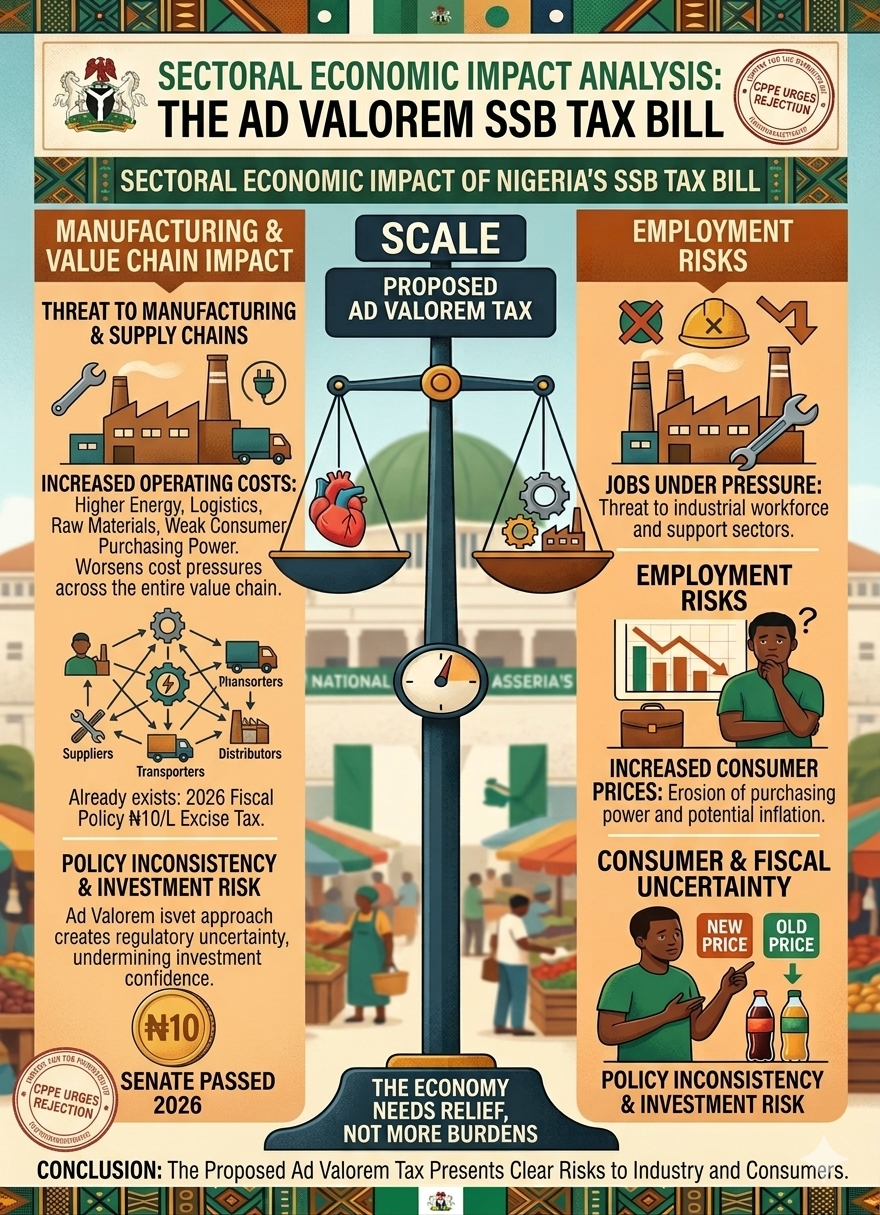
The Centre for the Promotion of Private Enterprise (CPPE) has called on the House of Representatives to reject the Sugar-Sweetened Beverage (SSB) Tax Bill recently passed by the Senate, warning that the proposed legislation would worsen the operating environment for manufacturers, threaten jobs, weaken investment confidence and impose additional burdens on consumers already grappling with rising living costs.
In a statement signed by the Chief Executive Officer of the Centre, Dr Muda Yusuf, expressed shock and deep concern over the Senate’s decision to proceed with the bill despite strong opposition from private sector stakeholders, including the Manufacturers Association of Nigeria (MAN) and other industry groups.
According to the Centre, the proposed tax comes at a time when the Federal Government is actively pursuing policies aimed at easing the cost of doing business, stimulating industrial growth and attracting investment into the economy.
“The bill is ill-timed, insensitive to prevailing economic realities and inconsistent with the Federal Government’s commitment to reducing the tax burden on businesses,” CPPE stated.
The Centre noted that manufacturers are already contending with multiple economic challenges, including elevated energy costs, high interest rates, exchange rate volatility, logistics bottlenecks, weak consumer purchasing power and numerous taxes and levies. It argued that imposing an additional excise tax on non-alcoholic beverages would further erode industrial competitiveness and undermine investment prospects.
Threat to Manufacturing and Employment
CPPE emphasized that the food and beverage industry remains one of the strongest pillars of Nigeria’s manufacturing sector, contributing significantly to industrial output, employment and economic growth.
The Centre explained that the sector supports a vast network of businesses spanning agriculture, packaging, logistics, hospitality, retail and distribution, making it a critical driver of inclusive economic development.
It warned that an additional tax burden on the non-alcoholic beverage industry would inevitably increase production costs, push up consumer prices, weaken demand, reduce capacity utilisation and place thousands of jobs at risk across the value chain.
“At a time when the economy requires stronger industrial growth and employment generation, this proposal risks becoming a tax on production, investment and jobs,” the statement noted.
Concerns Over Policy Consistency
CPPE also raised concerns about the implications of the bill for Nigeria’s investment climate, describing the proposed legislation as inconsistent with ongoing fiscal and tax reform efforts designed to create a more business-friendly environment.
The Centre observed that the 2026 fiscal policy framework already provides for an excise duty of ₦10 per litre on non-alcoholic beverages, arguing that introducing additional taxation through new legislation would create regulatory uncertainty and send negative signals to investors.
“Investors thrive on policy predictability. Frequent additions to the tax burden create uncertainty and undermine confidence among existing and prospective investors,” CPPE said.
Sugar Tax Not the Solution to Public Health Challenges
While acknowledging the need to address the growing incidence of diabetes and other non-communicable diseases, CPPE maintained that sugar taxation alone offers limited public health benefits.
The Centre argued that the major drivers of diabetes and related health conditions in Nigeria include poor dietary habits, excessive consumption of carbohydrate-rich foods, physical inactivity, sedentary lifestyles, inadequate health awareness and genetic predisposition.
According to CPPE, imposing additional taxes on beverages does little to address these underlying causes and instead results in higher production costs, increased consumer prices and reduced investment opportunities.
Advocates Alternative Public Health Measures
Rather than relying on punitive taxation, CPPE urged lawmakers to pursue policies that directly address lifestyle-related health challenges through public education and preventive healthcare interventions.
The Centre recommended increased investment in nutrition education, public health awareness campaigns, promotion of physical exercise, encouragement of healthier food choices, improved preventive healthcare systems and urban planning initiatives that support active living through walking and cycling infrastructure.
“These interventions are more sustainable, more inclusive and far less damaging to economic activity than targeted taxation of a major manufacturing subsector,” the statement said.
Call to Reject the Bill
CPPE therefore appealed to members of the House of Representatives to decline concurrence to the bill, describing the legislation as fundamentally anti-growth and counterproductive to Nigeria’s economic aspirations.
“The proposed legislation penalises production, discourages investment, threatens jobs and imposes additional costs on already burdened consumers,” the Centre stated.
It urged lawmakers to uphold the House’s longstanding commitment to protecting citizens’ welfare and supporting productive enterprises by rejecting the bill in the interest of manufacturing sustainability, employment preservation, investment confidence and policy coherence.
Economy Needs Relief, Not More Taxes
CPPE concluded that at a time when businesses and households are struggling with unprecedented cost pressures, Nigeria requires policies that support production, encourage investment and create jobs rather than measures that increase economic burdens.
The Centre stressed that public health objectives and economic growth are not mutually exclusive and can be pursued simultaneously through policies that promote healthier lifestyles while safeguarding industrial development and employment.
“The Sugar-Sweetened Beverage Tax Bill fails this test and should therefore be rejected in its entirety,” CPPE concluded.