
























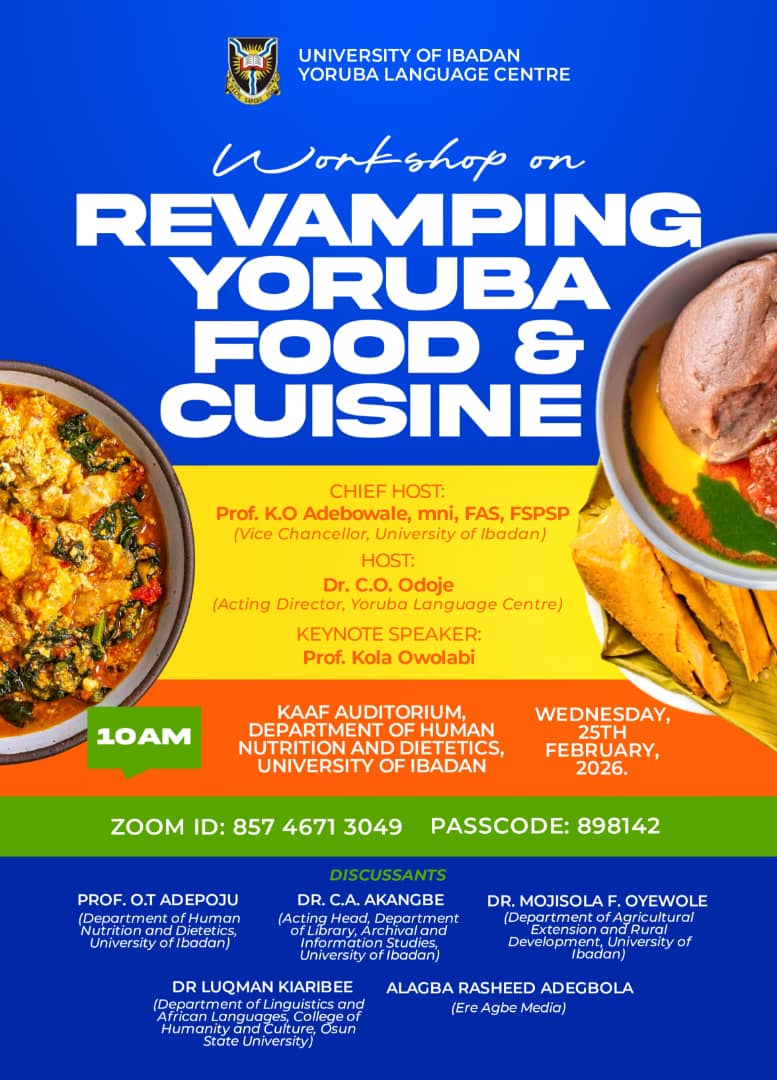
The Yoruba Language Centre, University of Ibadan, is set to host a thought-provoking workshop titled “Revamping Yoruba Food and Cuisine”, on Wednesday, February 25, 2026, at the KAAF Auditorium, Department of Human Nutrition and Dietetics, University of Ibadan.
The initiative is a deliberate effort to address the growing disconnect between modern dietary habits and indigenous food systems. The workshop will examine the steady decline in the consumption of traditional Yoruba meals and its implications for cultural identity and community health.
The event aims to bring together scholars, nutritionists, cultural advocates, and media practitioners into an atmosphere that will inspire and renewed our appreciation for traditional Yoruba cuisine, not only as a cultural asset, but also as a viable pathway to healthier living.
In his remarks, the Acting Director of the Yoruba Language Centre, University of Ibadan, Dr. Clement Odoje, explained that the initiative reflects the Centre’s responsibility not only to preserve language and culture, but also to promote aspects of Yoruba heritage that directly impact societal wellbeing.
Odoje noted that the workshop underscores the Centre’s broader commitment to bridging academic research, cultural advocacy, and community engagement, ensuring that indigenous knowledge systems remain relevant and beneficial to present and future generations.
“It is part of our social responsibility to educate people. We have realised that many of our traditional foods are gradually disappearing from our daily diets due to modernisation. This shift is negatively affecting our health. Revamping Yoruba cuisine about promoting healthier eating habits rooted in our heritage,” he said.
Beyond cultural revival, the workshop will also explore the economic and developmental potential embedded in Yoruba food systems. Indigenous ingredients, culinary techniques, and food enterprises represent untapped opportunities for local innovation, agro-development, and expansion within the creative industries. The gathering is expected to generate actionable recommendations that bridge academia, community knowledge, and industry practice. Participants will examine how strategic documentation, research, branding, and youth engagement can modernise the presentation of Yoruba cuisine without compromising its authenticity.