





















Nigeria has been re-elected to the Council of the International Telecommunication Union (ITU) for another four-year term starting from 2027 to 2030 in global telecommunications governance.
The result of the re-election, which was announced on Monday, November 16, 2026, at the ITU Plenipotentiary Conference in Doha, Qatar, saw Nigeria among 13 African countries elected to the Council.
Other African countries included, Algeria, Côte d’Ivoire, Egypt, Ghana, Kenya, Mauritius, Morocco, Rwanda, Senegal, South Africa, Tanzania, and Tunisia.
The ITU Council oversees the implementation of the union’s strategic and financial plans, guides its work between Plenipotentiary Conferences, and also shapes decisions on international telecommunications development.
With Nigeria retaining its seat, it will go a long way toward preserving its voice on key global issues, including connectivity, spectrum management, satellite communications, emerging technologies, and digital inclusion.
A statement by Mrs Nnenna Ukoha, Director of Public Affairs of the NCC, stated that Nigeria’s re-election reaffirmed its influence in Africa’s digital-development agenda and its role in advancing the continent’s priorities within the ITU.
The statement said: “This re-election reflects the strong commitment of the Federal Government to advancing Nigeria’s interests in international telecommunications governance. The Nigerian Communications Commission (NCC) expresses our profound appreciation to His Excellency, President Bola Ahmed Tinubu, GCFR, for his leadership, support and clear charge to the Nigerian delegation to secure the country’s re-election.
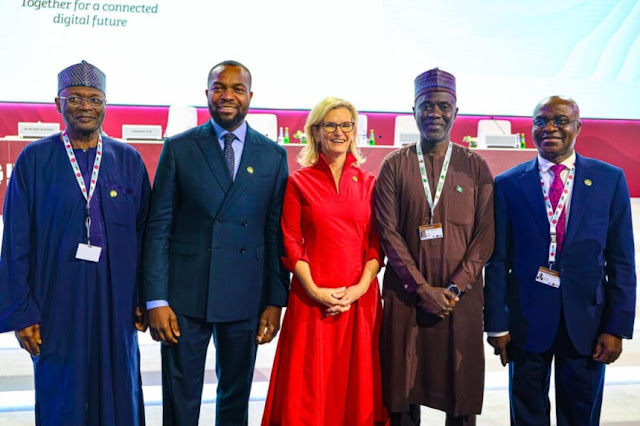
“We particularly commend the Honourable Minister of Communications, Innovation & Digital Economy, Dr. ‘Bosun Tijani, who led the Nigerian delegation and provided strategic direction throughout the campaign. His leadership, engagements with fellow Ministers and representatives of Member States, and sustained advocacy for Nigeria’s candidature were instrumental to this outcome.
“We also commend the Ministry of Foreign Affairs, under the leadership of the Honourable Minister of Foreign Affairs, Ambassador Bianca Odumegwu-Ojukwu, for its critical diplomatic interventions and sustained engagements with counterparts across the world. These efforts were instrumental in mobilising international support, securing important endorsements and strengthening Nigeria’s candidature for re-election to the ITU Council.
“We equally recognize the contributions of Nigeria’s Ambassador to Qatar, Ambassador Mahmoud Yakubu, and Nigeria’s Head of Mission, Permanent Mission of the Federal Republic of Nigeria to the United Nations Organisation in Geneva, Ambassador Innocent Iwejuo, whose diplomatic engagements and coordination helped strengthen support for Nigeria’s candidature,” it stated.
Other dignitaries that were part of the Nigerian delegation included the Executive Vice Chairman and Chief Executive Officer of the NCC, Dr. Aminu Maida, and the Executive Commissioner, Technical Services, Engr. Abraham Oshadami.
The NCC particularly congratulated the newly elected ITU Secretary-General, Deputy Secretary-General, Directors of the three Bureaux, and fellow Council members, and look forward to working together to advance the Union’s shared objectives.
The statement particularly acknowledged the dedication and collective efforts of the broader Nigerian delegation, comprising representatives of the Federal Ministry of Communications, Innovation and the Digital Economy, as well as the Ministry of Aviation, Nigerian Airpsace Management Agency (NAMA), Nigerian Communications Satellite Limited (NigComSat), National Space Research and Development Agency (NASRDA), Defence Space Administration (DSA), and the National Emergency Management Agency (NEMA).
The statement further said that Nigeria’s re-election, builds on its record of active participation and leadership within the ITU as Dr. ‘Bosun Tijani, was elected Vice Chair of the ITU Council for 2025, the first Nigerian to hold a Council leadership role in nearly 50 years, before assuming the Chairmanship of the 2026 Council session held in Geneva from 28 April to 8 May 2026.
In that capacity Tijani presided over the opening plenary and ministerial retreat, steered policy deliberations on emerging technologies, stakeholder engagement, sustainable funding models and institutional reforms, and helped shape the Union’s preparatory work for the Plenipotentiary Conference (PP-26) in Doha, including endorsement of the revised Draft Strategic Plan and approval of the 2027 operational plan.
Tijani also served as Co-Chair of the ITU International Advisory Body for Submarine Cable Resilience, where he advanced multi-stakeholder recommendations on timely deployment and repair, risk mitigation and geographic diversity of critical subsea infrastructure, culminating in the Body’s final report at the WSIS Forum 2026.
The statement explained that these leadership roles, demonstrated Nigeria’s capacity to contribute beyond national interests, build consensus among Member States and support the ITU in responding to the evolving needs of the global telecommunications ecosystem.
It further stated; “With this renewed mandate, Nigeria will continue to advocate for policies that expand meaningful connectivity, improve access to digital infrastructure, promote efficient use of spectrum resources and support the responsible adoption of emerging technologies. We will also strengthen international cooperation in cybersecurity, innovation, capacity development, and technology transfer”.
The NCC noted that the seat provides an important opportunity to ensure that Nigeria’s national digital development priorities are represented where international telecommunications decisions are made, adding that it also creates avenues for deeper partnerships, greater investment, and stronger cooperation in building a resilient and inclusive digital economy.
The statement also said that Nigeria’s continued presence on the council is an opportunity to strengthen Africa’s continental voice in global telecommunications governance.
It stated that Nigeria recognised the responsibility that comes with the mandate and will work closely with other African member States to advance shared priorities, address the continent’s connectivity challenges and ensure that the interests of developing nations remain central to the ITU’s work.
The NCC said; “We thank the member States that placed their confidence in Nigeria. We also appreciate the support of our African partners and the wider international telecommunications community”.
Nigeria returns to the ITU Council with a clear commitment to contribute meaningfully to the decisions that shape the future of global connectivity by ensuring that the decisions translate into greater opportunities for Nigerians, Africans and the wider developing world.