































The Nigerian equities market closed on a marginally negative note, as the benchmark index dipped by 1 basis point, bringing the year-to-date return to 60.85%.
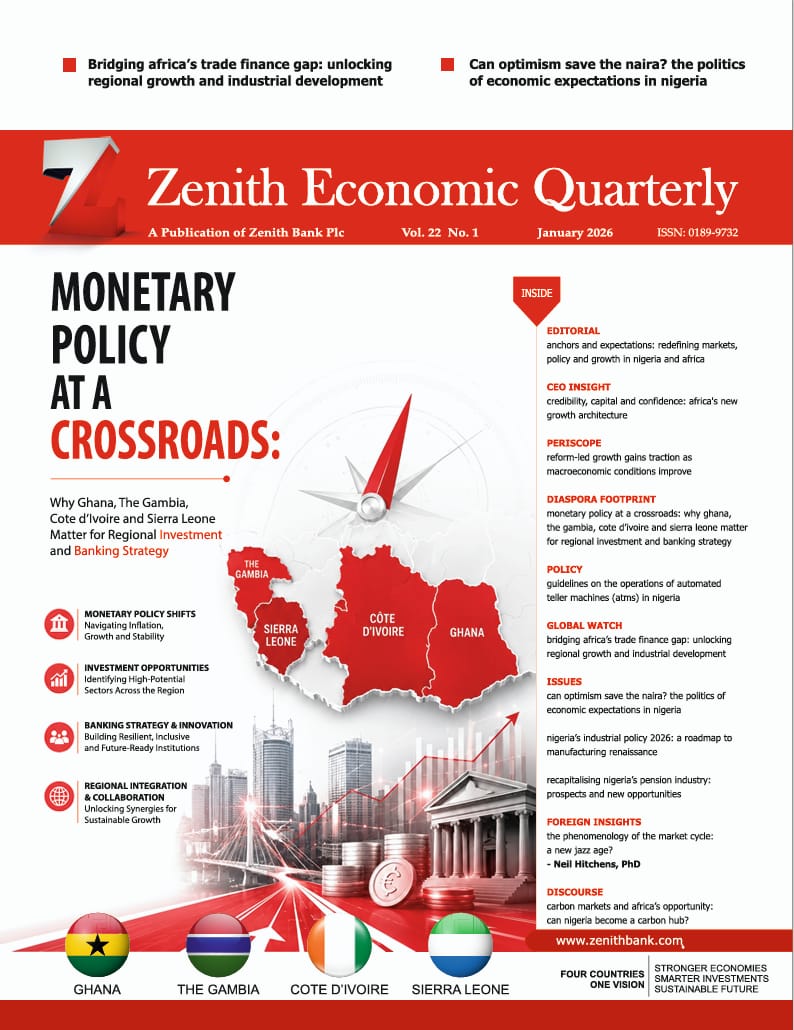 https://www.digital.zenithbank.com/ZEQ/ZEQ-jan-2026/index.html#p=1
Market activity was mixed, with trading volume advancing by 2.36% to 798.7 million shares, while total value traded declined by 14.25% to ₦37.19 billion.
Despite the weak market performance, market breadth remained slightly positive, with 40 gainers against 39 decliners, reflecting mild bullish sentiment across select counters.
On the sectoral front, the banking sector dominated trading activity, with UBA being among the most actively traded stocks by both volume and value. Recent market highlighted increased block trades and elevated investor interest in UBA and other major banking names, reinforcing liquidity within the sector.
Meanwhile, the oil and gas sector emerged as the best-performing sector, posting a daily gain of 0.40%, while maintaining an impressive year-to-date return of 125.24%.
On the performance chart, Oando Plc and UPL Limited led the gainers’ table, while NCR Nigeria Plc topped the laggards’ list, followed by ZICHIS Nigeria Plc.
Fixed Income Market
The week opened with an improvement in system liquidity, which settled at a net negative position of ₦3.32 trillion. This development eased funding conditions among banks, leading to a 10bps decline in the Overnight (O/N) rate.
Meanwhile, the Nigerian Overnight Financing Rate (NOFR) and the Open Repo Rate remained unchanged at 22.00%.
In the FGN bond market, trading was mixed, with the average yield closing marginally higher at 16.12%, compared to 16.11% at the end of the previous week.
The NTB market sustained its mild bullish sentiment. Yields at the short end declined by 2bps, while the mid and long ends recorded dips of 1 basis point and 3bps, respectively. Overall, the average yield inched 2.1bps lower to close at 17.44%, down from 17.47%.
Nigeria’s Eurobonds continued its bearish trajectory, with the average yield rising marginally by 2.1bps to close at 6.97%, up from 6.95%.
Across global markets, investor sentiment remained pessimistic, driven by rising inflationary pressures following higher-than-expected core and headline inflation prints in the United States. Consequently, longer-dated U.S. Treasury yields surged as markets priced in expectations of tighter monetary policy.
Currency Market
Today, the naira appreciated against the dollar at the NAFEM window, with the USD/NGN pair declining marginally by 10bps to close at ₦1,371.00.
Meanwhile, Nigeria’s external reserves sustained their upward trajectory from last week, rising further by 0.06% to $48.57 billion. The continued increase in reserves was largely supported by improved foreign exchange inflows and renewed investor confidence driven by ongoing monetary and FX market reforms by the Central Bank of Nigeria.
In the commodities market, Brent crude oil prices declined marginally by approximately 0.1% to settle at $109.37 per barrel. The slight pullback was driven by easing concerns over potential supply disruptions surrounding the Middle East conflict and Profit-taking by investors after recent gains.