



























Advertisement
| In a seismic shift in the economic landscape, the third quarter of 2023 has witnessed a substantial and unexpected increase in Nigerian unemployment rates, sending shockwaves through the labour market. The unemployment rate surged to 5.0%, marking a significant 0.8% rise from the second quarter of 2023. |
KEY HIGHLIGHTS: Youth Unemployment: Youth aged 15-24 faced a significant unemployment rate of 8.6%, marking a substantial 1.4% increase from Q2 2023, underscoring the challenges faced by the younger workforce. Urban Areas Impact: Urban centers experienced a slight uptick in unemployment, reaching 6.0% in Q3 2023, with a marginal 0.1% increase from the previous quarter. Underemployment Trends: Time-related underemployment edged higher to 12.3% in Q3 2023, indicating a 0.5% increase from Q2 2023 and a more substantial 1.4% rise compared to Q4 2022. Agricultural Employment: Approximately 4.1% of the working-age population engaged in subsistence agriculture, reflecting a specific sector’s employment dynamics. Informal Employment Stability: The informal employment rate, while still prevalent at 92.3%, saw a slight decrease from 92.7% in Q2 2023. Labor Force Participation Decline: The labor force participation rate dipped to 79.5% in Q3 2023, down from 80.4% in Q2 2023, indicating a shrinking active workforce. Employment-to-Population Ratio: The employment-to-population ratio declined to 75.6% in Q3 2023, reflecting a 1.5% drop compared to Q2 2023. Combined Unemployment and Underemployment: The combined unemployment rate and time-related underemployment (LU2) surged to 17.3% in Q3 2023, up from 15.5% in Q2 2023, emphasizing the broader labour market challenges. Changing Work Dynamics: A significant 87.3% of workers were self-employed in Q3 2023, while only 12.7% were in Wage Employment, indicating a shift in work structures. This multifaceted snapshot of the labour market underscores the urgent need for a comprehensive response from policymakers, businesses, and financial institutions. |
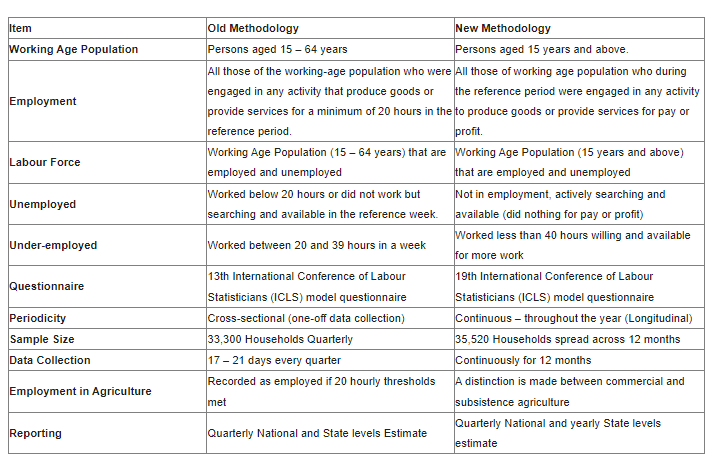
THE METHODOLOGY SHIFT AND ITS RATIONALE: In response to the evolving labour market landscape and the need for cross-country comparability, Nigeria embraced new guidelines set forth by the ILO’s 19th International Conference of Labor Statisticians (ICLS) in 2014. These guidelines advocated for a broader measurement of labour underutilization, recognizing all forms of work, paid or unpaid. The new standards also aimed to integrate labour statistics with GDP, thereby providing a more holistic understanding of labour’s contribution to the economy. The previous methodology, based on ILO’s 1983 guidelines, failed to capture the dynamics of the modern labour market, including the significant informal sector and the prevalence of unpaid work in Nigeria. By acknowledging and accounting for these aspects, the new methodology sheds light on a more accurate representation of the employment landscape. The new methodology has however faced criticism with arguments against its inconsistent application of the 19th ICLS resolution, and overly broad definition of “employed”. It is worth noting that one of the major advantages of the new methodology is its capturing of the informal sector. Also, factoring in the minimum wage rate and its dollar equivalent will buttress that the unemployment figure doesn’t accurately reveal the general living standard. |
| KEY CHANGES: |
UNEMPLOYMENT’S NEW UPWARD TREND: The graph below shows the unemployment trend in Nigeria from Q2 2020 to Q3 2023. |
BOTTOMLINE The Monetary Policy Committee (MPC) confronts the task of assimilating the recent surge in unemployment within the framework of market expectations leaning towards an imminent adoption of a hawkish stance. This necessitates a judicious approach to prevent exacerbating existing economic strains. Consequently, exercising patience and prudence by awaiting critical data points such as the forthcoming Q4 GDP results, slated for release on Thursday, emerges as a sensible strategy before delineating the trajectory for steering the economy. |
To read the entire report, click here