
























by Hon. Abd’Waasi Ismaheel Abiola
 https://www.digital.zenithbank.com/ZEQ/ZEQ-jan-2026/index.html#p=1
Legislative, they say, is a serious business for serious-minded people. On the other hand, Legislatures have a special and indispensable place in democratic governance because they are mandated to represent the concerns of the citizenry most directly in the Federal and state arms of government.
Embedded in the very concept of representative democracy is the idea that those affected by government decisions have a right to be involved in the decision-making process. The duty to support and facilitate this right falls on every member of Parliament (MP), and it cuts across every role of the MP, from representative to legislative to oversight. A member of the legislature can only succeed with meaningfully engaging constituents.
The benefits of doing so are extensive, and they accrue to MPs individually, to parliament as an institution, and to the public.
MPs who effectively engage with their constituents can build enduring political coalitions and secure continued electoral success. They are better equipped to expand their influence in government, elevate their public profiles, and develop their personal brands.
They have a greater ability to control their messages and speak for themselves rather than having their narratives mediated by party leaders, the press, or other outside groups. Constituent engagement is also often the most significant source of personal fulfilment. Many MPs cite the opportunity to make a tangible difference in people’s lives as where they derive the most tremendous meaning in their work.
Parliament as an institution also benefits very broadly from effective communication with constituents. Legislative solutions are better, more effective, and more sustainable based on the input of the people they impact. Furthermore, institutional capacity is significantly augmented by having access to independent analysis from outside experts and civil society organizations (CSOs).
This is especially helpful while parliaments are still building up the capacity of their research services and resources, ensuring they are not solely dependent upon the executive branch. Having independent sources of information is critical for conducting meaningful oversight as well.
Virtuous Cycle of Constructive Civic Engagement: Trust in Government, Citizens Share Feedback, Lawmakers Use Feedback to Fix Problems, Lawmakers Share Progress
Virtuous Cycle of Constructive Civic Engagement.
Hearing from a broad range of voices diversifies and improves parliament’s knowledge base, enriches debate, and expands deliberative capacity. With greater openness and transparency also comes greater public trust, and with this growing trust comes greater legitimacy and relevance and a stronger position for the executive arm. Regular two-way communication with the public also plays a critical part in educating citizens on the appropriate roles and functions of parliament, which helps to manage expectations and, in turn, further strengthens public trust.
The public can also greatly benefit from having their voices heard in the legislature and in places where decisions are made. The opportunity to share their lived experiences helps ensure that government programs and services are designed effectively and fixed when they are not. Confidence that their elected representatives are open with them and listening to their input helps create a virtuous cycle of constructive civic engagement.
This is imperative for both developing and mature democracies alike. Effective, meaningful constituent engagement is built upon several core principles, achieves several important objectives, and often happens within a few common challenges, as outlined below.
Principles
2. Transparency. Good constituent communication, like good governance, begins with openly sharing critical information. You are your constituents’ most direct conduit to the national government. Your engagement should be built on a commitment to openly share the work you are doing on their behalf and to be a source of information more broadly on government action, how decisions are being made, what the costs are, and what the impact is.
2. Accessibility. Making yourself and your staff regularly available to your constituents through various digital and in-person mechanisms is essential. Constituents should be able to submit their requests, comments, or questions easily, and you should ensure that they are all fully able to do so, regardless of disability or other barriers they may face.
3. Responsiveness. Meaningful engagement demands more than simply broadcasting your message to constituents. It would be best if you created a feedback loop, in which your members are able to provide their input to you, and in which you actively work to integrate and apply their input.
4. Authenticity. Build credibility with your constituents by being honest and authentic. It is challenging to build a real connection with the electorate if they feel you are playing a part. Speaking candidly (yet respectfully) can be particularly important when there are differences of opinion, setbacks in plans, or government failures that demand change and progress.
5. Inclusivity. It is essential to engage the full range of individuals and communities within your constituency, including those traditionally marginalized. This often includes women; youth; racial, ethnic, and religious minorities; and those with disabilities. Issues of poverty, inequalities, social norms, and legacies of social injustice create barriers to participation that must be overcome, which requires deliberate action to ensure their voices are heard and heeded.
6. Consistency. Engagement with your constituents must happen in an ongoing way. It is not just for campaign season or when a controversial issue arises. It should be a continuous dialogue that grows, deepens, and builds upon itself.
Resource. Be knowledgeable in how the government works and be able and available to navigate the central government on behalf of your constituents. If you have staff, it is essential to divide responsibilities among the staff so they can obtain a deeper understanding of how government functions regarding specific areas such as public health, transportation, or education, among others. The staff should be able to answer constituents’ basic questions on interacting with them.
Our Expectations from the Rep-elect:
There is no doubt that God has been so kind and fair to our noble town, Òkehò, since the return of democracy in 1999 till. Counting the number of House of Representative Members each Local Government/town has produced, Òkehò as a city has been so lucky to have produced three out of seven:
1999-2003: Barr. Tajudeen Adeniji – Òkehò
2003-2007: Dr Wale Okediran – Iseyin
2007-2011: Hon. Abass Olopoenia – Òkehò
2011-2015: Hon. Kola Olabiyi – Otu
2015-2019: Hon. Biodun Olasupo – Iseyin
2019-2023: Hon. Shina Peller – Iseyin
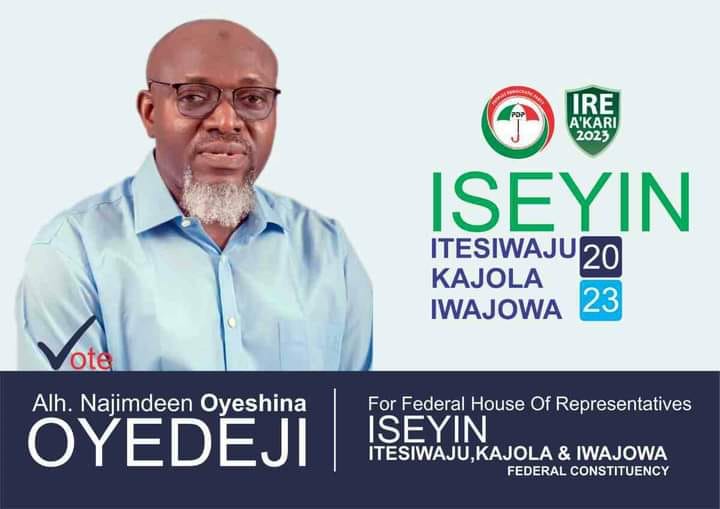
2023-till date: Hon. Najimdeen Oyeshina Oyedeji- O’shine – Òkehò
But unfortunately and regrettably, the first two had failed to utilize the opportunities as their performances was absmally low. Hardly could anyone see any sign that the town had its sons of the soil at the Green Chamber for eight years, not to talk of uncountable numbers of cities that make up the other three local governments in our Federal Constituency.
Here comes again, another ample opportunity to redeem the image and place the town’s name, Òkehò, on the world map. To make this happen, i.e. to achieve adequate representation, Hon. Najimdeen Oyedeji O’shine should include the following in his law-making or legislative duties.
Alhaji Najimdeen Oyeshina Oyedeji is expected to attract developmental projects to the constituency, some are some quick wins:
A. Joining Senator Abd’Fatai Buhari for co-sponsoring bills for rehabilitating Òkehò-Iganna to Ayegun Benin Republic border road.
B. Lobbying Senator Abd’Fatai Buhari to site the Oke-Ogun proposed University of Agriculture and Technology in Òkehò.
C. Sponsoring of a bill to upgrade the various level of education across the Federal Constituency.
D. Lobby with leadership of the House, other colleagues and MDAs to facilitate the employment opportunities for the graduates even if it would cost him millions of naira to procure them.
E. Facilitate Mega Empowerment for the constituents as this forms part of the language the party members understand.
F. Sponsoring of a bill to beef up security architecture of our Federal Constituency.
G. Establish a functioning Scholarship foundation for the less privileged and best students across the Federal Constituency.
H. Obtaining free JAMB and WAEC forms for the students alongside Organizing free coaching classes across the Federal Constituency.
Hon. Abd’Waasi Ismaheel Abiola is a professional trainer and consultant with a broad background in accounting, auditing, guidance and counselling, social media commentary, political analyst and finance.
Prior to his recent appointment by the Federal Government as an Internal Auditor, Federal Polytechnic, Ayede, Ogbomoso, Oyo State, he was a Record Officer, AL-FRUQAN CICS Ltd, a non-interest Islamic Co-operative Society owned by Kajola Local Government, Staff, Òkehò.
His experience includes audit management;information systems, financial, and operational auditing; financial reporting; consulting and training; teaching, lecturing and mentoring.
As a financial expert and political guru, Hon. Abd’Waasi has delivered highly interactive, political gathering, social gathering, practical training and consulting to internal auditors and other professionals.
Hon. AbdWaasi is a seasoned politician, a young emerging political leader and a motivational speaker. He specializes in leading control self-assessment, creative and critical thinking, information technology, operational auditing, risk assessment courses and buying and selling of farm produce.
He was the former editor-in-chief, AL-Balagh Magazine, a publication of AL-Balagh Model College, Isia, Okeho. He is also the head of Media Team to Hon. John Olaleru and Senator Abd’Fatai Buhari, PhD in Kajola Local Government till date.