



























By Femi Adefemiwa
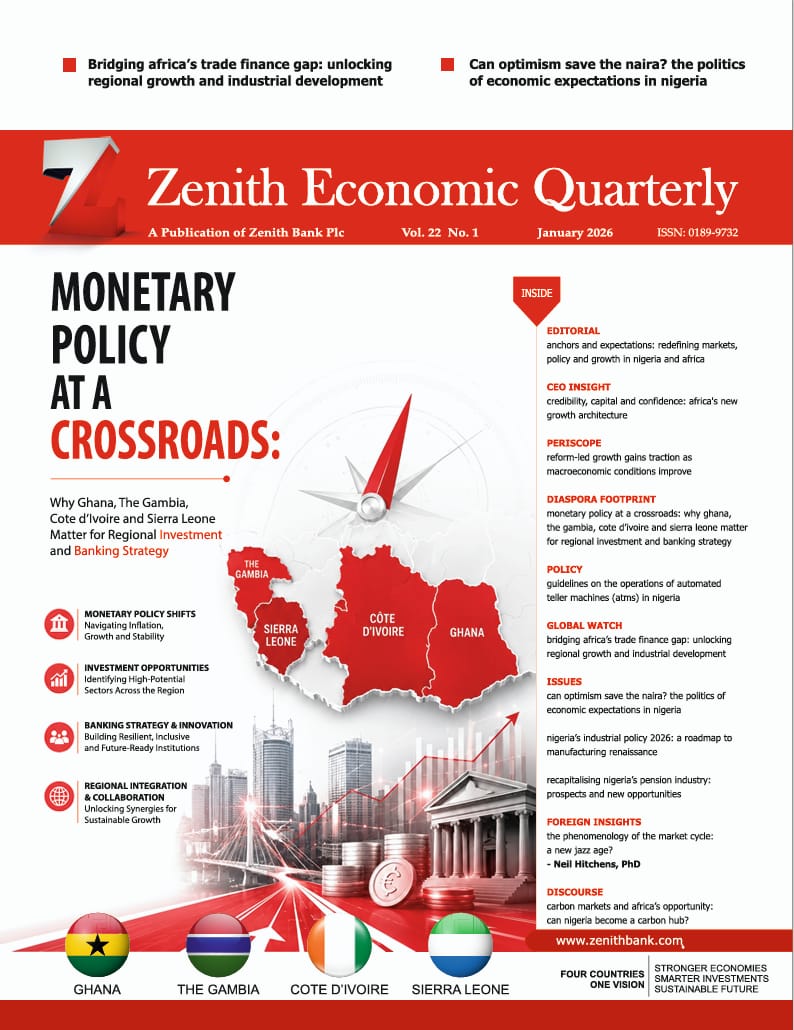 https://www.digital.zenithbank.com/ZEQ/ZEQ-jan-2026/index.html#p=1
Nigeria is too delicate, too complicated, and too historically uneven to pretend that power rotation does not matter. Ours is a country built around difficult balances — ethnicity, religion, region, language, and competing historical grievances. It is perhaps one of the few nations where political stability is tied not only to competence and elections, but also to the perception of fairness among its diverse peoples.
It was in recognition of this reality that the political understanding of rotational presidency emerged after the return to democratic rule in 1999. Though unwritten in the constitution, it became a stabilising principle designed to preserve inclusion and national cohesion by ensuring that power rotates between the geographical North and South.
That understanding should not be casually discarded.
The return to civilian rule in 1999 came after years of military dominance and deep national tension following the annulment of the June 12 election, believed to have been won by Chief M.K.O. Abiola. The emergence of Chief Olusegun Obasanjo that year was therefore not accidental. It was part of a broader national attempt to heal wounds, reduce mistrust, and reassure the South that it remained an equal stakeholder in the Nigerian project.
That political balancing arrangement, though imperfectly implemented over the years, has helped moderate tensions across several national political fault lines, among which the North-South divide remains the most primary and sensitive.
This is why I strongly hold the opinion that the presidency should remain in the South until 2031.
Those now advancing mathematical arguments based strictly on calculations from 1999 should remember that Nigeria did not begin in 1999. Before the Fourth Republic, political power at the center had substantially remained under northern dominance for decades, particularly throughout the military era. History cannot suddenly be edited simply because a new democratic calendar became convenient.
What is unfair is unfair. Simple.
The issue before the country today is bigger than constitutional technicalities. It is about political sensitivity, national trust, and the management of perception in a deeply divided society. Countries like Nigeria are not governed successfully by legal provisions alone. Not everything constitutional is necessarily fair.
Nigeria survives largely on balancing, restraint, accommodation, and the ability of leaders to make others feel included.
We need a country where all feelings must be heard and respected. Leadership is not and should not be the prerogative of any region or group. We must grow beyond primordial nationalism and divisive rhetoric.
For this reason, every serious political party interested in fielding a presidential candidate in 2027 should look toward the South. That would not only be politically responsible, it would also demonstrate an understanding of the delicate equilibrium upon which Nigeria itself rests.
The politics of domination has never built stable nations. The politics of preferential conduct just might.
At defining moments in history, nations are preserved not merely by constitutions, but by the wisdom, restraint, and sensitivity of political actors willing to rise above narrow advantage for the sake of national stability.
Nigeria is once again at such a moment.
Femi Adefemiwa is a global Nigerian, public communicator, and advocate for good governance. He is the author of “Remote Working From Africa: A Practical Guide” and writes from the United States of America. He can be reached at jerome.adefemiwa@gmail.com.