
















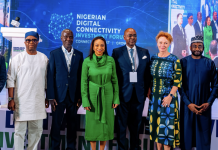







When the Nigerian Communications Commission (NCC) convened stakeholders in Abuja for the maiden edition of its Digital Awareness and Sensitisation Fora, the conversations went beyond familiar talking points about faster internet and emerging technologies. Instead, the gathering marked a deliberate attempt to place inclusion, equity and infrastructure protection at the centre of Nigeria’s digital transformation agenda, an ambition reinforced weeks earlier at a high-level business roundtable on broadband investment and critical national infrastructure.
Held on November 13, 2025, the inaugural Digital Awareness and Sensitisation Fora brought together regulators, policymakers, academics, industry leaders, development partners, civil society organisations and community representatives under the theme “Leaving No One Behind: Digital Assets, Equity, and Empowerment.”
The forum was conceived as a practical platform to bridge the persistent gap between digital policy, infrastructure deployment and everyday realities for millions of Nigerians still on the margins of the digital economy.
Across panel discussions and exhibitions, participants interrogated how inclusive digital policies can be designed and implemented in a country where access remains uneven. Conversations focused on the need for accessible infrastructure, adaptive digital literacy programmes, and affordability in digital services, especially for women, persons with disabilities, rural communities and young people. Innovators, fintech organisations and students showcased solutions that reflected both the creativity and constraints of Nigeria’s digital ecosystem, underscoring the message that innovation thrives where access exists.
The NCC framed the forum against a compelling demographic backdrop. Africa has the world’s youngest population, with about 60 per cent under the age of 25, and Nigeria contributes significantly to that figure. For the Commission, this youth population represents an untapped national asset rather than a looming burden. Officials stressed that without deliberate inclusion, however, the same demographic advantage could quickly turn into a liability, widening inequality and unemployment in a rapidly digitising global economy.
That urgency was evident in the breadth of institutions represented at the forum. Partners included the Universal Service Provision Fund (USPF), National Orientation Agency (NOA), National Council of Women Societies (NCWS), Association of Telecommunications Operators of Nigeria (ATCON), FintechNGR, Korea International Cooperation Agency (KOICA), Association of Nigerian Inventors (ANI), Joint National Association of Persons with Disabilities (JONWAD), and key education regulators such as the National Universities Commission (NUC), National Board for Technical Education (NBTE) and Secondary Education Boards. Their presence reinforced a shared understanding that digital inclusion cuts across education, gender, disability, innovation and economic policy.
While the forum focused on awareness and empowerment, it also reflected a wider national debate already unfolding around broadband connectivity—the backbone of Nigeria’s digital economy. That debate had been sharpened in October 2025, when the NCC hosted a business roundtable on improving investments in broadband connectivity and safeguarding critical national infrastructure at its Digital Economy Complex in Mbora, Abuja.
At that roundtable, NCC Executive Vice Chairman, Dr. Aminu Maida, challenged participants to rethink the value of connectivity, not as a convenience but as an economic and security necessity. From manufacturers coordinating global supply chains to entrepreneurs running online businesses and security agencies relying on live intelligence, he argued that connectivity has become the “quiet enabler” of modern life. When networks fail, productivity stalls, opportunities disappear and, in critical situations, lives can be put at risk.
Nigeria’s digital progress, Dr. Maida acknowledged, has been tangible. By August 2025, broadband penetration stood at approximately 48.81 per cent, with over 140 million Nigerians connected to the internet. The ICT and telecommunications sector has emerged as one of the leading contributors to national GDP. Research cited at the roundtable showed that a 10 per cent increase in broadband penetration could drive about 1.38 per cent GDP growth in developing economies, highlighting the scale of opportunity still ahead.
Yet ambition has often collided with structural and regulatory constraints. Nigeria’s National Broadband Plan (2020–2025) set targets of 70 per cent broadband penetration and 90,000 kilometres of fibre optic backbone by the end of 2025. Under the administration of President Bola Ahmed Tinubu and the leadership of the Minister of Communications, Innovation and Digital Economy, Dr. Bosun Tijani, these targets became rallying points for reform. The NCC, as sector regulator, translated them into a mix of advocacy, regulation and enforcement.
One of the most consequential outcomes was the Critical National Information Infrastructure (CNII) Presidential Order, signed in June 2024, which formally designated telecommunications infrastructure as critical national assets, where he detailed how the NCC, in collaboration with the Office of the National Security Adviser, had begun operationalising the order through stricter site security standards, public awareness campaigns and coordinated enforcement. These efforts, he said, had already led to the dismantling of organised cartels involved in telecom equipment theft.
Despite this progress, the scale of disruption remained sobering. Between January and August 2025, Nigeria recorded more than 19,000 fibre cut incidents, over 3,200 cases of equipment theft and thousands of site access denials. The economic cost of these disruptions through outages, delayed restorations and rising security expenses has been borne by operators and consumers alike, threatening service quality and investor confidence.
Another persistent challenge highlighted at the roundtable was the fragmented regime governing Right of Way (RoW) fees for fibre deployment. Although the Nigerian Governors Forum agreed on a benchmark rate of N145 per linear metre, implementation has varied widely. The NCC reported that 11 states had waived RoW fees entirely, while 17 others had capped charges at the agreed rate. Still, inconsistent enforcement, multiple taxation and slow permitting processes continue to delay rollout in many parts of the country.
To counter these headwinds, the Commission pointed to recent regulatory interventions that had begun to restore investor confidence. Earlier in 2025, the NCC approved cost-reflective tariff adjustments, a move that operators said enabled them to commit more than $1 billion in additional broadband investments. The Commission also commissioned a wholesale fibre study aimed at opening backbone infrastructure on transparent terms, reducing duplication and accelerating last-mile expansion.
Transparency emerged as another theme linking the roundtable and the Digital Awareness Forum.
The NCC announced expanded performance disclosures, including outage reporting and quality-of-service maps, to strengthen accountability across the value chain. Plans were also unveiled for an Ease of Doing Business Portal and a Nigeria Digital Connectivity Index, designed to publicly rank states on digital readiness and competitiveness.
In this context, the Digital Awareness and Sensitisation Fora served as a human-centred complement to infrastructure and investment debates. Participants repeatedly stressed that broadband expansion must translate into real empowerment, better access to education, healthcare, markets and government services, if it is to justify the scale of public and private investment required.
Without digital literacy, affordability and trust, connectivity risks becoming another layer of inequality rather than a tool for inclusion. By the close of the forum, a consistent message had emerged: Nigeria’s digital future depends on alignment. Federal and state governments, regulators, operators, educators, security agencies and communities must move in step. States that have waived RoW fees and supported infrastructure protection were cited as examples where policy coherence had already begun to unlock faster network expansion.
Taken together, the NCC’s recent engagements signalled a maturing digital policy conversation—one that recognises both the transformative power of connectivity and the hard realities that threaten its reach. As Dr. Maida observed at the roundtable, pipelines of oil are steadily giving way to pipelines of fibre, and prosperity in the 21st century will be defined less by physical resources than by data, connectivity and human potential.
The question now confronting Nigeria is not whether the digital revolution will continue, but whether its benefits will be broadly shared. The Digital Awareness and Sensitisation Fora, paired with renewed efforts to protect and expand broadband infrastructure, suggested that the NCC is betting on inclusion as the measure of success, and on collaboration as the only viable path forward.