























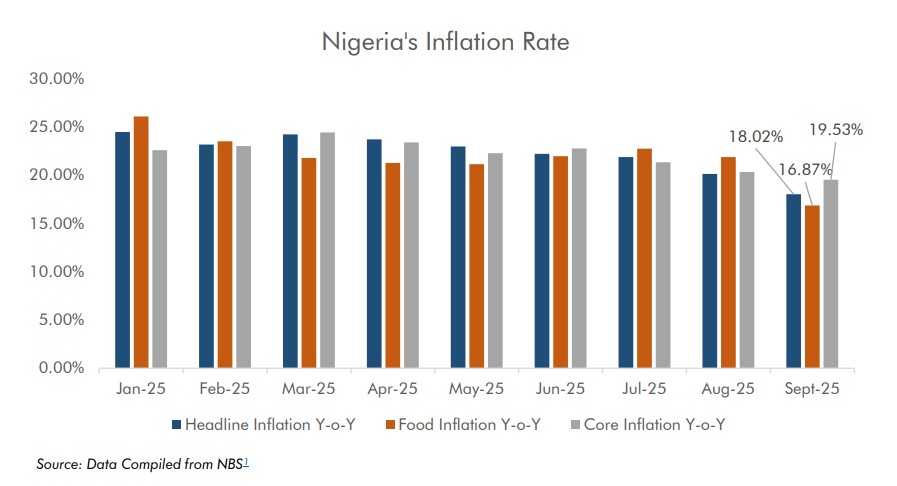
Nigeria’s headline inflation eased to 18.02% in September 2025, down from 20.12% in August, marking the sharpest deceleration in price growth this year.
 https://www.digital.zenithbank.com/ZEQ/ZEQ-jan-2026/index.html#p=1
The moderation followed the CBN’s Monetary Policy Committee (MPC) decision to cut the policy rate by 50 basis points, indicating that the easing stance is beginning to transmit to consumer prices.
The decline was broad-based, led by lower food and energy costs, with both headline and food inflation recording their steepest year-on-year declines of 2.10% and 5.00%, respectively.
On a month-on-month basis, the trend was reinforced by a notable moderation in food prices, showing that short-term price pressures are softening across key consumer segments.
Month-on-month, headline inflation fell by 0.02% to 0.72% from 0.74% in August. Food prices declined by -1.57%, reversing the 1.65% increase recorded in August, while core inflation edged lower by 0.01% to 1.42% from 1.43% in the previous month.
Harvest Winds Cool the Food Inflation
Nigeria recorded a disinflation in the food index, reflecting improved price stability across major food categories. Food inflation moderated sharply, with year-on-year food inflation easing to 16.87%, while month-on-month prices fell by 1.57%, marking one of the largest slowdowns this year.
The moderation was driven by stable transportation costs and increased food supply from the main harvest season, which typically spans late August to October across the northern regions.
The increased supply of freshly harvested staples during this period boosted market availability and eased price pressures across key food categories.
Core Prices Ease, Naira Holds Firm
Core inflation continued its downward trajectory in September 2025, reflecting a gradual easing of underlying price pressures and confirming early signs that monetary and exchange rate policies are gaining traction. The index declined to 19.53% year-on-year from 20.33% in August, while month-on-month readings edged lower to 1.42% from 1.43%. The consistent moderation underscores a structural shift rather than a temporary relief, supported by improved FX liquidity, moderated consumer spending, and tighter monetary controls that have begun to stabilize pricing in non-volatile sectors.
At the same time, the Naira appreciated by 3.3% in September, marking its second-strongest monthly performance in 2025, behind the 4.13% gain recorded in January. The strengthening of the currency was driven by greater transparency in the foreign exchange
market, increased foreign portfolio inflows, and a rebound in crude oil production, which lifted fiscal receipts and reduced pressure on the demand for dollars. The improvement in the FX market structure and liquidity has translated into reduced imported inflation, directly supporting the moderation in core prices.
However, sustaining these gains remains essential. The sharp appreciation witnessed in early 2025 quickly reversed as market confidence waned amid liquidity strains. This time, however, the backdrop appears more balanced. With reform momentum, policy consistency, and a relatively stable macro environment, the Naira’s recovery stands on firmer ground.

The currency’s performance signals improved confidence in Nigeria’s macro framework, though sustainability remains key. Together, the easing in core inflation and the appreciation of the Naira highlight a convergence toward short-term price stability. While risks from global oil price volatility and capital flow reversals remain, the September data suggest that Nigeria’s policy adjustments and external inflows are beginning to anchor expectations and strengthen macroeconomic balance.
What to Expect Ahead: Inflation, Currency Strength, and Gas Costs
The Naira has continued to appreciate modestly against the dollar in October, extending the positive momentum from September, though at a slower pace. This relative stability is expected to persist in the near term, helping to contain inflationary pressures and allowing the disinflation trend to continue through October. A stronger or stable exchange rate remains critical in sustaining the recent moderation in both headline and core inflation.
However, short-term inflation dynamics have been disrupted by the PENGASSAN strike, which affected the supply of fuel and gas and delayed maintenance operations at the NLNG Train 4 facility. The resulting supply shortages triggered sharp increases in gas prices across outlets. Given the largely unregulated nature of the domestic gas market, limited availability quickly translated into higher retail prices.
The gas price surge is likely to feed into headline inflation for October, potentially causing a slight uptick. While the strike has been suspended and an agreement reached, the inflation outlook now depends on how quickly supply normalizes in the gas market. A rapid improvement would limit the upward impact, while prolonged disruptions could reverse some of the recent inflation gains.
On the food side, the ongoing harvest season continues to exert downward pressure on food prices, particularly in the northern regions where supply volumes have risen. Given that food inflation accounts for about 40% of the inflation basket, this should help offset some of the upward pressure from higher energy costs, keeping headline inflation relatively contained.
Overall, while a temporary increase in month-on-month inflation is possible due to energy price shocks, the broader trend of declining inflation remains intact. If gas supply stabilizes quickly and price moderation resumes, inflation is expected to continue its downward path. Under this scenario, the CBN’s Monetary Policy Committee could consider another rate cut in its November meeting, leveraging the improving inflation outlook and currency stability to further support economic growth.
Bottom Line
The September inflation data highlights broad-based disinflation, with headline, food, and core inflation, all posting declines year-on-year and food prices even recording deflation month-on-month. The combination of harvest season supplies, stable energy costs, and a stronger naira has been central to this trend. Looking ahead, the continued, though slower, appreciation of the naira should help sustain disinflationary pressures. However, the recent PENGASSAN strike and maintenance at NLNG have pushed gas prices sharply higher, introducing renewed risks to headline inflation in October.
While food inflation is expected to ease further and offset some of this pressure, the pace of recovery in gas supply chains will be critical to determining whether October maintains the disinflation momentum or sees a slight rebound in headline inflation