

























Nigeria recorded a total capital importation of $6.44 billion in the fourth quarter of 2025, representing a 26.6% year-on-year increase and a 7.1% rise quarter-on-quarter, according to the National Bureau of Statistics (NBS). The latest figures signal a sustained recovery in foreign capital inflows, driven by improved investor sentiment and heightened financial market activity.
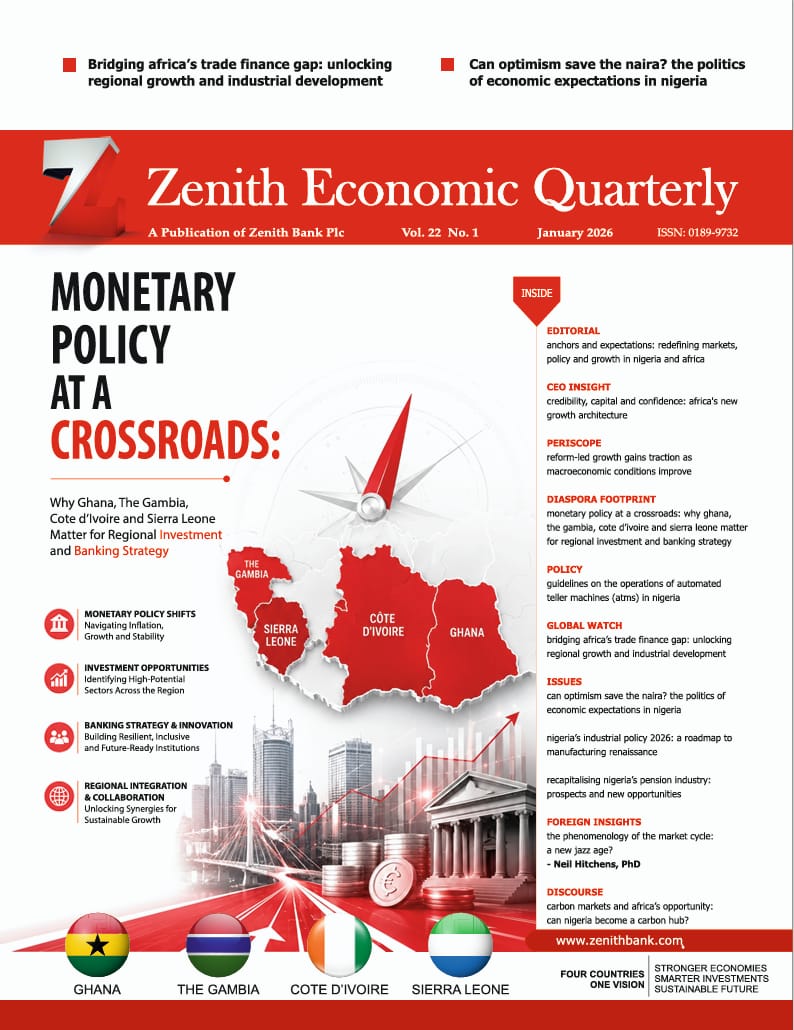 https://www.digital.zenithbank.com/ZEQ/ZEQ-jan-2026/index.html#p=1
Portfolio investments remained the dominant component, accounting for $5.49 billion, or 85.1% of total inflows, with strong participation in money market instruments and bonds. However, Foreign Direct Investment (FDI) continued to lag at $357.8 million (5.6%), reflecting persistent investor caution toward long-term commitments despite improving macroeconomic conditions.
Sectoral analysis revealed a significant concentration of inflows into financial services, with the banking sector attracting $3.85 billion (59.8%), followed by financing activities at $1.94 billion (30.2%). Real sector inflows remained limited, reinforcing concerns that foreign investors continue to favour short-term, liquid assets over productive investments. By country of origin, the United Kingdom led with $3.73 billion (57.9%), followed by inflows from the United States and South Africa.
Despite the positive momentum, analysts caution that the heavy reliance on short-term portfolio flows poses sustainability risks and exposes the economy to potential capital flow volatility.
Meanwhile, Nigeria’s oil sector recorded a notable setback, with a production shortfall of approximately 16.6 million barrels in the first two months of 2026, according to data from the Nigerian Upstream Petroleum Regulatory Commission (NUPRC). Total crude oil and condensate production stood at about 92 million barrels between January and February, significantly below the government’s projected 108.6 million barrels, based on a benchmark of 1.84 million barrels per day.
Average daily output declined from 1.63 million barrels per day (bpd) in January to 1.48 million bpd in February, with crude oil production dropping more sharply from 1.46 million bpd to 1.31 million bpd over the same period. Although condensate production provided some support, it was insufficient to offset the broader decline. Major export terminals, including Qua Iboe, Bonny, Forcados, Escravos, and Brass, all recorded reduced volumes, underscoring persistent structural challenges in the oil sector and limiting Nigeria’s ability to fully benefit from elevated global oil prices.
In the financial markets, system liquidity declined during the week, opening at ₦8.15 trillion and closing at ₦5.93 trillion. The Open Buy Back (OBB) rate held steady at 22.00%, while the Overnight (OVN) rate eased slightly to 22.26%, with rates expected to remain around current levels in the near term.
The Treasury Bills market remained active, supported by strong liquidity and robust investor demand. Oversubscriptions were recorded across multiple auctions, including Open Market Operations (OMO) and Nigerian Treasury Bills (NTB), reflecting sustained investor appetite. Average benchmark yields rose by 14 basis points to 17.63%, while stop rates for key instruments moderated slightly.
Similarly, the Federal Government bond market experienced mixed sentiment, with early bearish pressure driven by geopolitical tensions, particularly developments involving the United States and Iran. Selective buying interest later emerged, stabilizing yields, which closed marginally higher at 15.59%.
The Eurobond market was marked by heightened volatility, influenced by geopolitical developments in the Middle East and U.S. macroeconomic data. Despite intermittent recoveries, the market ended the week on a bearish note, with average benchmark yields rising by 29 basis points to 7.41%.
In the currency market, the Naira depreciated by 1.97% week-on-week, closing at ₦1,353.90/$ at the Nigerian Foreign Exchange Market Window (NFEM), reflecting ongoing pressures in the foreign exchange market.
On the equities front, the Nigerian Exchange (NGX) recorded marginal declines, with the All-Share Index (ASI) dipping by 0.02% to close at 200,913.1, while market capitalization settled at ₦128.98 trillion. Trading activity was mixed, with volume declining but value traded increasing. On a weekly basis, the market posted a modest gain of 0.12%, supported by strong performances in select stocks, although declines in others weighed on overall sentiment.
Year-to-date, the NGX has delivered a robust return of 29.11%, with notable gains across key indices, including Oil & Gas and Banking, reflecting continued investor interest in the equities market despite prevailing economic headwinds.
While Nigeria’s capital inflow recovery is a positive signal for external liquidity, underlying structural challenges—particularly in oil production and the composition of capital flows—highlight the need for sustained reforms to ensure long-term economic stability and growth.