






















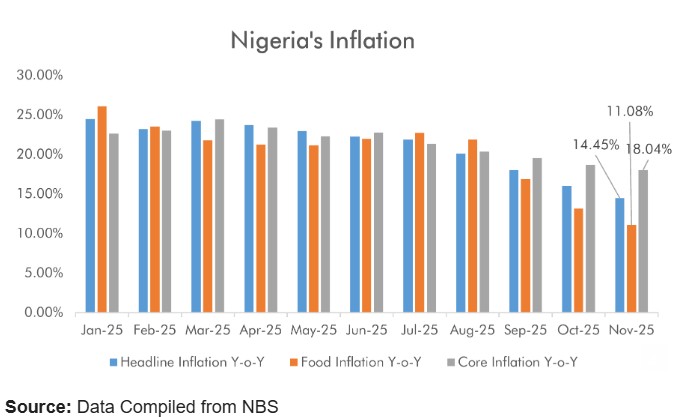
Nigeria’s disinflation trend extended into November, with headline inflation easing for an eighth consecutive month to 14.45%. This represents a 1.60% drop from the 16.05% recorded in October 2025. The moderation was broad-based on a year-on-year basis, with both food and core inflation printing lower. Food inflation fell sharply to 11.08%, a 2.04% decline compared to October, while core inflation moderated by 0.65% to 18.04%.
This sustained disinflationary trajectory brings the headline figure closer to the Monetary Policy Committee (MPC)’s long-term objective of single-digit inflation and is increasingly consistent with the wider disinflation pattern seen across several African economies.
However, the composition of the slowdown matters. Food inflation is decelerating at a much faster pace than core inflation, and given food’s heavy weight in the consumer basket, it is the primary driver of the headline print. In November, the 2.04% drop in food inflation accounted for the bulk of the decline in headline inflation, while core inflation showed only a gradual easing.
Conversely, core inflation, which strips out volatile components and better captures underlying price dynamics, remains relatively sticky. The relatively slower pace of moderation in core inflation suggests that while headline inflation is easing, disinflation is largely driven on the back of the more volatile food component, while underlying price pressures remain sticky and elevated.
The stickiness in core inflation suggests that inflation pressures could accelerate if food inflation were to spike. In that scenario, headline inflation could inch upwards quickly, because the core inflation backdrop remains firm and elevated, and is not declining fast enough to offset any renewed rise in food prices.
As such, a rebound in food prices, particularly around the December festive season when demand pressures typically rise and supply bottlenecks can tighten, could push headline inflation higher, even if core inflation continues to soften gradually.
Annual Relief, Monthly Reality
While year-on-year inflation continued to decelerate, month-on-month inflation recorded an uptick, underscoring the difference between trend disinflation and short-term price dynamics.
On a m-o-m basis, inflation was 1.22% compared to 0.93% recorded in October, with food inflation being the major resurgence as it increased to 1.13% from -0.37% in October, and core inflation declined by 0.14% to 1.28% from 1.42%.
This uptick reflects renewed momentum in current prices rather than a reversal of the broader trend, and it highlights why month-on-month inflation remains the more reliable gauge of present inflationary conditions, given the rebasing.
The increase in the month-on-month print reflects renewed price pressures within the month, driven by seasonal demand effects, early festive-related consumption.
Base effects play a central role in explaining the divergence between the easing year-on-year rate and the firmer month-on-month outcome. Inflation in late 2024 was elevated, creating a high comparison base for 2025 readings. As these high base months drop out of the annual calculation, year-on-year inflation declines mechanically, even when current monthly price increases remain positive or accelerate.
The month-on-month uptick, therefore, signals that underlying inflation dynamics remain unresolved. Core inflation captures more persistent pressures limiting the economy’s ability to absorb short-term food or demand shocks. As a result, any seasonal spike in food prices feeds through more quickly to headline inflation than would be the case in a lower-core environment.

Looking Ahead: Year-end Jump
Nigeria’s inflation is set to peak in December 2025, diverging sharply from the year’s trend and establishing itself as a structural outlier. This spike is not merely seasonal; it reflects the interaction of rebased CPI weights, base effects, and supply-demand dynamics.
The 2025 rebasing of the Consumer Price Index (CPI) recalibrates the basket of goods and services to reflect current consumption patterns, adjusting weights for items such as food, transport, and utilities. With these items accounting for larger shares of household expenditure post-rebase, price movements in December, traditionally a month of elevated demand due to festive spending, carry greater influence on headline inflation.
Seasonal and supply-side pressures further reinforce the trend. Food prices rise in response to logistics bottlenecks and higher festive demand, while energy and transport costs reflect currency volatility and elevated import bills. These elements, coupled with the rebased CPI weights, ensure that December stands out as the peak month of inflation for 2025.
Looking into 2026, the spike in inflation is expected to correct. As month-on-month growth returns to trend and the base effect unwinds, headline inflation should ease to levels more reflective of underlying price pressures.
Bottom Line
Nigeria’s headline inflation eased to 14.45% year-on-year in November, extending the disinflation trend for the eighth consecutive month, primarily driven by a sharp slowdown in food inflation to 11.08% y/y. Core inflation, however, remains elevated at 18.04% y/y, highlighting that underlying price pressures are still sticky and that the recent decline in headline inflation is not yet broad-based. The month-on-month dynamics tell a different story. Headline inflation accelerated to 1.22% m/m, while food prices rose 1.50% m/m, reflecting seasonal demand, a declining harvest tailwind, and tighter supply conditions. These trends indicate that near-term upside risks are building ahead of December, driven by festive spending, potential food-price pressures, rebased effect, and if the naira weakens.