
























Dangote Petroleum Refinery is preparing to launch its long-awaited Initial Public Offering (IPO) in October 2026, aiming to raise about $5 billion in what could become Africa’s largest-ever equity offering. The refinery, owned by the Dangote Group, is expected to list primarily on the Nigerian Exchange (NGX), while discussions are ongoing to broaden investor participation across several African capital markets. Proceeds from the IPO are expected to support the refinery’s capacity expansion and finance new downstream energy projects across the continent. The 650,000-barrels-per-day refinery has strengthened its position as a major regional fuel supplier following supply disruptions caused by geopolitical tensions in the Middle East. The planned listing is also expected to deepen Nigeria’s capital market by providing investors with exposure to one of Africa’s largest industrial assets. The transaction remains subject to regulatory approvals, with a prospectus expected ahead of the planned October offering.
Nigeria’s upstream oil and gas sector is projected to attract $30-$50 billion in offshore investment between 2026 and 2030, according to the Nigerian Upstream Petroleum Regulatory Commission (NUPRC). The Commission said the investment pipeline will be driven by 22 major offshore projects expected to boost crude oil production, create jobs, expand energy infrastructure, and strengthen the country’s energy security. The NUPRC attributed the improved outlook to reforms introduced under the Petroleum Industry Act (PIA), improved licensing transparency, and faster project approvals. Since 2024, the regulator has approved more than $57 billion in Field Development Plans, with several projects already progressing to Final Investment Decisions. The Commission also said preparations for the 2026 Licensing Round are underway as it seeks to attract further investment into Nigeria’s upstream sector. The planned projects are expected to support the government’s target of increasing crude oil production to 2 million barrels per day by 2027 and 3 million barrels per day by 2030.
NAICOM has concluded the 12-month insurance sector recapitalisation exercise following the July 31 deadline. The regulator confirmed that 43 insurance and reinsurance companies met the new minimum capital requirements, while eight firms remain under a 14-day verification process. The exercise aimed to strengthen insurers’ financial position and improve their ability to meet claims and underwrite larger risks. With the recapitalisation largely complete, investor focus is likely to shift towards how efficiently insurers deploy their stronger capital bases to drive premium growth, profitability and returns. Higher capital levels should give insurers greater capacity to take on larger and more complex risks while supporting investment in technology and new products. Insurers that can translate stronger balance sheets into premium growth, better underwriting results and improved investment returns could be better positioned to outperform over the longer term.
Money Market
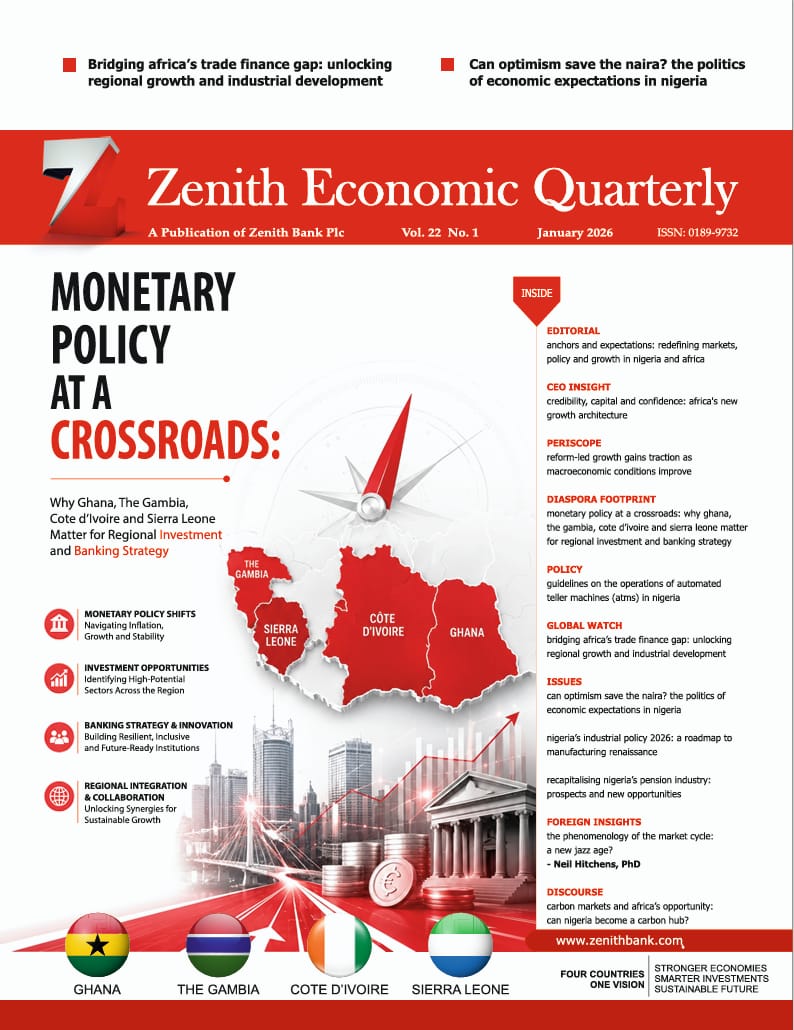 https://www.digital.zenithbank.com/ZEQ/ZEQ-jan-2026/index.html#p=1
System liquidity saw an increasing trend throughout the trading week, opening at ₦2.52 trillion on Monday, which was driven by OMO auction settlement, and closing at ₦4.07 trillion. Week-on-week, the Nigerian Overnight Financing Rate (NOFR) held steady, closing at 22.00%, while the Overnight (OVN) rate declined by 4bps to 22.10%.
We expect the rate to continue to hover around this level.
Treasury Bills Market
The Treasury Bills market traded on a bullish note this week, with sentiment largely shaped by the cancellation of the NTB auction. The week began with strong buying interest across the curve following the cancellation of the primary auction, while the CBN conducted two consecutive OMO auctions, offering a combined ₦1.20 trillion across various tenors. Investor demand remained exceptionally robust, with total subscriptions of ₦5.17 trillion, while the CBN allotted ₦4.67 trillion, as it continued to mop up excess liquidity in the absence of a primary market auction. Despite the aggressive OMO sales, secondary market demand remained concentrated on the newly issued 29-Jul bill, with yields marginally repricing from 16.95% to 16.80% during the week. By the weekend, activity remained subdued, although mild selling pressure emerged on the long end of the curve, particularly the 29-Jul bill, which was quoted at 17.05%/16.90% to close the week. Week-on-week, the average benchmark yield declined by 6bps to close at 18.44%.
Looking ahead, we expect market participants to maintain a cautious stance as they position ahead of the upcoming NTB auction.
FGN Bond Market
The FGN Bond market traded on a mixed, albeit positive note this week, supported by the absence of primary market auctions and selective demand across the curve. The week began on a positive note, with buying interest concentrated on the on-the-run maturities, particularly the 2035 maturity, which traded as low as 17.10% during the week. This demand also filtered into selected off-the-run maturities, as offers on the 2031 and 2033 maturities were seen below 17.00%. However, sentiment weakened midweek as selling pressure resurfaced across the curve, with market participants positioning ahead of the next FGN bond auction, pushing yields higher. By week-end, this bearish tone persisted as improved offers was seen across the curve, with the 2038 maturity quoted at 17.60%/17.40% to close the week. Week-on-week, the average benchmark yield declined by 19bps to close at 16.71%.
We expect similar sentiment to persist, as market participants await fresh catalysts.
FGN Eurobond Market
The Eurobond market traded on a mixed note this week, with sentiment driven by developments in U.S.-Iran negotiations and key U.S. labour market data. The week began on a positive note after President Donald Trump said talks with Iran would resume, raising hopes of reopening the Strait of Hormuz and easing tensions in the Middle East. However, optimism faded as Iran denied that negotiations with Washington were underway, while renewed attacks on shipping and threats to Gulf energy infrastructure reinforced concerns over the security of global oil supplies. Sentiment improved mid-week after Trump described discussions with Iran as constructive, although the positive tone proved short-lived as geopolitical uncertainty persisted. On the macro front, weaker-than-expected U.S. labour market data, including a weaker JOLTS Job Opening report and an unexpected decline in July nonfarm payrolls, reduced expectations of further Federal Reserve tightening. Week-on-Week, the average benchmark yield declined by 8bps to close at 6.83%.
We expect market direction to be driven by evolving geopolitical developments, CPI and PPI data.
Currency Market
The value of the Naira to the dollar appreciated by 0.19% week on week to close at ₦1,365.68/$ at the Nigerian Foreign Exchange Market Window (NFEM).
Equities Market
The local bourse ended the day with the benchmark NGX All-Share Index (ASI) increasing by 0.15% to close at 245,573.6 points while market capitalisation also increased to close at N158.29 trillion. Market breadth was negative at 0.91x. Trading activity was active on the day, with the volume of shares traded increasing by 185.83% to 1.52 billion units, while the total value of shares traded also increased by 30.10% to ₦26.58 billion.
Reflecting the week’s performance, the NGX All-Share Index appreciated by 0.12%, as gains in AVACAP (+33.33%), FCMB (+13.10%), and FIRSTHOLDCO (+12.23%) were offset by declines in THOMASWY (-26.71%), TRANSEXPR (-23.76%), and CMFC (-22.68%).
Overall, the NGX has posted a year-to-date gain of 57.81%. Other notable indices are the NGX Top 30 Index (0.19%; 0.28% 1WK; +58.69% YTD), NGX Banking Index (1.53%; 4.27% 1WK; +70.62% YTD), NGX Oil & Gas Index (-0.04%; -0.12% 1WK; +96.27% YTD), and NGX Insurance Index (-0.21%; -2.64% 1WK; -2.44% YTD).