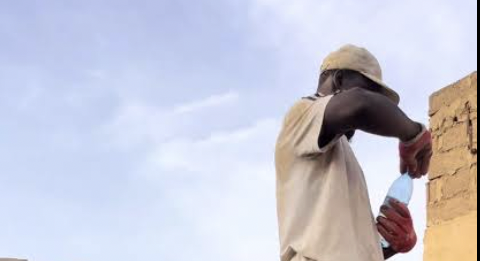



























Our Next stop was the old Oyo National Park which was a very long distance. It is about 1 hour drive from Igbeti. We learnt during the tour that the Old Oyo which was formerly known as Oyo Ile was deserted in the 18th century after the war with Hausa/Fulani raiders, no wonder I couldn’t get to see any hawker on the way to even buy Coca-cola from as I was dehydrated at some point. Thanks to being prepared from home, I had to settle with my H2O. Of course, that is what a Chemistry student calls water.
 https://www.digital.zenithbank.com/ZEQ/ZEQ-jan-2026/index.html#p=1
We first got to the boundary which we learnt some folks do come there to pray and anything they ask for would be answered. On hearing this, many prayer warriors who were amongst us tourist started “skabashing” silently (of course your faith will always make thee whole).
We delved in further into the site of the Old Oyo National Park, where we first came across the defence system. It was actually a wall built with clay and at least 12ft tall considering am 5.6ft tall, I estimated the wall to be 2x of my height. One interesting thing about the wall in this dense forest are the bullet holes. Am so sure the kind of gun used for war in that area is what is Dane Gun also called Sakabula, a type of long-barrelled flintlock musket claimed to be imported West Africa in the mid 19th century according to Wikipedia.
Long story short, Sakabula is a native gun produced by blacksmiths mostly for hunting animals but can also be used during wars. The baffling thing was how the primitive natives of Oyo Ile got to discover that the bullet or pellets that come from Sakabula doesn’t penetrate a clay mould. No internet, no technology but they found out on their own (it would have been great to know the name of the man who discovered this effective mechanism in Nigeria). Four of those defence walls were built and it was a safe refuge for the fighters to hide behind and shoot their enemies. From this location we moved to see the natural fortress built by rock and can accommodate almost if not more 1000 people.
The Agbaku Cave
The Agbaku cave we learnt was first used by Oranmiyan who was the first Alaafin of Oyo many centuries ago. The place was later converted to a hideout base where the royal families would hide for safety during wars. It was believed that enemies that pursue anyone to the cave would die mysteriously before entering the cave hence the name Agbaku (saving you from death).
After the first fall of this city by Oranmiyan, Alaafin Abiipa who later relocated the Oyo people to the old city converted the cave to Aare Onakakanfo’s (the Alaafin’s special military force and head of Yoruba army) quarters where he was to stay with his family.
Let us digress a little bit and share some insight into Aare Onakakanfo’s position. In that era, before you can be Aare Onakakanfo, you would pass through a spiritual exercise which include shaving the head after receiving 201 incisions each made with different lancets and are specially prepared from ingredients of 201 viols. Each viols are rubbed into each cuts. This incisions are mainly to make the Kakanfo fearless and courageous. These have been accrued to the stubborn and obstinate nature of the Aares. It is also interesting to note that Oyo Indigene residents were never made Kakanfos because the position was never a giveaway or “emilokan” post to anyone. Not even the Alaafin got the position. The Kakanfos were required to go to war at least once in three years on the orders of the Alaafin and the Kakanfo must return DOA (dead or alive) within three months. Now let us get back to the Agbaku cave.
I personally loved the beauty of the rock the way it was formed. Of course am not settling for the story of when enemies pursue the old Oyo indigenes and they die mysteriously outside the cave, I rather have this interesting idea as regards. I would like to describe the place as a safe house with lots of vantage points where enemies coming in pursing can be shot with guns, bows, arrows or poisonous darts from the top of the cave. I was not opportune to get to the top and see the back (which actually was very painful) but from the structure, it would be easy to create an ambush for unsuspecting enemies.
This reminds me of the movie, Jumong, where his first settlement with the refugees couldn’t be penetrated. A beautiful site it is, won’t mind camping there with wifey in the nearest future, just that the wild animals in that environment are enough for me to have a rethink and sit back at home and teach my students chess moves online rather than the moves to dodge being prey to animals in that wild LOL.
Look out for Part 3.
Oyeleye Olawale is a certified Chess in School Instructor and a licensed National Arbiter.