Category: Features

Featured posts

  • Feature: Nigeria needs to pass an Anti-Tribal Bill 2023

    Feature: Nigeria needs to pass an Anti-Tribal Bill 2023

    by Ayo Akinfe

    In the wake of the whipping up of nasty ethnic prejudices in Lagos State during the gubernatorial elections, we need to pass a Nigerian Anti Tribal Bill 2023 with the following provisions

    [1] Make your state of birth your state of origin

    [2] Make it compulsory to grant indigent status to anyone who has lived in a state for up to five years

    [3] Categorise the use of the word tribe as hate speech. Only animals live in tribes. Europeans never refer to themselves as coming from tribes. Using the word tribe should attract a 12 month jail sentence

    [4] Society groups and non-governmental organisations should form a National Anti-Tribal Movement. Poverty has no ethnic group, bad roads kill all of us and when Nepa takes light, no one is spared. The bony hand of hunger is blind to ethnic origin

    [5] Carry out a nationwide sensitisation campaign to educate our people on the fact that there was no such thing as tribe in pre-colonial Africa. It was colonial conquest that created the phenomenon

    [6] Promote the speaking of Nigeria’s three main languages as a means of cutting out the numerous languages in the country. Remember the story of the Tower of Babel? Numerous languages were designed to prevent the workmen achieving their goal and it succeeded in frustrating their project. Basically, the less languages the better

    [7] Have the ultimate goal of making Pidgin and Queens English the two languages spoken in Nigeria. How many Brits still speak Celtic or Welsh today? How many native Americans speak Luo, Cheyenne or Lakota?

    [8] Grant a sum of N500,000 to all newly wed couples who marry across the ethnic divide to encourage inter-marriages

    [9] Make it compulsory for every state governor to appoint at least one non-indigene into his cabinet. Also encourage the wearing of other ethnic groups clothing at least once a month

    [10] Carry out an annual review and give states that come tops with regards to promoting equality preference when it comes to the locating of federal projects

  • Feature: Electing the Chairman of the Nigerian Governor’s Forum and Proposed Action Plan

    Feature: Electing the Chairman of the Nigerian Governor’s Forum and Proposed Action Plan

    With the gubernatorial elections now done, the Nigerian Governors Forum should elect a new chairman and adopt an action plan which looks something like this

    Ayo Akinfe

    [1] We wholeheartedly endorse the call for a restructured Nigeria run according to the dictates of the 1963 constitution, whereby the federating units control all the resources within their domains

    [2] We are in 100% support of an immediate federal ban on open grazing

    [3] We shall ask our members to open six mega cattle ranches in Borno, Yobe, Kaduna, Niger, Taraba and Bauchi states

    [4] By 2030, every state in Nigeria will be economically self-reliant and as such the federal allocation regime will be abolished that year

    [5] Every state in Nigeria is committed to generating and distributing all the power it uses internally by 2030

    [6] Every state in Nigeria pledges to spend at least 30% of its annual budget on education for the next 20 years in a bid to achieve 100% literacy

    [7] Every Nigerian governor is from henceforth obliged to attract at least $1bn in foreign direct investment annually

    [8] We shall be writing to the Organisation of Islamic Conference demanding that a minimum of $5bn worth of Islamic finance invested in Nigerian infrastructure annually or we shall revoke our membership

    [9] Every local government area in Nigeria must have at least 12 primary schools, six secondary schools and one technical vocational college

    [10] Every governor is obliged to ensure that at least one third of his commissioners are female as from 2023

  • Feature: Can Amotekun by the Blueprint for State Police in Nigeria?

    Feature: Can Amotekun by the Blueprint for State Police in Nigeria?

    By Ayo Akinfe

    I shall be watching closely to see if Tinubu and Shettima can use Amotekun as a blueprint for state police forces as part of their security plans

    [1] With Nigeria increasingly veering towards state police forces as the centralised Nigeria Police Force is hopelessly overwhelmed by the current insecurity epidemic, Amotekun is looking like the best template to use to combat the epidemic

    [2] I like the fact that all sorts of safeguards are being put in place to prevent the Amotekun Corps becoming a band of thugs, political hoodlums, an ethnic militia or an uncontrollable congregation of hooligans. I am pleased that it is not being used by governors during these elections. We need a bill sent to the National Assembly on this matter if the Amotekun blueprint is to be adopted nationally

    [3] Among the checks and balances I have read about are suggestions that recruits be given psychiatric tests, that they get their forms attested to by the traditional rulers, district police officers or local government chairmen and that an insurance scheme be provided for all operatives. This is a good start

    [4] For now, what is also lacking is a commercial masterplan to make the project an exemplary initiative in self-sustainability. A State Police Security Bill needs to address all this too. Every geo-political zone will have to make its regional police force self-sustaining. In the southwest for instance, what I would do is clear 10,000 square kilometre of land in Irepo, Olorunsogo, Orelope and Ori Ire local government areas of Oyo State extending into Ejigbo, Ola Oluwa, Iwo, Orolu and Odo Otin local government areas of Osun State. There, we will open a leopard colony which I will call Amotekunville. I will import 200 leopards from DR Congo and open Nigeria’s first big cat sanctuary. Getting the project going will involve resettling villagers as happened when we built Kainji Dam in 1964

    [5] I will also import about 5,000 impala antelopes so the leopards have a food source. The idea is to make the sanctuary self-sustaining so animals can feed as if they are in the wild. By 2025, I will look to include zebras, buffaloes, wild boars and baboons to Amotekunville

    [6] By 2025, I will start construction on 500 tourists cabins, three hotels, a nature trail, restaurants, etc to facilitate the growth of an unprecedented tourist industry. The whole idea is to make Amotekunville self-sustaining to the point whereby it can fund the Amotekun Corps without government intervention. My plan is that by December 2025, a bustling tourist industry is up and thriving

    [7] I will also invite textile manufacturers to open a clothing factory in somewhere like Ijebu Ode to make Amotekun attires from Aso oke, adire, ankara, guinea brocade, etc. We will produce designer agbadas, head ties, laptop cases, IPad covers, etc

    [8] A keyring and other memorabilia factory will be opened in say Akure with a mandate to produce as many mementos as possible. They will churn out Amotekun mugs, T-shirts, pens, rulers, baseball caps, trainers, etc. Annually, this factory should be generating at least $50m

    [9] I would sell Amotekun rights to our food producers so they start producing Amotekun Ikokore, Amotekun Gbegiri, Amotekun Asun, Amotekun Lafun, Amotekun Gari, Amotekun Elubo, Amotekun Jollof Rice, Amotekun Ogi, etc. Over the next two years, I would also open the Amotekun Electronics Company in say Epe. It will manufacture finished household goods like fridges, TV sets, laptops, washing machines, etc. The idea is for it to become the local equivalent of Phillips

    [10] I would also build an Amotekun cocoa grinding plant, sawmill and palm oil processing plant at Ore. Given Ore’s location on the Sagamu-Benin Expressway, it is well located to ship these goods to the rest of the country. A regional railway link will be built, linking all five states together. A dedicated line will then be constructed linking them with Abuja

  • Feature: Leveraging mobile money to drive financial inclusion of women

    Feature: Leveraging mobile money to drive financial inclusion of women

    By Rosemary Kimaku and Mohit Bhargava

    The World Bank’s Global Findex Database 2021 shows that the world has made considerable progress towards female financial inclusion in the last 10 years. The gender gap in formal financial account ownership across developing countries has fallen from 9% to 6%, highlighting that women are getting closer to financial equality.  Growth in account ownership by women is much faster than men and 68% of adult women in developing countries are now included in formal financial systems. In many developing countries, this growth in account ownership amongst women is mainly driven by mobile money.

    Mobile money accounts have a simple registration process which requires less documentation and better affordability with zero fees and no minimum balance requirements. Consequently, in many developing countries mobile money services have become a leading alternative to banking systems. Data from Global Findex and FinScope studies corroborates this with reports showing that in at least 20 low- and middle-income countries more women have mobile money accounts than bank accounts. In 10 of these 20 countries the leading mobile money service is powered by Ericsson Wallet Platform, our global fintech platform. In three of these countries, Rwanda, Uganda, and Ghana, more than half of the adult female population has a mobile money account. Furthermore, in six of 10 countries, 30% to 40% of the female adult population has a mobile money account.

    Unsurprisingly, in most of these countries less than 20% of the female adult population has a bank account. The numbers indicate that in these countries mobile money has contributed substantially to increasing the financial inclusion of women.

    Mobile money helps to narrow the gender gap of financial access in some countries. For example, in Liberia the gender gap in mobile money account ownership is 8 percentage points, compared to bank or financial accounts where it is 19 percentage points. In Uganda, Ghana, Cameroon, and Liberia, more women than men have only a mobile money account.  For example, in Ghana 31% women have only a mobile money account compared to 27% of men.

    Service providers encourage the adoption of mobile money amongst women by offering services focused on women. Examples include grant distribution for girls’ education into their mother’s mobile money account, insurance and monetary support for healthcare, subsidy disbursement to women for shifting to clean cooking fuels, micro-loans for women entrepreneurs running small and medium-sized businesses, and many more. Mobile money also digitizes traditional financial tools mainly used by women like savings clubs, burial societies, village savings and loans associations (VSLAs) making them more secure, transparent, and easy-to-use. In some countries, female merchants make up a considerable part of local markets. Mobile money enables these low-income merchants to go digital, accept mobile payments, and modernize their businesses at low-cost.

    There are a few other steps required to increase the mobile money adoption of women:

    • All stakeholders including governments, NGOs, regulators, industry bodies and mobile money providers should work collectively to roll out digital and financial literacy programs for women and create more awareness about the benefits and use of mobile money services.
    • Raise the participation of women in the entire mobile money ecosystem. Mobile money providers should increase the proportion of female mobile money agents, enable more female merchants to accept mobile money, feature women in mobile money marketing campaigns and have more female employees at all levels of mobile money organizations from technology to leadership roles. This will create a more female-focused and female-friendly environment and generate more trust and comfort amongst women consumers.
    • Governments and mobile money providers should enable a collection of more detailed gender-disaggregated data. A high quality of gender-disaggregated data can be a very useful tool to develop baseline targets, policies and programs to reduce the gender gap in financial inclusion.

    It is encouraging to see that mobile money enables equal access to financial services and works towards increasing the financial inclusion of woman in many countries. However, this is just the beginning, and we need to increase the efforts multifold to fully close the gender gap in financial access. Ericsson Wallet Platform along with the mobile financial services it powers, will continue focusing on leveraging and enhancing mobile money as a tool to drive full financial inclusion for women.

    By Rosemary Kimaku, Business Development Manager, Mobile Financial Services at Ericsson and Mohit Bhargava, Mobile Money Marketing Lead

  • Feature: Nigeria should Build Regional Economic Hubs

    Feature: Nigeria should Build Regional Economic Hubs

    By Ayo Akinfe

    With attention turning to gubernatorial elections, I would like to think that Tinubu is working on plans to get governors to build regional economic hubs maybe starting off with this one in the southwest which I have named the Awolowo Proclamation

    [1] The Southwest Governors Forum shall provide loans with interest rates of no more than 5% interest to anyone wishing to delve into agriculture. Such loans will be tailored towards buying hybrid seedlings, pesticides, herbicides, fertilisers and farming equipment like tractors, water tanks, silos and barns

    [2] The Southwest Governors Forum will make land available to everyone interested in venturing into agriculture. This policy is to ensure that farms are a minimum of five acres, so farmers can benefit from economies of scale. Farmers will be encouraged to pool their resources together and form cooperatives to enhance unit-per-head output and make the best use of machinery possible

    [3] The Southwest Governors Forum will build a freight railway network linking six states so that farm produce is easily transported within the geo-political zone

    [4] As from 2024, the Southwest Governors Forum is banning the export of all primary products from the geo-political zone. From January 1 2024, every agricultural product, solid mineral or primary commodity must be processed with at least 50% value added before it is exported

    [5] All 137 local governments within the six states of the geo-political zone will be given full autonomy. Governors will not touch a penny of their allocation and will be writing to the finance minister to pay local government chairmen directly

    [6] Also, the Southwest Governors Forum will be writing to the Independent National Electoral Commission to conduct local government elections in all local government areas within the six states directly. From henceforth, no state government shall be involved in local government polls

    [7] Amotekun Corps will metamorphosise into a regional police force but to avoid it being used by governors as a private army of political thugs, at least four of the six governors in the region and one governor from each of the other five geo-political zones must sanction the deployment of men for major operations

    [8] The Southwest Governors Forum shall be constructing at least three major sea ports along the coastline between Lagos and Ondo States to relieve the pressure on Apapa. They will be at Badagry, Lekki and Ayetoro in Ondo State

    [9] The Southwest Governors Forum is proposing a resource control formula that involves states keeping 50% of their revenue, 15% going into the Sovereign Wealth Fund, 20% going into the federation account and 15% going into a geo-political zone fund

    [10] By 2030, the Southwest Governors Forum aims to have zero illiteracy, have at least one general hospital in every local government area, have every state totally self-reliant, have 70% of the roads in their states tarred, ensure each state at least generates the power it consumes and have full employment

  • MAN sets Agenda for the New Administration

    MAN sets Agenda for the New Administration

    MAN sets Agenda for the New Administration

    The Manufacturers Association of Nigeria (MAN) has sent an agenda for the new administration. This was contained in a statement signed by the Director-General of the Association, Segun Ajayi-Kadir,mni

    Please find below the statement-

    A change in administration is usually greeted with expectations, particularly when it was preceded by electioneering campaigns when promises are made by the candidates of the various political parties. Even though MAN is an advocacy group and apolitical, we have expectations from the incoming government and look forward to working with them to accelerate the economic development of Nigeria, particularly the manufacturing sector. This is more reason why MAN’s blueprint for the accelerated development of manufacturing in Nigeria was widely circulated to the leading political parties during the campaign season.

    The assumption is that the new government will move swiftly to fulfill those promises they made and thereby justify the confidence reposed by the electorate. This is the essence of the social contract and in a democratic society, the government is expected to be accountable to the people and deliver on the promises made.

    What manufacturers want

    Our expectations, as manufacturers, are coming against the backdrop of a reduction in the Manufacturers CEO Confidence Index (MCCI) in the last quarter of 2022. As you are aware, the MCCI is a quarterly survey of MAN to gauge the pulse of the operators and trends in the manufacturing sector. We mirror their response to the movement in the macroeconomy and government policies using primary data that is mined through a direct survey of 400 CEOs. We observe diffusing factors like current business conditions and business conditions for the next three months; current employment conditions and employment conditions for the next three months; and current production levels and production levels for the next three months. In the latest survey for the fourth quarter of 2022, the aggregate index score declined from 55.4 points in Q3 2022 to 55.0 in Q4 2022. This shows that CEOs of manufacturing industries have less confidence in the economy.

    Consequently, we have expectations, especially now that the first phase of the elections has come and gone. To start with, we should expect that the transition should take place in a peaceful atmosphere and all the contestations should follow established and legal processes.

    We can then talk of a smooth and effective transfer of governance and handover to the new administration. Effective in terms of ensuring that the transition committee works well with the incoming team and the new administration is able to hit the ground running. So, we should expect that there is minimal downtime in governance. Seeing that the new administration settles down and makes the needed appointments in good time, and the right people.

    Now to the real issues, the overarching priorities are security and the economy. Since the Association’s area of interest is the economy, I will dwell more on that.

    I think that there should be a realization that the economy is in a parlous state and needs a quick rejig. We need to reset our priorities and stop the hemorrhage. 

    Let us take a look at the key economic indicators: The inflation rate is 21.82% and the Naira exchanges for the Dollar officially at N460 and on the streets, which is by far the most patronized by economic actors is about N750. On interest rate, the MPR is 17.5%, while the lending rate is 27.63%, to most manufacturers, the latter is the norm.

    We have unemployment, which is prevalent amongst the youth at 33.3%, even as the GDP annual growth rate is about 3.52%. Today, government debt to GDP ratio is 37% from 34.5% last year. The latest addition that is disrupting the economy in a profound manner is the redesign of the national currency and the attendant scarcity, an otherwise excellent monetary control measure by the CBN, but for the inexplicable poor management of the transition process. So, if the problem lingers, the new administration should swiftly address it, without throwing away the baby with the bath water. 

    There is also the evident inadequacy of needed infrastructure and the myriad of macroeconomic challenges that has constituted binding constraints to the performance of the economy

    With this background, the new government should not be under any illusion about the need to stop the drift and hit the ground

    There are low-hanging fruits, there is also the long-term perspective for stabilizing and growing the economy.

    I would suggest that the President, when sworn in, should set specific deliverables to be accomplished within the first 100 days in office. A must-do list within the 1st 100 days after the swearing-in. And I will offer suggestions on those issues:

    1. Permanently resolve the lingering difficulties with the currency transition if it has not been completely addressed by the outgoing government. As already indicated, this has resulted in a more than 25% dip in sales of manufactured products.
    2. Direct the CBN and ensure that it complies with the prioritization of foreign exchange to the productive sector, particularly to manufacturers to import raw materials, spares, and machinery that are not locally available. And taking immediate and time-bound steps to achieve the unification of the foreign exchange windows.
    3. Direct the NERC to admit all qualified applicant companies into the Eligible Customer Scheme in order to allow them access to power as stipulated in the Electric Power Sector Reform Act 2005.
    4. Direct all relevant agencies of government to ensure that the electronic call-up system at ports aimed at redressing the congestion works without fail.
    5. Ensure that the Finance Bill 2022, if not assented to before the transition, includes the critical inputs of the organized private sector. In particular, the jettisoning of the highly objectionable removal of the 10% investment allowance on the acquisition of plants & machinery (in the Company Income-tax Act, section 32). Additionally, to ensure that the imposition of the 0.5% levy on eligible imports from third countries is limited to goods that we have capacity to produce locally and quite importantly, exclude raw materials that are not locally available.  The input of the organized private sector on the CEMA bill should also be taken on board before the amendment bill is signed into law.
    6. Take a definite stand by ordering the removal of fuel subsidy. The decision should be outright and immediate steps should be taken to commence removal.
    7. Announce a special policy initiative to address the revival of closed and distressed industries, particularly in the northeast where 60% of our member companies have closed.
    8. Craft and announce a special policy initiative to leverage diaspora expertise and investment to address evident gaps and help to boost the performance of the economy.
    9. Direct all ministries, departments, and agencies of government to unfailingly comply with Executive Order 003 on the patronage of made-in-Nigeria products. In this regard, there should be a strict application of the margin of preference, effective monitoring and periodic evaluation of compliance,` and appropriate sanctions meted out to MDAs acting in breach of the executive order. 
    10. Announce a special policy initiative to de-risk manufacturing and unleash adequate funding for the sector through effective funding of special lending windows.

    The Association is desirous to see all recommendations implemented by the new administration. We believe that if the prosperity of Nigeria is paramount, then the productive sector should be given maximum priority for the general good of all in terms of wealth and job creation for the Nation.

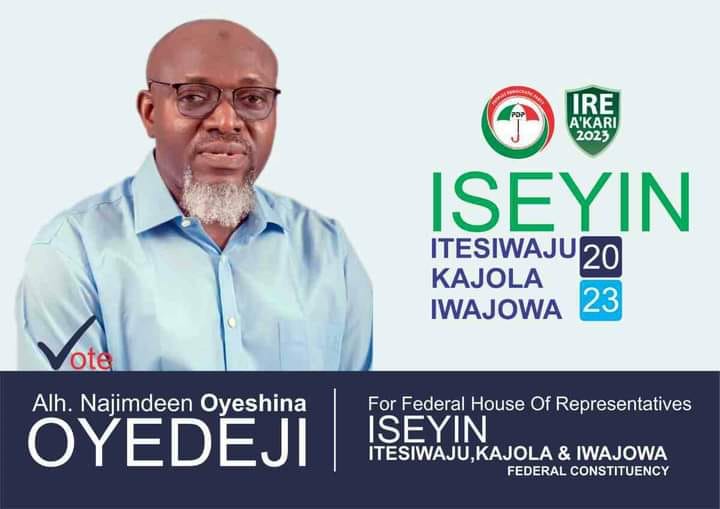
  • Feature: Our Expectations from Alh. Najimdeen Oyeshina Oyedeji, House of Representative Member-Elect

    Feature: Our Expectations from Alh. Najimdeen Oyeshina Oyedeji, House of Representative Member-Elect

    by Hon. Abd’Waasi Ismaheel Abiola

    Legislative, they say, is a serious business for serious-minded people. On the other hand, Legislatures have a special and indispensable place in democratic governance because they are mandated to represent the concerns of the citizenry most directly in the Federal and state arms of government.

    Embedded in the very concept of representative democracy is the idea that those affected by government decisions have a right to be involved in the decision-making process. The duty to support and facilitate this right falls on every member of Parliament (MP), and it cuts across every role of the MP, from representative to legislative to oversight. A member of the legislature can only succeed with meaningfully engaging constituents.

    The benefits of doing so are extensive, and they accrue to MPs individually, to parliament as an institution, and to the public.

    MPs who effectively engage with their constituents can build enduring political coalitions and secure continued electoral success. They are better equipped to expand their influence in government, elevate their public profiles, and develop their personal brands.

    They have a greater ability to control their messages and speak for themselves rather than having their narratives mediated by party leaders, the press, or other outside groups. Constituent engagement is also often the most significant source of personal fulfilment. Many MPs cite the opportunity to make a tangible difference in people’s lives as where they derive the most tremendous meaning in their work.

    Parliament as an institution also benefits very broadly from effective communication with constituents. Legislative solutions are better, more effective, and more sustainable based on the input of the people they impact. Furthermore, institutional capacity is significantly augmented by having access to independent analysis from outside experts and civil society organizations (CSOs). 

    This is especially helpful while parliaments are still building up the capacity of their research services and resources, ensuring they are not solely dependent upon the executive branch. Having independent sources of information is critical for conducting meaningful oversight as well.

    Virtuous Cycle of Constructive Civic Engagement: Trust in Government, Citizens Share Feedback, Lawmakers Use Feedback to Fix Problems, Lawmakers Share Progress

    Virtuous Cycle of Constructive Civic Engagement.

    Hearing from a broad range of voices diversifies and improves parliament’s knowledge base, enriches debate, and expands deliberative capacity. With greater openness and transparency also comes greater public trust, and with this growing trust comes greater legitimacy and relevance and a stronger position for the executive arm. Regular two-way communication with the public also plays a critical part in educating citizens on the appropriate roles and functions of parliament, which helps to manage expectations and, in turn, further strengthens public trust.

    The public can also greatly benefit from having their voices heard in the legislature and in places where decisions are made. The opportunity to share their lived experiences helps ensure that government programs and services are designed effectively and fixed when they are not. Confidence that their elected representatives are open with them and listening to their input helps create a virtuous cycle of constructive civic engagement.

    This is imperative for both developing and mature democracies alike. Effective, meaningful constituent engagement is built upon several core principles, achieves several important objectives, and often happens within a few common challenges, as outlined below.

    Principles

    2. Transparency. Good constituent communication, like good governance, begins with openly sharing critical information. You are your constituents’ most direct conduit to the national government. Your engagement should be built on a commitment to openly share the work you are doing on their behalf and to be a source of information more broadly on government action, how decisions are being made, what the costs are, and what the impact is.

    2. Accessibility. Making yourself and your staff regularly available to your constituents through various digital and in-person mechanisms is essential. Constituents should be able to submit their requests, comments, or questions easily, and you should ensure that they are all fully able to do so, regardless of disability or other barriers they may face.

    3. Responsiveness. Meaningful engagement demands more than simply broadcasting your message to constituents. It would be best if you created a feedback loop, in which your members are able to provide their input to you, and in which you actively work to integrate and apply their input.

    4. Authenticity. Build credibility with your constituents by being honest and authentic. It is challenging to build a real connection with the electorate if they feel you are playing a part. Speaking candidly (yet respectfully) can be particularly important when there are differences of opinion, setbacks in plans, or government failures that demand change and progress.

    5. Inclusivity. It is essential to engage the full range of individuals and communities within your constituency, including those traditionally marginalized. This often includes women; youth; racial, ethnic, and religious minorities; and those with disabilities. Issues of poverty, inequalities, social norms, and legacies of social injustice create barriers to participation that must be overcome, which requires deliberate action to ensure their voices are heard and heeded.

    6. Consistency. Engagement with your constituents must happen in an ongoing way. It is not just for campaign season or when a controversial issue arises. It should be a continuous dialogue that grows, deepens, and builds upon itself.

    Resource. Be knowledgeable in how the government works and be able and available to navigate the central government on behalf of your constituents. If you have staff, it is essential to divide responsibilities among the staff so they can obtain a deeper understanding of how government functions regarding specific areas such as public health, transportation, or education, among others. The staff should be able to answer constituents’ basic questions on interacting with them.

    Our Expectations from the Rep-elect:

    There is no doubt that God has been so kind and fair to our noble town, Òkehò, since the return of democracy in 1999 till. Counting the number of House of Representative Members each Local Government/town has produced, Òkehò as a city has been so lucky to have produced three out of seven:

    1999-2003: Barr. Tajudeen Adeniji – Òkehò

    2003-2007: Dr Wale Okediran – Iseyin

    2007-2011: Hon. Abass Olopoenia – Òkehò

    2011-2015: Hon. Kola Olabiyi – Otu

    2015-2019: Hon. Biodun Olasupo – Iseyin

    2019-2023: Hon. Shina Peller – Iseyin

    2023-till date: Hon. Najimdeen Oyeshina Oyedeji- O’shine – Òkehò

    But unfortunately and regrettably, the first two had failed to utilize the opportunities as their performances was absmally low. Hardly could anyone see any sign that the town had its sons of the soil at the Green Chamber for eight years, not to talk of uncountable numbers of cities that make up the other three local governments in our Federal Constituency.

    Here comes again, another ample opportunity to redeem the image and place the town’s name, Òkehò, on the world map. To make this happen, i.e. to achieve adequate representation, Hon. Najimdeen Oyedeji O’shine should include the following in his law-making or legislative duties.

    Alhaji Najimdeen Oyeshina Oyedeji is expected to attract developmental projects to the constituency, some are some quick wins:

    A. Joining Senator Abd’Fatai Buhari for co-sponsoring bills for rehabilitating Òkehò-Iganna to Ayegun Benin Republic border road.

    B. Lobbying Senator Abd’Fatai Buhari to site the Oke-Ogun proposed University of Agriculture and Technology in Òkehò.

    C. Sponsoring of a bill to upgrade the various level of education across the Federal Constituency.

    D. Lobby with leadership of the House, other colleagues and MDAs to facilitate the employment opportunities for the graduates even if it would cost him millions of naira to procure them.

    E. Facilitate Mega Empowerment for the constituents as this forms part of the language the party members understand.

    F. Sponsoring of a bill to beef up security architecture of our Federal Constituency.

    G. Establish a functioning Scholarship foundation for the less privileged and best students across the Federal Constituency.

    H. Obtaining free JAMB and WAEC forms for the students alongside Organizing free coaching classes across the Federal Constituency.

    Hon. Abd’Waasi Ismaheel Abiola is a professional trainer and consultant with a broad background in accounting, auditing, guidance and counselling, social media commentary, political analyst and finance.

    Prior to his recent appointment by the Federal Government as an Internal Auditor, Federal Polytechnic, Ayede, Ogbomoso, Oyo State, he was a Record Officer, AL-FRUQAN CICS Ltd, a non-interest Islamic Co-operative Society owned by Kajola Local Government, Staff, Òkehò.

    His experience includes audit management;information systems, financial, and operational auditing; financial reporting; consulting and training; teaching, lecturing and mentoring.

    As a financial expert and political guru, Hon. Abd’Waasi has delivered highly interactive, political gathering, social gathering, practical training and consulting to internal auditors and other professionals.

    Hon. AbdWaasi is a seasoned politician, a young emerging political leader and a motivational speaker. He specializes in leading control self-assessment, creative and critical thinking, information technology, operational auditing, risk assessment courses and buying and selling of farm produce.

    He was the former editor-in-chief, AL-Balagh Magazine, a publication of AL-Balagh Model College, Isia, Okeho. He is also the head of Media Team to Hon. John Olaleru and Senator Abd’Fatai Buhari, PhD in Kajola Local Government till date.

  • Feature: “Why I pay taxes”

    Feature: “Why I pay taxes”

    By Salisu Na’inna Dambatta

    “As a villager, I loathed paying taxes, or what they called revenue, in our weekly open air market,” said Maitabo, the livestock trader who is now an industrialist in the big city where he established factories that turned out a basket of consumer goods, including polished rice.

    He said he spent the first 40 years of his life in his native village without electricity. There was no smooth, all-season motorable road to his village either. The only school in the district was in Alkarya, the district headquarters of his Karkara collection of hamlets, tiny villages, and homesteads.

    Maitabo said he previously viewed paying the community tax and cattle tax to the local leaders as an unnecessary dishing money out to big men who dress nicely, ride bicycles, even motor cycles and build cemented houses with roofs made of shiny corrugated iron sheets.

    However, as his livestock trade expanded and the necessity for Maitabo to hire articulated trailers to convey his wares from the big livestock markets where he buys them in hundreds to far-flung consumption centres of Kano, Ibadan, Warri, Abuja, Benin, Uyo, Yenagoa, Port Harcourt and Okigwe near Umuahia, he appreciated that the wide, smooth and tarred highways plied by the trailers were important facilitators for his flourishing lucrative trade.

    He also realised that the trailers conveying his livestock travel through thick forests where security personnel were stationed to protect travellers from marauders. The trailers were driven on bridges built by the government to cross both big rivers and streams: the days of using risky ferries to cross the rivers were over.

    As an industrialist who graduated from livestock trade and living in a rural Nigeria 50 years ago, he is now face to face with the importance and benefits of paying taxes. And he no longer loathes paying taxes as he did previously. He nowadays encourages other business owners and everyone who will listen to him to pay taxes as and when due.

    His favourite justification for his willingness to pay taxes was the improvement he noticed to the wellbeing of people in his village during a visit. The authorities have provided a laterite road linking his village to other towns; a windmill that draws potable water from a deep well for his community; a dispensary that meets the health care needs of a cluster of villages including his home village, and the most wonderful of all, the electricity that was wired to the village by the Rural Electrification Authority.

    Maitabo will tell his listeners that it was long after he enjoyed various government services that it dawned on him that the livestock tax he paid and the flat tax paid by all male adults in his village, contributed to the pool of money spent in providing those services in his and other neighbouring villages.

    Now as a dweller in a city, the owner of manufacturing plants and a fleet of trailers that bring raw materials to his factories and evacuate manufactured goods from there, he realises that the constant electricity supplied to his factories and the smooth roads used by his articulated trucks were emplaced by government using the very taxes he previously loathed to pay.

    He now discourages tax evasion; shun false tax entries and avoids quarrels with tax officials. Maitabo believes as the World Bank does in a Subnational Studies on ease of doing business that, taxpayers and businesses are interested in what they get for their taxes: quality infrastructure including good roads, reliable railway network, functional aviation facilities, efficient sea ports, continuous supply of electricity and telecommunication connectivity, which are all vital for the sound functioning of an economy.

    A healthy workforce enhances economic competitiveness and productivity. This makes governments invests in the provision of health services. Government also spends on imparting relevant skills to improve the efficiency of workers. It provides tertiary education facilities such as the 37 Federal Polytechnics, 43 Federal Universities and 27 Federal Colleges of Education where top-level human capital is nurtured to support the economy through technical innovations.

    Maitabo often explains to his listeners that although the government in Nigeria charges excise, import and export duties and collects petroleum profit tax to raise revenue to finance the operations of the security forces namely the Nigeria Police Force, the Department of State Services, the Nigerian Army, Navy, Air Force, and the Civil Defense, he noted that the bread and tea millions of Nigerians buy daily, complete with fried eggs and the meals they enjoy in countless eateries and open air restaurants, including the peppersoup, are not taxed by the government.

    Maitabo is always at his best telling people who listen to him why he pays taxes. He points out that revenues from taxes are used to compensate public servants who provide essential services as ambulance drivers, fire fighters, nurses in healthcare centres and air traffic controllers who contribute to safe aviation in the country.

    He narrates correctly that Nigerians who travel anywhere by road, sea and air, inevitably drive on government-provided roads, use safe sea lanes cleared by the country’s maritime authority and fly out or land at beautiful airports built by government–using money from taxes.

    Maitabo admits that he benefits immensely from the services provided by the government which it pays for with money generated through taxation, and wished that those services continue to improve sustainably, often saying, “That is why I pay taxes.”

  • Feature: Tinubu should Cash in on the Commercial Opportunities availed by the Ukrainian Conflict

    Feature: Tinubu should Cash in on the Commercial Opportunities availed by the Ukrainian Conflict

    By Ayo Akinfe

    I just hope that all these businessmen Tinubu is meeting with are telling him that he has to cash in on the commercial opportunities the Ukrainian conflict offers

    [1] All receipts that accrue from crude oil in excess of $60 a barrel should go into a special infrastructure fund

    [2] All receipts that accrue from crude oil in excess of $80 a barrel should go into a special economic diversification fund

    [3] All receipts that accrue from prices in excess of $100 a barrel should go into a dedicated clean energy fund

    [4] Basically, we should see this as our last chance to diversify the Nigerian economy and invest the bonanza judiciously. Tinubu should see the conflict as a means of raising capital for economic diversification

    [5] For me, the bulk of the cash has got to go towards supporting manufacturing. Whether we like it or not, manufacturing has got to take over from religion, Nollywood and owambes as our favourite national past time

    [6] We must also spend at least $20bn annually on key infrastructure like railway networks, ports, power plants, roads, power plants, airports and shopping malls

    [7] Whatever we do, the goal has got to be to wean our states off federal allocation, with the ambitious target of making a few self-reliant by 2025

    [8] I will not invest in education, healthcare and housing at the federal level as I believe that is the responsibility of state governments

    [9] We should also offer to manufacture munitions for Russia and Ukraine. Everyone else profits from our wars, so why shouldn’t we cash in on theirs?

    [10] Nigerian states should also lease land to Ukrainian grain companies and food processors in a bid to get them to relocate. We should aim to fill the void brought about by a drop in Ukrainian output

  • Feature: The Need for a Better France-Africa Partnership

    Feature: The Need for a Better France-Africa Partnership

    by Serah Makka & Najat Vallaud-Belkacem

    After the withdrawal of French forces from Mali and more recently from Burkina Faso and responding to the – rightly – growing demands of his Sahelian and sub-Saharan allies, President Macron has called for a new relationship with Africa. This partnership would be a more “balanced, reciprocal and responsible”. The image of France on the African continent is in decline, particularly among its youth who form more than 60% of the continent’s population. Beyond military issues on their continent, young Africans are right to be frustrated at the way France has recently raised the registration fees for foreign students or how differently the Hexagon has welcomed Ukrainian refugees compared to their compatriots’ fleeing wars and life-threatening situations. It is therefore in a climate of growing mistrust that Emmanuel Macron began his 18th trip to Africa since his first election. 

    Africa is calling for an equal partnership of mutual respect. A partnership of mutual benefit where both partners are satisfied with the outcomes and benefits of their relationship.  While President Macron has detailed the renewal of his military strategy, beginning a new, more modest era for French troops in Africa, he paid relatively little attention to the economic, cultural, social, health and ecological aspects. These are areas that France and Africa must write and perhaps re-write together.

    To truly achieve this new partnership of equals, France must above all base this renewed relationship on trade and investment that are more efficient, more transparent and more in line with African priorities. For these priorities to be fully heard, Paris must above all continue to support Africa’s access to the negotiating table on the international scene, starting with the integration of the African Union into the G20, in the same way as the European Union.

    To truly speak on an equal footing, France must also demand for greater transparency in the methodologies applied by the rating agencies to the debts of African countries, in order to put an end to the double standard in force on the perception of risks that put developing countries at a major disadvantage.

    Rebalancing the distribution of available resources to deal with the climate, health and economic crises that know no borders, Emmanuel Macron must also support the inevitable reforms of the multilateral development banks, which could lend up to 1,000 billion dollars additional resources to low- and middle-income countries.

    And to remain a credible interlocutor on an increasingly competitive international scene, France must begin by finally achieving the historic commitment of allocating 0.7% of its gross national income to development aid, which will be added to domestic resources and other development finance needed to support essential social sectors such as education or health.

    Africa has solutions to the world’s climate needs through its green minerals. However, we must ensure that value is added to the minerals before they are exported out of Africa, for the people in Africa to also benefit from the product of its own soil. 

    In the end, Africa has always wanted to be considered as a true partner on the economic level as well as on that of the principles and values it defends. The time lost by France in turning a deaf ear can now only be made up for by a radical change of method. Africa does not expect France to solve all its problems for it. But Africa expects France to keep its commitments and to promote more equitable rules of the game of globalization so that Africa and France benefits.

    Serah Makka is an Executive Director, ONE in Africa & Najat Vallaud-Belkacem is a Director, ONE in France

  • Feature: Women in Public Relations: Thoughts for International Women’s Day 2023

    Feature: Women in Public Relations: Thoughts for International Women’s Day 2023

    By Elvis Eromosele 

    Every day is public relations day. This is because the business of strategy and planning, communications and positioning never sleeps or stops. March 8, International Women’s Day, a day set aside to celebrate women, is a good time to recognize the role of women in public relations practice and the opportunity for growth. 

    You would agree that public relations is an exciting and challenging field, one that offers a variety of opportunities for women to grow and thrive. It is equally engraced and enriched through the practice of women. 

    While it is true that women in public relations face unique challenges, there are also many opportunities for women to contribute, excel and make a significant impact. 

    My goal is to explore opportunities for growth in public relations for women, with a particular focus on the skills and qualities that women bring to the table.

    One of the biggest opportunities for growth in public relations for women is the increasing demand for diverse voices and perspectives. According to a recent survey by the Public Relations Society of America (PRSA), diversity and inclusion are among the top trends that are shaping the public relations industry. This means that companies and organisations are looking for public relations professionals who can bring a fresh perspective and a diverse range of experiences to their work.

    Also, the reality is that women are uniquely positioned to meet this demand for diversity and inclusion in public relations. Women bring a range of experiences and perspectives to the table, and they are often skilled at building relationships and communicating effectively with a variety of stakeholders. These skills are particularly valuable in the field of public relations, where building and maintaining relationships with the media, clients, and other stakeholders is essential.

    Another opportunity for growth in public relations for women is the increasing focus on social media and digital communications. According to a report by the Pew Research Center, women are more likely than men to use social media platforms like Facebook and Instagram. This means that women in public relations are well-positioned to help companies and organisations navigate the complex world of social media and digital communications.

    In addition, women are skilled at storytelling and creating engaging content, which is essential in the field of public relations. Women are often natural storytellers, and they have a talent for creating content that resonates with their target audience. This skill is particularly valuable in the digital age, where creating compelling content is essential for engaging audiences and building relationships with stakeholders.

    Furthermore, there are many opportunities for women to take on leadership roles in the field of public relations. According to a recent report by PRWeek, women make up a significant portion of the public relations industry, but they are underrepresented in leadership positions. This means that there is a significant opportunity for women to step up and take on leadership roles in the field. Many women are already taking up this challenge. 

    Aside from everything else, women tend to excel at multitasking, managing multiple projects and clients simultaneously, and navigating complex situations with tact and diplomacy. These skills are essential for success in the public relations industry, where professionals are often juggling various responsibilities and work in high-pressure environments.

    Undoubtedly, with a focus on developing leadership skills and taking advantage of the opportunities available, women in public relations can achieve great success and make a meaningful contribution to the industry.

    As we celebrate the achievements of women today, it is also a call to action to create more opportunities for women to succeed as entrepreneurs, leaders, and changemakers. 

    I salute every woman in public relations. Thank you for your contributions. Specifically, I’ll love to mention the best public relations strategist that I know, Funmi Onajide. She is a teacher, mentor, and coach. Thank you for ALL that you do. 

    Happy International Women’s Day 2023! 

    Elvis Eromosele, a Corporate Communication professional and public affairs analyst lives in Lagos.

  • Feature: Get Northern Nigerian Youths into Creative Endeavour

    Feature: Get Northern Nigerian Youths into Creative Endeavour

    By Ayo Akinfe

    Tinubu has got to make bringing the millions of northern youths who have opted for criminal lifestyles into productive endeavours his immediate priority.

    [1] Our new president-elect needs to see himself as a post-war leader whose immediate priority is the decommissioning and rehabilitation of soldiers. Kind of similar to Clement Atlee, Britain’s prime minister who assumed office in 1945 and converted millions of young soldiers into industrial workers

    [2] Something like 80m Nigerians are living below the United Nations poverty threshold of $2 a day. It is thus no surprise that across northern Nigeria where zero opportunities exist for our youth, they have resorted to criminal behaviour like kidnapping, banditry, armed robbery, etc

    [3] What still leaves me in awe is how countries like Germany, Japan, France, the Netherlands, the Soviet Union, etc bounced back from the devastation of war to rebuild their economies almost immediately after World War Two. Within five years, they had surpassed pre-war industrial output

    [4] By 1945, in Germany, virtually every factory had been bombed. Likewise, in the Soviet Union, nothing was left standing by the Nazi occupiers and in Japan, cities like Tokyo were more or less flattened. However, by 1950, you would not have known that a war took place. Very little happens in life without precedence

    [5] When World War Two was over, in the Soviet Union, about 25m people perished, in China the Japanese had slaughtered 27m souls, in Poland, 20% of the population was wiped out, while in The Netherlands, people resorted to cannibalism to survive. They all suffered 10 times more than what we are going through in Nigeria today but alas, they came through. It is amazing what the “can do” spirit can enable humans to achieve

    [6] Nigeria is currently wracked by insecurity as Fulani herdsmen, kidnappers, Boko Haram terrorists and armed bandits run riot. However, are the total number of criminals we are talking about up to 1m? We need a masterplan to get out of this rut

    [7] At the end of World War Two in May 1945, there were 5m British ex-service men decommissioned. These were young men who had been trained to kill, with many of them suffering from all sorts of traumas after what they went through. Had they not been properly rehabilitated, there would have been a crime epidemic in the land. Bola Tinubu needs to go and study how they were settled back into society

    [8] Under an ambitious plan presided over by Ernest Bevin, Britain’s labour and national service minister, by the end of 1945, demobilised soldiers reached 750,000 and this number doubled two months later after Japan’s surrender. By 1947, about 4.3m men and women returned to civvy street

    [9] Across Britain, demobilisation centres were established where service men and women were offered retraining to enable them adapt to civilian life. I ask myself sometimes why Nigeria does not open herdsmen rehabilitation centres to train our cattle rearers on modern animal husbandry techniques, how to run ranches, how to manufacture compound feeds, etc. I am sure that in the process they will uncover thousands of potential veterinary surgeons and some will even go on to become professors

    [10] Has anyone in Nigeria actually compiled statistics, detailing how many criminals and miscreants there are in society today? If we did and had an industrial plan to get them back to work, we could have peace within a year. I await details of our rehabilitation plan. Over to you Asiwaju Bola Tinubu!

  • Feature: APC won as a result of Atiku’s Selfish Ambition & Ohanaeze Ndigbo’s failure

    Feature: APC won as a result of Atiku’s Selfish Ambition & Ohanaeze Ndigbo’s failure

    By Ayo Akinfe

    Tinubu won this election by default as he was a beneficiary of Atiku’s selfish personal ambition and Ohanaeze Ndigbo’s failure to get the PDP to zone its presidential ticket to the southeast

    [1] It is all over now ladies and gentlemen. Bola Tinubu has won with about 2m votes, securing 25% of the vote in 31 states. Contrary to a lot of commentaries, technology helped a lot in these elections. It actually detected voter fraud where it happened and exposed it

    [2] However, the star of the show was former Anambra State governor, Peter Obi, whose Labour Party came from nowhere to win in 11 states, including Lagos and the Federal Capital Territory

    [3] If you ask me, had Peter Obi clinched the PDP presidential ticket and run as their candidate, I believe he would have coasted to victory. He now heads a genuine national movement that will remain popular for the foreseeable future

    [4] Most Nigerians believe in fair play and hold on to the principle of a rotational presidency. It is only fair that the presidency rotates between the north and the south, so Atiku Abubakar wanting to assume office after eight years of Muhammadu Buhari is simply a crime against humanity

    [5] Given that we have had Presidents Olusegun Obasanjo and Goodluck Jonathan, it is only fair that this time around the position should have gone to the southeast. In Peter Obi, the southeast geo-political zone had the right man in the right place at the right time

    [6] When I look at the amount of energy Ohanaeze Ndigbo put into the Obedient movement, I ask why they did not apply all this pressure on the PDP. They should have used all their clout to get the party to zone its presidential ticket to the south

    [7] As far back as 2019, Ohanaeze Ndigbo should have mounted a nationwide charm offensive seeking to get the 2023 presidency zoned to the southeast. Ohanaeze’s leadership should have been wooing the leaders of all the other five zones using every weapon in its arsenal

    [8] For me, if Atiku had supported Peter Obi as the PDP presidential candidate with maybe Rabiu Kwankwaso as his running mate, they probably would have secured a landslide victory, beating Tinubu in all six geo-political zones

    [9] Bola Tinubu alienated the Middle Belt by picking a fellow Muslim as his running mate. You need to see the way Peter Obi swept the vote in Plateau and Nasarawa states to see how unpopular the same faith ticket was among northern Christians. Other northern states with large Christian communities like Taraba, Kaduna and Adamawa voted for Atiku

    [10] Had this election been a two-horse race between Peter Obi of the PDP and Bola Tinubu of the APC, it would have been no contest. The good news for the PDP and Ohanaeze is that they can target 2027, fielding Peter Obi as a consensus candidate!

  • Feature- Your Voice Matters: Why Eligible Citizens Must Come Out To Vote

    Feature- Your Voice Matters: Why Eligible Citizens Must Come Out To Vote

    By Elvis Eromosele

    Voting is an essential aspect of democratic governance, as it is the only way through which the people can exercise their power to choose their leaders and shape their future. Nigeria, a country blessed with abundant human and natural resources, is poised for another democratic exercise as her citizens head to the polls to elect their leaders. It is time to get it right with a leader that will ensure that ALL citizens partake of the country’s blessedness.

    As we approach election day, every eligible citizen must come out and vote. Voting is not just a civic duty; it is also a right and a privilege that must be exercised. Every vote counts, and every vote matters in determining who becomes the leader of our great country.

    There are several benefits of voting that we must take into consideration. First and foremost, voting gives us the power to choose our leaders. This means that we have the opportunity to vote for people who have our best interests at heart, people who can drive our country forward and bring about the positive CHANGE that we desire.

    In addition, voting is a way to hold our leaders accountable. We vote them into office, and we can vote them out if they fail to deliver on their promises. It is our responsibility to ensure that those who are elected into public office fulfil their campaign promises and work for the betterment of the country. Equally, be ready to ask the hard questions of those you vote into office.

    Furthermore, voting helps to foster national unity and integration. Elections provide a platform for all Nigerians to come together, regardless of tribe, religion, or political affiliation, and make a collective decision on the future of the country. It is an opportunity for us to put aside our differences and work towards a common goal. It is not based on ethnicity or religion but on capacity, competence and character.

    As we head to the polls on Saturday, it is important to note that we must avoid inducements or activities that can disrupt the elections. We must remain vigilant and report any attempts to buy votes or engage in any form of malpractice to the appropriate authorities.

    It is important that our vote is based on our conviction and not on the amount of money that we have received from any candidate or political party.

    Moreover, we must ensure that we conduct ourselves in a peaceful and orderly manner during the election. We must avoid any form of violence or activities that can lead to the disruption of the election process. We must remember that the future of our country is in our hands, and we must take responsibility for it. There are several numbers available for this. If you are in Lagos here are the Police Emergency Numbers 08127155132, 08065154338, 08063299264, 08039344870. Also, remember that 767 and 112 are fully functional.

    These are the Military hotlines for Lagos 08034025825, 08023190487, 09024409000 08033709434

    The Nigerian Communications Commission (NCC) has also dedicated its Consumer Toll-Free Number 622, to serve as the 2023 Presidential Election Incident Hotline to enable voters and members of the public across Nigeria to report any issues that may affect them, or others, during the elections on Saturday, February 25, 2023. If you see anything, say something.

    If you are a Nigerian and eligible to vote, then by all means come out and vote this Saturday. This is an opportunity for us to exercise our power and choose our leaders. We can’t complain for four years and then when it is time to have a say we abdicate.

    The essential thing is to ensure that we vote only for people who have our best interests at heart and who can drive our country forward.

    Remember, every vote counts, and every vote matters. Go out and vote!

    Eromosele, a Corporate Communication professional and public affairs analyst lives in Lagos.

  • Feature- Naira Redesign: Evaluating the Effectiveness of CBN’s Communication

    Feature- Naira Redesign: Evaluating the Effectiveness of CBN’s Communication

    By Elvis Eromosele

    There is a popular theory that Nigerians are resilient. The CBN naira redesign policy put that famous theory to the test in several ways. People have been stretched in a myriad of directions in the scramble to overcome the scarcity of new naira notes. Banking halls, ATM points, and POS stations are packed out with people seeking cash to handle everyday transactions.

    Every day over the last couple of weeks has been a nightmare for most Nigerians. Many have struggled to pay for the essentials including food not because they don’t have money but simply due to the challenge of accessing funds from the banks.

    Banks have been vilified for this reason. Some have even called them ‘economic saboteurs’. This perception unfortunately led to attacks on bank branches, including arson. Preventable.

    There are other villains in this stodgy tale – the POS operators who overcharge to exchange cash, the bank staff who sell cash and the regulator of the financial sector, the CBN.

    In my books, the CBN failed on two fronts. Number one, it was slow to wise up to the antics of the banks as they refuse to dispense the new naira notes all through December and the first three weeks in January. Also, the CBN hardly appeared to have had a communication strategy for the naira redesign policy.

    My focus here is on communication shortcomings.

    How many jingles were created and aired? Were there any billboards? How about television commercials?

    It would appear that the CBN did not treat the whole exercise with the seriousness that it deserves, in terms of communication.

    It makes one question whether the CBN has a communications unit. What role did public relations play to get the message out there? The CBN could have done more to communicate the naira redesign message. I’ll be quick to admit that because the whole process has politics written all other it, the CBN’s communications team was possibly hamstrung all through. This does not excuse the bank.

    Now, when a central bank introduces new currency notes, it’s important to communicate the change to all citizens in the country. And it must do it effectively. The bank must take certain steps to get the message out there.

    For instance, the central bank can issue public announcements through various media channels such as newspapers, radio, television, and social media platforms. The announcements should provide clear information about the new currency notes, including their design, security features, and the timeline for the introduction.

    Aside from one or two advertisements in print newspapers and social media posts, how radio and television jingles did the CBN deploy?

    How many persons reading this can remember any message about the naira redesign policy?

    Please note that we are possibly the group that most actively seeks news.

    The central bank should have launched and pushed educational campaigns to educate the public about the new currency notes. Brochures, flyers, and posters would have been produced during this campaign and distributed to schools, banks, and public places such as shopping malls, markets, and bus stops.

    In addition, the CBN could have sought opportunities for collaboration with banks and financial institutions to ensure that they are aware of the new currency notes and can help in spreading the message to their customers. It could have partnered with the Nigerian Union of Journalists (NUJ), the Nigerian Institute of Public Relations (NIPR), the National Orientation Agency (NOA)and the Federal Ministries of Information and Communications and Digital Economy.

    With the partnership, telecommunications services providers could have easily sent out text and WhatsApp messages every weekday and twice on weekends.

    The central bank could also have provided training sessions for businesses and retailers to ensure that they are aware of the new currency notes and can educate their customers about the changes.

    We should ask questions. For instance, how many public events such as exhibitions, roadshows, and seminars did the CBN organise to showcase the new currency notes and provide information to the public?

    When it set a deadline for the demonetization of the old notes, did it provide clear guidelines on how and where to exchange them?

    How many people can honestly say that the central bank used a variety of communication methods to ensure that the message reaches all citizens in the country?

    Did the CBN provide clear and concise information to avoid confusion and facilitate a smooth transition to the new currency notes?

    The answer to these questions is a measure of the effectiveness of the CBN’s naira redesign

    communications strategy.

    The reality is that the CBN could have done more. The truth is that all through the period, the CBN acted like it couldn’t be bothered.

    In implementing a project such as introducing new currency notes, it’s essential for the central bank to continuously monitor and review the process to ensure that it stays on track and achieves its objectives. This would have helped it make the necessary adjustments.

    How did the bank fare here?

    Consider monitoring. The central bank ought to have monitored the project’s progress regularly, and if possible, in real time. This will enable it to identify issues and address them promptly.

    The CBN failed to monitor the banks.

    The central bank was almost asleep while the banks withheld new naira notes. It played the ostrich when people complained about the unwillingness of the banks to load ATMs with the new notes or pay across the counter.  

    Furthermore, the collection of feedback from stakeholders, such as citizens, financial institutions, and businesses should have been a priority. This enables it to evaluate the satisfaction with the new currency notes and the project’s overall progress.

    How about the area of identifying potential risks to the project’s success and the development of plans to mitigate or manage them? Were there contingency plans in place in case of unexpected events? Did it activate these plans when things went south?

    Did the central bank seek external expertise to provide an independent assessment of the project’s progress and suggest areas for improvement?

    Did the CBN do everything that it could to ensure that the project achieved its intended objectives?

    The first time that I saw a new note was the last week in January 2023. Of course, I didn’t mind because I could still use the old notes. Panic began to set in when the January 31, deadline drew close.

    As patriotic Nigerians, we pretend to understand the haste but we can’t excuse the shortcomings, failings and gross inefficiency with which the process was handled.

    The CBN, it would appear, didn’t rate the citizens. It pretended not to hear genuine complaints, ignored veritable solutions and refuse to evaluate the process to improve it.

    The CBN could have done a lot of things differently and better. The suffering the people went through was needless and we should be talking about compensation.

    The central bank didn’t do justice to the naira redesign communication. So, the CBN should be rightly counted as a villain in this naira redesign imbroglio.

    Eromosele, a Corporate Communication professional and public affairs analyst lives in Lagos.